
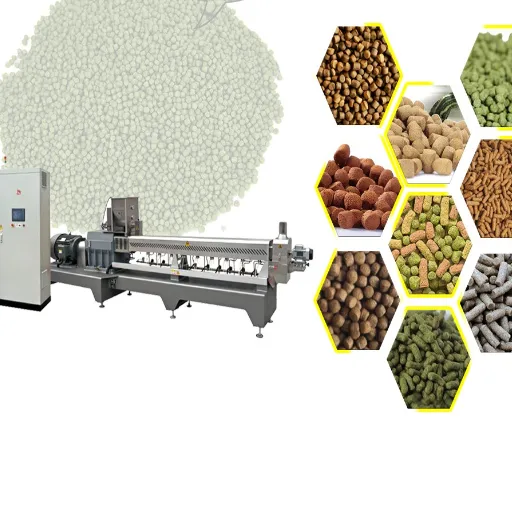
Aquatic Feed Production Line: A Complete Equipment Selection Guide

An aquatic feed production line is a fully integrated system that transforms raw ingredients into specialized feed pellets for fish, shrimp, and other farmed aquatic species. The right line can cut your feed conversion ratio by 15-20% and pay back its capital cost within two to three growing seasons. The wrong line locks you into high waste, poor water stability, and stunted growth.
Feed represents 60-70% of total aquaculture production costs. Every percentage point you shave off waste or improve digestibility flows straight to your bottom line. Yet too many producers choose their aquatic feed production line based on upfront price alone, ignoring how core technology, capacity matching, and species-specific requirements shape long-term profitability.
In this guide, you will learn how to evaluate extrusion versus pelleting technology, how to size each stage of your fish feed production line from grinding through packaging, and how to avoid the five mistakes that derail most first-time buyers. We will also walk through real capacity and budget benchmarks for aquatic feed manufacturing equipment so you can build a realistic plan.
Key Takeaways
- Extrusion produces floating, slow-sinking, and sinking feed with superior digestibility; pelleting is cheaper but limited to fast-sinking pellets.
- A complete aquatic feed production line needs seven stages: receiving, grinding, mixing, extrusion/pelleting, drying, coating/cooling, and packaging.
- Twin-screw extruders handle high-fat formulas and species changeovers better than single-screw systems, making them the most future-proof choice.
- Small lines run 100-300 kg/h and cost 8,000−8,000−25,000; medium lines hit 300 kg/h-1 t/h at 25,000−25,000−80,000; large industrial lines exceed 1 t/h and range from 80,000to80,000to650,000+.
- The most expensive mistake is undersizing grinding and drying capacity relative to the extruder, creating a production bottleneck that is expensive to fix later.
What Is an Aquatic Feed Production Line?
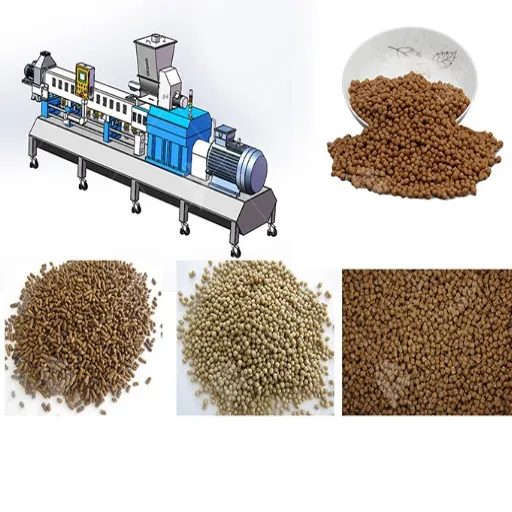
An aquatic feed production line is an end-to-end manufacturing system that receives raw materials, processes them into nutritionally balanced pellets, and packages them for distribution. Unlike a standalone extruder or pellet mill, a complete line coordinates every step so that capacity, particle size, moisture, and temperature stay consistent from intake to finished bag.
The standard process flow includes seven stages:
- Raw material receiving and cleaning: removes stones, metal, and foreign matter.
- Grinding: reduces particle size to the fineness your forming equipment demands.
- Mixing and batching: combines macro-ingredients, premixes, and liquids to exact formulas.
- Conditioning and forming: cooks and shapes the mash into pellets via extrusion or mechanical pelleting.
- Drying: reduces moisture from 18-25% down to 10-12% for shelf stability.
- Coating and cooling: adds oils, vitamins, and probiotics; brings pellets to ambient temperature.
- Screening and packaging: removes fines and bags the finished product.
When these stages are balanced, your aquatic feed production line delivers consistent pellet durability, optimal water stability, and uniform nutrition in every batch. When they are mismatched, you get broken pellets, mold risk, and animals that refuse to eat.
Want to see how modular extrusion systems fit into a complete line? Explore our twin-screw extrusion solutions designed for aquatic feed and pet food applications.
Extrusion vs. Pelleting: Choosing the Right Core Technology
The single most important decision when designing your aquatic feed production line is whether to extrude or pellet. This choice determines your product range, capital budget, operating cost, and the species you can serve profitably.
How Extrusion Works for Aquatic Feed
Extrusion cooking pushes preconditioned feed mash through a barrel under high temperature (110-200 degrees C) and mechanical shear. A quality aquafeed extruder uses precise preconditioning to hydrate and heat the mash before it enters the cooking chamber. The sudden pressure drop at the die causes rapid expansion, creating a porous, fully gelatinized pellet.
This process delivers three advantages that pelleting cannot match:
- Buoyancy control. By adjusting starch content, screw speed, and die configuration, aquafeed extrusion can produce floating pellets for tilapia, slow-sinking pellets for shrimp, or dense sinking pellets for catfish and carp.
- Superior digestibility. Starch gelatinization rates reach 80-95% in extruded feed versus 30-50% in pelleted feed. Higher gelatinization means better nutrient absorption and lower feed conversion ratios.
- Improved water stability. Extruded pellets develop a sponge-like structure that resists disintegration for one to three hours. This reduces waste in the pond and prevents water quality degradation.
When Raj Patel expanded his shrimp farm near Chennai in 2023, he switched from imported pelleted feed to an on-site extrusion line. His water stability improved from 20 minutes to over 90 minutes. Feed waste dropped by roughly 30%, and his FCR fell from 1.8 to 1.4 within two grow-out cycles. The extruder cost more upfront, but the savings in feed alone covered the difference in 18 months.
How Pelleting Works for Aquatic Feed
Pelleting compresses conditioned mash through a ring die using mechanical pressure rather than high-pressure thermal cooking. The result is a dense, hard pellet that sinks quickly.
Pelleting lines cost less to install and operate. They work well for:
- Producers serving bottom-feeding species like catfish and carp that do not need floating feed.
- Operations with limited capital where low upfront cost outweighs long-term efficiency gains.
- Regions where electricity costs or boiler infrastructure make extrusion uneconomical.
The trade-off is clear. Pelleted feed has lower digestibility, requires binders to achieve acceptable water stability, and cannot produce floating or slow-sinking pellets. If your market ever shifts toward species that feed at the surface or mid-water, a pelleting line cannot adapt.
Extrusion vs. Pelleting Comparison
| Factor | Extrusion Line | Pelleting Line |
|---|---|---|
| Processing temperature | 110-200 degrees C | 80-90 degrees C |
| Starch gelatinization | 80-95% | 30-50% |
| Buoyancy options | Floating, slow-sinking, sinking | Fast-sinking only |
| Water stability | 1-3 hours | 20-40 minutes (with binders) |
| Fat inclusion capacity | Up to 25% | Up to 8-10% |
| Capital cost | Higher | Lower |
| Operating cost per ton | 1-1.5x pelleting | Baseline |
| Best for | Premium feed, multiple species | Budget sinking feed, single species |
Ready to compare extrusion configurations for your species mix? Contact our team for a tailored line layout and capacity calculation.
Essential Equipment in an Aquatic Feed Production Line
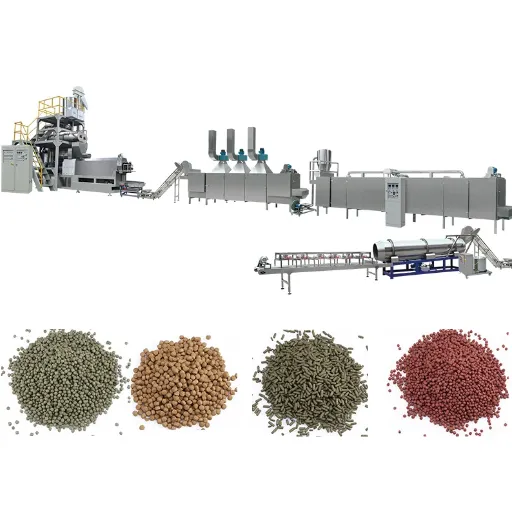
Every aquatic feed production line is only as strong as its weakest stage. A high-capacity extruder fed by an undersized grinder will stall, overheat, and deliver inconsistent quality. Here is how to balance each stage.
Raw Material Preparation: Grinding and Mixing
Aquatic species have short digestive tracts, so particle size matters more than in livestock feed. Most extrusion lines need superfine grinding to 120-200 mesh for shrimp and fry feed, while adult fish feed can tolerate 80-120 mesh.
Key equipment at this stage:
- Hammer mills for coarse primary grinding.
- Ultrafine grinders or air-jet mills for premium applications.
- Twin-shaft paddle mixers that achieve a coefficient of variation below 5% in under three minutes.
Batching accuracy is equally critical. Macro-ingredients should dose within plus or minus 1%, while micro-ingredients like vitamins and minerals need plus or minus 0.5% precision. Loss-in-weight scales are the standard for medium to large lines.
The Extruder or Pellet Mill: The Heart of the Line
This machine sets your capacity ceiling and product range.
Single-screw extruders suit small to medium operations with simple formulas. They are straightforward to operate and maintain, but they struggle with high-fiber or high-fat recipes and offer less precise process control.
Twin-screw extruders use two intermeshing screws that provide better mixing, more stable pressure, and superior heat transfer. A twin screw extruder fish feed configuration handles alternative proteins, high oil levels, and frequent recipe changes with minimal adjustment time. For producers who plan to serve multiple species or eventually diversify into pet food production, a twin-screw extruder is the most flexible foundation.
Ring die pellet mills remain the standard for pure sinking-feed operations. Look for models with two or three jacketed conditioners for improved steam penetration and pellet durability.
Drying and Cooling Systems
Fresh extruded pellets carry 18-25% moisture. That must drop to 10-12% before packaging or mold will develop in storage.
- Multi-layer belt dryers are the industry standard, operating at 80-120 degrees C.
- Counterflow coolers bring dried pellets to ambient temperature without condensation.
- Industrial microwave drying systems offer rapid, uniform moisture removal with lower energy consumption in some configurations. They also provide simultaneous sterilization, which reduces microbial load and extends shelf life.
If you are evaluating drying technology for your aquatic feed production line, consider the energy recovery options now available on premium belt dryers. Heat recovery units can cut drying energy use by up to 45%, which matters when you are processing thousands of tons per year.
Post-Processing: Coating, Crumbling, and Screening
Not every pellet leaves the extruder in its final form.
- Vacuum coaters spray oils, pigments, and heat-sensitive vitamins onto cooled pellets without destroying nutrients.
- Crumblers break large pellets into micro-pellets for fry and juvenile stages.
- Vibrating screens remove fines and broken pieces that would cloud water and waste feed.
Packaging and Automation
Small farms often use semi-automatic bagging into 25 kg sacks. Large commercial mills need fully automatic Form-Fill-Seal machines with checkweighing, metal detection, and palletizing.
Modern aquatic feed production lines run on PLC or SCADA control systems that store recipes, monitor motor load, and alert operators to temperature deviations. Remote diagnostic capability is valuable if your supplier is overseas and you need fast troubleshooting support.
Matching Equipment to Your Aquatic Species
Different species eat at different depths, prefer different pellet sizes, and tolerate different nutrient densities. Your aquatic feed production line must match these needs or your feed will sit uneaten at the bottom of the pond.
Pellet Size by Species and Life Stage
| Species | Fry (0-5 g) | Juvenile (5-50 g) | Adult (50+ g) | Feed Type |
|---|---|---|---|---|
| Tilapia | 0.5-1.0 mm | 1.5-2.5 mm | 3.0-6.0 mm | Floating |
| Catfish | 0.8-1.2 mm | 2.0-3.0 mm | 4.0-8.0 mm | Sinking |
| Carp | 1.0-1.5 mm | 2.0-3.5 mm | 4.0-8.0 mm | Sinking |
| Shrimp | 0.5-1.2 mm | 1.5-2.5 mm | 2.5-4.0 mm | Slow-sinking |
| Salmon/Trout | 1.0-2.0 mm | 2.0-4.0 mm | 5.0-10.0 mm | Slow-sinking |
Die selection and screw configuration determine pellet diameter and density. A line that can switch dies and adjust screw speed in under 30 minutes gives you the flexibility to serve multiple species or contract-manure feed for neighboring farms.
Species-Specific Formulation Considerations
Tilapia tolerate high carbohydrate levels but need 28-32% protein. A floating fish feed machine for tilapia must produce pellets that stay on the surface for 2-4 hours. Shrimp demand 35-42% protein with precise amino acid profiles and attractants. Salmon and trout require high fat inclusion, often 18-25%, which pushes the limits of single-screw extruders.
Twin-screw extrusion systems handle these high-fat formulas more reliably because the intermeshing screws create self-wiping action that prevents material slip and maintains consistent barrel fill. This is why most premium aquafeed manufacturers have moved toward twin-screw technology over the past decade.
Sizing Your Aquatic Feed Production Line: Capacity, Space, and Budget
Buying for today’s demand alone is a costly mistake. The right aquatic feed production line leaves headroom for growth without requiring a complete rebuild.
Small, Medium, and Large Configurations
| Scale | Capacity | Footprint | Price Range (USD) | Typical Configuration |
|---|---|---|---|---|
| Small | 100-300 kg/h | 60-100 sq m | 8,000−8,000−25,000 | Crusher, mixer, dry extruder, small dryer, manual packing |
| Medium | 300 kg/h-1 t/h | 150-300 sq m | 25,000−25,000−80,000 | Twin-shaft mixer, wet extruder, multi-layer dryer, semi-auto packing |
| Large | 1-10 t/h | 400-800+ sq m | 80,000−80,000−650,000+ | Twin-screw extruder, PLC automation, steam conditioning, energy recovery dryer |
These prices reflect Chinese-manufactured equipment with CE certification. European and North American brands typically cost two to three times more for comparable capacity, though they may offer more advanced automation and traceability systems.
Planning for Future Growth
When the Acuaforte cooperative in Uganda launched in 2021, they installed a 300 kg/h dry extrusion line to serve local tilapia farmers. Demand grew faster than expected. By 2024 they needed 1.2 t/h capacity.
Because their original supplier had designed the line with modular expansion in mind, they upgraded the extruder motor, added a second dryer module, and automated the packaging stage without replacing the entire plant. Total upgrade cost was 40% less than installing a new line from scratch.
Modular design principles to insist on:
- Oversized conveying and mixing by 30-50% relative to your initial extruder capacity.
- Expandable dryer modules that bolt on rather than requiring complete replacement.
- Common die and screw inventory that works across a range of extruder sizes from the same manufacturer.
- Standardized PLC architecture that accepts additional sensors and automation layers as you scale.
Total Cost of Ownership
Upfront price is just the entry fee. Over a 10-year life, energy, spare parts, and downtime usually exceed the original purchase price. Ask suppliers for documented kWh per ton at factory acceptance testing. Compare die and screw replacement costs, which for heavily used aquatic feed lines may occur every 8,000-12,000 tons depending on ingredient abrasiveness.
Key Specifications to Evaluate When Buying Equipment
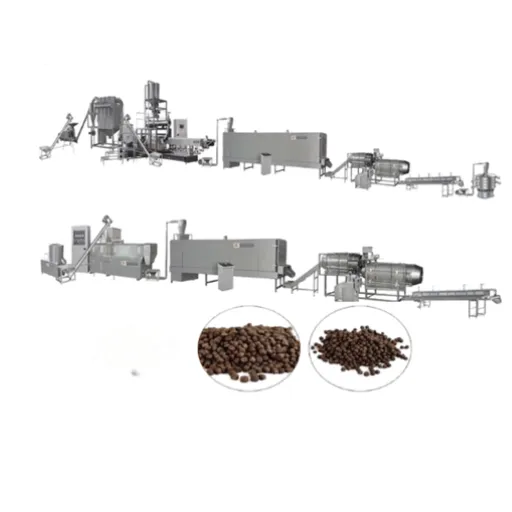
Once you know your capacity and technology path, evaluate suppliers on build quality, control systems, and compliance. Any aquatic feed manufacturing equipment you choose should meet international safety standards and integrate smoothly with your existing setup. Explore our full range of food production line equipment for modular, scalable solutions.
Material and Build Quality
All food-contact surfaces should use SUS304 or SUS316L stainless steel. Screws, dies, and cutting blades should use wear-resistant alloy steel with documented hardness ratings. In humid tropical environments, corrosion-resistant coatings on non-contact frames extend machine life significantly.
Automation and Control
A modern aquatic feed production line should include:
- Recipe management with password-protected access levels.
- Real-time monitoring of barrel temperature, screw RPM, motor load, and die pressure.
- Alarm logging and trend data export for quality traceability.
- Remote diagnostic capability via Ethernet or cellular modem.
Energy Efficiency and Compliance
Demand CE certification or equivalent safety documentation. Verify that electrical components carry recognized brand names (Siemens, Schneider, ABB) so replacements are available locally. Ask about energy recovery on dryers and whether the extruder uses an IE3 or IE4 efficiency motor. These details determine whether your line meets emerging carbon audit requirements and keeps operating costs under control.
Common Mistakes to Avoid When Setting Up an Aquatic Feed Line
After reviewing hundreds of installations over more than a decade, we see the same errors repeatedly.
- Undersizing grinding capacity. If your grinder cannot keep the extruder hopper full, the extruder runs starved, generating heat spikes and poor pellet quality. Size grinding for at least 120% of extruder nominal capacity.
- Ignoring steam boiler infrastructure. Wet extrusion requires reliable steam at 6-10 bar. Producers who skip boiler sizing end up with inconsistent conditioning and variable pellet density. Budget for the boiler, water treatment, and piping as part of the total project cost.
- Choosing fixed configurations over modular designs. A non-expandable line forces you to sell or scrap equipment when you outgrow it. Modular lines protect your investment.
- Neglecting local power and humidity conditions. Voltage fluctuations and ambient humidity above 80% require upgraded electrical protection and moisture-sealed control cabinets. Specify these at purchase, not after the first breakdown.
- Skipping operator training and spare parts planning. Even the best aquatic feed production line delivers poor results with untrained operators. Insist on hands-on training during commissioning. Order an initial spare parts package including dies, cutting blades, bearings, and seals so you are not waiting weeks for a critical component.
Conclusion
Choosing an aquatic feed production line is one of the most consequential decisions an aquafeed producer makes. The technology you select, extrusion or pelleting, sets the boundaries of what you can produce, for which species, and at what quality level. The capacity you install determines whether you can grow with your market or watch competitors pass you by.
Extrusion offers superior digestibility, water stability, and product flexibility. Pelleting offers lower capital cost for dedicated sinking-feed operations. In most cases, a modular twin-screw extrusion line delivers the best long-term return because it adapts as your market evolves.
Balance every stage of your line, from grinding through packaging, around your target capacity. Size for 60-70% initial utilization, not 100%. Demand food-grade stainless steel construction, proven automation platforms, and a supplier who can support you across time zones.
Ready to configure an aquatic feed production line for your farm or mill? Request a custom quote and our engineering team will design a layout matched to your species, capacity goals, and budget.