
How to Make Dry Dog Food: Complete Manufacturing Guide

The production of commercial dry dog food depends on extrusion cooking which operates at high temperatures and high pressures to create shelf-stable kibble from raw materials. The operation progresses through seven stages which start with grinding and mixing and proceed to extrusion and drying and coating and packaging. Manufacturers who master each stage can produce dry food products which are both nutritious and tasty and comply with international safety requirements.
Rajesh expanded his snack manufacturing facility in Pune when he opened pet food production operations in 2025 because he believed that the new process would work like his current extruded snack production system. He discovered that kibble required manufacturers to implement three different requirements which included maintaining proper moisture levels and protecting against pathogens and preserving nutritional content. The facility now produces 800 kg of premium dry dog food per hour after he completed his system retrofitting and his upgrade to a co-rotating twin-screw extruder. The production of commercial dog food requires producers to understand which exact elements make pet nutrition different from regular food processing.
This guide provides complete instructions for producing dry dog food in industrial quantities. The complete modern pet food production manufacturing process along with its necessary equipment specifications and cost benchmarks and compliance requirements will be revealed to you.
Key Takeaways
- Commercial dry dog food relies on extrusion cooking, a seven-stage process from raw material grinding through final packaging.
- Twin-screw extruders handle complex, high-meat recipes with superior mixing and stability compared to single-screw systems.
- Post-extrusion coating preserves heat-sensitive vitamins that would otherwise degrade during the cooking phase.
- Moisture must drop to 8-11% during drying to achieve 10-18 months of shelf stability.
- Entry-level production lines start near 80,000,whileindustrialsystemsscalepast80,000,whileindustrialsystemsscalepast500,000 with typical ROI in 18-36 months.
How to Make Dry Dog Food: The 7-Stage Extrusion Process
Extrusion cooking is the dominant method for producing dry dog food worldwide. The process forces a dough-like mixture through a barrel under high pressure, high temperature, and mechanical shear.
Friction in the extruder creates steam which increases temperatures to a range of 120-160 Celsius. The system operates at a pressure range of 3 to 8 MPa. The process results in starch cooking while it also kills Salmonella bacteria. The process leads to protein denaturation. The process makes proteins easier for the body to digest.
The cooked dough passes through a die which shapes it into its final form to reach normal atmospheric pressure. The material expands to create the familiar porous texture found in kibble.
Dry kibble constitutes over 60% of total worldwide pet food manufacturing. Extrusion dominates because it delivers three outcomes simultaneously: thorough cooking, precise shaping, and shelf-stable output. Businesses use extrusion as their primary method although they have access to alternative techniques like baking and cold-pressing which exist for premium niches.
Want to see how a complete production line fits your facility? Explore our pet food production line solutions and compare capacity options side by side.
Stage 1: Raw Material Selection and Preparation
Core Ingredients
The production of dry dog food begins with an exact recipe for each batch. The main protein sources in dog food recipes use rendered meat meals as their primary protein source. The three most common protein sources used in recipes are chicken meal, poultry by-product meal, and fish meal.
The animal protein content of the product gets combined with plant proteins as additional components. Soybean meal, pea protein, and corn gluten meal are popular options. The carbohydrate bases which include corn and wheat and rice and barley create both structure and energy.
Essential fatty acids get delivered through fats and oils. The product becomes more appealing to consume after adding them. The vitamin and mineral premixes provide all necessary nutrients to achieve complete nutritional balance.
The industry trend shows premium products now use fresh meat at 20-30% of their total ingredients. High-quality recipes also add probiotics and omega-3 fatty acids and functional ingredients which include glucosamine. The required food-grade standards must be met by all ingredients which need to be accompanied by analysis certificates.
Pre-Treatment Requirements
Before mixing raw materials need to have their particle size standardized throughout the entire batch. Grinders reduce dry ingredients to a size between 80 and 120 mesh. The distribution of particles at this size range establishes stable texture.
The kibble maintains its nutritional value because its grinding process ensures that all nutrients become evenly distributed throughout the product. The process of magnetic separation removes all metal particles from the product. This system safeguards all equipment that comes after this stage. The incoming moisture level needs to stay between 10 and 15 percent. This method prevents the formation of clumps inside storage silos.
Preparation work occurs to eliminate any potential quality problems which might emerge later. The process of extrusion encounters challenges because uneven particle sizes produce different density results. The presence of excess moisture in raw material silos leads to mold development. Reputable suppliers provide consistent grind specifications and batch-to-batch certificates that simplify incoming quality control.
Stage 2: Mixing and Preconditioning
Precision Blending
The twin-shaft paddle mixer receives both dry materials and wet materials for their exact mixture requirements. The computer-based dosing systems perform weight measurements of all measured elements according to the recipe specifications which they use to introduce fats and oils. The mixers operate for five to ten minutes until the batch reaches more than ninety-five percent mixing completeness. The process produces dough-like material which maintains equal moisture content and fat content throughout the entire product.
The process of mixing materials produces direct effects which determine how stable the extrusion process will perform. The extruder barrel experiences a surge effect when fat pockets or dry clumps enter the system. The surging process leads to three different outcomes which include varying kibble density, broken pieces and uneven cooking. Modern mixers use stainless steel contact surfaces together with sealed discharge systems which stop contamination during the process of moving materials into the extruder.
Preconditioning
The process of preconditioning combines both hydration and partial heating of the mixture which then proceeds into the extruder. Steam together with water injection systems increase the mash temperature to 96-98C while the moisture content reaches 28-29% on a wet basis. The pre-cooking step activates starch gelatinization which enhances digestibility while decreasing thermal energy requirements for the extruder barrel.
High-throughput operations depend on effective preconditioning processes. Wet-type extrusion systems depend on this process to achieve their maximum production output while maintaining operational stability. Dry-type extruders skip preconditioning and rely solely on barrel friction for heat, which limits recipe flexibility and output volume.
Stage 3: Extrusion Cooking and Kibble Forming
How the Extruder Works
The preconditioned mash enters the extruder barrel where co-rotating screws move it ahead while developing increasing pressure. The barrel temperatures start at 50C about the inlet and reach 70C through the middle section and exceed 90C close to the outlet. The standard screw speeds operate between 300-600 RPM which varies according to the selected recipe and the desired production capacity. The cooking process maintains in-barrel moisture levels at 28-29% throughout the entire duration.
The environment creates three essential results. The first result shows that temperatures above 120C kill more than 99% of dangerous bacteria.
The second result shows that starch gelatinization rates reach over 85%. The process enables dogs to digest carbohydrates.
The third result shows that proteins undergo partial denaturation. The process enables better nutrient absorption. The amino acid profiles maintain their original structure. The cooked dough develops at the die end. The die system uses pressure to push the material through its designed openings.
Die Plates and Kibble Shaping
Kibble production uses die plates as molds which shape the kibble. The system produces circular pieces through its circular holes. The bone-shaped dies and star-shaped dies and triangular dies create different product shapes. The different shapes help companies target specific dog breeds while they establish their market identity. The hole diameters start at 2 mm for tiny dogs and extend to 8 mm for big dogs. The rotary knife system cuts the extruded ribbon when it leaves the die.
The process of density and expansion changes according to three factors which include die geometry and moisture content and barrel pressure. The production of denser and less expanded kibble requires larger dies which operate at lower pressure. Higher pressure production through smaller dies creates products which have lighter and puffier results. To achieve specific bulk densities which support their brand identity manufacturers modify these parameters.
Single-Screw vs. Twin-Screw Extruders
Choosing the right extruder technology defines your production capabilities. Here is how the two systems compare:
| Feature | Single-Screw Extruder | Twin-Screw Extruder |
|---|---|---|
| Best For | Basic kibble, simple grain-and-meal recipes | Premium food, high meat content, complex formulas |
| Fresh Meat Inclusion | Limited (under 12%) | Up to 20-30% |
| Fat Content Limit | 6-8% | 11-13% (up to 17% in some systems) |
| Mixing Uniformity | Basic | Superior (greater than 95%) |
| Starch Gelatinization | 75-85% | Greater than 90% |
| Production Stability | Can surge with feed variations | Highly stable, 24-hour continuous runs |
| Cleaning / Changeover | Difficult, often requires disassembly | Self-wiping, significantly faster |
| Capital Cost | Lower (5,000−5,000−30,000 for small units) | Higher (30,000−30,000−500,000+) |
| Efficiency Gain | Baseline | 30-50% higher output per barrel size |
Single-screw extruders remain viable for small workshops and basic formulations. Their lower capital cost and simpler maintenance appeal to startups with budget constraints. However, twin-screw extruders have become the industry standard for commercial pet food manufacturing. Their superior mixing, recipe flexibility, and operational stability justify the higher upfront investment for most producers planning growth.
Learn more about our food extrusion solutions and find the right system for your recipe requirements.
Stage 4: Drying and Cooling
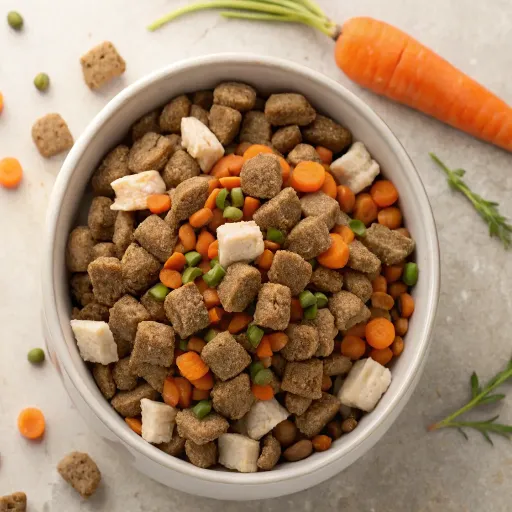
Freshly extruded kibble contains moisture levels between 20 percent and 25 percent. Mold can grow at this moisture level while it also reduces product lifetime. Multi-pass belt dryers use their hot air system to remove moisture until it reaches 8-11% during a 15-20 minute process which operates at temperatures between 80-100C. The system uses precise temperature control to achieve two goals which include reaching the required dryness level for shelf stability and protecting vitamins from degradation.
The process of cooling starts right after this point. Kibble reaches room temperature through the process of forced air circulation. The procedure takes place before the product undergoes coating or packaging. The process of skipping proper cooling creates conditions which lead to condensation. Storage bins and packaging materials develop moisture accumulation. This process starts fat oxidation together with mold development.
Maria, who works as a quality manager at a Polish mid-sized plant, discovered that insufficient cooling time caused frequent mold complaints at her facility. The solution to her problem required her cooling conveyor system to be extended by four meters.
Stage 5: Coating and Enrichment
The extrusion process generates heat which results in vitamin and flavor compound losses. The initial mix should not receive excessive ingredients because this will create problems with expansion while it increases production costs. Manufacturersintroduce fats and oils together with heat-sensitive nutrients to the process after they have completed the drying phase. The revolving coating drum system applies palatability enhancers to kibble together with essential fatty acids and vitamin premixes.
Post-extrusion coating maintains all nutritional elements of the food product. The extrusion process through high heat treatment causes essential vitamins A, E, C, thiamine, and folic acid to experience major nutritional losses. The instability of vitamin K3 makes it highly vulnerable. The vulnerability of this system has been confirmed through research published in PubMed. The method of nutrient coating after cooking protects all nutrients until they reach the final product.
The two main coating techniques consist of drum coating and vacuum coating. Drum coating uses its spraying method to apply nutrients directly on top of surfaces. Vacuum coating uses its vacuum system to drive fat molecules into deeper sections of the kibble. The process results in better control over flavor stability.
Stage 6: Quality Control and Safety
Physical Testing
Quality teams measure kibble size, shape, density, and expansion ratio against specifications. Inline sensors reject pieces that deviate from target parameters. Color consistency indicates proper cooking and coating application. Hardness testing ensures the final product matches the dental profile of the target breed size.
Chemical and Nutritional Analysis
Laboratory tests confirm that the finished kibble product fulfills its nutritional requirements. The tests determine the amounts of protein, fat, fiber, ash, and moisture present in the samples. The vitamin and mineral tests verify that the post-extrusion coating contains the essential nutrients in the correct amounts.
All products that enter the United States market must fulfill AAFCO nutritional requirements for their product category. The requirements apply to the specified age group. European markets follow FEDIAF guidelines.
The AAFCO system controls how much nutrients products contain because it does not permit any assessment of nutrient absorption. Two products can display identical guaranteed nutritional content yet create completely different health effects based on the quality of their ingredients and the accuracy of their manufacturing methods.
Microbiological Safety
Most pathogens die during extrusion cooking yet pathogens can reenter the product through either the packaging process or the coating process. The HACCP system controls essential elements of the production process through monitoring. The finished product tests examine the presence of Salmonella, E. coli, and mold. All US facilities that operate under FSMA regulations need to establish systems for stopping outbreaks and tracking environmental conditions.
Stage 7: Packaging and Storage
Automated packaging systems perform weight measurement and product filling and bag sealing and label application at the same speed as their extruder system. Nitrogen flushing displaces oxygen inside bags, which slows fat oxidation and vitamin degradation. Multi-layer packaging films create barriers against moisture and light which help maintain product quality during its transportation process.
Properly dried and packaged dry dog food achieves 10-18 months of shelf life. Warehouses need to keep their storage areas at temperatures below 25C and their humidity levels under 60%. Mold growth and rancidity develop because even tiny amounts of moisture that enter through broken packages.
How to Make Dry Dog Food at Scale: Equipment and Line Design
Floor Space and Layout
The production line for standard dry dog food needs a linear flow design which connects all operational areas from raw material entry to complete product distribution. The typical process moves through ten distinct steps which include receiving and storage followed by grinding and mixing and then extrusion and drying and coating and cooling and packaging and finished goods storage.
The raw area and finished area need to stay completely distinct from each other because this measure stops any possibility of cross-contamination.
The small commercial lines require two hundred to four hundred square meters of space. Industrial facilities which operate above 2 000 kilograms per hour usually need more than 1 000 square meters of space including special spaces for equipment maintenance. The building height needs to reach the required level for both storage silos and all overhead conveying systems.
Capacity and Power Requirements
| Model Type | Capacity | Installed Power | Typical Application |
|---|---|---|---|
| Small Dry | 100-150 kg/h | 74 kW | Pilot plants, startups |
| Medium Dry | 200-250 kg/h | 105 kW | Small commercial operations |
| Large Dry | 300-500 kg/h | 205 kW | Regional producers |
| Small Wet | 800-1,000 kg/h | 132 kW | Mid-scale manufacturers |
| Medium Wet | 1,000-1,500 kg/h | 165 kW | Large commercial facilities |
| Industrial Wet | 2,000-2,500 kg/h | 226 kW | Major production plants |
| Heavy Industrial | 3,000-5,000 kg/h | 360 kW | Multi-national supply |
Wet-type systems require a boiler for steam generation, which adds to initial infrastructure costs. Dry-type systems avoid that requirement but offer lower capacity and less recipe flexibility.
Automation and Control Systems
Modern production lines use PLC-based control systems with touchscreen interfaces. Operators store recipes for different products and recall them with minimal changeover time. Automated packaging lines weigh and fill bags with precision that reduces giveaway. Some manufacturers now integrate AI-driven predictive maintenance that monitors bearing temperatures, vibration, and motor loads to schedule service before failures occur.
Advanced lines require only 1-2 operators per shift. That labor efficiency directly impacts per-kilogram production costs and ROI timelines.
Browse our complete food equipment range to configure a line that matches your capacity and budget targets.
Cost and ROI Considerations
The entry-level pilot lines begin production at a cost range between 80,000 and 120,000. The cost of complete automated mid-scale commercial facilities typically falls between 200,000 and 400,000. Industrial systems that operate above 2,000 kg per hour will exceed $500,000 based on the level of customization required and the specific material requirements and additional systems needed such as boilers and cooling towers.
Budget requirements include all costs related to equipment and facility construction and system installation and equipment testing and procurement of first raw materials. First-time producers tend to underestimate the necessary costs of utility infrastructure development. Wet extrusion systems need steam boilers and water treatment and drainage systems which dry lines do not require.
The duration required to achieve return on investment varies depending on the specific market and the level of equipment usage. A mid-scale production line that operates for two shifts each day will reach its ROI target within 18 to 36 months. The cost of production per kilogram decreases between 20 and 25 percent during the first year because operators improve their recipes and decrease scrap and reduce operational downtime. The Vietnamese startup team documented a 22 percent reduction in per-kilogram expenses within eight months after starting up their first twin-screw line through decreased labor needs and diminished raw material waste.
Compliance and Safety Standards
The AAFCO nutritional adequacy standards for the specified life stage need to be followed by dry dog food products that enter the United States market. The complete and balanced products need to demonstrate compliance through laboratory testing or feeding experiments. FEDIAF nutritional guidelines serve as the official European standard because they require specific vitamin quantities while establishing protein and fat minimums for their dietary requirements.
Food safety regulations require all equipment to meet their requirements. The CE marking system establishes mechanical safety requirements and electrical safety requirements for products sold in European markets. ISO 22000 and HACCP certification demonstrate systematic food safety management. The FSMA preventive controls regulations govern animal food manufacturing facilities in the United States.
The new labeling regulations set to begin in 2025 and 2026 establish a requirement for standardized Pet Nutri labeling format.
Conclusion
The process of producing commercial dry dog food requires expertise in seven separate stages which are interconnected with one another. The final product reaches its nutritional value together with its safety level and its taste appeal through the entire process which includes raw material preparation and precision mixing and extrusion cooking and drying and coating and quality control and packaging. Equipment selection through single-screw or twin-screw extrusion choice determines your recipe options and production limits and future maintenance expenses.
The global pet food market continues to grow, driven by rising pet ownership and premiumization trends. Manufacturers who invest in modern extrusion technology, rigorous quality systems, and compliant facilities position themselves to capture that demand. The basic principles for producing dry dog food remain unchanged whether you are a beginner or an experienced operator who wants to expand your existing production capabilities. You need to manage your operations. Your nutritional content needs to be verified through testing. Your organization must maintain food safety standards throughout all operational procedures.
Ready to design your dry dog food production line? Contact our engineering team for a customized proposal that matches your recipe, capacity targets, and budget.