

How to Microwave Pasta Without Drying It Out

To microwave pasta without drying it out, you must restore the moisture lost during refrigeration. Place your noodles in a microwave-safe dish and add a tablespoon of water or a splash of sauce to create a steam reserve. Cover the bowl tightly with a vented lid or a damp paper towel to trap humidity, then heat at medium power in 60-second intervals. This controlled environment prevents the starch from turning brittle, ensuring the pasta stays supple.
The Hydration Challenge
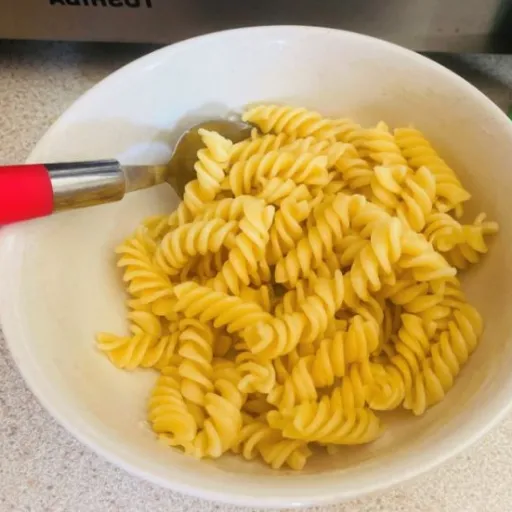
Pasta is a structural matrix of starch and protein. Once it is cooked, it enters a state of maximum hydration, but as it cools in the refrigerator, a process called retrogradation begins. The starch molecules realign into a rigid, crystalline structure, effectively locking away the water that previously made the noodles tender. This is why leftover penne feels like a cold plastic pipe.
The microwave presents a unique hurdle because it targets that very water.
In a typical 1,100-watt residential unit, the electromagnetic waves cause water molecules to vibrate at roughly 2.45 billion times per second. If the pasta is already depleted of surface moisture, this friction doesn’t just heat the food; it rapidly evaporates the internal water content. Without an external source of humidity, the noodles transition from cold and stiff to hot and brittle in under 90 seconds. To win the hydration challenge, you aren’t just heating the meal—you are essentially conducting a targeted rehydration mission.
Why leftover pasta turns crunchy in the microwave
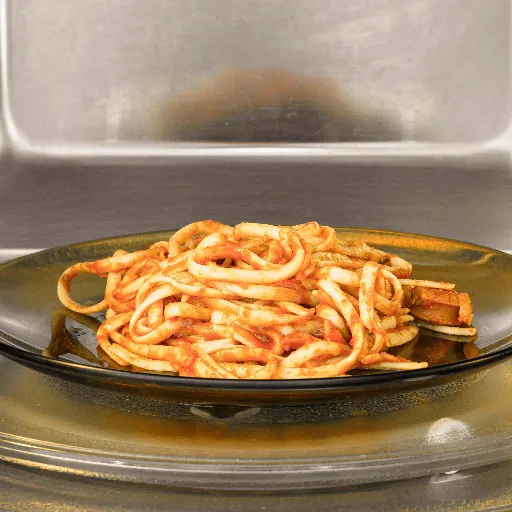
The “crunch” is actually a sign of localized dehydration. When pasta sits in the fridge overnight, the starch granules undergo retrogradation, essentially expelling moisture and turning the noodle into a dense, semi-crystalline state. Once you place it in the microwave, the high-frequency waves specifically target the remaining water molecules. If those molecules evaporate before the starch has a chance to soften, the noodle fibers fuse together into a brittle, glass-like texture.
Think of a plain bowl of farfalle with no sauce. Without a protective layer of fat or liquid, the thin edges of the “bowties” reach boiling temperatures almost instantly. In a 1000-watt microwave, these edges often hit the 212°F threshold while the thicker center is still barely lukewarm.
Industry observations in high-volume food service suggest that sauces act as a thermal buffer, but even then, sugars and salts in the sauce can accelerate “hot spotting.” This phenomenon causes the pasta to skip the tender phase entirely and go straight to being scorched. You aren’t just reheating; you’re accidentally finishing a dehydration process that makes the pasta structurally closer to a cracker than a noodle.
5 steps to reviving cold noodles with steam
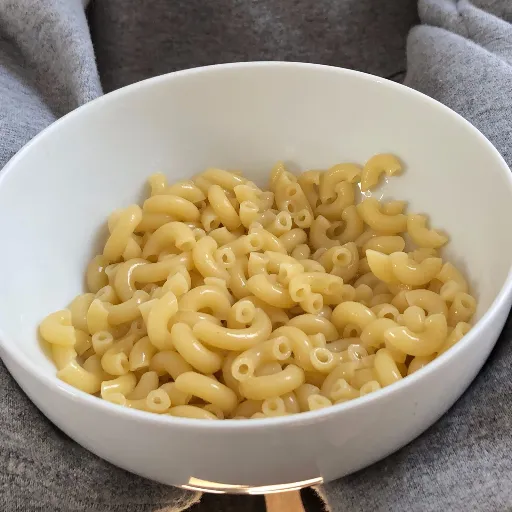
The objective when reheating pasta is to reverse the starch retrogradation that occurred in the fridge. To do this, you have to treat the microwave like a steamer rather than an oven. If you simply heat the noodles, they remain stiff; if you steam them, the heat penetrates the crystalline starch structures and allows them to absorb moisture again, returning them to an al dente state.
This requires a shift in how you stack and hydrate the dish. Industry observations from prepared-meal manufacturers suggest that the spatial arrangement of the food significantly dictates how evenly steam can circulate. If the pasta is packed too tightly, the center stays a cold, gelatinous block while the exterior dries out.
Choosing the right vessel
A shallow, wide ceramic bowl is almost always superior to a deep, narrow container. You want to maximize the surface area exposed to the micro-vibrations. Avoid using plastic containers that have warped over time, as they often fail to sit flat on the turntable, leading to uneven heating. Glass or lead-free ceramic is preferred because these materials retain heat longer, helping to finish the warming process through conduction after the microwave has stopped.
Adding the essential liquid component
Noodles lose significant moisture the longer they sit. For a standard single serving—roughly 140 to 180 grams of cooked pasta—you should add approximately one tablespoon of water. If the pasta was originally tossed in an oil-based sauce, consider using a splash of chicken or vegetable broth instead. The salt and fats in the broth integrate better with the existing flavors and help re-emulsify any oils that may have separated and hardened in the cold.
Creating a localized humidity seal
The moisture you just added is useless if it escapes into the microwave’s vent system. You need to trap it. A damp, heavy-duty paper towel draped directly over the pasta creates a semi-permeable barrier.
For even better results, use a microwave-safe plate as a lid over your bowl. This creates a pressurized “mini-sauna.” As the water heats up, the steam is forced back down into the pasta fibers. This localized humidity prevents the edges from curling and hardening into those dreaded “pasta shards.”
The intermediate stir strategy
Microwaves have “dead zones” where energy doesn’t hit as effectively. Never heat for three minutes straight.
Set the timer for 60 seconds, then remove the dish and stir the contents thoroughly. This move is critical because it redistributes the steam and the added liquid from the bottom of the bowl to the top. It also breaks up clumps of spaghetti or penne, ensuring that the interior pieces are finally exposed to the heat.
Should you keep the sauce and pasta together?
Deciding whether to separate your components depends entirely on the sauce’s base. If you have a bowl of pasta already tossed in a robust tomato or meat sauce, keeping them together is actually an advantage. The sauce acts as a protective thermal blanket, insulating the noodles from direct radiation. In these cases, the moisture within the sauce migrates into the pasta as it heats, which may help reverse that stiff, refrigerated texture.
However, cream or butter-based sauces are a different story.
Practical experience shows that high-fat sauces like Alfredo or carbonara are prone to “breaking” when hit with intense microwave energy. The emulsion collapses, leaving you with a puddle of oil and clumpy, dry solids. If your pasta is sitting in a pool of cream sauce, consider adding a teaspoon of milk—about 5 or 6 milliliters—before heating. This helps stabilize the emulsion.
Industry observations from large-scale catering suggest that for optimal results with delicate sauces, the pasta should be heated slightly under-temp first, with the sauce added and stirred in during the final 30 seconds. This prevents the sauce from reaching a hard boil, which is the primary cause of curdling and textural failure.
Dealing with specific pasta shapes and dense baked dishes
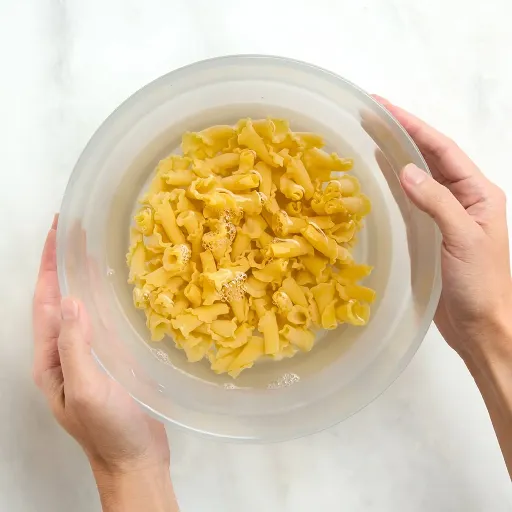
Geometry plays a larger role in reheating than most people realize. In a microwave, thin edges and protrusions act like lightning rods for electromagnetic energy, while dense centers remain stubbornly cold. If you treat a delicate angel hair the same way you treat a heavy rigatoni, you’ll end up with a meal that is simultaneously burnt and icy.
Industry observations from test kitchens suggest that “surface-to-volume ratio” is the metric that matters most. The more surface area a shape has relative to its thickness, the faster it dehydrates. This is why small, intricate shapes like orzo or shells often require a more aggressive liquid-to-pasta ratio—sometimes up to 20ml of extra water per cup—to counteract the rapid evaporation.
Long strands like Spaghetti or Fettuccine
Long, thin noodles have a frustrating tendency to fuse into a single, impenetrable nest. Once the starch sets in the fridge, the strands bond together. If you blast this “nest” with heat, the outer layers turn into a leathery shell before the core even begins to thaw.
The most effective fix is the donut method. Spread the noodles toward the edges of the plate, leaving a literal hole in the center. Because microwaves typically struggle to hit the very middle of a dish, this arrangement forces the energy to penetrate the thickest part of the pasta pile from the sides. Adding a teaspoon of olive oil before the first 45-second cycle helps lubricate the strands, making them easier to untangle during the intermediate stir.
Thick, layered Lasagna slices
Lasagna is the final boss of microwave reheating. Its density is its downfall; the internal temperature of a thick 350-gram slice might stay at 40°F while the top layer of cheese is literally bubbling at 210°F.
To prevent the pasta sheets from turning into cardboard, you have to slow down. Cut the slice into two smaller pieces or poke several deep vertical holes through the layers with a fork to allow steam to migrate into the center. Cover the dish with a glass lid or a heavy ceramic plate rather than just a paper towel. This creates a more robust seal. By using a 50% power setting for roughly four to five minutes, you allow the heat to conduct inward slowly, which may prevent the edges of the noodles from hardening while the sauce in the middle finally reaches a safe eating temperature.
Microwave Power Levels
Most people treat the “Start” button as a binary switch—it’s either on or off at 100% capacity. In reality, blasting a delicate starch like pasta with full power is the fastest way to ruin its texture.
When you run a microwave at its default high setting, the magnetron is firing constantly. This creates intense heat that can quickly exceed 212°F at the surface of the noodle, causing the water within the pasta to flash into steam and vanish.
Industry observations suggest that for reheating dense or starch-heavy foods, dropping to 50% or 60% power is significantly more effective. At these lower levels, the machine cycles the energy on and off. During those “off” seconds, the heat has a chance to migrate toward the center of the pasta pile through conduction rather than just aggressive radiation.
Consider a realistic scenario: you are reheating a bowl of fettuccine. At full power, you might reach a safe internal temperature in 90 seconds, but the edges will be leathery. If you extend the time to 3 minutes but cut the power to 50%, the heat penetrates gently. This cautious approach prevents the “hot spotting” that tends to turn the outer noodles into brittle shards while the middle remains an icy clump. It takes longer, but the quality trade-off is undeniable.
Industrial insights: How commercial kitchens manage starch retrogradation
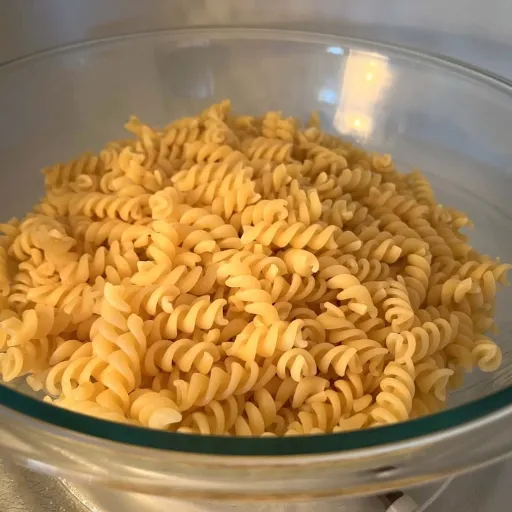
In high-volume food service, “reheating” isn’t a casual task—it is a controlled chemical reversal. Commercial kitchens battle starch retrogradation, the process where amylose and amylopectin molecules realign into a rigid structure as pasta cools. If you’ve ever pulled a brick of cold fettuccine from a container, you’ve seen this physics in action.
Industry observations from large-scale commissary kitchens show that the goal isn’t just applying heat; it’s re-plasticizing the starch. To do this, chefs often utilize specialized equipment or, in the absence of a steamer, a “slingshot” method. This involves hitting the pasta with a brief, high-energy burst to loosen the bonds, followed immediately by a resting period where the residual heat—ideally held between 145°F and 160°F—does the heavy lifting. This prevents the “thermal shock” that tends to shatter the starch matrix and leave you with mush.
The role of oil in moisture retention
In professional settings, pasta intended for later service is almost never stored dry. A light coating of fat—usually a high-quality olive or vegetable oil—serves as a microscopic moisture barrier.
Practical experience shows that oil acts as an insulator against the aggressive evaporation typical of a 1200-watt microwave. When you heat oiled pasta, the lipid layer traps the steam against the surface of the noodle. Instead of the water escaping into the microwave’s cavity, it is forced back into the grain. This simple application of about 7.5 milliliters of oil per portion can be the difference between a supple noodle and one that feels like a piece of dehydrated leather.
FAQ Section
Is it better to use water or oil when reheating pasta?
Water is generally more effective for rehydrating the starch, as it creates the steam necessary to soften noodles that have hardened in the fridge. However, if your pasta was originally prepared with a heavy oil or butter base, adding a teaspoon of olive oil can help prevent the strands from sticking together. For the best results, use a tablespoon of water to provide moisture and a tiny drizzle of oil to maintain a smooth, non-stick texture.
Can I microwave dry, uncooked pasta to save time?
You can, but it isn’t necessarily a time-saver compared to stovetop boiling. To do this safely, you must fully submerge the dry noodles in a large, microwave-safe bowl of water, ensuring there is at least an inch of liquid above the pasta line. It typically takes about 3–5 minutes longer than the package’s “al dente” instructions because the water needs time to reach a boil within the microwave cavity before the cooking process truly begins.
Why does my pasta stay cold in the center but burn on the edges?
This is a classic case of uneven wave distribution. Microwaves struggle to penetrate dense piles of food, meaning the exterior noodles absorb all the energy while the core relies on slow heat conduction. To fix this, arrange your pasta in a ring or “donut” shape on the plate. This increases the surface area exposed to the waves and allows the center of the dish to heat at the same rate as the perimeter.
How do I keep creamy sauces from breaking or curdling in the heat?
High heat is the enemy of dairy emulsions like Alfredo or carbonara. When these sauces get too hot too fast, the proteins clump and the fats separate into a greasy mess. To prevent this, add a splash of milk or heavy cream before heating and drop your microwave power to 50%. This lower intensity allows the sauce to warm up gently without reaching the violent boil that causes the emulsion to collapse.
Is plastic wrap safe for creating a steam seal?
While many brands are labeled “microwave safe,” you should always ensure the plastic does not directly touch the food, as high-fat sauces can cause the wrap to melt or leach chemicals. A safer and more sustainable alternative is to use a microwave-safe ceramic plate or a damp paper towel. These options effectively trap the steam required to keep your pasta moist without the risks associated with overheating thin plastic films.