
The Science and Craft of Extracting Pure Oil from Roses

Extracting pure oil from roses requires a precise balance of temperature and timing to capture the flower’s volatile aromatic compounds. Whether utilizing professional steam distillation to produce rose otto or using a carrier oil for a slow, cold-process infusion, the goal remains the same: isolating the essential lipids from the petals without heat degradation. Understanding the labor-intensive transition from fresh harvest to concentrated extract is the first step in mastering this complex botanical process.
Beyond the Scent: What Exactly is Rose Essential Oil?
True rose essential oil is not merely a concentrated perfume; it is a complex volatile secondary metabolite. When you analyze oil from roses at a molecular level, you find over 300 unique chemical compounds, including citronellol, geraniol, and nerol. These aren’t just aromatic markers. They are the plant’s own defense and reproductive signals, isolated through rigorous physical force or heat.
In a professional laboratory setting, technicians often observe that the profile of the oil shifts based on the extraction method used. For example, steam distillation yields “Rose Otto,” a pale yellow liquid that may actually solidify at room temperature due to its natural wax content. Contrast this with a solvent-extracted absolute, which tends to be more viscous and reddish. Because the yield is incredibly low—often requiring about 4,000 kilograms of petals to produce just one liter of oil—the substance is essentially a biological luxury. It is a dense, hydrophobic liquid that represents the chemical “soul” of the flower, stripped of its cellulose and water.
3 ways to capture the essence of a rose

Extracting oil from roses is fundamentally a battle against time and heat. Because the aromatic compounds are so volatile, the method you choose dictates whether the final product is a light, therapeutic “Otto” or a deep, waxy absolute. Industry observations reveal that the chemical profile of a single harvest can diverge wildly depending on the mechanical or chemical stress applied during processing. While large-scale distilleries prioritize speed and volume, boutique operations often lean into slower, more temperamental techniques to preserve the heavier base notes that provide the flower’s characteristic “jammy” scent.
Steam distillation: The gold standard for purity
In a typical steam distillation scenario, pressurized vapor passes through layers of fresh petals, rupturing the microscopic oil glands. As the steam cools in a condenser, the essential oil separates from the water, floating on the surface due to its lower density. This method produces Rose Otto. It is a meticulous process; roughly 60,000 roses are required to produce just one ounce of pure oil. Because the heat is intense, some of the more delicate, water-soluble components are lost to the byproduct, which becomes rose water. This remains the preferred choice for aromatherapy because it leaves no chemical residue, though the high temperatures may slightly alter the scent compared to a fresh bloom.
Solvent extraction for delicate rose absolutes
For certain species, like Rosa centifolia, steam is too harsh. Instead, a solvent like hexane is used to wash the petals, creating a “concrete”—a thick mixture of wax, pigment, and essential oil. Later, alcohol is introduced to separate the aromatic compounds from the plant waxes. This produces an absolute. Many high-end perfumers prefer absolutes because the process occurs at lower temperatures, capturing a scent that is truer to a garden rose. However, trace amounts of solvent often remain, which is why absolutes are rarely used in clinical therapeutic settings.
Simple infusion methods for the home hobbyist
If you lack a copper still, a solar infusion is the most accessible path. By submerging dried petals in a stable carrier oil, such as jojoba or sweet almond, you allow the lipids to slowly pull the scent from the plant material. A practical example involves placing a sealed jar in a warm, sunny window for about four to six weeks. While this doesn’t create a “pure” essential oil, it results in a potent, fragrant body oil. It is a gentle, low-tech alternative that avoids the risk of scorching the delicate petals.
Why does it take thousands of petals to produce a single drop?

The staggering ratio of raw material to finished product is a matter of microscopic biology. Rose petals are not oily by nature; rather, they contain tiny glandular trichomes that house minuscule amounts of aromatic compounds. To capture a meaningful volume of oil from roses, you are essentially performing a massive salvage operation. Industry observations indicate that a single gram of pure rose otto may require upwards of 1,300 to 2,100 individual blossoms depending on the humidity and soil quality of the harvest.
Consider a realistic scenario where a distillery processes a standard batch: a mountain of petals roughly the size of a small car might yield just a few tablespoons of liquid. This scarcity is why the price point reflects that of precious metals. The oil is a high-density energy storage of the plant’s essence. Because the petals are nearly 88% water, the majority of the weight is lost as steam or discarded as “spent” biomass during the heat exchange, leaving behind only the most resilient, hydrophobic molecules.
Harvesting for Potency
The chemistry of a rose is in constant flux, governed by a circadian rhythm that dictates the concentration of its most valuable lipids. Industry observations confirm that the yield of oil from roses can drop by as much as 40% if the harvest is delayed by even a few hours. This isn’t just about freshness; it’s about preventing the evaporation of volatile terpenes that the plant releases as the day warms up.
Pickers must work with a sense of urgency that borders on the fanatical. Once the sun hits the petals, the rose begins to “exhale” its fragrance into the atmosphere, meaning the oil you intended to bottle is literally vanishing into thin air. Professional operations prioritize this narrow window to ensure the wax-to-oil ratio remains optimal for the distillery.
The critical 4-hour window: Why dawn is the best time to pick
The ideal harvest begins in the pre-dawn gray, roughly between 4:15 AM and 8:30 AM. During these quiet hours, the dew acts as a natural sealant, keeping the essential oil trapped within the petal’s glandular tissues. A realistic scenario involves hundreds of workers moving through the fields before the first rays of sun crest the horizon. If the temperature climbs above 82°F, the chemical composition shifts, often resulting in a “flat” scent profile. By mid-morning, the most delicate top notes have largely dissipated. Efficiency is paramount; any bag of roses sitting in the sun for more than 25 minutes begins to ferment, ruining the entire batch.
Selecting the right cultivars: Damask vs. Centifolia
Not all roses are biologically equipped for extraction. The Rosa damascena, or Damask rose, remains the undisputed champion of the industry due to its exceptionally high oil content and deep, spicy aromatic profile. It is the backbone of Bulgarian and Turkish production. In contrast, the Rosa centifolia, often called the “Cabbage Rose,” is prized in Grasse, France, for its lighter, honey-like sweetness. While damascena survives the high heat of steam distillation well, centifolia is more temperamental. It tends to be better suited for solvent extraction to create absolutes, as its fragile petals often turn to a scentless mush under direct steam pressure.
Essential Equipment for Small-Scale Extraction
Scaling down the extraction of oil from roses from industrial fields to a tabletop setup requires a shift in focus toward thermal precision. You aren’t just boiling water; you are managing a delicate phase change. A dedicated copper or high-borosilicate glass alembic still is the centerpiece. Copper is often preferred in industry observations because it reacts with sulfur-containing compounds, stripping away “off” notes that can muddy the floral profile.
A digital hot plate with magnetic stirring is a practical example of how to maintain a consistent 212°F without the hot spots of an open flame. You also need a high-efficiency Graham condenser, where cold water circulates to snap the aromatic steam back into liquid form. In a realistic scenario, a hobbyist might use a small 2-liter boiling flask, which, given the low yield of roses, may only produce a microscopic film of oil atop the hydrosol. Finally, an essential oil separator—sometimes called a Florentine flask—is vital for siphoning off that precious, buoyant layer from the bulk of the floral water.
Identifying Purity
Authentic oil from roses possesses a chemical fingerprint that is notoriously difficult to forge. Because of its high market value, “cutting” the oil with cheaper geranium or palmarosa—which share the geraniol molecule—is a common industry observation. A pure Rose Otto often reveals its identity through physical state; it tends to crystallize into delicate, needle-like stearoptenes when temperatures dip below 68°F. If your oil remains perfectly thin and fluid in a cold room, it may be heavily diluted or entirely synthetic. True purity feels slightly waxy rather than greasy, reflecting the natural protective coatings of the petals that survive the distillation process.
Avoiding the “fragrance oil” trap: Common red flags in retail
The most immediate red flag is the price tag. If a 10ml bottle is retailing for $15, it is physically impossible for it to be pure. A realistic scenario involves “Rose Fragrance” or “Nature Identical” oils, which are laboratory-constructed scents designed to mimic the smell but lack the 300+ bio-active compounds of the real plant. Check the botanical name. If the label doesn’t specify Rosa damascena or Rosa centifolia, you are likely holding a synthetic blend. Authentic oils are almost always stored in dark amber or cobalt glass, as UV light degrades the delicate aromatic esters within hours of exposure.
The role of Gas Chromatography in professional grading
To move beyond guesswork, professional distillers rely on Gas Chromatography and Mass Spectrometry (GC-MS). This process vaporizes a tiny sample of the oil from roses and pushes it through a long capillary column. As the various molecules travel at different speeds, the machine produces a “chromatogram”—a visual map of every chemical constituent. A practical example of this is spotting the exact percentage of phenylethyl alcohol; if this number is too high in a distilled oil, it suggests the oil was actually recovered from the distillation water rather than the first press, indicating a lower grade of purity.
Storage secrets to prevent oxidation and scent degradation
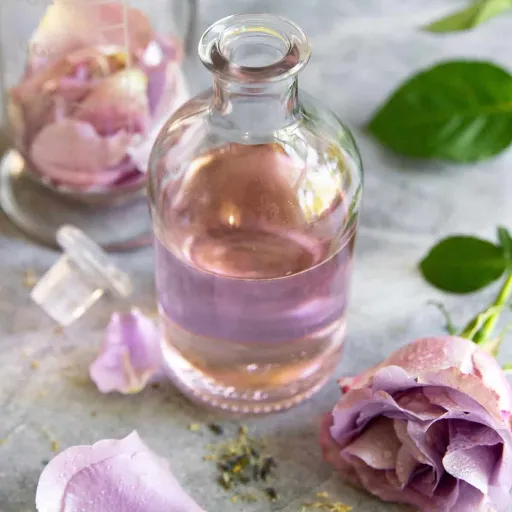
Once the oil from roses leaves the condenser, its greatest enemies are oxygen, light, and fluctuating temperatures. Exposure to air triggers oxidation, a chemical reaction that breaks down delicate esters into harsh-smelling acids. To fight this, industry observations suggest using “headspace management.”
A practical example is transferring your oil into progressively smaller amber glass vials as you use it. By minimizing the pocket of air trapped inside the bottle, you significantly slow the degradation process.
Storage at a constant 54°F to 59°F often proves ideal. While many hobbyists reach for the kitchen fridge, the frequent door-opening causes temperature swings that may stress the oil’s molecular stability. In a realistic scenario, a dedicated dark cellar or a temperature-controlled beauty fridge provides the steady, light-free environment needed to preserve that intricate floral profile for several years.
FAQ Section
Q: Is rose water the same thing as rose essential oil?
A: No, though they are both products of the same distillation process. Rose water, or hydrosol, is the fragrant condensate remaining after the steam has cooled. While it contains water-soluble aromatic elements, it lacks the concentrated, lipid-based compounds found in the essential oil itself. The oil is the hydrophobic “soul” of the flower that floats on top of the hydrosol, and it is exponentially more potent and expensive than the floral water byproduct.
Q: Can I make high-quality rose oil using dried petals?
A: It is virtually impossible to produce professional-grade essential oil from dried material. The volatile aromatic compounds begin to evaporate the moment a rose is picked; by the time a petal is fully dried, the microscopic oil glands have largely shriveled or oxidized. You can use dried petals for a slow oil infusion in a carrier oil, but the resulting product will lack the therapeutic complexity and vibrant scent profile found in oil extracted from fresh, dew-covered blooms.
Q: Why is pure rose Otto often sold in such tiny quantities?
A: The extreme scarcity of the product dictates the small packaging. Because it takes roughly 4,000 kilograms of fresh petals—the equivalent of several million roses—to produce just one liter of oil, the cost of production is massive. Selling in 1ml or 2ml vials makes this “liquid gold” accessible to consumers while preventing the rapid oxidation that occurs when a large bottle is frequently opened. Even a single drop is powerful enough to scent an entire room or formulate multiple skincare products.
Q: Does the color of the rose affect the chemical composition of the oil?
A: Definitely. While the botanical species is the primary factor, the pigments in a rose often correlate with its chemical profile. Deep red roses tend to contain higher levels of heavier, spicier notes, whereas pale pink or white roses often yield oil with a higher percentage of lighter, citrus-like terpenes. These variations are why high-end perfumers are so specific about sourcing; a slight shift in petal hue can alter the balance of citronellol and geraniol in the final extract.
Q: How long does the extraction process typically take from bloom to bottle?
A: The physical distillation usually takes about three to five hours per batch, but the entire cycle is a race against time. From the moment the flower is hand-picked at 5:00 AM, it must reach the still within hours to prevent fermentation. Once the oil is separated from the hydrosol, it often requires a period of “resting” for several weeks to allow the scent to stabilize and mature before it is considered ready for retail bottling.
Q: Are the leftover petals useful for anything after the oil is removed?
A: In industrial settings, the spent petals are rarely wasted. Once the oil and water have been extracted, the remaining biomass is often composted and returned to the rose fields as nutrient-rich fertilizer. Some boutique operations also dry the “spent” petals for use in low-grade potpourri or as a natural exfoliant in soaps, though they retain almost none of their original scent or therapeutic properties after the intense heat of the distillation process.