
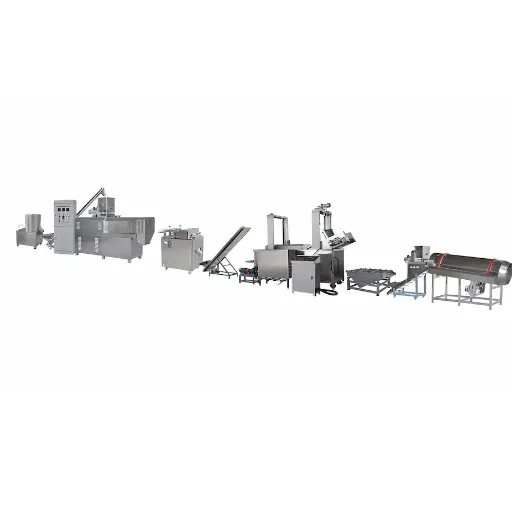
2D 3D Pellet Production Line: A Complete Guide to Equipment, Process, and Selection

It is estimated that the market for snack pellets across the globe stands at more than $6 billion currently, and the companies that have targeted investment towards the 2D&3D Pellet Production Line have been able to capture the profitable segments. However, a decision of whether one should engage the 2D line of manufacturing flat chips and rings or the 3D comprising bugles and shells is more than just a decision of which product form to use. This choice has a number of implications on the readiness of capital investments, consumption of energy, or what is the maximum possible rate of production, and finally, the cost-effectiveness of the firm.
You have information on the availability of snack pellet or half-product advantages that can be carried on shelves across the globe. However, developer’s specific needs on which kind of line to establish to meet certain production objectives is what you are missing. This instruction manual provides detailed information on the process of making 2D and 3D snacks, all equipment necessary to this end, and provides suggestions on how to analyze all cost factors of acquiring ownership with the aim of removing any uncertainties surrounding the buying decision.
When Raj Patel sought to open multiple new snack outlets In Gujarat’s state in 2022, he focused only on his needs as he believed that the traditional 2 dimensional line will be just fine. However, less than a year and a half later, geared-up retailers wanted to stock 3D bugs and criss-cross patterns, making the shelves different. Raj’s dilemma was to whether invest in modification of his old line or add the third dimension in a new one. His knowledge could have sufficed to understand why twin-screw extrusion was available and make such a bold decision from the beginning, avoiding the wasteful spending on $80,000 due to building twice the lead time infrastructure of 2D&3D Pellet Production Line.
Want to avoid a costly mismatch? Explore our fried snack production lines to see how integrated frying and seasoning solutions pair with pellet extrusion systems.
What Are 2D and 3D Pellet Snacks?

What Is a 2D Pellet Snack?
A two-dimensional (2D) pellet snack is an unprocessed flat snack base that is produced as one bulk mass by the single-shot extrusion process using a pellet snack machine. Raw 2D pellets are compact, non-perishable slabs, which will require further processing – cooking – before consumption.
Examples of common 2D shapes are flat chips, rings, stars, wheels, wavy strips, papads, and onion rings. Due to the simplicity of the extrusion manufacturing technique, 2D pellets are typically used for such simple, routine products that are required in large volumes and for which efficiency (output/geometry) rather than complexity is desired. The raw components are potato starch, corn starch, wheat flour, cassava starch, or tapioca.
What Is a 3D Pellet Snack?
The ingredients of a 3D pellet snack are subjected to a series of complex extrusion steps resulting in the formation of highly decorative three-dimensional – often hollow – shapes enigmatic in the nonwoven industry. Presentation of these products on a shelf is compelling and as such they attract high increase in price due to their appearance and intricacy.
Twisted chips, elbow macaroni, fasteners, moisturizing curling irons, hoses, conical shapes, woven box crisps, and cushion food snacks are often seen among 3D shapes. To form such particular shapes, the twin-screw extruder used must contain an additional device in the form of a die and, in some cases, another device for cutting or imprinting. Extra operations increase the power usage and level of productivity in comparison to 2D lines, but makes it possible to move into more profitable segments of products.
Why Are They Called “Half-Products”?
The terms 2D&3D Pellet Production Line ‘half-productsT’ or semi-goods include both variants. This is because, despite leaving the plant already processed, the pellets are hard with a low water content and need to be cooked, either fried or cooked in hot air, before being eaten.
This partially finished product provides three major opportunities for business. First and foremost, it enables a significant increase in shelf life and ease of distribution across the continents. Secondly, it allows the snack owners to adjust the final taste of the products and oil levels at the retail stage and during small scale production. Finally, it enables the producers to switch between favorite fried and baked versions respectively on the basis of the ever changing health concerns.
How a 2D 3D Pellet Production Line Works
Standard Process Flow
Every 2D 3D pellet production line follows a similar core sequence from raw material to finished package. Understanding each stage helps you identify where customization matters most for your product portfolio.
1. Raw Material Mixing
The process begins with precise blending of starches, flours, water, and additives in a batch or continuous mixer. Consistency at this stage determines pellet density and expansion quality later.
2. Screw Conveyor Feeding
A screw conveyor transports the mixed dough into the extruder at a controlled rate. Steady feeding prevents pressure fluctuations that could cause uneven cooking or malformed shapes.
3. Extrusion (Cooking and Forming)
The extruder applies heat, shear, and pressure to gelatinize the starches and form a continuous dough mass. For 2D pellets, a single-screw extruder may suffice. For 3D pellets, a twin-screw extruder is almost always necessary because it provides superior mixing, temperature control, and shape complexity.
4. Pattern Pressing or Compound Shaping (for 3D)
3D lines often include a pattern presser or compound shaper after the extruder. These units laminate layers of dough or cut complex geometries that single-stage dies cannot achieve alone.
5. Pre-Drying
Freshly extruded pellets contain too much moisture for stable storage. A multi-layer dryer or conveyor oven reduces moisture content to roughly 8-12 percent. This step is critical for preventing mold and ensuring uniform expansion during frying.
6. Frying or Hot-Air Puffing
The dried pellets are then fried in hot oil at 150-200°C for 15-30 seconds, or puffed in a hot-air expansion chamber. Frying typically delivers a richer crunch and higher expansion ratio, while hot-air puffing appeals to health-conscious markets by reducing oil content.
7. De-oiling (if fried)
A vibrating de-oiler or centrifugal unit removes excess surface oil after frying. This step controls fat content and improves mouthfeel.
8. Flavoring and Seasoning
Flavoring drums or electrostatic coating systems apply oil, salt, spices, or sweet coatings evenly across the expanded product.
9. Cooling and Packaging
Finally, forced-air cooling brings the snacks to ambient temperature before automated weighing and packaging. Proper cooling prevents condensation inside the bag, which protects shelf stability.
The Role of the Extruder
The extruder is the heart of any 2D 3D pellet production line. Choosing between a single-screw and twin-screw design is one of the most consequential equipment decisions you’ll make.
Single-Screw Extruders are simpler and less expensive. They work well for basic 2D shapes with standard starch formulations. However, they offer limited mixing precision and can’t handle complex 3D geometries or high-protein, multigrain recipes. A single-screw fried snack pellet extruder is best suited for flat chips and simple rings where raw-material variety is limited.
Twin-Screw Extruders use two intermeshing screws to deliver superior heat transfer, kneading action, and process control. According to industry analysis, twin-screw extrusion now holds approximately 58% of the production technique market share in 2025. This dominance reflects the industry’s shift toward 3D innovation, health-oriented formulations, and recipe flexibility.
Twin-screw systems also allow faster die changes and more accurate cutter synchronization. That means you can switch from rings to bugles in minutes rather than hours, which directly improves overall equipment effectiveness.
Drying and Frying Considerations
Moisture management separates average pellet operations from world-class ones. If pellets enter the fryer with uneven moisture, you’ll get inconsistent expansion, off-flavors, and shorter shelf life.
Target a uniform pre-dry moisture of 8-12 percent before frying or puffing. Multi-layer dryers with independent temperature zones give you the best control. Gas, electric, or steam heating options are available depending on your local utility costs.
Hot-air expansion is gaining ground rapidly. Market data projects that hot-air puffing will capture 55% of processing share by 2025 as consumers shift toward lower-fat, baked-style snacks. If your target market values clean-label or reduced-oil products, designing your line with hot-air capability from the start is a smart long-term move.
2D vs 3D Pellet Production Line: Key Differences
When buyers research 2D vs 3D pellet snacks, they often focus on shape alone. For manufacturers, the real decision shapes your capital budget, operating costs, maintenance schedule, and pricing power.
| Factor | 2D Line | 3D Line |
|---|---|---|
| Extrusion Process | Single-shot | Multi-stage |
| Typical Capacity | 300-400 kg/h | 200-300 kg/h |
| Installed Power | ~65-100 kW | ~150-210 kW |
| Initial Investment | 100,000−100,000−200,000 | 250,000−250,000−500,000 |
| Energy Consumption | 20-30% lower | 30-50% higher |
| Shape Complexity | Flat, simple | Complex, hollow, layered |
| Maintenance Costs | Lower | 10-15% higher |
| Premium Pricing Potential | Limited | 20-30% higher margins |
Production Speed and Scalability
In general, 2D production processes achieve higher performance rates, as there is no need to stop the flow of the line to produce on the resins. An average commercial two-dimensional line produces 300 to 400 kgs of products per hour, and most of the time the manufacturers will choose two-dimensional 2D systems precisely because they focus on high volume low profitability customer base.
A typical rate for a 3D line would be lower than 200-300kg per hour due to additional forming and shearing procedures also required. However, due to the unique quality of the 3D forms produced, prices can be increased by 20% to 30% on average. Therefore, a lower throughput for a certain manufacturer focusing more on ‘differentiated’ end-markets than ‘toggle’ markets, is not a challenge, but an opportunity.
Energy and Operating Costs
The 2D technology requires 20 % to 30 % less energy when compared to the 3D counterpart. Regional electricity costs, which are very high, also come into play over the long run of 10 years operations. In 3D operations, operating costs are generally around 10 to 15% higher than 2D because of the extra violence if it involves complex dies, cutters and pattern forming devices.
Product Quality and Consumer Appeal
2D chips are thought to have more consistency because they are more uniform in size and width. It is the most popular shape in supermarkets. On the other hand, 3D allows textural appeal and provides hollow spaces to enhance flavoring. Surveys have revealed that eye-catching objects tend to prompt instant shopping decisions especially among youthful segments of the population and newer geographical regions.
How to Choose the Right 2D 3D Pellet Production Line

1. Define Your Product Portfolio
Start with the end product. If your strategy centers on mass-market flat snacks like chips, rings, and papads, a 2D line offers the fastest payback. If you plan to launch premium bugles, cones, or dual-flavor layered snacks, a 3D line or a versatile twin-screw system is essential.
Many successful manufacturers future-proof their investment by selecting a twin-screw extruder with interchangeable dies. This approach lets you produce both 2D and 3D shapes on the same core platform, giving you flexibility without duplicating infrastructure. Learn more about our advanced food extrusion solutions to see how modular systems scale with your business.
2. Match Capacity to Demand
Entry-level operations typically require 100-150 kg/h capacity. These lines fit startup facilities or regional brands testing market demand.
Mid-scale manufacturers usually target 200-350 kg/h. This range balances capital efficiency with enough volume to serve multiple retail channels.
Industrial-scale plants often need 400-500+ kg/h. At this level, automation, recipe memory, and rapid die-change systems become critical for maintaining uptime and product consistency.
Maria Santos, a snack producer in São Paulo, learned this lesson the hard way. She purchased a 100 kg/h line in 2021 to minimize risk. By 2023, her 3D net crisps had won contracts with two national distributors.
Her line was now the bottleneck, running 20 hours a day with unsustainable maintenance costs. Upgrading to a 350 kg/h twin-screw system cut her per-unit operating cost by 18% and restored normal shift patterns within six months.
Need help sizing your line? Our team can analyze your projected volumes and recommend the right capacity tier. Learn more about twin-screw extrusion technology and how it scales from pilot to industrial production.
3. Evaluate Total Cost of Ownership
Purchasing the asset is barely the start. A proper understanding of the cost of doing business calls for a thorough examination of power use, factors for maintaining the facility, utilities, and raw material options.
Return on investment is lower in terms of 2D&3D Pellet Production Line because it is less expensive to set up and it has less energy requirements. It is a great selling point especially in a market where price is very important. Meanwhile, 3D lines attract more investment and operating costs for low associated costs in the long run.
Take into account the variety of material. Twin-screw extruders are better for breadsticks and alike products with MCT and gluten-free products than the single screw. Prompt market response and health issues may cause you to change recipes over time, but equipment with flexibility will enable recovery of costs.
4. Check Equipment Standards and Support
Food safety laws and regulations cannot be disregarded. Ensure that any surface which may come into contact with food is made from food-grade stainless steel materials like SUS 304 or SUS 316. These materials are easy to clean, withstand rusting and comply with the HACCP and FDA regulations required for exportation worldwide.
Pay attention to the available functions of the system that concern automation. A PLC controller with recipes storage enables operators to change production with minimum skill improvement. Pay attention to production lines which offer remote diagnostics, stock of spare parts, and commissioning as necessary. Loses due to stoppage of work in a facility manufacturing snacks are giant, this is why technical assistance which is quick, very often, repays itself in the very first year.
Pellet production lines made by the company Shandong Loyal Industrial have undergone specific preparation in the modules upgrades. This way, a person can initially launch a 2D design, and later on add new 3D shaping equipments without changing the entire line. This protects your capital and mkes you more flexible whenever there are changes in the level of consumer demand.
Market Trends Driving 2D & 3D Pellet Demand

The snack pellet industry is expanding on multiple fronts. According to Strategic Market Research, the global snack pellets market reached 6.21billionto6.21billionto10.7 billion in 2024 and is growing at a 3.7% to 6.3% compound annual growth rate.
3D Pellets Are Taking Share
Future Market Insights projects that 3D and double-layer pellets will capture 35.9% of the form segment in 2025. This growth is driven by consumer demand for novelty, dual-flavor products, and visually distinctive packaging that stands out in retail and e-commerce channels.
Health-Conscious Processing Is Rising
Hot-air expansion is projected to account for 55% of processing methods by 2025 as consumers shift away from deep-fried snacks. Baked and air-popped pellets appeal to clean-label, low-fat, and reduced-oil segments without sacrificing the light, crispy texture that defines pellet snacks.
Regional Growth Patterns
Europe currently leads the global market with approximately 46% share, driven by mature retail infrastructure and strong demand for premium snack varieties. East Asia, however, is the fastest-growing region. Markets like Japan and Southeast Asia are expanding at roughly 5.1% annually as disposable incomes rise and Western-style snacking habits spread.
Equipment Market Outlook
The snack pellet equipment market alone was valued at $1.11 billion in 2024 and is forecast to grow at 5.2% CAGR, according to Market Data Forecast. This indicates sustained capital investment across the industry, which benefits manufacturers who upgrade early with efficient, flexible lines.
Ready to explore how these trends affect your product strategy? Read our overview of snack production line technology to see how extrusion, frying, and packaging integrate into a single automated workflow.
Conclusion
A 2D 3D pellet production line is one of the most consequential capital investments a snack manufacturer can make. The right choice depends on a clear understanding of your target market, capacity requirements, and long-term product roadmap.
Here are the key takeaways to guide your decision:
- 2D lines deliver higher throughput, lower energy use, and faster payback. They are ideal for mass-market flat snacks like chips, rings, and papads.
- 3D lines enable complex, premium shapes such as bugles, shells, and net crisps. They require higher investment and energy but can command significantly higher margins.
- Twin-screw extruders offer the flexibility to produce both 2D and 3D shapes, making them a future-proof choice for growing manufacturers.
- Hot-air expansion is gaining market share rapidly as health-conscious consumers seek lower-oil alternatives.
- Food-safe stainless steel, PLC automation, and strong after-sales support are non-negotiable features for any serious production line.
If you’re planning a new facility or upgrading an existing line, the best time to align your equipment with market demand is now. Contact Shandong Loyal Industrial for a tailored consultation, capacity analysis, and custom quote on a 2D 3D pellet production line designed specifically for your goals. Our engineering team brings over a decade of experience in extrusion technology, and we’re ready to help you turn snack trends into profitable production.
Explore related solutions: See how our co-extrusion snack solutions can add center-filled products to your portfolio for even greater differentiation.