
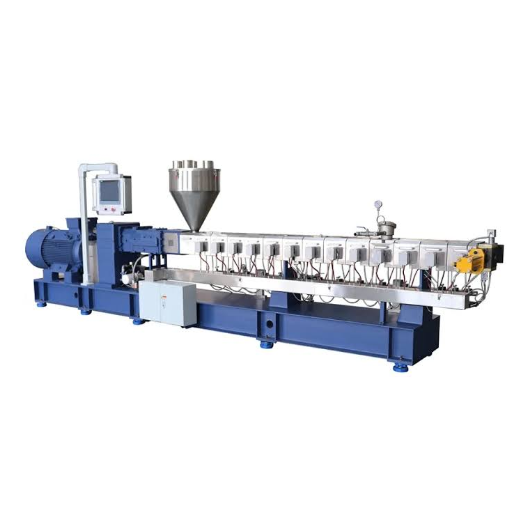
Twin Screw Extruder Working Principle: How It Works, Zone by Zone

A twin screw extruder works by forcing raw ingredients through a heated barrel with two intermeshing, co-rotating screws. As the material travels through five zones, feeding, melting, mixing, venting, and discharge, the screws apply shear, pressure, and heat that cook, plasticize, and shape it before it’s pushed through a die.
Most people never see that process happen. It runs inside a sealed steel barrel in a matter of seconds. And for a lot of plant operators, that’s exactly the problem: an extruder that “just works” is also a black box you can’t fix when it stops working.
You’ve probably stood at the end of the line, watching puffs come out uneven, and wondered whether the issue is temperature, moisture, or screw speed. You’re not wrong to wonder. A twin screw extruder doesn’t cook by magic, it cooks through a repeatable sequence of physical forces you can learn, measure, and control.
This guide walks you through that sequence, zone by zone, in plain language. By the end, you’ll be able to picture what’s happening inside the barrel, name the forces at work, and see why two screws do what a single screw can’t.
Key Takeaways
- A twin screw extruder moves ingredients through five zones, feeding, melting, mixing, venting, and discharge, in a matter of seconds.
- Two intermeshing, co-rotating screws wipe each other clean, which eliminates dead zones and speeds changeover and cleaning.
- Water is not just an ingredient; it acts as a plasticizer that melts starch into an amorphous, formable mass at roughly 10–25% moisture.
- Heat comes from two sources, mechanical shear and barrel heating, and the balance between them changes how the product cooks.
- Specific Mechanical Energy (SME) is the single most useful number for dialing in consistent product quality.
What Is a Twin Screw Extruder?
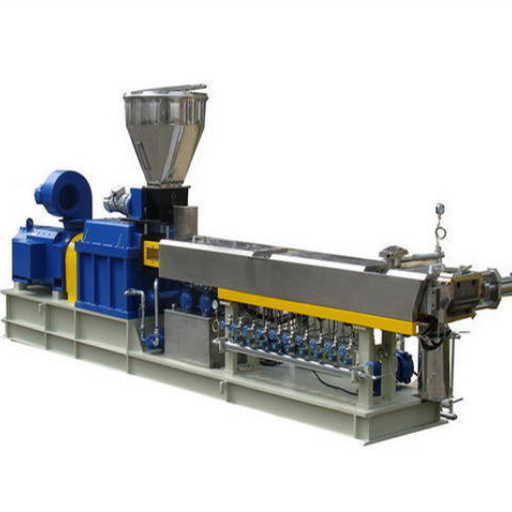
A twin screw extruder is a continuous processing machine that cooks, mixes, and shapes food using two rotating screws inside a temperature-controlled barrel. Think of it as a high-pressure, high-shear cooking tunnel that turns dry powders and liquids into a hot, formable dough in seconds.
The machine has a handful of parts that matter:
- The barrel, a segmented steel cylinder that holds the material and acts as a heat exchanger.
- Two intermeshing screws, the heart of the machine. They convey the material forward while shearing and mixing it.
- The gearbox and drive, delivers torque to both screws in precise synchronization.
- The feeder, meters dry ingredients into the barrel at a controlled rate.
- Heating and cooling zones, temperature control along the barrel’s length.
- The die, the shaped opening at the end that gives the product its final form and builds back-pressure.
- The cutter, a rotating knife that slices the extrudate into pieces as it exits.
What separates a twin screw from a single screw is the second screw. Two intermeshing screws can pump, mix, and cook a far wider range of materials, from fine flour to coarse granules, and from low-fat to high-protein, high-fat recipes. That flexibility is why the twin screw extruder machine guide calls it the workhorse of modern food extrusion.
Want to see this machinery in a real production line? Explore our food extrusion solutions to understand how these principles scale to industrial output.
The Twin Screw Extruder Working Principle: 5 Processing Zones
Here’s the core of the twin screw extruder working principle. The barrel isn’t one uniform space, it’s a series of five zones, each with a specific job. Understanding these zones is what turns a “black box” into a process you can control.
- Feeding and preconditioning
- Plasticizing and melting
- Mixing and homogenizing
- Venting and degassing
- Discharge and shaping
Zone 1: Feeding and Preconditioning
The process starts before the barrel. Dry ingredients are metered into the feeder, and often into a preconditioning cylinder first. There, steam and water are blended into the dry mix so every particle reaches a uniform temperature and moisture level.
Why does this matter? Because moisture has to be even before cooking starts. If some particles are wetter than others, they’ll cook at different rates, and you’ll see it later as inconsistent density and texture.
Priya, a shift supervisor at a snack plant, learned this the hard way. Her corn puffs kept coming out with alternating light and dense sections, and her team chased barrel temperatures for a week with no luck. The real culprit was upstream: the steam nozzle in the preconditioner had partially clogged, so moisture wasn’t reaching the mix evenly. Once they cleaned the nozzle, the puffs snapped back to uniform. The lesson stuck with her, “fix the feed first” became her default first step.
Zone 2: Plasticizing and Melting
Once inside the barrel, the material enters the cooking zone. Here, mechanical shear from the rotating screws and heat from the barrel work together to melt the ingredients.
This is where the chemistry happens. Heat and shear break down the crystalline structure of starch and turn it into an amorphous, melted mass, a process called gelatinization. In simple terms, the starch granules absorb water, swell, and lose their rigid structure, becoming a hot, sticky dough.
The material near the end of this zone often turns translucent. That’s your visual cue that cooking is nearly complete. If it doesn’t turn translucent, the melt isn’t fully cooked, a sign you may need more heat, more shear, or more moisture.
Zone 3: Mixing and Homogenizing
After melting, the dough passes through a section of the screws designed specifically for mixing. This is where kneading blocks and mixing elements take over.
These elements don’t just move material forward. They cut, fold, and stretch it, dispersing fats, flavors, colors, and additives evenly throughout the melt. For a fortified snack or a high-meat pet food, this zone is what distributes ingredients uniformly, so every bite delivers the same nutrition and flavor.
Zone 4: Venting and Degassing
As the dough cooks, moisture turns to steam. In many recipes, some of that steam needs to escape, or the final product will be too wet or expand unevenly.
The venting zone is a pressureless section of the barrel, often with an opening to the atmosphere. Here, volatile compounds and excess moisture vent out. The key detail: pressure only builds in the “filled” sections of the screws, before the die and before kneading blocks. The venting zone sits in a partially-filled section, so it can release steam without pushing material out the vent.
Zone 5: Discharge and Shaping at the Die
Finally, the cooked, mixed melt reaches the die, the shaped opening at the end of the barrel. The die does two things at once: it shapes the product and it creates back-pressure.
That back-pressure is crucial. It’s what keeps the material under pressure until the final instant. For puffed snacks, the melt is superheated and pressurized right up to the die face. The moment it exits, the pressure drops and the moisture flashes to steam, inflating the product into a puffed structure.
The shape and size of the die opening, combined with that pressure drop, determine expansion and texture. Smaller openings build more back-pressure. Tapered openings produce smoother surfaces with less damage. This is where a recipe’s final form is decided.
How the Two Screws Interact: Intermeshing and Self-Wiping
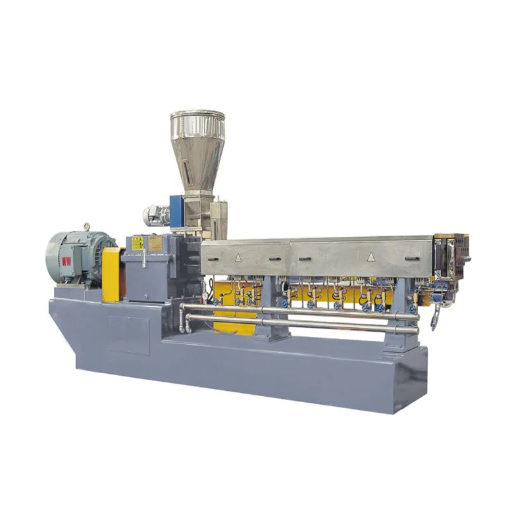
The reason a twin screw extruder can do all of this in seconds comes down to how the two screws fit together.
In a co-rotating twin screw extruder, both screws turn in the same direction and intermesh, the flight of one screw sits in the channel of the other. This geometry creates something called self-wiping action: as each screw rotates, it continuously scrapes the other screw clean.
That self-wiping action has real, practical consequences:
- No dead zones, material can’t sit stagnant in a corner and over-cook or burn.
- Faster changeover, switching from one product to another takes less time because there’s less residue to clean out.
- Tighter residence time control, every particle spends a predictable amount of time in the barrel, which means more consistent cooking.
Mike, who runs a pet food line in Texas, saw this in action when he moved from a single screw to a twin screw. His team made high-meat kibble with 45% fresh chicken, and the single screw kept smearing and clogging on the high-fat recipe. The twin screw’s self-wiping action and superior mixing meant the fat stayed dispersed instead of sticking to the flights. Changeover between recipes dropped from hours to under an hour.
The interaction between screws also explains where pressure lives. In a twin screw extruder, only some sections of the barrel are fully filled with material. Those filled sections build pressure. The partially-filled sections don’t. Designers use this deliberately, placing pressureless zones for venting or for adding a second ingredient mid-barrel. For a deeper look at rotation direction and geometry, see our single screw vs twin screw extruder comparison.
The Four Forces Inside the Barrel: Temperature, Pressure, Moisture, and Shear
Strip away the machinery, and a twin screw extruder is a system of four interacting forces. Master these, and you master the machine.
Moisture as a Plasticizer
Water does more than hydrate. It acts as a plasticizer, a substance that softens starch and protein and lowers the energy required to melt them. Most food extrusion runs at roughly 10–25% moisture, though some formulas go up to about 28%.
Here’s the practical takeaway: the more moisture in the recipe, the less mechanical energy you need to cook it. Dry, low-moisture recipes demand more shear and more heat. Wet recipes need less. Getting this balance right is what separates a smooth-running line from one that over-torques the motor or produces a gritty, undercooked product.
Heat and Shear Working Together
Heat in a twin screw extruder comes from two sources, and they’re very different:
- Mechanical energy, generated by the screws themselves through viscous dissipation and friction. High-viscosity, high-protein materials rely mostly on this.
- Thermal energy, supplied by barrel heating, or by steam injected directly into the barrel. High-moisture, low-viscosity, or high-fat materials lean more on this.
The balance between these two is a tuning knob. Injecting steam into a partially-filled section can dramatically cut the mechanical energy the drive has to deliver, which reduces wear on the screws and gearbox.
Pressure Profile Along the Screw
Pressure doesn’t build evenly along the barrel. It spikes only in the filled zones, right before the die, and before any pressure-consuming element like a kneading block.
Why this matters: it means you can have a pressureless section mid-barrel for venting or for adding a second ingredient, without losing pressure where you actually need it at the die. Understanding this profile is what lets engineers add a flavor, a color, or a second powder at exactly the right point.
Specific Mechanical Energy (SME)
If you remember one technical term from this article, make it Specific Mechanical Energy (SME). SME measures how much mechanical work the screws perform per unit of product, typically expressed in watt-hours per kilogram (Wh/kg).
SME is the single most useful number for reproducing a product consistently. When you know the SME that gives you the right density and texture, you can hold that target across shifts, machines, and even plants. If product quality drifts, your first diagnostic question should be: has the SME changed? For more on how screw geometry shapes SME, see our twin screw extruder machine guide.
From Ingredient to Product: What Happens to Different Foods
The same five zones produce very different results depending on the recipe. Here’s how the working principle plays out across four common products.
Puff Snacks: Expansion at the Die
For corn puffs and similar snacks, everything builds toward a single moment at the die. The melt is cooked and superheated under pressure. The instant it exits, moisture flashes to steam and inflates the product. The degree of expansion depends on moisture content, die geometry, and the temperature-pressure balance, which is why Zone 5 gets so much attention in snack production.
High-Meat Pet Food: Mixing High-Protein, High-Fat Recipes
High-meat kibble is a mixing challenge first. Fresh meat is high in moisture and fat, and it tends to smear rather than blend. The twin screw’s intermeshing, self-wiping geometry keeps that fat dispersed and moving, while the mixing zone distributes it evenly through the starch. It’s the wider moisture window, from roughly 6% to 50%, that lets a twin screw handle a recipe a single screw would simply choke on.
Modified Starch: Precise Gelatinization Control
Modified starch production is all about hitting a precise viscosity and degree of gelatinization. That requires tight control over temperature and shear, which is exactly what SME measures. By holding a specific SME target, producers make a consistent pre-gelatinized starch for convenience foods. Learn more in our modified starch extruder machine overview.
Breakfast Cereal: Cooking and Shaping in One Pass
Breakfast cereal shows off the twin screw’s efficiency. Cooking, mixing, and shaping happen in a single continuous pass, then the cut pieces move on to drying. That continuous flow is why extrusion lines can hit the high throughputs cereal production demands.
The R&D team at a cereal startup used SME to solve a nagging problem. Their flakes kept coming out either too hard or too fragile, and they couldn’t reproduce the good batches. By logging SME for every run, they found the sweet spot, 240 Wh/kg, and locked it in. After that, batch-to-batch variation all but disappeared. “We stopped guessing and started measuring,” their process engineer said.
Ready to see how a twin screw extruder fits your specific recipe? Request a custom extrusion analysis and we’ll help you dial in the parameters.
Twin Screw vs Single Screw: Why the Mechanism Matters
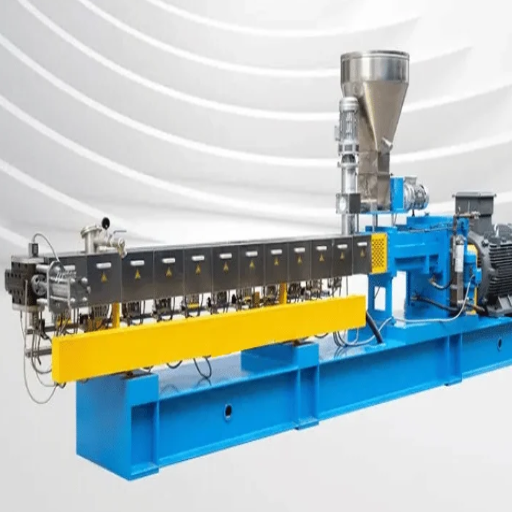
The twin screw extruder working principle is worth understanding partly because it explains why two screws outperform one for complex foods.
A single screw relies mainly on friction between the material and the barrel wall to move product forward. That works for simple, high-starch, free-flowing recipes, basic corn curls, for example. But it struggles with high-protein, high-fat, or high-moisture formulas.
A twin screw doesn’t rely on that barrel friction. The two intermeshing screws actively pump and mix the material, which means:
- A wider moisture window, roughly 6–50%, versus 12–35% for single screw.
- Better mixing, kneading blocks and self-wiping action disperse ingredients evenly.
- Faster, more consistent cooking, more controlled shear and residence time.
| Factor | Single Screw | Twin Screw |
|---|---|---|
| Moisture range | 12–35% | 6–50% |
| Mixing | Friction-driven, basic | Kneading blocks, superior |
| Best for | Simple, high-starch products | Complex, high-protein and high-fat recipes |
| Changeover | Slower | Faster (self-wiping) |
| Capital cost | Lower | Higher |
None of this makes single screw “wrong.” For a simple product at lower volume, single screw is often the right, more economical choice. But when the recipe gets complex, the twin screw’s mechanism is what makes it possible. For the full decision framework, see our single screw vs twin screw extruder guide.
Frequently Asked Questions
How does a twin screw extruder work?
A twin screw extruder works by conveying ingredients through a heated barrel with two intermeshing, co-rotating screws. The screws apply shear and pressure that cook and plasticize the material as it passes through feeding, melting, mixing, venting, and discharge zones before being forced through a shaping die.
What is the working principle of a twin screw extruder?
The working principle is continuous cooking and shaping under controlled shear, pressure, temperature, and moisture. Two intermeshing screws convey the material while kneading blocks and the die build pressure, converting raw ingredients into a cooked, formable melt.
What are the five zones of a twin screw extruder?
The five zones are feeding, plasticizing (melting), mixing, venting (degassing), and discharge (shaping at the die). Each zone has a distinct function in the cooking process.
What is self-wiping in twin screw extrusion?
Self-wiping is the action where each intermeshing screw scrapes the other clean as they rotate. It eliminates dead zones, prevents material from burning, and speeds up changeover between products.
What is the difference between co-rotating and counter-rotating twin screw extruders?
In co-rotating extruders, both screws turn in the same direction and are favored for mixing and cooking food. In counter-rotating extruders, the screws turn in opposite directions and can act as a positive displacement pump, useful for different material-handling needs.
Conclusion
The twin screw extruder working principle isn’t magic, it’s a repeatable sequence of five zones, driven by four forces you can measure and control.
To recap what matters most:
- Five zones, feeding, melting, mixing, venting, and discharge, transform raw ingredients in seconds.
- Intermeshing, self-wiping screws eliminate dead zones and speed changeover.
- Water is a plasticizer that controls how much energy your recipe needs.
- SME is the number that lets you reproduce quality consistently.
When you understand the mechanism, you stop reacting to problems and start preventing them. That’s the difference between running a black box and running a process.
If you’re evaluating twin screw extrusion for your line, or you want to optimize the parameters on an existing machine, we’re here to help. Contact Shandong Loyal for a consultation, and let’s put these principles to work on your product.