
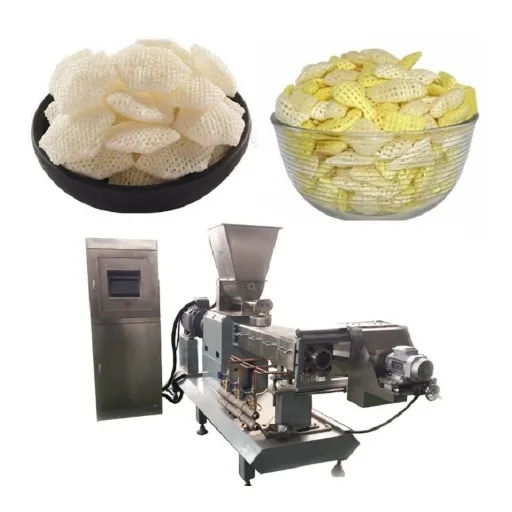
2D 3D Pellet Production Line: Complete Guide to Equipment, Process & Selection

A 2D 3D pellet production line is an automated manufacturing system that produces semi-finished snack pellets in flat (2D) or three-dimensional (3D) shapes, which are later fried, baked, or hot-air puffed into finished crispy snacks. Choosing the right line means balancing equipment complexity, production capacity, operating costs, and the product shapes your market demands.
Last year, a snack producer in Nairobi told us they had spent eight months trying to decide between a 2D line and a 3D line. Their sales team wanted eye-catching bugles and shells for premium retail shelves. Their finance team wanted the lower capital outlay of a flat-pellet system. The real problem? They could not find a single guide that explained the engineering and economics in plain terms. Most manufacturer pages listed equipment; almost none explained how to choose. This guide solves that problem.
By the end, you will understand how a 2D 3D pellet production line works, what equipment you actually need, how 2D and 3D systems differ in cost and output, and how to select a configuration that fits your product goals and budget.
Key Takeaways
- A 2D 3D pellet production line turns starches and flours into stable, semi-finished pellets that expand 3–4× during final frying or hot-air puffing.
- 2D lines suit high-volume, flat products like rings and wheels; 3D lines create premium bugles, shells, and hollow shapes with higher margins.
- Typical investment ranges from 100,000–100,000–200,000 for a 2D line and 250,000–250,000–500,000 for a 3D line, before ancillary equipment.
- Key process parameters include 20–25% moisture after extrusion, 8–10% after drying, and frying near 190°C for proper expansion.
- Buyers should evaluate total cost of ownership, supplier support, food-safety compliance, and modular upgrade paths, not just sticker price.
What Are 2D and 3D Pellet Snacks?
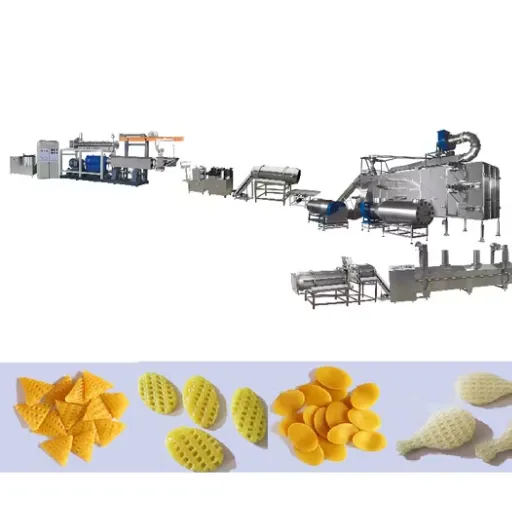
Pellet snacks are intermediate, shelf-stable products made from starch-based dough. Food manufacturers often call them half-products because they are not eaten straight from the snack pellet production line. They are dried, packed, and later expanded by the end-user or at a second processing stage.
What is a 2D Pellet Snack?
A 2D pellet snack is a flat, single-layer product. Common shapes include wheels, stars, rings, strips, squares, flakes, and sala chips. These pellets are extruded through a simple die plate and cut at the die face. Because the forming process is straightforward, 2D lines generally run faster and require less complex tooling. For detailed flat-pellet equipment, throughput optimization, and lower-CapEx configurations, read our 2D pellet snack production line guide.
What is a 3D Pellet Snack?
A 3D pellet snack has depth, texture, and visual complexity. Think of bugles, cones, shells, spirals, pillows, goldfish, flowers, tennis-racket shapes, and hollow pani puri balls. Many 3D shapes are created by pressing two sheets of dough together and cutting them at the edges, or by using advanced multi-layer dies. The result is a product that looks premium on the shelf and can command a higher retail price. For full details on 3D-specific equipment, compound shaping, and die libraries, see our 3D pellet snack production line guide.
Why “Half-Products” Matter
The half-product model gives snack businesses two big advantages. First, dried pellets are dense and stable, so they are cheap to ship and store. Second, the final expansion step can happen close to the consumer market, which means fresher products and lower logistics costs. For exporters in particular, this is a major benefit.
How a 2D 3D Pellet Production Line Works
A complete snack pellet line follows a consistent process flow, though the exact configuration changes depending on whether the final product is fried, baked, or air-puffed.
Standard Process Flow
- Raw material mixing, Starches, flours, water, and additives are blended to a uniform dough.
- Screw conveyor feeding, The dough is transported into the extruder at a controlled rate.
- Extrusion, Heat, shear, and pressure cook the starch and form the pellet.
- Shaping and cutting, Dies, rotary cutters, or compound shapers create the desired form.
- Pre-drying, Moisture drops from roughly 20–25% to 8–10%.
- Final expansion, Pellets are fried at ~190°C or puffed with hot air.
- De-oiling, Excess oil is removed from fried products.
- Seasoning, Flavors and coatings are applied evenly.
- Cooling and packaging, Products are cooled and packed for distribution.
Critical Process Parameters
Getting these numbers right separates a profitable line from a line that wastes raw material and energy:
| Stage | Parameter | Typical Target |
|---|---|---|
| Mixing | Dough moisture | 25–30% |
| Extrusion | Product temperature | 90–120°C |
| Post-extrusion | Pellet moisture | 20–25% |
| Drying | Temperature | 45–60°C |
| Drying | Time | 3–5 hours |
| Finished pellet | Moisture | 8–10% |
| Frying | Oil temperature | ~190°C |
| Expansion | Size increase | 3–4× |
When Ravi Sharma, a production manager at a Mumbai-based fryums company, upgraded his line, the biggest improvement came from tightening drying controls. His old dryer ran hot and fast, which caused case-hardening. The surface looked dry, but the interior retained too much moisture. When the pellets hit the fryer, they expanded unevenly and cracked. After switching to a low-temperature, multi-zone dryer and holding 45–60°C for the full cycle, his rejection rate fell from 12% to under 4%.
Single-Screw vs Twin-Screw Extrusion
The extruder is the heart of any 2D 3D pellet production line. The two main types serve different needs:
- Single-screw extruders are simpler, less expensive, and well-suited to 2D pellets made from standard wheat or potato starch formulations.
- Twin-screw extruders offer better mixing, higher shear control, and greater flexibility for 3D shapes, multi-layer products, and non-standard recipes such as high-protein or gluten-free doughs.
For a detailed equipment comparison, torque curves, and die-design considerations, see our pellet snack extruder machine selection guide.
Frying vs Hot-Air Expansion
Traditionally, pellets are expanded by frying in a continuous fryer. This gives the crispiest texture and the fastest throughput. However, health-conscious consumers are driving demand for lower-fat snacks. Hot-air expansion uses heated air instead of oil to puff the pellet. It produces a lighter product with less fat, though the texture and shelf life differ from fried snacks.
If you plan to market baked or air-puffed lines, make sure your dryer and seasoning systems are configured for lower-oil products. For more on drying and sterilization equipment, explore our industrial microwave drying solutions.
2D vs 3D Pellet Production Line: Key Differences
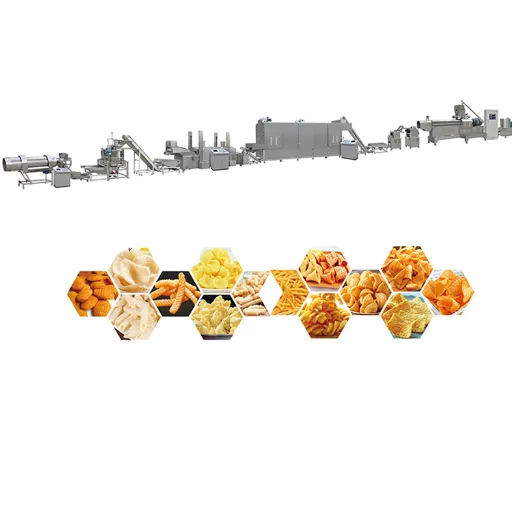
The choice between 2D and 3D production is not about which technology is “better.” It is about which technology matches your market, margin goals, and capital budget.
Side-by-Side Comparison
| Factor | 2D Line | 3D Line |
|---|---|---|
| Shapes | Flat rings, wheels, stars, strips, squares | Bugles, cones, shells, spirals, pillows, hollow balls |
| Extruder | Single-screw usually sufficient | Twin-screw preferred |
| Forming | Simple die-face cutting | Compound shaping, multi-layer dies, edge sealing |
| Speed | 300–400 kg/h typical | 200–300 kg/h typical |
| Energy use | 20–30% lower | 30–50% higher |
| Initial investment | 100,000–100,000–200,000 | 250,000–250,000–500,000 |
| Maintenance | ~20% lower | 10–15% higher |
| Product margin | Standard | 20–30% premium potential |
When to Choose a 2D Line
Choose a 2D line when you need high throughput, lower capital outlay, and proven demand for flat snacks. 2D lines are ideal for commodity markets, private-label contracts, and regions where price sensitivity dominates. They are also easier to operate and maintain, which matters if skilled technicians are scarce.
When to Choose a 3D Line
Choose a 3D line when you want product differentiation, premium positioning, or entry into markets that reward novelty. 3D shapes stand out on retail shelves and offer better seasoning adhesion because of their complex surfaces. The higher equipment cost is often offset by higher selling prices and stronger brand recognition.
When to Consider a Hybrid Line
Some manufacturers need both. A modular 2D 3D pellet production line can switch between flat and dimensional products by changing dies, cutters, and shaping attachments. This flexibility costs more upfront than a pure 2D line but less than buying two separate lines. It is a strong option for contract manufacturers or businesses testing new product categories before committing to a dedicated 3D system.
Core Equipment in a Snack Pellet Production Line
Every 2D 3D pellet production line is a system, not a collection of standalone machines. If one stage is undersized or poorly controlled, it constrains the entire pellet snack production line.
Mixer and Screw Conveyor
The mixer blends starches, flours, water, and additives into a uniform dough. Consistency here directly affects extrusion stability. A screw conveyor then feeds the dough into the extruder at a steady rate. Variable frequency drives on both units help match throughput to downstream capacity.
Extruder and Shaping Systems
The extruder cooks and forms the dough. For 3D products, a compound shaping machine may press two dough sheets together before cutting. Die inserts determine the final shape, and quick-change die systems reduce changeover time between products. Food-grade materials and polished surfaces are essential for hygiene and easy cleaning.
Dryer and Cooling Conveyor
Drying is where many lines fail. A multi-layer belt dryer with independent temperature zones gives better control than a single-pass unit. The goal is to remove moisture gently without creating surface cracks. After drying, pellets pass through a cooling conveyor to stabilize them before storage or packaging.
For buyers focused specifically on drying, our technical team can advise on dryer specifications as part of the overall line design.
Fryer, De-Oiler, and Flavoring Drum
If the final product is fried, a continuous fryer with automatic oil-level and temperature control is standard. A vibratory de-oiling conveyor removes excess surface oil. The flavoring drum then applies powders or oil-based seasonings evenly. For baked lines, the fryer is replaced by a hot-air expansion chamber.
Packaging and Auxiliary Systems
Auxiliary equipment includes metal detectors, check-weighers, conveyors, and vertical form-fill-seal packaging machines. Dust collection and explosion protection for starch handling are also critical, especially in large plants.
How to Choose the Right 2D 3D Pellet Production Line
Equipment selection should follow a structured decision process. Skipping steps leads to mismatched capacity, hidden costs, and buyer’s remorse.
Define Your Product Portfolio
Start with the end product. Which shapes do you want to sell in year one? Which shapes might you add in years two and three? If your portfolio is mostly flat products with occasional 3D trials, a modular 2D line with upgradeable 3D attachments may be enough. If premium 3D shapes are central to your strategy, invest in a twin-screw 3D line from the start.
Match Capacity to Demand
Capacity planning is about more than peak output. Consider:
- Current demand and forecasted growth
- Operating shifts per day
- Product mix and changeover frequency
- Downtime for cleaning and maintenance
A line that is too small creates bottlenecks. A line that is too large wastes capital and energy. Most experienced buyers size for 80% utilization at projected year-two demand.
Evaluate Total Cost of Ownership
The purchase price is only part of the equation. A useful total-cost-of-ownership framework includes:
| Cost Category | What to Include |
|---|---|
| Capital expense | Equipment, shipping, installation, commissioning |
| Energy | Electricity for extruder, dryer, fryer, and auxiliary systems |
| Labor | Operators, maintenance staff, quality control |
| Consumables | Oil, seasonings, wear parts, dies, and molds |
| Maintenance | Scheduled service, spare parts, unexpected repairs |
| Downtime | Lost production during changeovers or breakdowns |
A low-priced line with poor energy efficiency and expensive spare parts can cost more over five years than a higher-priced, well-engineered system. For detailed cost ranges by capacity, hidden-cost warnings, and ROI calculation examples, see our snack pellet production line price breakdown.
Verify Supplier Capabilities
Ask potential suppliers specific questions:
- Can they provide recipe support and operator training?
- What is their spare-parts lead time?
- Do they offer on-site installation and commissioning?
- What food-safety certifications do they hold?
- Can they show running references for products similar to yours?
At Shandong Loyal Industrial, we typically provide on-site commissioning, recipe guidance, and lifetime technical support. Our lines are built with food-safe SUS 304 stainless steel and designed for easy cleaning and maintenance. If you are comparing options, explore our 2D 3D pellet production line and request a detailed quotation tailored to your product goals.
RFP Checklist for Equipment Buyers
Use this checklist when requesting proposals:
- Required capacity range (kg/h)
- Product shapes and sizes
- Raw material specifications
- Power supply and utility requirements
- Floor space and layout constraints
- Automation level desired (manual, semi-automatic, fully automatic)
- Compliance requirements (CE, FDA, FSSAI, etc.)
- Warranty and after-sales support terms
- Delivery and commissioning schedule
- Training program for operators and maintenance staff
Popular Product Applications for a 2D 3D Pellet Production Line
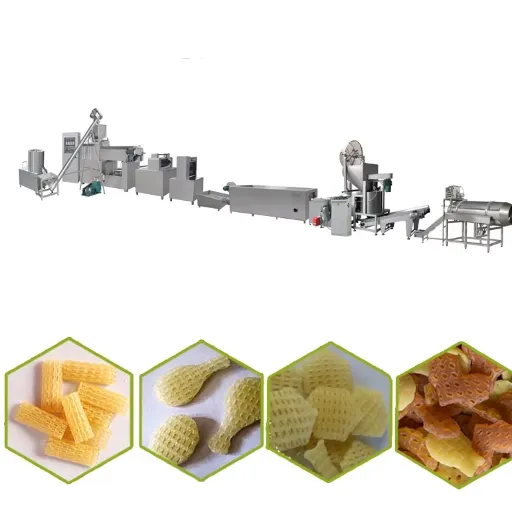
One of the strengths of a 2D 3D pellet production line is its versatility. The same core line can produce a wide range of snack categories by adjusting recipes, dies, and processing parameters.
Fryums and Papad
Fryums are popular in India, the Middle East, Africa, and Southeast Asia. These dried pellets expand quickly when deep-fried and are seasoned with spices, salt, or chili. Papad and similar flat products are typically 2D, while some shaped fryums use 3D dies for visual appeal. If fryums are your target market, our fryums production line guide covers raw-material formulations, regional seasoning profiles, and B2B export packaging strategies.
Bugles and 3D Cones
Bugles are cone-shaped corn snacks with a distinctive crunch. They require a 3D cone-forming die and careful control of dough moisture and expansion temperature. Because of their unique shape, bugles often command premium shelf placement. For cone-forming die specifications, capacity tables, and seasoning adhesion tips specific to bugles, see our bugles snack production line guide.
Pani Puri / Golgappa
Pani puri pellets are small, hollow, spherical shells that puff into light, crispy balls when fried. The wall thickness must be uniform; otherwise, the shells crack or fail to inflate. This application is a good example of where 3D compound shaping and precise moisture control are essential. For wall-thickness targets, frying parameters, and packaging options specific to golgappa production, read our pani puri pellet making machine guide.
Prawn Crackers and Sala Chips
Prawn crackers and sala chips are regional favorites that use tapioca or potato starch as the base. These products can be 2D or lightly embossed and are often sold dried for home frying or as ready-to-eat snacks.
If you are entering the snack business, our fried snack production line portfolio covers a wide range of extruded and fried products beyond pellets.
Market Trends and Growth Outlook
The snack pellet industry, and demand for the 2D 3D pellet production line in particular, is growing steadily. This growth is driven by urbanization, convenience snacking, and product innovation.
Global Market Size
According to Market Research Future and Future Market Insights, the global snack pellets market was valued at approximately USD 3.35 billion in 2025 and is projected to grow at a compound annual growth rate of 4.3–5.8% through the mid-2030s. The snack pellet equipment market is expanding in parallel, supported by automation upgrades and new plant investments in Asia-Pacific, Africa, and the Middle East.
Health and Better-for-You Snacks
Consumer demand for lower-fat, oil-free, and clean-label snacks is pushing manufacturers toward hot-air expansion and baked pellet technologies. Searches for oil-free snack options have risen sharply, and brands are responding with multigrain, legume-based, and high-protein formulations.
Automation and Industry 4.0
Modern 2D 3D pellet production line systems increasingly use PLC-based control systems with touchscreen HMIs, recipe storage, and remote diagnostics. These features reduce operator error, shorten changeover times, and make it easier to maintain consistent quality across shifts.
Regional Growth Patterns
Europe holds a large share of the mature snack pellet market, while Asia-Pacific is the fastest-growing region. India, China, Southeast Asia, and parts of Africa are seeing strong demand for both local snack formats and export-ready pellet half-products.
Compliance, Safety, and Operational Best Practices
A 2D 3D pellet production line must meet food-safety, worker-safety, and environmental standards. Ignoring these areas can lead to product recalls, fines, or production shutdowns.
Food Safety Standards and Materials
All food-contact surfaces should be made from food-safe stainless steel, typically SUS 304 or SUS 316. Equipment should be designed for clean-in-place or easy disassembly. Relevant standards include HACCP, ISO 22000, FDA regulations for the U. S. market, CE marking for Europe, and FSSAI compliance for India.
Dust Explosion Prevention
Starch and flour dust are combustible. Facilities must have proper dust collection, grounding, and explosion venting. Electrical equipment in dusty zones should carry the appropriate hazardous-area rating. Operator training on dust hazards is not optional.
Maintenance and Operator Training
A well-maintained line lasts longer and produces more consistent product. Create preventive maintenance schedules for the extruder screws, die plates, dryer belts, fryer oil, and seasoning drums. Train operators on startup and shutdown sequences, recipe changes, and emergency stops.
Energy Efficiency and Sustainability
Energy is a major operating cost. Look for lines with variable frequency drives, insulated dryers, and oil-filtration systems that extend frying oil life. Water recycling and scrap-recovery systems can further reduce waste and environmental impact.
Frequently Asked Questions
What are 2D and 3D pellet snacks?
2D and 3D pellet snacks are semi-finished, starch-based products that are dried for storage and later expanded by frying or hot-air puffing. 2D pellets are flat shapes such as rings and wheels. 3D pellets have complex shapes such as bugles, shells, and hollow balls.
What equipment is needed for a snack pellet production line?
A standard line includes a mixer, screw conveyor, extruder, shaping and cutting system, dryer, fryer or hot-air expansion chamber, de-oiler, flavoring drum, cooling conveyor, and packaging equipment. Dust collection and safety systems are also required.
How much does a 2D 3D pellet production line cost?
A 2D line typically ranges from 100,000to100,000to200,000. A 3D line usually costs between 250,000and250,000and500,000. Full turnkey installations with high automation, large capacities, and auxiliary systems can exceed $800,000.
What is the production capacity of a pellet snack line?
Small lines produce 80–120 kg/h. Medium lines produce 200–300 kg/h. Large industrial lines can reach 300–800 kg/h or more, depending on product density and equipment configuration.
What raw materials are used in snack pellet production?
Common raw materials include potato starch, corn starch, cassava starch, wheat flour, rice flour, water, and additives such as salt, colorants, and modified starches. Specialty products may use quinoa, chickpea flour, pea protein, or vegetable powders.
Can one line produce both 2D and 3D pellets?
Yes. Modular 2D 3D pellet production lines can switch between flat and dimensional products by changing dies, cutters, and shaping attachments. This flexibility is useful for contract manufacturers and businesses testing new products.
Conclusion
A 2D 3D pellet production line is a major capital investment, but it is also a gateway to one of the most dynamic segments in snack manufacturing. The right line lets you produce stable, export-friendly half-products that expand into crispy, appealing snacks.
Before you buy, clarify your product portfolio, forecast real capacity needs, and evaluate total cost of ownership rather than just purchase price. Pay close attention to drying control, extruder selection, and supplier support. And do not overlook compliance, dust safety, and operator training. Whether you need a snack pellet production line for commodity flat products or a pellet snack production line for premium 3D shapes, the right configuration depends on your market, budget, and growth plans.
If you are ready to move from research to specification, contact our team at Shandong Loyal Industrial for a tailored proposal. We will help you match the right 2D 3D pellet production line to your product goals, budget, and growth plans.