
Food Manufacturing Process: A Complete Guide to Industrial Production
food manufacturing process encompasses the conversion of raw agricultural ingredients into ready-to-eat packaged items through seven primary stages: intake and preprocessing, blending and logistic, heat treatment, molding and structuring, dehydration and chilling, preprocessing and finalizing, and wrapping with requisite inspections. Every phase of the process requires dedicated tools, control parameters, and regulations that those in the food business strictly adhere to.
The recent development has come under scrutiny following what appears to be a short statement. Nevertheless, in 2023, when Rahul went all out to set a snacks factory in Pune, he realized the difference between theories and reality. He bought a twin-screw extruder, but he did not appreciate the effect of preconditioning temperatures on their starch profile. The initial production batches tormented him with inflationary expansion rates. The production rate was swinging by approximately 30%. The distributor was unable to supply for about a month and a half due to re-adjustment of the equipment.
In fact, it is the story understood by every food processing company anywhere in the world and not just in his case. The idea behind it is clear to all. However, it is hard to link each stage with an appropriate equipment setup and ascertaining the recipe dimensions and scale up pathway.
Well, thanks to this guide, this is no longer an issue. Precisely, these operations involved in industrial food manufacturing process will be explained as per each stage. The limitations of the types of equipment used, the benefits of these equipment, the downside of these equipment and why some of them cannot be used will be clear as well. Thereafter, overheads and benefits of expanding all or sections of the existing production line will also be explained.
Key Takeaways
- Industrial food manufacturing follows seven distinct stages from raw material to packaged product, and each stage requires specific equipment and parameter control.
- Batch processing suits small-scale and specialty production, while continuous processing maximizes throughput and consistency for high-volume operations.
- Recipe requirements directly drive equipment selection; moisture content, protein ratios, and starch profiles determine mixer, extruder, and dryer specifications.
- Modular production line design allows manufacturers to start at current capacity and expand without replacing core equipment.
- Automation integration at the mixing, processing, and packaging stages typically delivers 20–40% labor cost reduction alongside 15–30% throughput gains.
What Is the Food Manufacturing Process?
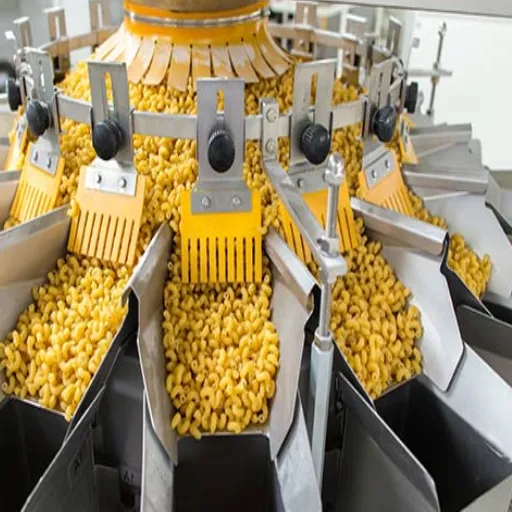
In the food manufacturing process, the food products are created from raw agricultural materials with the help of mechanical, thermal, and chemical operations in a controlled environment. This includes for instance grain milling, snack extrusion, pasta and noodle forming, drying of pet foods and the list of food operations goes on.
Different manufacturers make use of two operational processes.
The batch process, which involves carrying out every stage for some amount of raw material before proceeding to the other stage. With batch processing, this allows production to remain easy and can handle any other change in the recipe. As an example, a craft nutrition bar manufacturer can mix 200kgs, shape it, bake it, and pack it before switching to the next batch.
All of the components are processed in succession in a continuous manner in continuous processing. Raw goods are handed off at one end while packed products are received at another end of the system. Principally in high-volume food manufacturing processes (snacks, pasta, and beverages) where speed and uniformity are critical. Understanding the food manufacturing process will guide the choice of equipment that suits a particular scope.
Every subsequent equipment is designed on the basis of batch or continuous operation.
Stage 1 — Raw Material Reception and Preparation in Food Manufacturing
Every food manufacturing process starts with ingredient quality. The finished product depends heavily on how you handle raw materials before they ever reach the mixer.
Sorting, Cleaning, and Grading
In moving raw materials onto the manufacturing line, it is quite difficult to prevent foreign matter and other defects from coming in, as well. Therefore, automated material handling solutions are equipped with optical, weight-based, and metal beam exclusion systems in order to remove impurities. In addition, they may incorporate washers for the removal of attached dirt as well as organisms. Graders are used to pull out the material based on dimensions, consistency, or even color, so the process cannot be interrupted further.
This also includes pre-milling, removing outer husk and germ for grains; washing and peeling as well as inspection for vegetables or fruits. Trimming, comminution or defatting is often necessary as a unit operation for protein ingredients like meat or soy before they reach the formulation stage.
Preprocessing
Each product undergoes its own type of prep. Cereals can undergo milling into certain mesh sizes or soaking in water to cause swelling of amylose and amylopectin. Vegetables, on the other hand, can be prepared by dicing/slicing/blanching them so as the color and consistency can be achieved. Proteins are very often grated/powdered or emulsified and in some cases, heat is applied to bind them better.
It is of paramount importance that the raw material and required particle size at the mixing stage match the used preprocessing equipment. Indeed, a pasta line requires durum flour of fine grinding. Potentially, coarse-ground grains and protein meals are incorporated in a pet food system. While in a snacks production line, pre-gelatinized starch is used in order to meet the extrusion time requirements. Fitting food production machinery is important at this step as it nips potential complications in the bud.
Omission of this important stage causes a chain of problems. Uneven particle distribution prevents uniform hydration. Any left-over material interferes with subsequent process equipment. And improper sanitation exposes products to recontamination which cannot be addressed at any other stage of the food manufacturing process.
Stage 2 — Mixing, Blending, and Formulation
Once prepared, ingredients come together according to precise recipes. This stage determines product identity in any food manufacturing process. A snack extrusion line and a pet food line may use similar equipment. But their formulation profiles make them entirely different operations.
Ingredient Proportioning and Homogenization
The Latest mixing technologies are sophisticated in that they utilize weighing devices and have the dosages interaction integrated into the system, so accuracy of each component can be attained. High shear mixers are used to form and compact micro ingredients or their combination with liquid. Such distribution of protein, starch and other compounds within a batch is what one aims at. The food industry has its own automated food production process. Raw material variation is addressed at the point of dosing, extruding, or baking.
Certain formulations warrant mixing stages. Initially, dry ingredients are mixed to allow for the uniform distribution of baking powder, coloring, microelements and other ingredients added at the liquid stage. Thereafter, the liquid components are brought in the desired moisture obtainment levels so as not to form boney or dry areas.
Recipe-Specific Adjustments for Consistent Quality
One of the factors in predicting the texture of the finished product relates to the moisture content at this moment. In pasta dough, the usual moisture content is between 28% and 32%. That of the pet food extrusion mixture is usually 22% to 26%. In snack formulating, moisture content distribution is extensive owing to expansion requirements. Mixing parameters on all of the options are variable so such uniform can be rated without remixes.
These are temperature concerns dispelled as well. The use of warm water or cold water may be preferential depending on the stages of starch hydrate formations yeasty. At times cold water may help in maintaining the integrity of the protein. Some food manufacturing process involve preconditioning, in other words steaming and heating the mixture partially before it is fed to the extruder. preconditions it partial cook, ensures less energy is used in extrusion and better product consistency.
Want to see how recipe precision translates to equipment configuration? Explore our food extrusion solutions to learn how twin-screw systems adapt to specific formulation profiles.
Stage 3 — Processing and Thermal Treatment
This is the transformation stage of the food manufacturing process. Raw mixed materials become recognizable food products through heat, pressure, and mechanical force.
Extrusion Cooking
The process takes place by extruding the material, putting it under the desired mechanical shear, pressure, and sometimes heat to operate the material in a continuous manner. This is well facilitated by twin-screw extrudes. The starch molecules are cooked through gelation, pressure causes the products to expand, and the die plates are used in the shaping of outputs. This is the same method used to produce breakfast cereals, extruded-puffed snacks, textured proteins, kibble, and extrusion.
The final products density, texture as well as appearance is further controlled by the screw profile, temperature of the barrel and the die configuration. Co-rotating intermeshing screws wipe themselves thus decreasing the amount of residue build-up and increasing the heat transfer performance. Single line extruder can produce more than one variation of products, simply by changing some of the parameters within the line in accordance with varying recipes.
Frying, Baking, and Roasting
Not all products are extruded before being cooked. Frying uses oil, and snacks fried in oil pass through endless fryers to be made crispy and of a certain color, which meets the specification. Depending on the capacity and the types of products, oil filtration systems, fryers, and heat exchanging systems or structures are in different shapes or sizes. Items such as bread and cake pass through tunnel ovens systems that have sections with different temperatures to prevent excessive hardening of the crust or moisture excessive penetration. The process of roasting in food items is commonly aimed at achieving flavor and moisture reduction by a dry heating method.
Pasteurization and Sterilization
Ready-to-eat products and liquid ingredients require pathogen control. Pasteurization reduces microbial load to safe levels. Sterilization eliminates virtually all microorganisms. Methods include high-temperature short-time (HTST) processing, ultra-high temperature (UHT) treatment, and microwave sterilization.
Each thermal method affects flavor, nutrition, and shelf life differently. Your product category and target market regulations dictate which approach fits. See how our industrial microwave systems support rapid sterilization with minimal thermal degradation.
Stage 4 — Forming, Shaping, and Cutting
After cooking or extrusion, products take their final physical form. Precision matters at this point in the food manufacturing process. Variations in size, weight, or shape create packaging problems and quality complaints.
Die Plates, Molds, and Cutters
Extruded products take shape as they pass through dies. Round, square, star, or custom profiles all come from interchangeable die plates. Rotary cutters slice continuous extrudate into consistent lengths using blade speed synchronized with line throughput. For pasta operations, sheeting and cutting rollers create specific noodle shapes from flat ribbons to intricate forms.
Mold-based forming serves biscuits, nutrition bars, and confectionery. Depositors drop measured portions into molds. Compression rollers press dough into shaped cavities. The mold surface finish affects release properties and product appearance.
Portion Control and Uniformity
Automated cutting and portioning systems use vision sensors and weight feedback to maintain tight tolerances. For nutrition bars or biscuits, this means every unit hits the target gram weight. For noodles, it means every strand maintains consistent length and cross-section.
Uniformity at this stage directly impacts packaging efficiency and customer satisfaction. Overweight products give away material. Underweight products trigger regulatory violations. Irregular shapes jam packaging machines and create poor shelf presentation.
Stage 5 — Drying, Cooling, and Stabilization
Freshly processed products carry heat and moisture that must be controlled before finishing and packaging. Inadequate drying or cooling in a food manufacturing process causes condensation, mold growth, and texture degradation.
Drying Technologies
Belt dryers move products through controlled temperature zones on perforated conveyors. Hot air circulates through the product bed, carrying away evaporated moisture. Fluidized bed dryers suspend particles in heated air for rapid, even moisture removal. And industrial microwave drying machines use electromagnetic energy to heat water molecules directly from the inside out. Microwave drying often reduces processing time by 50–75% compared to conventional hot-air methods.
Maria’s pet food production line in Mexico City ran its drying ovens on gas for three years. Her energy bills consumed 18% of production costs. After switching to an industrial microwave drying system, she cut drying time from 45 minutes to 12 minutes per batch. Energy costs dropped to 9% of production spend. Product moisture variance improved from plus-or-minus 2.5% to plus-or-minus 0.8%. The equipment paid for itself in 14 months.
Cooling and Moisture Control
Counter-flow coolers reduce product temperature while preventing moisture reabsorption. Ambient air moves opposite to product flow, maximizing heat exchange efficiency. Proper cooling halts the cooking process, stabilizes texture, and prepares products for coating or packaging.
Temperature and airflow must be balanced carefully. Too rapid cooling creates surface cracking. Too slow cooling allows bacterial growth in warm, moist conditions. Some products require staged cooling, where initial rapid temperature reduction gives way to gradual equilibration before packaging.
Stage 6 — Coating, Flavoring, and Finishing
This stage adds the sensory qualities that differentiate products on the shelf. Oil, seasonings, sweeteners, and functional coatings all apply here in the final transformation of the food manufacturing process.
Oil and Seasoning Application
Rotary coating drums tumble products through oil mists and seasoning powders. Drum angle, rotation speed, and dwell time determine coating uniformity. Spray systems apply precise quantities of liquid flavorings through atomizing nozzles. The challenge is even distribution without oversaturation. Too much oil accelerates rancidity. Too little seasoning leaves products bland.
For snack operations, seasoning application often happens immediately after drying while the product is still warm. This timing improves adhesion and reduces the amount of oil needed as a binder. Our fried snack production lines integrate flavoring drums for continuous seasoning without interrupting flow.
Enrobing and Surface Treatment
Some products receive chocolate, yogurt, or glaze coatings through enrobing systems. A curtain of coating flows over the product, and excess material recirculates. Others get dusted with functional powders like vitamins, minerals, or probiotics. Each finishing method requires specific temperature controls and application rates to achieve uniform coverage without clumping.
The finishing stage directly impacts shelf appeal and repeat purchase rates. It is also where manufacturers can add value through functional ingredients that support health claims.
Stage 7 — Packaging and Quality Assurance
The final stage of the food manufacturing process protects product quality and communicates brand identity. It is also where compliance documentation comes together.
Automated Packaging Lines
Vertical form-fill-seal machines create bags from roll stock, fill them with product, and seal them in one continuous motion. Flow wrappers handle individual bars and biscuits with tight clearances for material efficiency. Cartoning systems group retail units into shelf-ready cases. Modern packaging lines integrate weighing, metal detection, and labeling into synchronized operations that match upstream production speed.
Metal Detection, Weighing, and Labeling
Inline checkweighers reject underweight or overweight packages before they reach the case packer. Metal detectors and X-ray systems catch foreign contaminants that earlier stages might have missed. Label applicators ensure every package carries accurate ingredient declarations, nutritional data, allergen warnings, and regulatory markings.
Compliance and Traceability
HACCP plans, lot codes, and batch records create traceability from raw material source to retail shelf. Global standards including ISO 22000 and regional regulations like FDA FSMA or EU 852/2004 require documented controls at this stage. Packaging materials themselves must meet food-contact safety standards. SUS 304 and 316 stainless steel construction supports both hygiene requirements and long service life across all food-contact equipment.
How to Design an Efficient Food Production Line
Understanding individual stages is essential. But optimizing the connections between stages determines real-world efficiency.
Modular Design for Future Scaling
Start with the capacity you need today. Choose equipment that accepts upgrades rather than demanding replacement. A modular extrusion system might begin with a 200 kg per hour configuration and expand to 800 kg per hour through screw profile changes, barrel extensions, and auxiliary additions. This approach protects capital investment while preserving future growth options.
Modularity applies beyond extrusion. Mixers can add interchangeable bowls or agitators. Dryers can extend with additional heating zones. Packaging lines can integrate extra forming heads. The key is selecting equipment platforms designed for expansion from the outset.
Space Optimization and Workflow Layout
Goods received would queue closer to the offloading points. All operational devices that are facilitating the activity should be centered. Goods packaged after processing should be stored in the opposite direction to shipping points. The intention is to achieve smooth running of the materials with little going back and forth in the process. The cleaning systems are mostly fixed with a long reach pipe and so require dedicated corridors that do not infringe the production flow.
Apart from mixers having vertical section and those conveyors mounted on the ceiling, the height of the ceiling is also very important. Where heavy machinery such as extruders or large hoppers is installed, the floor should also be able to bear the weight efficiently. Steam and electric power appliance support in lines, should always be within easy reach in the majority of areas without having to remount.
Automation Integration and ROI
Automation delivers the highest returns at repetitive, precision-critical stages. Automated dosing eliminates human error in formulation. Continuous extruders run with minimal operator intervention beyond monitoring and adjustment. Robotic palletizing handles finished goods at speeds no manual team can match. These are the core advantages of automated food manufacturing at scale.
According to industry benchmarks from PMMI and automation analysts, integrated automation typically reduces labor costs by 20–40% while increasing throughput by 15–30%. Payback periods vary by product and scale, but many manufacturers see full ROI within 18 to 36 months.
The team at Golden Pasta in Vietnam started with a single mixer and a small extruder in 2019. By 2024, they had expanded to a fully automated pasta macaroni production line running at 500 kg per hour. They added equipment in three phases. Each phase paid for itself before the next expansion. Their modular approach meant they never replaced a core machine. They only added capacity.
Ready to design a production line that matches your current needs and future goals? Browse our complete food production line solutions to explore modular configurations tailored to your product and capacity targets.
Common Challenges and How to Overcome Them
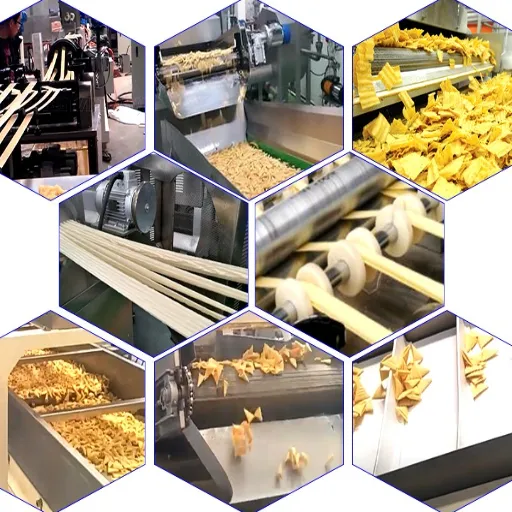
Even well-designed lines encounter problems. Anticipating them saves time and money.
Inconsistent Product Quality
The issues related to the loss of quality usually originate from blending or heat treatments. This mainly contributes to the irregular moisture content of the ingredients, use of worn out die plates or inconsistency in the temperature of the extrusion barrel. In order to remedy this, extruder process parameters are monitored cyclically; the wearing components are replaced according to schedule and the inline sensors are employed to monitor the process engaging the plant operator before the defects emerge over a great number of products.
At the level of each operation in the line, defined procedures are undertaken to take samples for analysis, preventing the processes from being chained together in the event that any is faulty. At the mixing stage a moisture meter is employed and at the die, a temperature gauge is fitted while the packaging stage incorporates a camera or vision system, providing a total of three checks. If at any of these points there is any deviation from the acceptable parameters, the operation will pause to correct and resume and very low quality stock will not be further distributed to the storage.
High Maintenance and Downtime
Over time, abrasives cause more wear than usual on screws, barrels and dies, because these components are all moving when the equipment is in motion. The bearings get warm during use, after a certain point they fail for lots of other reasons. There is degradation of electrical equipment in elevated temperatures and humid conditions. Unexpected shut down does not occur with concern over the calendar and preventive maintenance plans based on actual hours worked. Another thing is having all important spare parts within the facilities reduces extent of likely downtime from days to hours.
Food-grade stainless steel fabrication of the equipment facilitates uses against aggressive cleansing agents and does not promote rusting. Threaded components (screws) and lining inside a barrel made of wear-resistant materials reduce servicing frequency for high wear materials. All these materials are more expensive initially. They are however extremely economical when the cost of the equipment is evaluated for the entire lifespan of the equipment.
Scaling Production Without Sacrificing Standards
In the face of increasing demand, manufacturers often find themselves tempted to push the equipment beyond its limits. This could however be seen to lead to the overloading of mixers which causes poor mixing. Extruder speed, when optimized to a higher level than necessary produces a lot of heat and a poor expansion. Attempting to handle more than the usable capacity of the dryer results to wet products.
In this strategy, production capacity is increased in stages as opposed to forced production increase which is typical. Another mixer will be added which can blend any two components keeping the same quality but twice the volume of that blend. Unlike the one zone only drying where the residence increases with the increase in throughput, this two zones system allows additional throughput without increase in residence time. Such a tendency helps to stick to standards with which one has won the clientele.
Frequently Asked Questions
How does the food manufacturing process differ for snacks versus pet food?
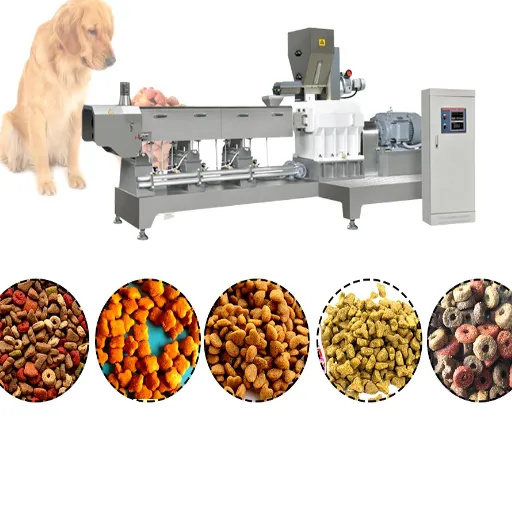
The core food processing steps remain similar: mixing, extrusion, drying, and packaging. But snack production often emphasizes expansion, texture, and flavor intensity. Pet food prioritizes nutritional density, digestibility, and pellet durability. Pet food production lines use specialized extruder configurations to achieve the dense, durable kibble that pets require. Equipment choices reflect these differences through screw profiles, die designs, and coating systems.
What food production equipment is needed for a complete line?
A complete line typically includes material handling systems, mixers or blenders, processing equipment such as extruders, fryers, or ovens, forming and cutting tools, dryers or coolers, coating and flavoring systems, packaging machines, and quality control stations. The exact food production equipment configuration depends on product type, capacity targets, and automation level.
Is batch processing or continuous processing better for food manufacturing?
Batch processing offers flexibility for recipe changes and smaller volumes. Continuous processing delivers higher throughput and greater consistency for standardized products. Many manufacturers start with batch systems and transition to continuous lines as volume and product stability justify the investment.
How much does it cost to set up an industrial food manufacturing line?
Costs vary widely by product complexity and capacity. Small specialty lines might start around 50,000to50,000to150,000. High-capacity automated systems for snacks or pet food can range from 300,000toover300,000toover1 million. Modular designs allow manufacturers to spread investment across multiple expansion phases.
What food safety standards apply to food manufacturing equipment?
Key standards include HACCP for hazard control, ISO 22000 for food safety management systems, and regional regulations like FDA FSMA in the United States or EU 852/2004 in Europe. Equipment materials must meet food-contact standards, with SUS 304 and 316 stainless steel being the most common choices for food processing machinery.
Conclusion
The entire food manufacturing process involves a series of seven sequential operations from raw materials to the final product. Every step is an opportunity to improve and enhance the system, and every interface between the steps must be carefully treated in design. Those who know the whole process are able to make more precise appliance selection. More precise appliance selection means higher productivity, lower cost, and more stable quality.
Your product must first and foremost be broken down into its components – what needs to be done at every stage. Determine how many units of certain product you will be able to produce. And buy machines which are very precise now and will allow you to accommodate changes in the future. A food processing line is more than just a way to string machinery together. It is a system designed to accommodate your product, your operating circumstances, and your expansion plans.
Contact our team today for a tailored consultation on your food manufacturing process. We design modular production lines for snacks, pasta, pet food, and more — engineered to your exact recipe and capacity requirements.