

Cost of Pet Food Production Equipment: A Complete 2026 Pricing Guide

How much do you have to spend on pet feed processing machinery? For production of a typical line, the cost is in the range of 45,000to600,000and depends on the several factors such as the capacity, the layout and the components.
Most vendors just conceal these numbers behind the contact form, making potential buyers wonder if they can afford such equipment at all. Given this situation, the purpose of this texts involves uncovering the precise cost of pet food production equipment in 2026, including utilities and infrastructure expenses which at times are not published anywhere.
When Elena Voss attempted to write up the capital budget for a pet food production factory in Hamburg for the first time, she allocated 80,000 already based on one Ali Baba advertisement that she stumbled across at 2am. The money she spent six months later was well over the 80,000 dollars budget she had planned to spend. Her actual expenses went up to 137,000.
The cost of pet food production equipment in China is approximately forty-two hundred dollars. She also went onto site upgrades electrical and assumed its cost to be 6.2 thousand dollars. Lastly, there was an additional cost for the spare parts kit – a screw and a barrel in particular – four thousand eight hundred dollars. This was accompanied by startup support, which she also attributed to the cost of the equipment. Elena explains that there is some particular logic to this.
There is also the additional burden of 50% of the machine cost, which is $300,000 for the equipment. Given such limited budgets, all players involved resort to these ridiculous statements that “ranges from $50,000 to $500,000″.
By the time you finish this piece, tearing one’s strands out over missing a detail for components is going to be a thing of the past. Provo and Kroko refrigeration units will be introduced to you and their prices for each type explained. As a consumer, you will be shown the unseen expenses that make many people’s budget reading experience surprising. Moreover, one shall not be intimated after receipt of any estimates from any seller anywhere.
Key Takeaways
- A complete pet food production line ranges from 45,000fora150kg/hstartupdry−typesystemto45,000fora150kg/hstartupdry−typesystemto600,000+ for an industrial 5,000 kg/h wet-type configuration.
- The extruder represents 25-40% of total equipment cost; peripheral equipment (dryer, flavoring, packaging) often exceeds the extruder price combined.
- Hidden costs including shipping, installation, facility prep, and spare parts typically add 15-25% on top of equipment sticker price.
- Wet-type lines cost 30-50% more upfront than dry-type but usually deliver lower energy costs and better expansion quality.
- Phased investment lets you start producing for 40-60% of full-line cost by adding flavoring and packaging automation in Year 2.
What Drives the Cost of Pet Food Production Equipment?
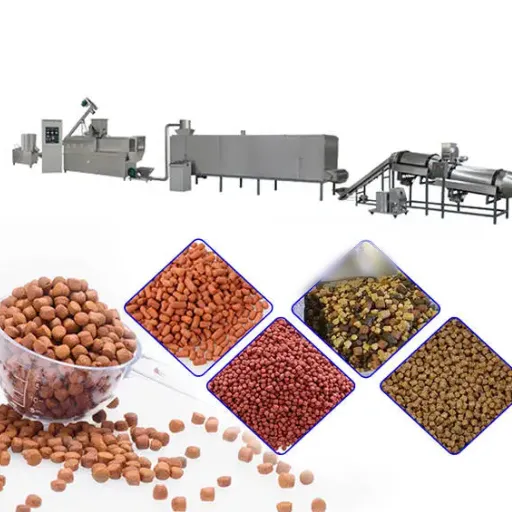
Seven factors determine the cost of pet food production equipment. Understanding these drivers helps you control costs and avoid paying for specifications you do not need.
Production capacity is the primary cost driver. A 150 kg/h extruder costs roughly 15,000−15,000−25,000. A 2,000 kg/h unit runs 80,000−80,000−150,000. Capacity scales non-linearly because larger machines require heavier-duty motors, reinforced barrels, and more sophisticated control systems.
Extruder type creates the next biggest price gap. Single-screw extruders handle basic formulations at lower cost. Twin-screw extruders process complex recipes with high fresh meat inclusion but cost 50-100% more. Twin-screw models now command roughly 68.5% of the pet food extrusion market, driven by demand for premium nutrition as the global pet food industry continues to expand, according to Future Market Insights.
Configuration plays a crucial role. The available dry-type extruders rely on such systems exclusively. Steam preconditioning is available in wet-type systems, which makes using a boiler and having water treatment and steam piping necessary. This preparation gear increases the entry barrier to the tune of 15,000−15,000−40,000 but tends to augment energy productivity and product characteristics significantly.
Material quality determines both cost as well as hygienic levels. When referring to food safeties 304 grade stainless steel is in use. Destroys such equipment use 316 Grade for aggressive conditions or for very specific regulations, considering additional costs for the equipment about 10-15 percent.
Involved levels of automation range from standard operating panels with switches to full fledged PLC panels fitted with touch screens, recipes and remote control capabilities. Simple manual controls help to maintain low cost. Complete automation consist and keep the cost of pet food production equipment in the region of 8,000−8,000−20,000 yet they minimize associated operator and labor mistakes.
Different requirements apply in the various markets of the world. For Europe, the CE marking scheme applies and for the US, relevant legislation requires FDA approval. These and others such as ISO 22000 entail, at times, design changes, documentation, and testing on the supplier’s end, all of which are factored into the pricing.
Die shapes, cutting devices, and barrels, like any custom feature, mean additional engineering time and complexity to manufacture. All other configurations would be at a lessor cost.
Complete Pet Food Production Line: Component-by-Component Cost Breakdown
Most articles bundle pet food production line cost into one vague number. Here is the actual cost of pet food production equipment, broken down component by component, with price ranges reflecting Chinese-manufactured equipment in 2026.
Raw Material Preparation
Grinding and mixing equipment prepares your raw ingredients before extrusion. Expect to budget 7,000−7,000−35,000 for this stage.
| Component | Price Range | Notes |
|---|---|---|
| Grinder / Crusher | 3,000−3,000−15,000 | Hammer mill for grains; higher end for bone-in meat processing |
| Mixer / Blender | 4,000−4,000−20,000 | Batch or continuous; higher capacity pushes price up |
Extrusion System
The extruder is your production core and the single biggest factor in pet food production equipment pricing. This is where ingredient blends transform into cooked, shaped kibble under heat and pressure. Explore our full range of extrusion solutions for dry-type and wet-type configurations at every capacity tier.
| Component | Price Range | Notes |
|---|---|---|
| Single-screw extruder | 15,000−15,000−60,000 | Lower pet food extruder price point; best for simple formulations |
| Twin-screw extruder | 35,000−35,000−150,000 | Handles complex recipes, fresh meat inclusion up to 20-40% |
| Preconditioner (wet type) | 8,000−8,000−25,000 | Steam conditioning for better gelatinization and expansion |
Our pet food extruder buying guide explains exactly how to choose between single-screw and twin-screw systems for your recipes.
Drying and Cooling
Fresh extruded kibble leaves the die at 20-30% moisture. Drying drops this below 10% for shelf stability. Cooling prevents condensation in packaging.
| Component | Price Range | Notes |
|---|---|---|
| Dryer (electric or gas) | 12,000−12,000−50,000 | Belt or rotary; gas dryers cost more upfront but run cheaper long-term |
| Cooling conveyor | 5,000−5,000−18,000 | Length and airflow capacity determine price |
Flavoring and Coating
Post-extrusion coating applies fats, oils, and palatability enhancers that pets actually smell and taste. This stage dramatically affects product appeal.
| Component | Price Range | Notes |
|---|---|---|
| Oil / flavoring drum | 6,000−6,000−22,000 | Continuous rotary drums are standard; vacuum coating adds cost |
| Coating sprayer | 4,000−4,000−15,000 | Precision spray systems reduce waste and improve consistency |
Packaging
Automatic packaging transforms your production line from a manufacturing operation into a sell-ready business. Manual or semi-automatic options exist but slow throughput.
| Component | Price Range | Notes |
|---|---|---|
| Automatic packaging machine | 8,000−8,000−35,000 | VFFS or pre-made pouch systems; speed determines cost |
| Sealing and weighing systems | 3,000−3,000−12,000 | Multi-head weighers improve accuracy and reduce giveaway |
Auxiliary Equipment
Do not forget the systems that tie everything together.
| Component | Price Range | Notes |
|---|---|---|
| Control cabinet / PLC | 4,000−4,000−15,000 | Basic relay controls at low end; touchscreen recipe storage at high end |
| Steam boiler (wet type only) | 5,000−5,000−20,000 | Required for wet-type preconditioning; size matched to extruder capacity |
A complete pet food production line integrates all these components into a single workflow. Modular designs let you start with core extrusion and add peripherals as budget allows.
Pet Food Equipment Costs by Production Scale
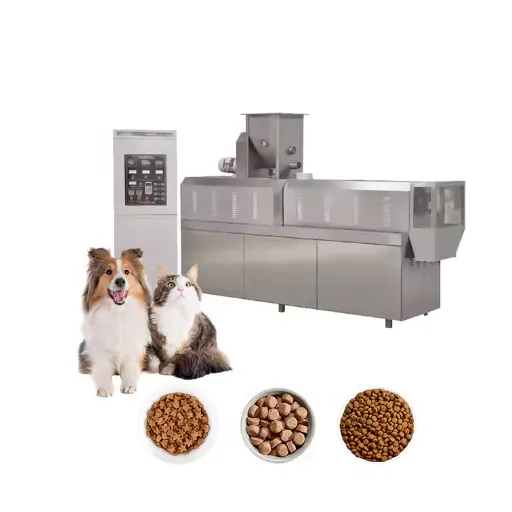
Your production target determines which configuration makes financial sense. Here is how the cost of pet food production equipment breaks down across three common scales.
Startup and R&D Scale (100-300 kg/h)
Total line investment: 45,000−45,000−95,000
A single-screw or small twin-screw dry-type extruder is typically used to form the core at a scale of this size. This design enables operation without the need for steam preconditioning and thereby avoids the capital cost of a boiler and water treatment. Many startup companies skip automatic packaging systems initially, using semi-automatic sealers to complete the process as they work towards perfecting the recipes and achieving minimum sales.
This is precisely what Marcus Chen did when he started his designer pet snacks company in Malaysia’s Kuala Lumpur. He hadichia aguino 62,000 spent on a 200kg/h dry− type production line that had no automatic packing facility for two manual operations. Twelve months later, the business had secured commitments from three distributors, allowing Marcus to purchase additional machines for 62,000ina200kg/hdry−typelinewithmanualpackaging. Twelvemonths later, with confirmed demand from three distributors, headdedanautomaticpackagingsystemfor18,000. Because of his stepwise expansion strategy, he was able to start generating income 40% sooner compared to the time it would have taken if he would have waited for the cost of pet food production equipment.
If you are planning a new operation, our guide on starting a pet food business covers the full startup framework beyond equipment selection.
Growing Commercial Scale (500-1,500 kg/h)
Total line investment: 120,000−120,000−250,000
Wet-type twin-screw extruders have become very popular especially in processing certain types of foods. Steam pre-conditioning promotes starch gelatinization encouraging improved expansion, higher digestibility and uniformity of kibble texture. Labor saving and reduced wastage cover additional investment in components such as PLC recipe controllers or automated packaging mechanisms in a short time.
When working at 1000kg/hr you are producing about 8000 tons in a shift. One person is sufficient if responsible for monitoring a line with a high level of operational excellence. Three to four are required to do the same job if done manually.
The 12,000 − 12,000 − 20,000 extra costs for having a full PLC system is always recovered within 8 – 12 months when working at that level of production.
Industrial Scale (2,000-5,000+ kg/h)
Total line investment: 280,000−280,000−600,000+
Industrial operations run multi-line configurations with centralized control rooms. At this level, energy efficiency dominates purchasing decisions. A line consuming 55 kWh per ton versus one consuming 75 kWh per ton saves 30,000−30,000−50,000 annually at full capacity. That difference justifies premium extruder pricing within two to three years.
Our dry kibble production line configurations scale from startup through industrial capacity with modular upgrades at each stage.
Dry Type vs. Wet Type: How Configuration Affects Your Budget
The choice between dry-type and wet-type extrusion is not just technical. It reshapes your entire capital budget.
| Factor | Dry Type | Wet Type |
|---|---|---|
| Equipment cost | 45,000−45,000−220,000 | 70,000−70,000−320,000 |
| Installation cost | Lower (no steam piping) | Higher (boiler, water treatment, steam lines) |
| Operating cost | Higher per ton (mechanical heating only) | Lower per ton (steam reduces electrical load) |
| Output quality | Good for standard kibble | Superior expansion and gelatinization |
| Best for | Startups, simple recipes, tight budgets | Commercial scale, premium products, complex formulas |
Dry-type lines avoid the 13,000−13,000−45,000 in additional steam infrastructure, which directly lowers the pet food production line cost. For a startup testing market demand, that difference might determine whether you launch this year or next. For a detailed walkthrough of the dry kibble manufacturing process, see our guide on how to make dry dog food.
However, wet-type systems typically reduce energy consumption by 15-25% per ton of output. At 1,000 kg/h running two shifts, that efficiency gain pays back the upfront premium within 18-24 months.
Our advanced extrusion systems include both dry-type and wet-type configurations with detailed efficiency specifications for each capacity tier.
Hidden Costs Every Buyer Should Budget For
Manufacturer’s pricing in relation to your apparatus purchase is incomplete. As a rule of thumb, another 15-25% is added to the cost of pet food production equipment particularly for additional charges which are not conspicuous on the part of the suppliers.
This basically covers logistical and transportation charged 3-8% of the cost of the equipment, based on domestic and across borders shipping rate and shipping container deployment. Last year, the cost of shipping a full 40-foot container from China to any part of Europe was within the range of 3,500−8,000 USD. The same cost to transport one to any coastline in Southeast Asia is estimated in 1,800−4,000 USD. Alternatively, it raises the costs per unit of freight and low costs of container per order.
Some vendors supply F O B price subject to installation costing approximately 5,000to25,000 us dollars. The rest are required changes including airfare and per diem for accompanying personnel and commissioning. Check that all required action specifications are met.
It’s also very crucial to highlight the fact that preparation of the premises for installation is important as some buyers may be caught unaware. For example your 380v-230v would not be enough; an upgrade to 380v-3phase would be needed. Or they would require a cooling system since the heat and moisture involved in drying need to be extracted.
The flooring structure might need reinforcement to accommodate heavy-duty machinery. Each case is different but the aggregate costs come to around 5,000 – 5,000 – 20,000 for such cases.
The standby supply of spare parts for any system should not exceed 10 percent of the equipment’s value. The rule is applicable to screws, barrels, dies and cutters among other components. That’s how the delays occasioned by weeks of production processes due to the shipment of international parts are cleared or minimized.
Operator courses may be free or charged 200-200-500 dollars per day excluding the cost of travel. This will cut down post purge wastes and there will be an increase in yield since the performance level of the machine will be high in relation with all the components within it.
Import taxes vary across different states and territories. A number of countries put food equipment in a less tarrifed range 0-5% as some countries charge 10-15% of the equipment value. Brokerage for customs overseas can be charged at a range of 300 – 300 – 800.
Services agreements and extended warranties fall in this category and they’re normally between 8 and 12 percent of the equipment cost per year. For very essential production lines, it can be considered as effective low premium alle purpose insurance against staying idling due to a glitch in production.
Similar to the previous case for the cost of pet food production equipment, labor costs are generally high.
New vs. Used Equipment: A Cost-Risk Analysis
Used pet food extruders typically sell for 50-70% of the cost of pet food production equipment after three to five years of operation. For a twin-screw extruder that cost 80,000new,thatmeans80,000new,thatmeans40,000-$56,000 on the secondary market. The savings are real. The risks are equally real.
Prior to a sale, used machines can be checked for screw or barrel wear as well as any defects in motor vibration measurements. Wear that exceeds a certain threshold degrades the output quality and may even damage the barrel. It is recovered broken these two components is almost the same amount as buying a new one.
There are three situations when it is beneficial to purchase equipment that has already been used: When the objective is simply to have a backup equipment since the downtimes are not bothersome, When an R&D establishment requires trying out a formula before going into large scale production, and When funds are too tight and affordable however complete maintenance prone devices exist in the market.
It must be new equipment in case there’s a certification issue for food safety, recipe complexity involves process management, or risk through lack of warranty is believed to be very injurious. It is not possible to find used extruders from whoever will give you a gearbox for two years.
Total Cost of Ownership: Looking Beyond the Purchase Price
Purchase of pet food production equipment which is priced the lowest to begin with seldom is associated with the lowest amount spent in five years.
Let me tell you the Math in there.
Take two equal lines of 1,000 kg/h with twin-screw manufacturing. Line A comes with 140,000 and uses 65 kW per ton produced while Line B is priced 180,000 with a usage rate of 50 kW per ton. Line B is $40,000 time higher than Line A.
At 2-shift operation from 8 AM to 4 PM for 251 years (250 days), Line ‘B’ saves almost 38 tons in a c year. at0.12perkWhth isWel J500, 4500perLe in1yen. As for Line B, it would consume approximately $22,500 less electricity in five years.
Now include the wear components. Poor quality screws and barrels might cost $3,000 or less initially but will need replacement within eight thousand hours rather than fifteen thousand hours. If one works 4,000 hours in a year, then it will mean replacing every two years and not four years as would have been the case. In five years, the “low cost” alternative would be $3,000 less initially but would require replacement after every eight thousand hours as opposed to fifteen thousand hours. However, with 4,000 working hours per year and assuming no material fatigue wear, this translates to replacement every two years instead of turns every four years. In five years, the “low cost” alternative costs only those invited screw model this screw weighs screw model we are going to look atpresnall the black describes industry around screw manufactures.
Consider yield differences in the analysis as well. In case of 2% improvement in idle process outputs out of a daily production of 2,000 kg, 40 kg of material will be saved. At a cost of production of $1.50 per кг, it corresponds to $60 a day and $15,000 a year. In five years, quality is superior compared to the cost of pet food production equipment.
When evaluating your complete production line investment and equipment ROI, always model the full five-year picture. A turnkey production line with higher upfront efficiency typically outperforms budget alternatives on total cost of ownership.
Financing Options and Payment Structures
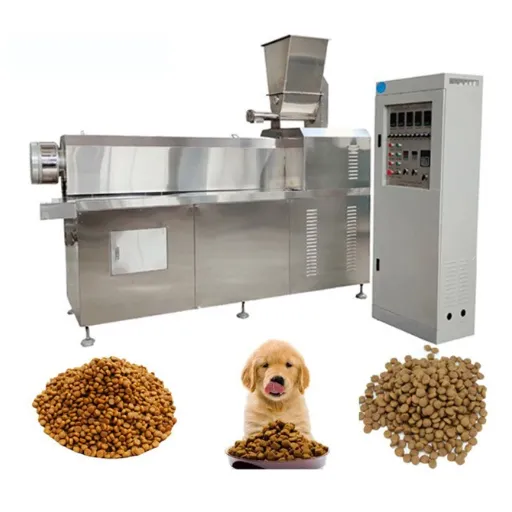
Most people who make purchases on this sort of order do not purchase the cost of pet food production equipment with cash. This means they are liberal enough to observe the current payment arrangement while planning their finances and making informed negotiations.
In general, most manufacturers charge a deposit of 30% on international equipment orders and a balance payment of 70% before the orders are shipped. This arrangement secures the seller during the manufacturing process while allowing the buyer to view the finished product before making the remaining payment.
It is worth mentioning that in the case of the Letter of Credit (LC), the bank charges are in the range of 500−500−2000 due to the opening of a LC to an internal buyer as well as the beneficiary internal buyer. LC will assure payment, but these payments are held by the bank until shipping documents are presented to show the arrival of goods. For this reason, especially when someone is buying internationally for the first time, these conditions are advisable.
Unlike the other markets where equipment leasing is common, like for vehicles and office stationery, food processing equipment rarely experiences leasing conditions. However, industrial Leasing Loan companies advance lease-to-own schemes. The expected annual equivalent rate over three to five years is between 8 and 15 percent.
For a majority of consumers, the most realistic source of financing is phased investment. A grinder and mixer, extruder and primary, still drying machine should do to get a platform.
Move on to add automatic roasting, cooling and bagging systems from operational proceeds in year two. This strategy makes it possible to commence production minus 40-60 per cent of full line budgeting within the hardest sectors.
Our production systems’ construction caters for this extent. Core extruders are delivered in advance. Enhancement of the systems is ready minus hassle of fitting the parts.
How to Get an Accurate Quote for Your Operation
The question of how much the pet food production equipment should cost is determined in the final phase of the process of understanding the costing aspects of pet food production equipment. Such details should be filled in before looking for any vendor.
The capacity – in kg/h or tons per day. Please try to be exact. Any attempt to be vague like “As much as possible” will result in proposals that would be much bigger in size and cost.
The types of recipes that you want to produce. For instance, grain-free, 30% meat food beverages require extruders that are different from those used in low cost corn-soy mixtures.
Other relevant specifications of the plant including the level of electricity available, full floor layout, height provisions and also the existing ventilation.
The level of certification required in the eventual areas of sales. Whether CE, FDA, ISO 22000 or their market equivalents, all bring two cost factors – that is design and construction of documentation.
Expenditure variation you are confined into. Coming out with this prescription upfront reduces or stops making those proposals whose costs surpass your limit.
Some common warning signs in quotations include general descriptions of equipment without any model numbers, inability to provide rated capacity, missing details such as specifications of control cabinets, or how the electrics are connected and such. There is also no indication whether the equipment will be installed or commissioned within the received quotation. An ideal quote must include all parts, power requirements, induced delivery terms or further details, if necessary. This comprehension is a must when looking to compare the cost of pet food production equipment as quoted by suppliers.
If you are starting a pet food business and need help prioritizing which equipment to buy first, our startup guide walks through the exact decision framework.
Conclusion
Understanding the true cost of pet food production equipment means looking past sticker prices to component breakdowns, hidden expenses, and total cost of ownership. Buyers who research pet food production equipment thoroughly before purchasing consistently avoid the budget overruns that plague first-time manufacturers.
The global pet food market continues to grow, with the American Pet Products Association (APPA) reporting sustained increases in pet industry spending year over year. A complete line ranges from 45,000foracompactdry−typestartupsystemto45,000foracompactdry−typestartupsystemto600,000+ for industrial wet-type configurations. The extruder represents roughly 25-40% of that total. Peripheral equipment combined often costs more than the extruder itself.
The configuration choice is as significant as the desired capacity. For example, dry lines have a low initial cost but have high energy consumption per ton processed while wet systems are costly but they recover the additional cost in increased efficiency within about two years. Staged investment plans enable production and revenue earning in months without requiring full line resources for the same period.
Purchase orders are signed by buyers who have prepared for the shipping, installation of the equipment, preparing the facilities, buying the spares, and any other requirements that may arise in the process. Prepare for these added costs by including 15-25% on the top of equipment pricing.
Looking forward to making a legitimate capital budgeting plan for your dog food production business? Reach out to Shandong Loyal Industrial Co., Ltd. for a comprehensive equipment offer that addresses your capacity needs, recipe wants, and building requirements.