
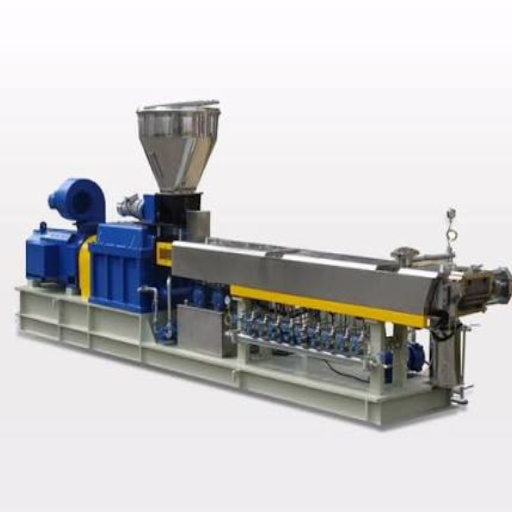
Co-Rotating vs Counter-Rotating Twin Screw Extruder: Which Do You Need?

For food processing, the answer is almost always co-rotating. A co-rotating twin screw extruder turns both screws in the same direction for strong mixing, self-cleaning, and high output. A counter-rotating design turns them in opposite directions for gentler, positive-displacement conveying. Here is when each earns its place.
The co-rotating vs counter-rotating twin screw extruder question trips up a lot of first-time buyers. When Priya’s snack team in Ahmedabad bought their first machine in 2023, a vendor sold them a discounted counter-rotating unit. They planned to run puffed corn snacks. Within two weeks, expansion was uneven and output sagged 30 percent below spec.
The problem was not the machine. It was the rotation direction.
Most buyers are told “twin screw” without learning that rotation direction changes the entire conveying and mixing behavior. This guide explains the difference, shows you the mechanism behind it, and gives you a clear framework to pick the right configuration for your product.
Key Takeaways
- For food extrusion, a co-rotating intermeshing twin screw extruder is the standard choice. Its self-wiping action and high shear suit snacks, high-meat pet food, textured vegetable protein, and modified starch.
- A counter-rotating extruder acts as a positive-displacement pump with lower shear and longer residence time. It fits gentle, heat-sensitive, and low-viscosity materials, plus rigid PVC profile extrusion.
- The difference comes down to mechanism: co-rotating uses drag flow and figure-eight inter-screw transfer, while counter-rotating moves material through closed C-shaped chambers.
- Match the rotation direction to your material viscosity, shear sensitivity, and need for positive conveying, not to the vendor’s price.
What Is the Difference Between Co-Rotating and Counter-Rotating Twin Screw Extruders?
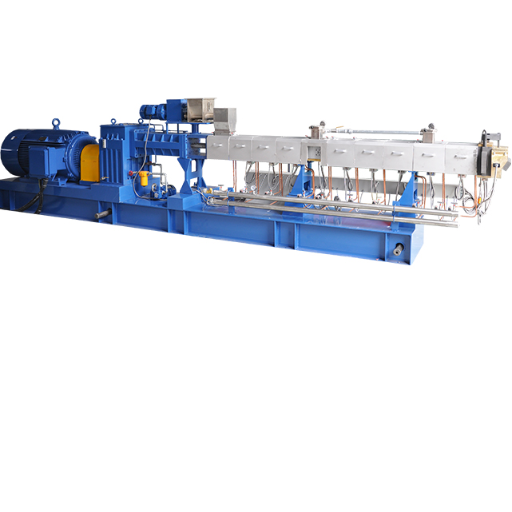
In a co-rotating twin screw extruder, both screws turn in the same direction. This produces strong distributive mixing, self-wiping action, and high throughput, making it the standard for food extrusion.
In a counter-rotating design, the screws turn in opposite directions. The machine acts as a positive-displacement pump with lower shear, higher pressure, and longer residence time, suited to gentle or highly viscous materials like PVC profiles.
That is the short answer. The reason it matters lives in how each machine moves material.
Both designs use two parallel screws inside a heated barrel. The difference is what the screws do to each other. When the screws intermesh and turn the same way, one flight continuously wipes the other clean. When they turn opposite ways, they form sealed chambers that carry material forward like a pump.
This single distinction drives nearly every performance difference that follows. To understand it, you have to look at the conveying mechanism. Our twin screw extruder machine guide covers the full machine, but here we focus on rotation direction.
How Rotation Direction Changes the Mechanism: Drag Flow vs Positive Displacement
Rotation direction is not a cosmetic setting. It changes whether the extruder conveys material by drag or by displacement. Understanding this one idea makes the whole comparison click.
Co-Rotating: Figure-Eight Flow and Drag Conveying
In a co-rotating machine, the two screws pull material back and forth between them in a figure-eight pattern. You may see this described as an infinity (∞) flow path. Material does not just ride down one channel. It transfers from one screw to the other at every intermeshing point.
This transfer is what creates strong mixing. As the melt swaps between screws, it folds, shears, and homogenizes. Additives, fats, and water distribute evenly across the whole melt.
Because the screws wipe each other, no material sits still. There are no dead zones where product can burn or degrade. This self-wiping action also shortens cleanup and speeds changeover between recipes.
The result is a short, narrow residence time distribution. Every particle spends roughly the same time in the barrel, and that consistency is exactly what food extrusion needs.
Counter-Rotating: C-Shaped Chambers and Positive Displacement
A counter-rotating intermeshing extruder works differently. The opposing screws form closed C-shaped chambers that trap material and push it forward. There is no drag flow in the usual sense. Forward movement comes from volume displacement, with a small additional calendaring flow where the screws pass each other.
This makes the machine behave like a positive-displacement pump. It builds steady pressure and conveys material reliably even when the material is thick or hard to move. The trade-off is shear. Because material moves in sealed chambers, it does not transfer between screws the same way, so mixing is weaker.
Longer residence time is the other side of the same coin. Material stays in the barrel longer, which is useful for some gentle processes but a drawback when you need fast, high-shear cooking.
Intermeshing vs Non-Intermeshing Counter-Rotating
Counter-rotating machines come in two flavors. Intermeshing designs form the closed C-shaped chambers described above. Non-intermeshing, or tangential, designs leave a gap between the screws.
Non-intermeshing counter-rotating extruders are chosen when dispersive mixing must be avoided. A common example is reducing fiber breakage in filled formulations. They also appear in reactive extrusion and devolatilization duties where you want to pull off volatiles without over-working the material.
For most food work, this is a niche. Our twin screw extruder working principle walks through the full process if you want the zone-by-zone detail.
Co-Rotating vs Counter-Rotating Twin Screw Extruder: The Full Comparison
Here is the side-by-side view. Keep it open while you read the product sections that follow.
| Factor | Co-Rotating | Counter-Rotating |
|---|---|---|
| Screw rotation | Same direction | Opposite directions |
| Material flow | Figure-eight (∞) inter-screw transfer | Closed C-shaped chambers |
| Conveying mechanism | Drag flow | Positive displacement |
| Mixing | Strong distributive and dispersive | Moderate, mostly distributive |
| Shear | Higher | Lower |
| Residence time | Short, narrow distribution | Longer |
| Pressure behavior | Builds mainly at die and kneading blocks | Steadier, pump-like |
| Self-cleaning | Yes, self-wiping | Weaker |
| Typical use | Food, compounding, TVP, modified starch | PVC profile, heat-sensitive, low-viscosity |
A numerical study published in the Korea-Australia Rheology Journal found that at equal screw speed and pitch, co-rotating machines deliver better conveying and distributive mixing. They generate a faster transport velocity, which helps move the melt between barrels.
Marcus runs a premium pet food line in Ohio. His recipes are 35 percent fresh chicken and 12 percent fat, which makes them sticky and heat-sensitive. He runs a co-rotating machine precisely because its figure-eight flow distributes the meat and fat evenly while the self-wiping action stops product from building up on the screw flights. The same recipe on a counter-rotating machine would mix unevenly and leave residue in the sealed chambers.
Not sure which configuration matches your recipe? Explore our food extrusion solutions to see how co-rotating systems handle real food formulations.
When to Choose a Co-Rotating Twin Screw Extruder
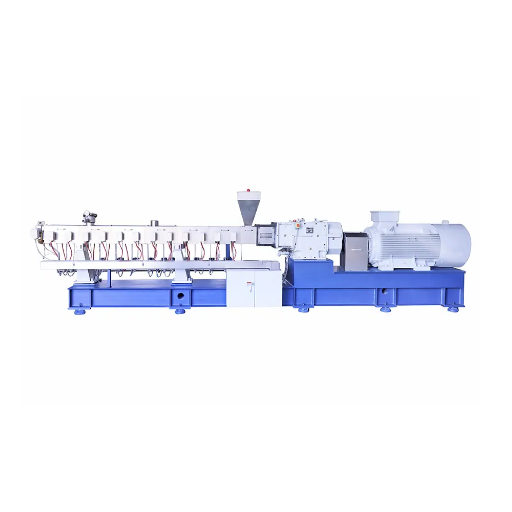
Choose a co-rotating machine when you need high shear, thorough mixing, and fast, consistent cooking. That covers most of the food industry.
- High-shear cooking and expansion. Puff snacks, breakfast cereals, and direct-expanded products need intense shear to gelatinize starch and build the pressure that drives expansion at the die.
- Complex, high-fat, or high-moisture recipes. High-meat pet food, textured vegetable protein, and fortified snacks demand even distribution of fats, proteins, and water.
- Modified starch and pre-gelatinized flour. These need precise shear and temperature control to hit the target viscosity.
- Frequent product changeovers. Self-wiping screws clean quickly between recipes, which matters when you run many SKUs on one line.
For food, co-rotating intermeshing is so dominant that the technical literature calls it the optimum system for extruder-cooked products. Its self-cleaning action and narrow residence time distribution are the two reasons why.
Priya’s team learned this the hard way. After switching from the discounted counter-rotating unit to a co-rotating intermeshing line, expansion uniformity and throughput both recovered. Her puffed corn snacks finally met spec.
When to Choose a Counter-Rotating Twin Screw Extruder
Counter-rotating machines are not obsolete. They are specialized. Choose one when your material or process rewards gentleness and positive conveying over high shear.
- Low-viscosity and heat-sensitive materials. Lower shear protects ingredients that degrade under intense mechanical work.
- Positive-displacement conveying. When you need steady, predictable pressure to move a hard-to-convey material, the pump-like behavior helps.
- PVC pipe and profile extrusion. This is the classic non-food application. Rigid PVC is heat-sensitive and needs gentle, positive conveying.
- Specific high-fiber or high-viscous feeds. Some feed patents cite reduced friction heat and uniform pellet sizing as reasons for a counter-rotating design.
A PVC pipe plant in Germany would never run a co-rotating machine. Its rigid PVC needs minimal shear and reliable positive conveying, so it runs counter-rotating extruders that move material through closed chambers. That single example proves rotation direction is a product decision, not a brand preference.
The trade-off is real. Counter-rotating machines mix less and self-clean more poorly than co-rotating ones. If you do not actually need gentleness, you are paying for a capability that hurts your mixing.
Co-Rotating vs Counter-Rotating for Specific Food Products
Let’s get concrete. Here is how the choice maps to the products you actually make.
Puff and Extruded Snacks
Co-rotating. Puff expansion depends on shear to gelatinize starch and build die pressure. A counter-rotating machine simply does not deliver the same shear, as Priya’s team discovered. Our fried snack production line and food extruders are built around co-rotating extrusion for this reason.
Pet Food and Aquatic Feed
Co-rotating for premium, high-meat, high-fat kibble and floating aquatic feed. The wide moisture window and even mixing distribute fresh meat without degrading it. A narrow exception exists for certain high-fiber, heat-sensitive feeds where a counter-rotating design’s reduced friction heat can help. Our pet food production line is engineered around co-rotating twin screw extrusion.
Textured Vegetable Protein and Meat Analogs
Co-rotating. High-moisture extrusion for fibrous meat analogs needs precise shear and temperature control to develop the layered protein structure. This is one of the most demanding food applications, and co-rotating intermeshing is the standard.
Modified Starch and Instant Foods
Co-rotating. Pre-gelatinized starch needs controlled shear to hit the target viscosity for instant soups, sauces, and bakery fillings. Our modified starch extruder machine gives you that control.
For a broader view of what co-rotating systems can produce, read our food extruder machine applications article.
The Verdict: Which Is Right for Your Production Line?
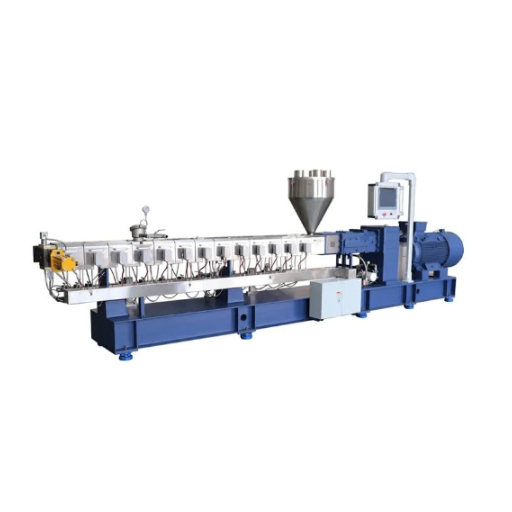
For the overwhelming majority of food extrusion, co-rotating is the default. Counter-rotating earns its place in specific, mostly non-food or low-viscosity duties.
Run your decision through three questions:
- How viscous and shear-sensitive is your material? High shear is good for starch and protein, bad for rigid PVC.
- Do you need positive-displacement conveying? If steady pressure to move a difficult material matters more than mixing, counter-rotating may fit.
- How much mixing do you need? Complex recipes with fats, proteins, and additives need the figure-eight transfer of a co-rotating machine.
If your product is a food and the answer to question three is “a lot,” co-rotating is almost certainly your machine.
Before you buy, step through the full selection criteria in our how to choose a twin screw extruder guide. It builds on this article and walks you through sizing, screw configuration, and supplier evaluation.
FAQ
What is the difference between co-rotating and counter-rotating twin screw extruders?
A co-rotating extruder turns both screws the same direction for strong mixing, self-wiping, and high shear. A counter-rotating extruder turns them opposite directions, acting as a positive-displacement pump with lower shear and longer residence time.
Which is better for food processing, co-rotating or counter-rotating?
Co-rotating is the standard for food. Its high shear and self-cleaning action suit snacks, cereals, pet food, textured vegetable protein, and modified starch. Counter-rotating fits gentle, heat-sensitive, or low-viscosity materials and PVC profile extrusion.
What is a self-wiping twin screw extruder?
A self-wiping twin screw extruder uses intermeshing screws that scrape each other clean as they turn. This removes stagnant material, cuts changeover time, and prevents product from burning onto the screw flights.
What is a counter-rotating twin screw extruder used for?
Counter-rotating extruders are used for rigid PVC pipe and profiles, low-viscosity and heat-sensitive materials, and specific high-fiber or high-viscous feed applications where gentle, positive conveying is preferred.
Can a counter-rotating extruder make puff snacks?
Not well. Puff expansion depends on high shear to gelatinize starch and build die pressure. Counter-rotating machines mix less and generate lower shear, so they struggle to produce consistent puffed snacks.
What is the difference between intermeshing and non-intermeshing twin screw extruders?
Intermeshing screws overlap and wipe each other. Non-intermeshing, or tangential, screws leave a gap. Non-intermeshing counter-rotating designs are used when dispersive mixing must be avoided, such as reducing fiber breakage or devolatilization.
Conclusion
The co-rotating vs counter-rotating twin screw extruder decision is easier once you understand the mechanism. Co-rotating machines move material in a figure-eight pattern with strong mixing, self-wiping, and high shear. That makes them the default for food. Counter-rotating machines pump material through closed chambers with lower shear and steady pressure, which suits gentle or non-food applications like PVC.
Match rotation direction to your material, not to a vendor’s pitch. If you make food and need thorough mixing, choose co-rotating. If you need gentleness and positive conveying, counter-rotating may earn its place.
Shandong Loyal Industrial Co., Ltd. has designed food extrusion systems for global manufacturers for over a decade. Our engineers will help you confirm the right rotation direction and configuration for your product.
Request a consultation today and get machinery matched to your recipe, capacity, and growth plans.