
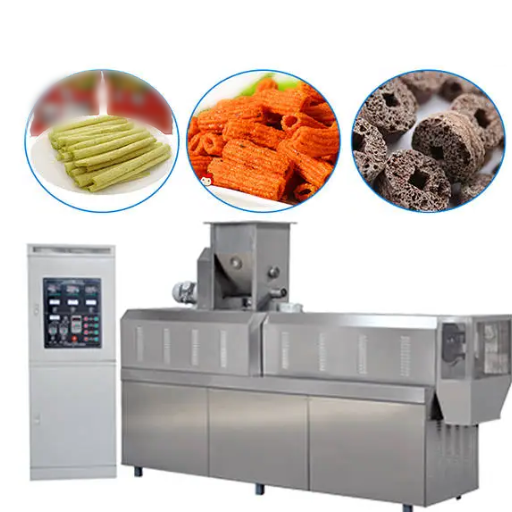
Food Extruder Machine Applications: 12 Products Explained

A food extruder machine cooks, mixes, and shapes raw ingredients into finished products using heat, pressure, and shear. Its most common applications are direct-expanded snacks, breakfast cereals, pasta, textured vegetable protein (TVP), modified starch, and dry or semi-moist pet food and aquatic feed.
In 2024, a snack manufacturer in Gujarat was running a single-screw extruder making corn puffs at 300 kilograms per hour. Business was steady, but the owner kept turning away customers who asked for fortified, center-filled snacks. He didn’t realize the same extrusion platform, configured differently, could open an entirely new product line without a new facility.
You may feel the same way. Most manufacturers only ever see a food extruder marketed for one product, so the machine’s full range stays invisible. This guide fixes that.
Below, you’ll find a complete map of food extruder machine applications, organized by product family. For each one, you’ll learn what it makes, which screw type fits, and where to go next if you want to produce it.
Key Takeaways
- A food extruder machine can make 12+ product families, from puffed snacks and breakfast cereal to pet food kibble and plant-based “meat.”
- Cold extrusion shapes dough without cooking (pasta, biscuit dough), while hot extrusion cooks, expands, and texturizes (puffs, TVP, kibble).
- Simple corn curls need only a single screw; fortified, co-extruded, and high-protein products usually need a twin screw.
- Plant-based protein (TVP/HMMA) is the fastest-growing application, using high-moisture extrusion above 40–50% moisture.
- The global extruded snacks market passed $54–72 billion in 2025, with corn as the dominant raw material.
What Is a Food Extruder Machine Used For?
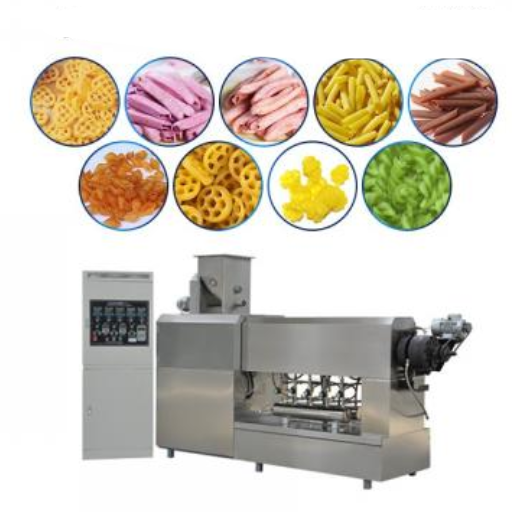
A food extruder machine uses rotating screws to push mixed ingredients through a heated barrel and a shaped die. Friction and controlled temperature cook the material while it moves. At the die, the pressure drop makes moisture flash off and the product expand into its final shape.
Extrusion splits into two broad categories.
Cold extrusion mixes and shapes dough at low temperature without cooking it. Pasta, macaroni, and biscuit dough are classic examples. The product holds its shape because of the die, not because of expansion.
Hot extrusion (also called extrusion cooking) applies enough heat and shear to gelatinize starch, denature protein, and cook the material inside the barrel. When it exits the die, the sudden pressure drop expands it into a light, crispy structure. This is how puffed snacks, breakfast cereals, pet food kibble, and textured protein are made.
Here is the full list of what a food extruder machine can produce:
- Snacks, direct-expanded puffs, corn curls, pellet half-products, co-extruded filled snacks
- Breakfast cereals, flaked cereals, puffed cereals, granola clusters
- Pasta and noodles, pasta, macaroni, instant noodles
- Pet food and aquatic feed, dry kibble, semi-moist food, floating and sinking fish feed
- Modified starch and ingredients, pre-gelatinized starch, instant flours, breadcrumbs, fortified rice
- Plant-based protein, textured vegetable protein (TVP), high-moisture meat analogues
- Baby food and specialty products, weaning foods, instant porridges, confectionery
For a deeper look at how the machine itself works, see our twin screw extruder machine guide.
Snack Food Extruder Applications
Snacks are the largest and most recognizable application for food extruders. The global extruded snacks market reached an estimated 54to54to72 billion in 2025, and corn remains the dominant raw material at roughly 46% of ingredients, according to Fortune Business Insights.
Watch a food extruder turn raw starch into expanded snacks, cereal, and kibble in real time.
Direct-Expanded Puffed Snacks
Corn curls, cheese puffs, and classic extruded snacks fall into this group. A starchy dough cooks inside the barrel and expands sharply at the die, creating the light, airy texture consumers expect. These are the easiest products to start with because the recipe is simple and the process is forgiving.
Half-Products and Pellets
Not every snack is expanded at the moment it is extruded. Pellet half-products, including 2D and 3D snack pellets and potato pellets, are extruded as dense shapes, dried, and stored. The buyer or a second manufacturer puffs or fries them later. This two-step approach lets a brand ship shelf-stable half-products across regions and control final expansion locally.
Co-Extruded and Filled Snacks
Co-extrusion adds a second die and a filling pump to inject a creamy or savory center inside a crispy shell. These products command a higher price but demand more control. That is where a twin screw extruder earns its keep, because it holds tighter temperature and shear across a more complex formulation.
When Marcus, a snack producer in Mexico, launched his first filled snack in March 2025, he tried to run it on his existing single-screw line. The filling collapsed the shell every few minutes, and waste climbed past 20%. Switching to a twin screw line gave him the process window he needed. Scrap dropped below 5%, and the new SKU became his best seller within a quarter.
Ready to explore snack production? See our fried snack production line and food extrusion solutions.
Breakfast Cereal Extruder Applications
Breakfast cereal was one of the first industrial uses of extrusion cooking, and it remains a core application today.
Direct-Expanded and Puffed Cereals
Puffed rice, corn puffs, and multigrain puffs use the same expansion principle as snacks but with cereal grains. Fine control over moisture and temperature determines whether the puff is light or dense.
Flaked Cereals
Cornflakes and multigrain flakes are produced by cooking the grain, forming it into pellets, then flaking and toasting. Extrusion handles the cooking and pellet-forming stages efficiently, replacing slower traditional batch cookers. Leading equipment makers such as Bühler build cereal-specific twin screw extruders for exactly this flaking workflow.
Granola, Cereal Bars, and Clusters
Extrusion also binds granola and cluster products, creating texture and reducing the need for added syrups. This application has grown with demand for higher-protein, lower-sugar breakfast options.
Pet Food and Aquatic Feed Extruder Applications
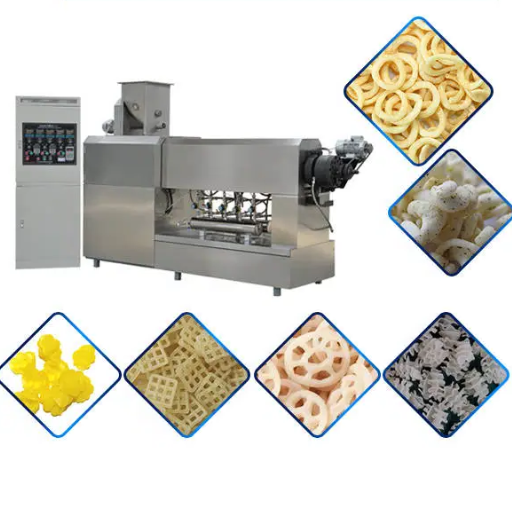
Pet food is one of the highest-value extrusion markets. Dry kibble and semi-moist pet food are almost entirely produced by extrusion cooking.
Dry and Semi-Moist Pet Food Kibble
Kibble requires precise control of density, moisture, and shape so every piece cooks evenly and stays shelf-stable. Twin screw extruders are standard here because they handle the higher fat and fresh-meat content modern recipes use.
Floating vs Sinking Fish Feed
Aquatic feed adds a technical twist: whether a pellet floats or sinks is set during extrusion, not afterward. By controlling expansion and density, a manufacturer can produce floating feed for surface-feeding species or sinking feed for bottom feeders from the same machine.
High-Protein and Fresh-Meat Recipes
Fresh-meat and high-fat formulations are the hardest to run. They need a wider moisture window and more shear, which a twin screw extruder provides. A single screw simply cannot hold these recipes stable.
A fish feed plant in Southeast Asia was losing contracts because its pellets sank when buyers wanted floating feed. The team adjusted the barrel temperature, screw speed, and die pressure on their twin screw extruder rather than buying new equipment. Within a week, the same line produced both floating and sinking feed, and the plant won back two customers.
See our pet food production line to learn how these systems are configured.
Modified Starch and Food Ingredient Applications
Food extruders are not only for finished consumer products. They are also a workhorse for ingredients that go inside other foods.
Pre-Gelatinized Starch and Instant Flours
Extrusion cooking gelatinizes starch quickly under controlled heat and shear. The result is pre-gelatinized starch and instant flours with specific viscosity and solubility profiles, used in instant soups, sauces, baby food, and bakery fillings.
Fortified Rice, Breadcrumbs, and Rusk
Extrusion reconstitutes broken rice into fortified, shaped kernels and produces uniform breadcrumbs and rusk for coatings. These applications turn low-value by-products into consistent, sellable ingredients.
Precision matters here more than raw output. Because temperature and shear control determine the final viscosity, screw configuration is the deciding factor. Our modified starch extruder machine is designed around that exact requirement.
Plant-Based Protein and TVP Extruder Applications
The fastest-growing application for food extruders is plant-based protein. Extrusion texturizes protein into fibrous, meat-like structures.
Textured Vegetable Protein (TVP) and Meat Extenders
TVP is produced from soy, pea, or other plant proteins that are cooked and texturized into chunks, flakes, or granules. It serves as a meat extender in processed foods and a base for plant-based products.
High-Moisture Meat Analogues (HMMA)
High-moisture extrusion runs at more than 40 to 50% moisture and passes the melt through a cooling die. The cooling aligns and cross-links the protein into a fibrous texture that resembles whole-muscle meat. This is the technology behind premium plant-based chicken and beef alternatives, and it is well documented in technical reviews of food extrusion technology.
Priya, an R&D lead at a plant-based startup in Singapore, spent eight months trying to reproduce a fibrous chicken texture with low-moisture extrusion. Every batch came out spongy. When she moved to high-moisture extrusion with a cooling die, the first trial produced the layered, tearable texture her company had been chasing. The product launched three months later.
Pasta, Noodle, and Other Food Extruder Applications
Beyond snacks and protein, extrusion handles a wide range of staple and specialty foods.
Pasta, Macaroni, and Instant Noodles
Pasta and macaroni are cold-extruded from semolina dough and then dried. Instant noodles use extrusion cooking followed by steaming and frying or air-drying. Both benefit from automated, continuous extrusion lines. See our pasta macaroni production line and instant noodle production line.
Baby Food and Weaning Foods
Extrusion produces precooked cereal-legume flakes and pellets that rehydrate into instant porridges. The process also improves digestibility and reduces anti-nutritional factors, which matters for infant nutrition.
Confectionery and Specialty Products
Extruders also shape chewing gum, licorice, toffee, and filled chocolates, and they micro-encapsulate flavors and functional ingredients. These are smaller niches but show the platform’s versatility.
Choosing the Right Extruder for Your Application
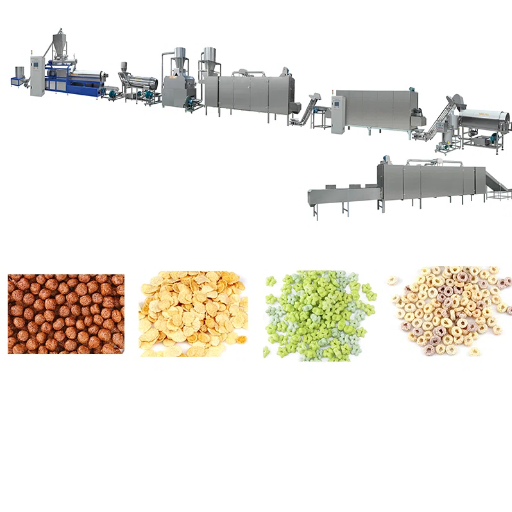
The right machine depends on your product, not on the highest output number in a brochure.
| Product Family | Screw Type | Moisture | Key Process Condition |
|---|---|---|---|
| Corn curls, basic puffs | Single screw | 12–20% | Simple high-starch recipe |
| Filled or fortified snacks | Twin screw | 15–30% | Tight temperature and shear control |
| Breakfast cereal | Twin screw | 15–30% | Controlled expansion and density |
| Pet food kibble (high meat) | Twin screw | 20–35% | Wide moisture window, high torque |
| Floating vs sinking fish feed | Twin screw | 20–30% | Density set by expansion control |
| Pre-gelatinized starch | Twin screw | 20–40% | Precise temperature and shear |
| TVP / plant-based meat | Twin screw | 25–50%+ | High-moisture extrusion, cooling die |
A simple rule of thumb: if your recipe is high-starch, low-fat, and single-ingredient, a single screw is usually enough. If it is multi-component, high-protein, high-fat, or needs a cooling die, a twin screw is the safer choice.
To compare the two technologies in detail, read our single screw vs twin screw extruder guide.
FAQ
What products can be made with a food extruder machine?
Puffed snacks, breakfast cereals, pasta, instant noodles, pet food kibble, floating fish feed, modified starch, breadcrumbs, fortified rice, TVP, plant-based meat, and baby food, among others.
What is the difference between cold and hot extrusion?
Cold extrusion shapes dough without cooking it, as with pasta. Hot extrusion cooks the material inside the barrel and expands it at the die, as with puffed snacks and kibble.
Which extruder is best for pet food?
A twin screw extruder is standard for pet food, especially high-meat and high-fat recipes that need a wider moisture window and more mixing.
Can one extruder make multiple products?
Yes. Changing the die, screw configuration, and process settings lets a single twin screw extruder switch between snacks, cereal, and pet food, often in under 30 minutes.
How are extruded snacks different from fried snacks?
Extruded snacks expand and cook inside the extruder, while many pellet half-products are fried or puffed afterward. Extrusion gives precise shape and density control before any frying step.
Conclusion
A food extruder machine is far more flexible than most buyers realize. The same platform produces puffed snacks, breakfast cereal, pet food, modified starch, and plant-based protein. The difference is in the screw type, moisture level, and die.
Here is what to remember:
- Match the machine to the product, not to a brochure’s maximum output.
- Use a single screw for simple, high-starch products and a twin screw for complex or high-protein formulations.
- Treat plant-based protein and pet food as the highest-value, fastest-growing applications.
- Cold extrusion shapes, hot extrusion cooks and expands.
If you’re weighing which extruder fits your target product, we can help you map the application to the right configuration before you commit. Request a consultation and we will walk through your recipe, output, and growth plans together.
The right food extruder machine applications are closer than you think, and the same investment can open several product lines at once.