
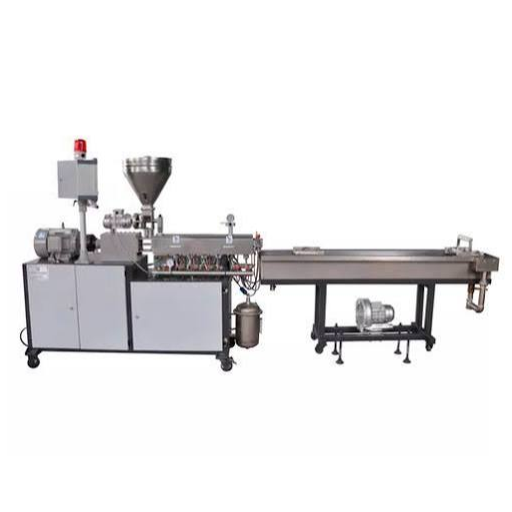
Laboratory Twin Screw Extruder: The Food R&D Buyer’s Guide

A laboratory twin screw extruder is a compact, bench-scale version of a production twin screw extruder, built to develop and test food formulations before you commit to a full line. Most lab units use screw diameters from 11 mm to 30 mm and handle anywhere from a few grams up to about 20 kg per hour, so you can screen ingredients and refine recipes on small, affordable batches.
That small size is exactly where a lot of food teams go wrong. Priya, a formulation scientist at a plant-protein startup, developed a high-moisture meat analogue on a 24 mm lab extruder and loved the texture. Six months later, the first production run came out dense and rubbery. The recipe had not changed. The scale had. Her team had never matched one hidden variable between the two machines, and it cost them a six-figure production order.
You’ve probably felt the same worry: lab results that don’t survive contact with a production line. This guide solves that problem. You’ll learn what a lab twin screw extruder actually does, which specifications drive performance, how to make your lab results transfer to production, and what these machines really cost. By the end, you’ll know exactly what to ask before you buy.
Key Takeaways
- A lab twin screw extruder runs 11-30 mm screw diameters and roughly 0.06-20 kg/h, letting you test recipes on grams-to-kilograms of material instead of full production runs.
- Food behaves differently from plastic, so polymer-first advice often misses the moisture, cooking, and expansion parameters your recipes depend on.
- Scale-up transfers only when you match Specific Mechanical Energy (SME) and residence time distribution (RTD), not just geometry.
- Prices span three bands: about 1,000−1,000−5,000 for compact units, 15,000−15,000−26,000 for mid-grade R&D machines, and $40,000+ for higher-precision systems.
- Always verify a supplier’s trial support, segmented screw inventory, and scale-up engineering help before you buy.
What Is a Laboratory Twin Screw Extruder?
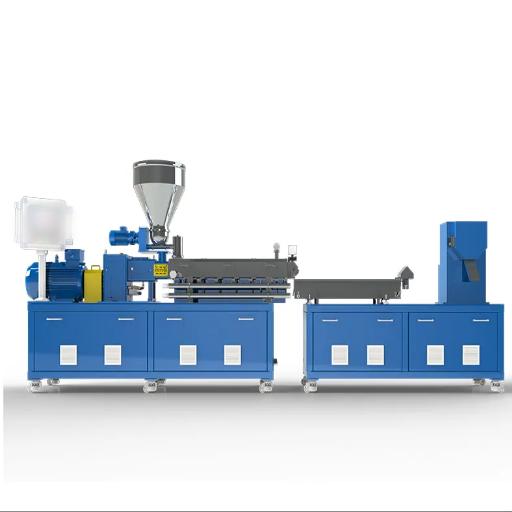
A laboratory twin screw extruder is a scaled-down version of the industrial twin screw machines used to make snacks, cereal, pet food, and textured proteins. Two intermeshing, co-rotating screws turn inside a heated barrel, applying shear, pressure, and heat to cook and shape ingredients in a continuous pass.
The key difference from production equipment is scale and purpose. A lab extruder exists to answer questions cheaply: Does this recipe mix? Does it expand? What viscosity does it hit? You feed in small amounts, measure the result, and iterate without burning thousands of kilograms of raw material.
Lab machines sit at the bottom of a three-tier funnel. Lab-scale units (typically 11-30 mm screws) handle screening and early formulation. Pilot-scale units (roughly 24-35 mm, up to about 100 kg/h) validate recipes under near-production conditions. Production extruders start around 50 mm and run continuously at commercial throughput.
Two intermeshing screws matter even at this small scale. They give you a wider moisture window, better mixing, and the self-wiping action that eliminates dead zones and speeds changeover between test batches. If you’re new to the technology, start with our twin screw extruder machine guide for the fundamentals, then come back here for the buying decisions.
What a Lab Twin Screw Extruder Is Used For
Lab twin screw extruders earn their keep across four distinct jobs in a food development program.
Formulation Screening and Recipe Development
Before you scale anything, you need to know if a recipe works. A lab extruder lets you test ingredient ratios, moisture levels, and additive loads in hours instead of weeks. You might screen a dozen starch and protein blends in a single afternoon, each using only a few hundred grams.
New Product and Ingredient Trials
When a customer asks for a new snack shape or a cleaner label, you prototype it on the bench first. Testing a new fiber, a plant protein, or a natural color on a lab machine tells you whether the idea survives heat, shear, and pressure before you spend on a production trial.
Pilot Trials and Pre-Commercial Validation
Once a formula works, a pilot-scale extruder confirms it under conditions closer to the real line. This is where you nail down texture, expansion ratio, and bulk density with statistically meaningful sample volumes. Anton Paar’s TwinLab 30/40, for example, pushes up to 100 kg/h specifically to bridge lab research and pilot production.
Generating Scale-Up Data
The most underrated job. A lab extruder fitted with data logging captures torque, temperature, pressure, and throughput, which become the numbers you match on the production line. We’ll return to this in the scale-up section because it’s the difference between a recipe that transfers and one that doesn’t.
These tasks map directly to food products you already make. Puff snacks, breakfast cereal, modified starch, high-moisture meat analogues, pet food, and infant formula all begin life on a small twin screw extruder. For a deeper look at how each product behaves in the barrel, see our food extruder machine applications guide.
Want to see how a food-specific lab extruder fits your R&D workflow? Explore our food extrusion solutions and talk to an engineer about a pilot trial.
Lab-Scale vs Pilot-Scale vs Production: Which Do You Need?
This is the first real buying decision, and it’s driven by three things: sample size, throughput, and how much scale-up confidence you need.
| Tier | Screw Diameter | Typical Throughput | Best For |
|---|---|---|---|
| Lab-scale | 11-30 mm | 0.06-20 kg/h | Formulation screening, early trials |
| Pilot-scale | 24-35 mm | 18-100 kg/h | Recipe validation, pre-commercial runs |
| Production | 50 mm+ | 100 kg/h+ | Continuous commercial output |
If your goal is early screening with scarce or expensive ingredients, a lab-scale machine is the right call. Modern units work from as little as 20 grams per batch on Thermo Scientific’s Process 11 up to around 200 grams on Coperion’s ZSK MEGAlab, so you protect your ingredient budget.
If you already have a proven formula and need validation volumes for customer samples or regulatory work, skip straight to pilot. Diego, the process lead at a Latin American snack company, made this call correctly. He had a validated corn-based puff recipe from a contract lab, so he bought a pilot extruder instead of a bench unit. He ran 50 kg validation batches, nailed the expansion ratio, and went to production in a single quarter.
The trap is buying a lab machine when you actually needed pilot scale, or vice versa. Lab units cannot produce meaningful commercial samples. Pilot units are overkill for pure ingredient screening and cost several times more to run. Match the machine to the job.
6 Specifications to Evaluate Before You Buy
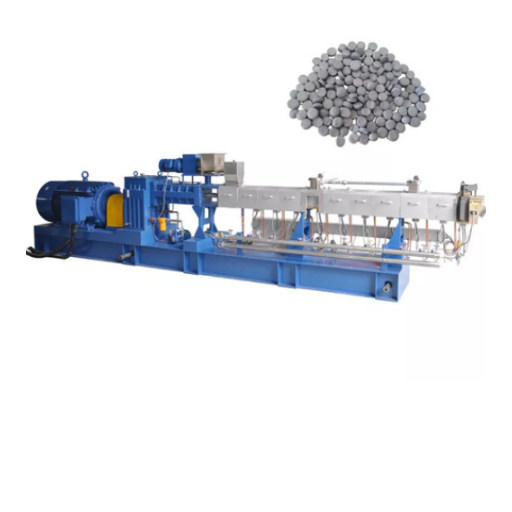
When you compare lab twin screw extruders, six specifications do most of the work. Here is what each one means for food R&D.
1. Screw Diameter
Screw diameter sets your throughput ceiling and your minimum sample size. An 11 mm Xtrutech XTS11 conserves material for early screening. A 24 mm or 27 mm class machine gives you production-relevant shear history. Pick the smallest diameter that still generates the shear and output your recipes need.
2. L/D Ratio and Barrel Configuration
L/D ratio, the screw length divided by diameter, sets how much residence time and energy your material sees. Food lab extruders commonly run 25:1 to 40:1, with modular barrels extendable toward 48:1 or 60:1 for high-energy processes. Modular, segmented barrels also let you add a vent or a side feeder later.
3. Torque and Drive Power
Torque limits how hard you can shear a tough formulation, and drive power caps your throughput. A 12 mm Labtech unit produces about 2 x 12 Nm on a 2.2 kW motor, while a 16 mm Thermo Scientific Process 16 offers more headroom. For high-protein or high-fiber food recipes, favor torque.
4. Throughput and Minimum Sample Size
Check both ends. Can it hit the throughput you need for pilot batches, and does the minimum sample size protect your ingredient budget? The 16 mm Process 16 spans 0.4 to 18 kg/h, a usefully wide window. If a recipe requires a rare ingredient, a 20-gram minimum matters more than a high maximum.
5. Temperature, Moisture, and Feeding (Food-Specific)
This is where polymer-first advice fails food teams. Your extruder must control moisture injection and steam preconditioning, hold precise barrel temperatures for cooking, and handle food-grade stainless steel contact surfaces. Twin screw extruders process roughly 6-50% moisture, versus about 12-35% for single screw, which is why they manage high-moisture proteins and high-fat pet food that single screw cannot.
6. Controls, Data Logging, and DoE Support
A lab extruder without data logging is a very expensive mixer. Look for PLC or touchscreen control that captures torque, temperature, pressure, and screw speed, and exports it for design-of-experiments (DoE) analysis. This data is the foundation of scale-up fidelity, so treat it as a must-have, not a nice-to-have.
For a deeper technical read on how screw elements and barrel zones drive these results, see our twin screw extruder screw configuration guide.
Scale-Up Fidelity: Why Your Lab Results Must Transfer
Priya’s failed production run, the one from the introduction, came down to this section. Scale-up is not a magic property of an extruder. It is an engineering discipline, and it hinges on two parameters.
The first is Specific Mechanical Energy (SME), the mechanical work delivered per kilogram of material. The second is residence time distribution (RTD), how long material spends in the barrel. If these two values differ between your lab machine and your production line, the material sees a different thermo-mechanical history, and the product changes, often dramatically.
This is why geometric similarity alone isn’t enough. You can copy the screw profile and L/D ratio exactly, but as screw diameter increases, the surface-area-to-volume ratio falls. Heat conducted through the barrel becomes less effective, and more energy must come from viscous dissipation. Research on extrusion scale-up confirms the risk: a recipe that relied on barrel heating at lab scale may under-cook at production scale.
The practical fix is to design for constant SME. That usually means a modular, segmented screw that you can reconfigure to match the energy input of your production line, plus data logging that lets you compare SME and RTD between the two machines directly. Several makers, including Coperion and Thermo Fisher, emphasize “proven geometry” and DoE software precisely because this matching is hard to do by hand.
The payoff is real. When Diego matched SME between his pilot extruder and the production line, his puff snack hit the target expansion ratio on the first commercial run, something that routinely takes weeks of trial and error otherwise. When you are ready to move past the bench, our how to choose a twin screw extruder guide walks through production-scale selection.
Ready to make your lab results transfer? Request a consultation and bring your formulation data to an engineer who will map your scale-up path.
Laboratory Twin Screw Extruder Price: What to Expect
Lab twin screw extruder pricing is less opaque than production pricing, but it still spans a wide range. Three bands cover most of the market.
- Compact and basic units run about 1,000−1,000−5,000. These are benchtop or mini extruders, often from Chinese manufacturers in Nanjing, Zhangjiagang, and Qingdao. They’re affordable entry points, but controls and food-grade options are limited.
- Mid-grade R&D machines run about 15,000−15,000−26,000. This band gets you segmented screws, PLC control with data logging, and food-safe contact surfaces, the sweet spot for a serious food formulation program.
- Higher-precision systems start around 40,000andclimb.A21.7mmSHJ−20with1−15kg/houtputlistsnear40,000andclimb.A21.7mmSHJ−20with1−15kg/houtputlistsnear40,000; premium Western brands such as Thermo Fisher and Anton Paar sit higher still, reflecting tighter control, better support, and scale-up pedigree.
What drives the price is diameter, torque, controls, food-grade materials, and after-sales support. A 3,000compactunitanda3,000compactunitanda45,000 precision system both turn two screws, but they differ enormously in data quality, reproducibility, and the engineering support behind them.
New versus used is worth a thought. Used lab extruders can halve your cost, but you inherit unknown wear on the screws and barrel, and you rarely get scale-up support from the seller. For a machine you’re using to generate production data, the support is often worth more than the discount. For a fuller breakdown of total cost of ownership, see our twin screw extruder price guide.
What to Verify With the Supplier Before Buying
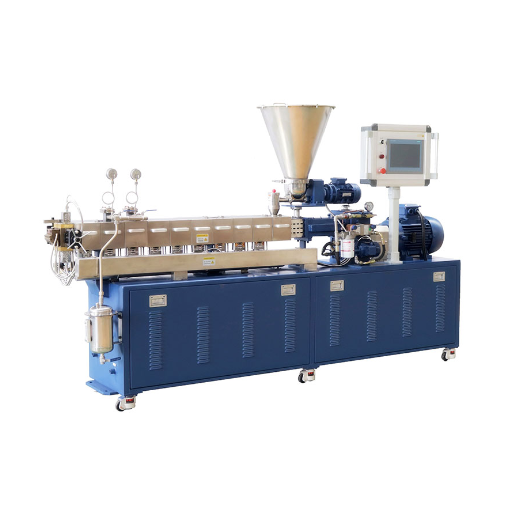
Price and specs are only half the decision. Before you sign, run this checklist with every supplier.
- Trial and pilot availability. Will they run your actual recipe on their machine before you commit? A supplier that refuses a trial is hiding something.
- Segmented screw inventory. Do they stock the screw elements you need to reconfigure for different recipes and scale-up targets?
- Scale-up engineering support. Can their engineers help you match SME and RTD to your production line, or are you on your own after delivery?
- Spare parts and lead times. Ask for the wear parts list and realistic shipping times for screws and barrel liners.
- Food-grade certifications. Confirm SUS 304/316 stainless steel contact surfaces and any hygienic design standards you require.
- After-sales and training. Who trains your operators, and how fast do they respond when something goes wrong?
Suppliers that answer these questions clearly are the ones you want to grow with. The ones that dodge them are selling boxes, not scale-up partners.
FAQ
What is a laboratory twin screw extruder?
A laboratory twin screw extruder is a compact, bench-to-pilot-scale version of a production twin screw extruder, used to develop and test formulations before full production. With screw diameters typically 11-30 mm and throughputs from a few grams to about 20 kg/h, it lets R&D teams screen ingredients and generate scale-up data on small sample quantities.
How much does a lab twin screw extruder cost?
Lab twin screw extruders range from about 1,000−1,000−5,000 for compact units, 15,000−15,000−26,000 for mid-grade R&D machines, and $40,000+ for higher-precision systems. Premium Western brands sit at the top of that range.
What screw diameter do I need for food R&D?
Most food formulation teams work in the 16-27 mm range, which balances production-relevant shear with economical sample sizes. Choose the smallest diameter that still delivers the shear and throughput your recipes require.
What is the difference between a lab and pilot twin screw extruder?
A lab extruder screens formulations on grams-to-kilograms of material, while a pilot extruder (roughly 24-35 mm, up to about 100 kg/h) validates recipes under near-production conditions with meaningful sample volumes.
Can you scale up from a lab twin screw extruder to production?
Yes, but only if you match Specific Mechanical Energy and residence time distribution between the machines. Geometric similarity alone is not enough, so look for modular screws and data logging that support constant-SME scale-up.
Conclusion
A laboratory twin screw extruder is the cheapest insurance you can buy against a failed production run. It lets you screen recipes on grams of material, validate them at pilot scale, and generate the data that makes your line run right the first time.
Remember the three decisions that matter. Match the machine tier to your job, whether that is lab, pilot, or production. Buy the six specifications that drive food performance, especially torque, moisture control, and data logging. And insist on scale-up fidelity, because matching SME and RTD is what turns a bench-top success into a production success.
The team at a university pilot hall once told a visiting startup a simple truth: “The extruder that saves you money is the one that lets you fail small.” Buy the right lab twin screw extruder, fail small, and scale with confidence.
Ready to specify your lab or pilot extruder? Request a consultation and let our engineers map the machine and the scale-up path for your next product.