Commercial vs Industrial Food Equipment: A Buyer’s Guide for Food Producers

The main difference between commercial vs industrial food equipment is scale and purpose. Commercial equipment is built for restaurants, cafés, catering, and foodservice operations that prepare moderate volumes of food for immediate sale. Industrial equipment is engineered for factories, co-manufacturing plants, and large-scale production facilities that process, package, and preserve high volumes of food through automated, integrated production lines.
That distinction sounds simple, but the wrong choice can cost you thousands in downtime, waste, or stunted growth. Choose commercial gear for a manufacturing plant, and you will hit a throughput ceiling within months. Buy an industrial line for a small café, and you will drain your budget on equipment you cannot fully use.
In this guide, you will learn how to tell the two categories apart, when each one makes sense, what the real cost difference looks like, and how to decide which scale fits your operation today and three years from now.
Key Takeaways
- Commercial food equipment serves restaurants, cafés, catering, and cloud kitchens with moderate daily volume and flexible layouts.
- Industrial food equipment serves factories and co-manufacturers with high-volume, continuous or large-batch production and strict compliance requirements.
- The switch from commercial to industrial usually becomes necessary when daily output exceeds what standalone appliances can reliably handle.
- 5-year total cost of ownership for commercial equipment is roughly 11,500–11,500–29,000, while industrial setups can run 26,000–26,000–66,000 but deliver lower per-unit cost at scale.
- Material grade, certification, automation level, and supplier support matter just as much as sticker price when choosing between the two.
What Is the Difference Between Commercial and Industrial Food Equipment?
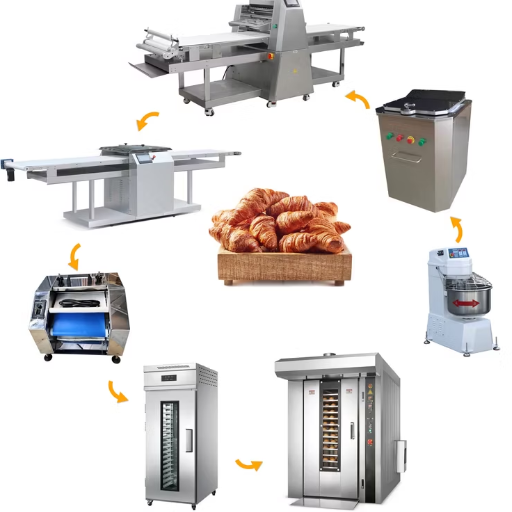
Commercial food equipment is designed for foodservice businesses that prepare meals or products for immediate consumption. Think of a restaurant kitchen, a bakery storefront, a hotel buffet, a food truck, or a cloud kitchen. These machines handle dozens to a few hundred servings per day, operate in open or compact layouts, and prioritize speed, flexibility, and staff usability.
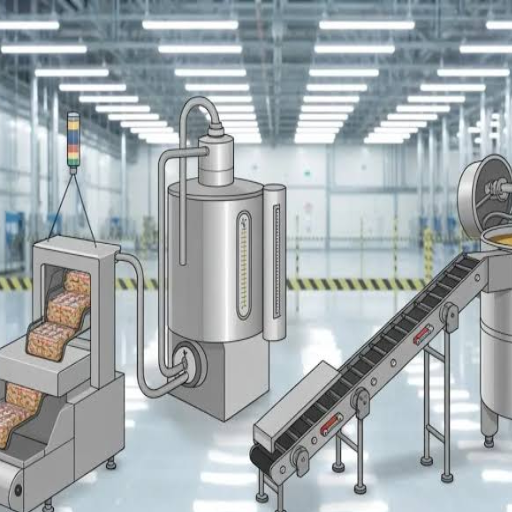
Industrial food equipment is built for food manufacturing. These are the machines you find in snack factories, pet food plants, pasta production facilities, frozen-food processors, and co-packing operations. They handle hundreds to thousands of units per hour, often run continuously or in large batches, and must integrate with conveying, packaging, quality control, and traceability systems.
A helpful way to picture the split is to compare a commercial convection oven with an industrial tunnel oven. The commercial oven bakes trays of pastries for a café. The tunnel oven moves products through a continuous heated chamber at a controlled speed, feeding directly into cooling, glazing, and packaging equipment. Both produce baked goods, but they solve completely different production problems.
Scale and Production Volume
Commercial equipment is sized for intermittent use. A commercial mixer might run for 30 minutes, rest while staff prep the next batch, then run again. Industrial mixers are rated for continuous duty cycles and are often paired with automated feeding, portioning, and downstream processing equipment.
As a rule of thumb, if your operation produces fewer than 500 units per day and each batch is different, commercial equipment is usually the right fit. Once you move past several thousand units per day of a single product, industrial equipment becomes the more reliable and cost-effective choice.
Equipment Design and Durability
Commercial machines are durable, but they are built for human-operated, stop-and-start workflows. Industrial machines are built from heavier-gauge food-safe stainless steel, use sealed bearings and sanitary welds, and are designed to run for years with scheduled maintenance.
Industrial equipment also tends to use higher-grade materials. For example, many industrial food processing lines use 316 stainless steel in areas exposed to salt, acid, or aggressive cleaning chemicals, while commercial equipment more commonly uses 304 stainless steel. Both are food-safe, but 316 offers better corrosion resistance for demanding environments.
Automation and Integration
Commercial equipment is typically standalone. A commercial fryer, oven, or mixer can be plugged in, placed on a counter, and used independently. Industrial equipment is modular. Each machine is designed to receive products from upstream equipment and pass them to downstream equipment, forming a continuous production line.
That integration is why industrial buyers talk about programmable logic controllers (PLCs), human-machine interfaces (HMIs), and manufacturing execution systems (MES). These systems coordinate speed, temperature, pressure, and timing across the entire line so that output is consistent from the first unit to the ten-thousandth.
Compliance and Certification
Both commercial and industrial equipment must meet hygiene and safety standards, but the bar rises with scale. Commercial kitchens typically need NSF or ETL sanitation certification and local health-department approval.
Industrial facilities often need CE marking for Europe, FDA compliance for the United States, HACCP plans, and sometimes 3-A Sanitary Standards or EHEDG guidelines for hygienic design. If you export globally, your equipment may need multiple certifications, which is why industrial buyers often ask for documentation before they ask for a quote.
Commercial Food Equipment: When It Makes Sense
Commercial food equipment is the right choice when your business prepares food for immediate sale or short-term consumption. It fits operations where menu variety, speed of service, and flexibility matter more than maximum throughput.
Typical Users and Use Cases
- Restaurants and full-service kitchens
- Cafés, bakeries, and pastry shops
- Food trucks and mobile vendors
- Hotels, banquet halls, and catering companies
- Cloud kitchens and ghost kitchens
- Small delis, butcher shops, and specialty food stores
Common Equipment Types
Commercial kitchens rely on familiar appliances: convection ovens, reach-in refrigerators and freezers, commercial dishwashers, prep tables, food processors, countertop mixers, commercial fryers, grills, and espresso machines. These tools are designed to be operated by kitchen staff with minimal specialized training.
Strengths and Limitations
The biggest strength of commercial food equipment is flexibility. A single commercial oven can bake bread in the morning, roast proteins at lunch, and reheat pastries in the afternoon. Installation is simpler, maintenance can often be handled in-house, and the upfront cost is far lower than industrial machinery.
The limitation is throughput. Commercial machines are not designed for continuous operation, and they rarely communicate with each other. If your daily volume grows beyond the machine’s duty cycle, you will face bottlenecks, inconsistent quality, and higher labor costs.
Mini-story: When Maria opened her artisan bakery in 2024, she invested in two commercial deck ovens and a 20-quart planetary mixer. For the first eight months, the setup was perfect. She baked 200 loaves per day, and the equipment fit her budget and space. By month fourteen, demand climbed to 800 loaves per day. The ovens were running 14 hours straight, cooling time became a bottleneck, and the mixer could not keep up with dough prep. Maria realized she had outgrown her commercial setup and needed an industrial continuous mixing and tunnel-oven line to maintain quality and protect her margins.
Industrial Food Equipment: When It Makes Sense
Industrial food equipment is the right choice when your business produces food at scale for distribution, retail, or long-term storage. It fits operations where consistency, throughput, and compliance matter more than menu flexibility.
Typical Users and Use Cases
- Snack and cereal manufacturers
- Pet food and aquatic feed producers
- Pasta, noodle, and instant noodle factories
- Frozen food and ready-meal processors
- Confectionery and bakery manufacturers
- Co-manufacturers and co-packers
- Large institutional catering facilities
Common Equipment Types
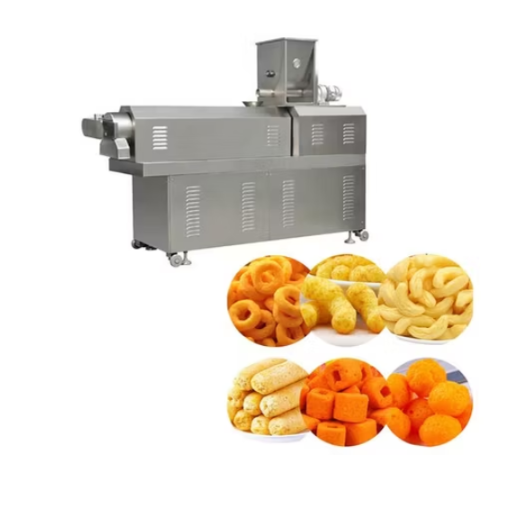
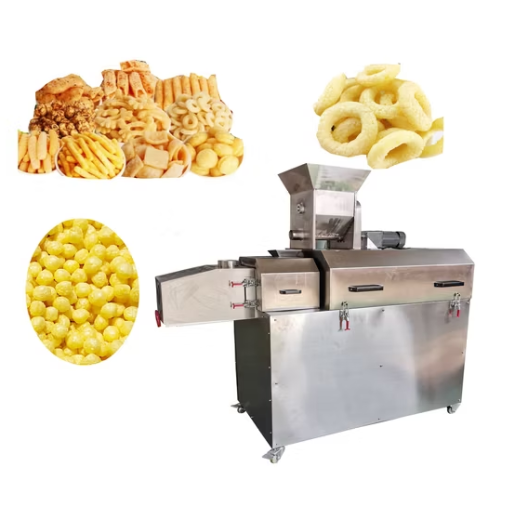
Industrial facilities use a different class of machinery. Examples include twin-screw extruders for snacks and pet food, continuous fryers for chips, industrial microwave dryers and sterilizers for spices and herbs, tunnel ovens for biscuits, industrial mixers and blenders for dough and batter, forming and portioning machines, vacuum packaging lines, and automated palletizing systems.
These machines are often arranged into integrated production lines. For example, a fried snack production line might include extrusion, frying, seasoning, cooling, and packaging equipment that moves product from raw ingredients to sealed bags automatically.
Strengths and Limitations
The biggest strength of industrial food equipment is throughput. A single industrial extruder can produce hundreds of kilograms of snack pellets per hour with consistent shape, density, and moisture content. Automated controls reduce human error, lower labor costs per unit, and make compliance documentation easier.
The limitation is capital intensity and specialization. Industrial machines require more floor space, higher utility capacity, professional installation, and trained operators. They are also less forgiving of recipe changes, so they work best when you have a stable product and predictable demand.
Mini-story: In 2023, a co-manufacturer named Acme Snacks landed a retail contract for 50,000 bags of puffed snacks per month. Their commercial batch fryer could only produce a few hundred bags per shift, and oil absorption varied from batch to batch. After switching to a continuous frying and extrusion line, output jumped to over 5,000 bags per shift, oil content stabilized, and labor hours per unit dropped by more than half. The equipment was a major investment, but it made the contract profitable.
Head-to-Head Comparison: Commercial vs Industrial Food Equipment
The table below summarizes the most important differences buyers should consider.
| Factor | Commercial Food Equipment | Industrial Food Equipment |
|---|---|---|
| Typical users | Restaurants, cafés, bakeries, food trucks, cloud kitchens | Factories, co-manufacturers, large institutional kitchens |
| Daily volume | Dozens to a few hundred servings | Hundreds to thousands of units per hour |
| Operation type | Intermittent, batch-by-batch | Continuous or large-batch production |
| Equipment design | Standalone appliances, flexible placement | Modular, integrated production lines |
| Materials | 304 stainless steel common | 304 or 316 stainless steel, heavier gauges |
| Automation | Manual or semi-automatic | Automated with PLCs, HMIs, and MES integration |
| Compliance | NSF, ETL, local health codes | CE, FDA, HACCP, 3-A, EHEDG, ISO |
| Maintenance | Monthly in-house servicing typical | Quarterly professional servicing typical |
| Upfront cost | Lower per machine | Higher per machine or line section |
| Per-unit cost | Higher at scale | Lower at scale |
| Best for | Foodservice and short-term consumption | Manufacturing and packaged products |
When Does Commercial Equipment Become a Bottleneck?
The transition point varies by product, but a few signs usually appear together:
- Your machines are running near their maximum duty cycle most days.
- You are adding staff mainly to keep up with volume rather than to add capabilities.
- Product consistency is drifting because equipment cannot maintain tight tolerances.
- Downtime for cleaning and changeovers is eating into production time.
- You are turning down larger orders because you cannot produce fast enough.
If two or more of these apply, it is time to evaluate industrial options.
Key Decision Factors for Buyers
Choosing between commercial and industrial food equipment is not just about budget. It is about matching your production reality to the right tool. Here are the factors that should drive the decision.
Production Volume and Growth Trajectory
Start with honest numbers. How many units do you produce today, and what do you expect in 12, 24, and 36 months? Commercial equipment is often the smarter choice for early-stage or low-variability operations. Industrial equipment makes sense when volume is already high or when a confirmed contract will push you past the limits of commercial appliances.
Product Type and Process Complexity
Simple products with few ingredients can often be made on commercial equipment at small scale. Complex products that require precise mixing, forming, thermal treatment, or packaging benefit from industrial control systems. For example, dry pet food kibble requires extrusion, drying, and cooling steps that are difficult to execute consistently without industrial machinery.
Budget and Total Cost of Ownership
Sticker price is only the beginning. Consider installation, utilities, training, spare parts, maintenance, and the cost of downtime. According to cross-industry B2B equipment data, 5-year total cost of ownership for commercial equipment typically ranges from 11,500to11,500to29,000, while industrial equipment ranges from 26,000to26,000to66,000. The industrial range is higher, but the cost per unit produced is usually lower at scale.
Space, Utilities, and Facility Requirements
Industrial equipment needs more floor space, stronger floors, higher electrical capacity, and often specialized ventilation or drainage. Before buying, confirm that your facility can support the machine’s power, water, compressed air, and exhaust requirements. A mismatch here can turn a simple delivery into a six-figure facility upgrade.
Compliance, Certification, and Customer Audit Requirements
If you sell into retail, foodservice chains, or export markets, your customers may require specific certifications. Industrial equipment is more likely to come with the documentation and hygienic design needed for third-party audits. Always confirm certification status before finalizing a purchase.
Staffing, Training, and Maintenance Capabilities
Industrial equipment requires trained operators and preventive maintenance programs. If your team does not have that expertise, budget for training and a service agreement. Commercial equipment is generally easier to operate and maintain in-house, which is why it fits smaller teams.
CTA: Not sure which scale fits your production goals? Explore our food production line solutions to see how modular industrial equipment can grow with your business.
Cost Comparison: What to Expect
Cost is usually the first question buyers ask, but the answer depends on scale, configuration, and what you include in the calculation.
Upfront Equipment Costs
Commercial machines typically range from 1,000to1,000to50,000 per unit. A commercial convection oven might cost 3,000–3,000–8,000, while a commercial mixer might cost 2,000–2,000–15,000 depending on capacity and features.
Industrial machines typically start around 50,000perunitandcanexceed50,000perunitandcanexceed500,000 for a complete line section. A twin-screw extruder for snack or pet food production might range from 80,000to80,000to300,000, while an industrial microwave drying system could range from 50,000to50,000to250,000 depending on throughput and configuration.
Installation, Commissioning, and Facility Costs
Commercial equipment usually plugs into existing utilities and can be installed in hours or days. Industrial equipment may require foundation work, electrical upgrades, utility rough-ins, and professional commissioning. These costs can add 10–30% to the total project budget.
Maintenance and Downtime Costs
Maintenance cycles differ significantly. Commercial equipment often requires monthly in-house maintenance, such as cleaning, lubrication, and wear-part replacement. Industrial equipment typically needs quarterly professional servicing, with more rigorous preventive maintenance programs.
Downtime is also more expensive at industrial scale. A single hour of lost production on a high-volume line can cost thousands of dollars, which is why industrial buyers invest in spare parts inventories and service agreements.
5-Year Total Cost of Ownership
| Cost Category | Commercial Equipment | Industrial Equipment |
|---|---|---|
| Upfront purchase | 5,000–5,000–50,000 | 50,000–50,000–500,000+ |
| Installation and commissioning | Low to moderate | 10–30% of equipment cost |
| Annual maintenance | 3–6% of equipment value | 3–6% of equipment value |
| 5-year TCO estimate | 11,500–11,500–29,000 | 26,000–26,000–66,000 |
These figures are benchmarks based on cross-industry B2B equipment data. Your actual costs will depend on product type, operating environment, and supplier support terms.
CTA: Want a clearer picture of what an industrial line might cost for your product? Learn more about food processing equipment cost benchmarks before you request a quote.
Upgrading from Commercial to Industrial: A Transition Framework
Moving from commercial to industrial equipment is a strategic decision, not just a bigger purchase. Use this framework to plan the transition.
Step 1: Confirm Demand
Do not upgrade on speculation. Look for sustained demand, signed contracts, or repeatable orders that justify the investment. Industrial equipment rewards predictability.
Step 2: Map Your Process
Document every step of your current production flow, from receiving raw materials to packaging finished goods. Identify bottlenecks, quality risks, and labor-heavy steps. This map will guide equipment selection and layout design.
Step 3: Define Specifications
Specify capacity, product dimensions, moisture or temperature targets, packaging format, and compliance requirements. The more specific you are, the more accurate your quotes will be.
Step 4: Evaluate Suppliers
Look for suppliers with experience in your product category, a track record of global installations, and strong after-sales support. Ask for reference customers, factory acceptance testing protocols, and spare-parts availability.
Step 5: Plan for Ramp-Up
Industrial lines rarely run at full speed on day one. Plan for commissioning, operator training, recipe fine-tuning, and a gradual ramp-up to target output. Most buyers reach stable production within 30–90 days of installation.
Common Mistakes to Avoid
- Buying based on sticker price alone. A lower-priced machine with weak support can cost more in downtime than a higher-priced machine with reliable service.
- Ignoring utilities and floor space. A machine that does not fit or cannot be powered is not a bargain.
- Skipping training. Even the best equipment underperforms if operators do not understand it.
- Overlooking future growth. Choose modular equipment that can scale with demand.
Mini-story: James ran a cloud kitchen that produced meal kits for local delivery. He started with commercial refrigeration, prep tables, and a pair of commercial ovens. When a regional grocery chain asked him to supply 10,000 frozen meals per week, he considered buying more of the same commercial equipment. After mapping his process, he realized that scaling commercially would require 12 additional staff members and triple his kitchen footprint. Instead, he invested in an industrial blast chiller, a continuous cooking line, and automated packaging equipment. The upfront cost was higher, but the labor savings and consistent output made the contract profitable within 14 months.
Frequently Asked Questions
What is the difference between commercial and industrial food equipment?
Commercial food equipment is designed for restaurants, cafés, catering, and foodservice operations that prepare moderate volumes of food for immediate sale. Industrial food equipment is built for factories and large-scale production facilities that process, package, and preserve high volumes of food through automated, integrated production lines.
How do I know if I need industrial food equipment?
You likely need industrial equipment if your daily output is approaching the maximum duty cycle of your commercial machines, if you need consistent quality at high volume, if you are producing packaged goods for retail or distribution, or if customers require certified manufacturing processes.
Is industrial food equipment worth the higher upfront cost?
Industrial equipment is worth the investment when it reduces per-unit cost, improves consistency, and enables growth that commercial equipment cannot support. If your volume is low or unpredictable, commercial equipment is usually the smarter financial choice.
What certifications should industrial food equipment have?
Common certifications include CE marking for Europe, FDA compliance for the United States, HACCP plans, NSF or 3-A Sanitary Standards, EHEDG guidelines, and ISO 9001 for quality management. The exact requirements depend on your product, market, and customer audits.
Can I use commercial kitchen equipment in a food manufacturing facility?
You can use commercial equipment for very small-scale manufacturing, but it is usually not suitable for high-volume or regulated production. Industrial facilities typically need equipment that meets stricter hygiene, documentation, and integration standards.
How long does commercial vs industrial food equipment last?
Heavy structural industrial equipment can last 12–18 years with proper maintenance. High-tech industrial inspection and packaging equipment typically lasts 7–10 years. Commercial equipment lifespan varies widely depending on use intensity but is generally shorter under continuous operation.
What is the typical payback period for industrial food equipment?
Payback periods vary by product and scale, but many buyers see full payback within 18–36 months when the equipment enables a new contract, reduces labor costs, or improves yield enough to lower ingredient waste.
Conclusion
The choice between commercial and industrial food equipment comes down to scale, product, and growth plans. Commercial equipment gives foodservice businesses the flexibility and lower upfront cost they need to serve customers every day. Industrial equipment gives manufacturers the throughput, consistency, and compliance they need to compete in retail, wholesale, and export markets.
If you are already bumping against capacity limits, struggling with consistency, or preparing for a large contract, it may be time to move from commercial appliances to an integrated production line.
Key takeaways:
- Match equipment scale to your daily volume and growth trajectory.
- Calculate total cost of ownership, not just purchase price.
- Confirm that your facility, staff, and compliance requirements can support industrial equipment.
- Choose suppliers who understand your product and can support you after installation.
- Plan for a ramp-up period rather than expecting full output on day one.
Ready to scale your production? Contact Shandong Loyal Industrial Co., Ltd. for a customized food production line quote designed around your product, capacity, and budget.