
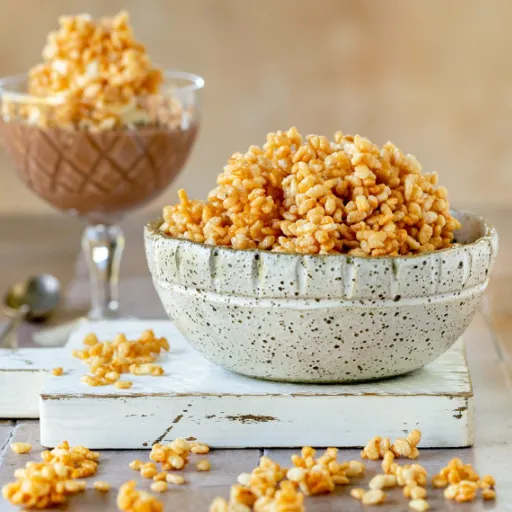
How to Make Puffed Rice: From Home Kitchen to Industrial Production

Home-cooked puffed rice involves boiling the rice until it is properly dried and letting the rice deep fried at a temperature range of 400-425°F for 3-10seconds which leads to puffing. In case of manufacturing facilities, certain equipment is used specifically for puffing grain, among three techniques: gun puffing, hot air popping and twin-screw extrusion. Currently, extrusion method most often applied in snack and cereal production, due to accuracy, speed and flexibility.
On their web pages, most people usually stop at the kitchen stage. That’s okay if all you want is to make a small amount of puffed rice yourself how to make puffed rice. You are a manufacturer of snacks willing to reach 10,000 packets per month. If this development becomes a reality, this food entrepreneur – is it better for me to put up a processing plant? Two cultures/dimensions come into play in this situation and you have to comprehend both. In this piece of work, all possible ways of making particular puffs at home will be considered, with scientific explanations of the texts physics used in the making of such puffs and what the factories are capable of doing transforming few grains in pounded products into loads of puffed greased products in an hour.
Key Takeaways
- Home cooks can make puffed rice by frying dried cooked rice in 400-425°F oil for 3-10 seconds, or by using a hot air oven method for a lower-fat alternative.
- Rice puffs because internal moisture flashes into steam when starch gelatinizes under heat and pressure; moisture content, temperature, and pressure must be precisely controlled.
- Gun puffing produces the lightest texture with 15-20x expansion but is a batch process with safety concerns.
- Twin-screw extrusion is the modern industrial standard, offering continuous production, custom shapes, and easy fortification with proteins or vitamins.
- The global extruded snacks market reached USD 54.80 billion in 2025, driven by demand for ready-to-eat cereals and puffed snacks.
- Manufacturers looking to scale should evaluate throughput, consistency, and food-safe stainless steel construction when choosing equipment.
What Is Puffed Rice? The Science Behind the Pop
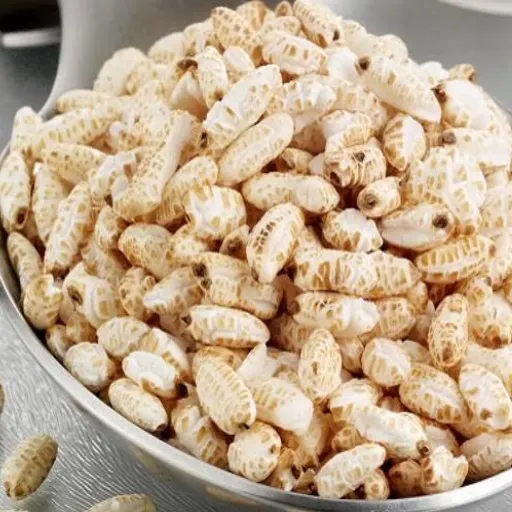
As a result of fast turning the moisture inside the rice into vapor, rice particles expand into much larger volumes than before and become puffed. When the starch in the grain is cooked through the application of heat and pressure, it changes its structure to form a flexible composite. In the event that the pressure is instantly relieved in such a system, the superheated water turns to steam suddenly within the starch and inflates it the manner balloons are inflated. A light and crunchy, hollow kernel is formed which has a great bulk but weighs significantly less than the original size of the grain.
There are three main conditions that determine the extent and success of rice puffing. They are moisture content, temperature, and pressure.
Before one attempts to puff rice, the moisture content in the grains should be within the range of 10 to 15 percent. If the rice grain is too dry, the amount of steam the kernel can expand is not that much. On the other hand, if the moisture content is too high, the rice becomes too hard or blackens before puffing. Accurate moisture content in preparations of commercial products is determined in the same way. In households, rice is cooked in the usual way and then placed in a low temperature oven or dehydrator for complete banting.
One of the factors affecting gelatinization of starch is a temperature. Gelatinization of rice starch is observed to take place around sixty to seventy degrees Celsius, although the temperatures necessary for puffing is much higher than this. When deep frying is done in a home setting, oils are usabale at less than 400 to 425 F. (204 to 218 C.). In the industry, extrusion machine’s barrel shall be maintained at 100 degrees and 200 degrees Celsius respectively, all depending on the type of dough.
The density change is also dependent on the pressure index. In case of shoot puffing, cereals are put in a hermetically closed gun with a pressure of about 15 bar. In die extrusion, there is a screw horizontal within the barrel to compressing the material long before it is out through the dies at the pressure. Weak pressure results in low level of expansion of the cereal as steam tends to leak out of the barrel slowly.
Pro Tip: Not all rice varieties puff equally. Parboiled rice works best for home frying because the partial cooking during parboiling pre-gelatinizes the starch. Long-grain white rice, jasmine, and basmati also perform well. Brown rice can puff but requires longer drying due to its bran layer.
Method 1: How to Make Puffed Rice at Home by Frying
The frying method is the most accessible way to make puffed rice at home. It requires no special equipment beyond a pot, oil, and a stove. This is the same technique that street vendors use across South Asia to make fresh murmura and mamra.
Step 1: Cook and Dry the Rice
Rinse one cup of long-grain or parboiled rice under cold water. Cook it in salted water according to package directions until tender but not mushy. Spread the cooked rice in a single layer on a baking sheet. Dry it in a 200 to 250 degree Fahrenheit oven for 2 to 3 hours, or until the grains are completely hard and translucent. You can also use a food dehydrator. The grains must feel rock-hard. Any remaining softness will prevent proper puffing.
Step 2: Heat the Oil
Pour 2 to 3 inches of neutral oil with a high smoke point into a heavy pot. Peanut, canola, or refined sunflower oil all work well. Heat the oil to 400 to 425 degrees Fahrenheit. Use a deep-fry or candy thermometer. Oil that is too cool will make the rice greasy without puffing. Oil that is too hot will scorch the grains.
Step 3: Fry in Small Batches
Add half a cup of dried rice to a fine-mesh strainer or a wire spider. Lower it into the hot oil. The rice should puff within 3 to 6 seconds. It will expand, float to the surface, and turn golden white. Immediately lift the strainer out and shake off excess oil. Work in small batches. Overcrowding drops the oil temperature and leads to uneven results.
Step 4: Drain and Season
Transfer the puffed rice to a plate lined with paper towels. Let it cool completely. Season while still slightly warm so salt or spices adhere. Try chaat masala and turmeric for a savory Indian snack, or cinnamon and sugar for a sweet breakfast topping.
Safety note: Hot oil can spit when moisture hits it. Make sure the rice is fully dried. Wear long sleeves. Keep a lid nearby to smother any flare-up.
Method 2: Hot Air Popping, The Healthier Home Alternative
Frying produces the crispiest texture, but it also adds fat. If you want a lighter, oil-free puffed rice, hot air popping is your best option. This method mimics commercial hot air systems on a smaller scale.
Oven Hot Air Method
Cook and dry the rice exactly as described in the frying method. Preheat your oven to its highest setting, usually 500 to 550 degrees Fahrenheit. Spread the dried rice on a preheated baking sheet in a single layer. Bake for 30 to 60 seconds, watching closely. The grains should puff and lightly brown. This method is less reliable than frying because home ovens cannot deliver the focused, superheated air flow of industrial fluidized bed systems. But with practice, you can achieve decent results.
Microwave Method
Place a small handful of dried rice grains in a brown paper bag. Fold the bag closed. Microwave on high for 30 to 45 seconds. Some grains will pop; others will not. This method is inconsistent because microwave heating is uneven, but it works in a pinch for a quick experiment.
The trade-off: Hot air methods produce a drier, less rich texture than frying. They are ideal if you plan to coat the puffed rice in a sweet glaze or if you are counting calories. Commercial producers often choose hot air puffing specifically for health-focused product lines.
Method 3: Gun Puffing, The Traditional Commercial Approach
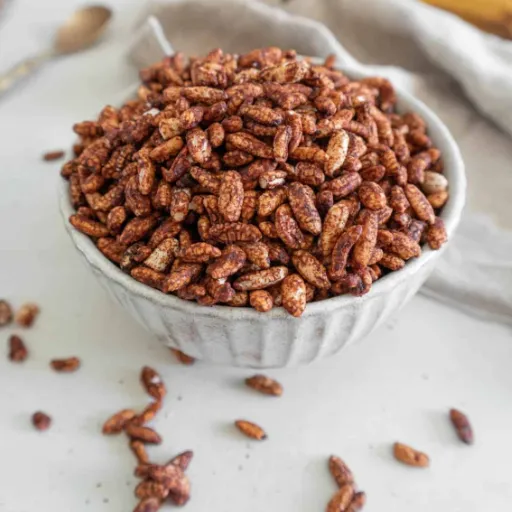
Gun puffing is the oldest industrial method for making cereals such as puffed rice and wheat. Even now, it is still in use for products such as puffed rice cakes, high-end cereals, and other specific traditional snack products. While the mechanism is somewhat impressive and competent, it is greatly dominated by extrusion for high production purposes.
Pressure puffing or gun puffing technique involves loading of whole rice kernels into a sealed pressure vessel also referred to as a puffing gun at times. In this process, the pressure chamber is heated by steam up to a temperature of about 200 C and pressure is increased to around 10 – 15 bars. The grains are cooked under pressure for 10-30 seconds duration. And then simultaneously the valve is opened within fraction of seconds thereby making the pressure back to one atmosphere. The rapid depressurization also referred to as ‘abrupt evaporation’ causes the water within every grain to vaporize or boil instantaneously on energy release thereby increasing the size of the kernels from 15 to 20 times.
As a result, what is obtained is rice which is as puffy as possible. Due to gun-puffing the grains are a-granric and the mouthfeel given is extremely high in crispiness. Premium rice cakes’ and old-fashioned cereals’ textures are, for many customers, associated with this particular mouthfeel.
Notwithstanding its merits gun puffing is not without its serious drawbacks. It is a batch (by the bunch) and not continuous process. Every cycle requires loading, pressurising, puffing, then unloading. Safety is also of great importance as rapid pressure release produces a loud noise which is reminiscent of a gun shot in this the name of the process. This immense expansion also causes the final product to become very moisture reactive. Gun-puffed rice becomes limp in a few days when stored incorrectly.
Mini-Story: When Marcus launched his artisanal snack brand in Portland in 2023, he chose gun puffing for his first product line. He loved the authentic, airy texture and the story it told. But by month six, his production bottleneck was crushing him. Each gun handled only 20 kilograms per hour. His waiting list stretched to six weeks. He eventually transitioned to a twin-screw extrusion system that delivered 300 kilograms per hour with consistent density. His cost per bag dropped by 40 percent, and he finally caught up with demand.
Method 4: Extrusion Puffing, The Modern Industrial Standard
Today, most breakfast cereals, puffed snacks, and RTE (ready-to-eat) products are made by extrusion. This method does not use whole grains. Instead, it starts with rice flour or dough, which gives manufacturers far more control over the final product.
How Extrusion Puffing Works
The operations commence with material preparation. Rice is turned over to the grinder and comes out as powder. The flour and water are placed in a pre-conditioner and supplemented to make up to 15% moisture. In this step proteins, vitamins, minerals or flavors may be incorporated.
The pre-conditioned dough is directed into the extruder box where the barrel is usually located. There remain one or two turns and then the material is transported forward cause it is put under high mechanical severing, temperature and stress. Barrel temperature is usually within 100-200 C degrees. Inside the barrel pressure comes to be anything between 50 and 150 bar.
There is a sudden drop in pressure when the exposed cooked dough comes to the die plate outside the barrel. The moisture within the heat turns into steam with a rapid expansion which increases the size of the dough around three to five folds. The extrudate is then cut into geometrically similar shapes such as balls, rings, pillows or sticks before the set-up of the structure.
The heated grains then move along a cooling or drying conveyor belt in order to lower their temperature and to stabilize their texture. Final moisture content reaches 2 to 4 per cent, which maintains crispness and avoids degradation during storage. Flavouring is optional, and can include drum-mixing of seasonings, sweeteners or oil mixes. After that, there is a short drying phase to make the coating adhere better before packaging and storing.
Why Extrusion Dominates Commercial Production
The most important advantage is that this one works without stopping. Instead of puffing guns that work in batches, in extrusion, it is possible for one to throw the material through the extruder without the need of stopping the operation. Based on the extruder concept, a twin-screw extruder can achieve throughout rates from 200 to 500 kg/hr.
Another equally important advantage is molding shapes. It is because the shape of the end product is controlled by the die – the metallic ‘form’ or ‘plate’ holding the extruders ‘screw’ in its bore, at the head of the barrel or extruding or draw off plane Product manufacturers change the die plate to produce ring shape products like cereals, pretzels and chocolate balls.
Nutrient fortification is important for health conscious consumers. When extrusion begins with flour, it is easy to add pea, whey, fiber, micronutrients to the mixture. However, most flour based gun puffing operations are incapable of this or it may be very difficult.
This ensures that bandcare is maintained. The nature of the extruder and operating conditions like screw speed, temperature, pressure all controlled by PLC mean that every extrusion batch has the same density, texture, and expansion ratio. Especially relating to twin screw extrusions, the control is even more accurate as the twin screw has high mixing ability with a self-cleaning screw.
The global food extrusion equipment market was valued at USD 1.6 billion in 2025 and is projected to reach USD 2.6 billion by 2034, growing at a 5.2 percent CAGR according to GM Insights. Twin-screw extruders alone accounted for USD 416 million in 2025. This growth reflects the food industry’s shift toward automated, flexible, high-throughput processing.
Want to see how modern extrusion systems handle puffed snack production? Explore our extrusion solutions to learn how twin-screw technology delivers precise control over texture, density, and shape for your product line.
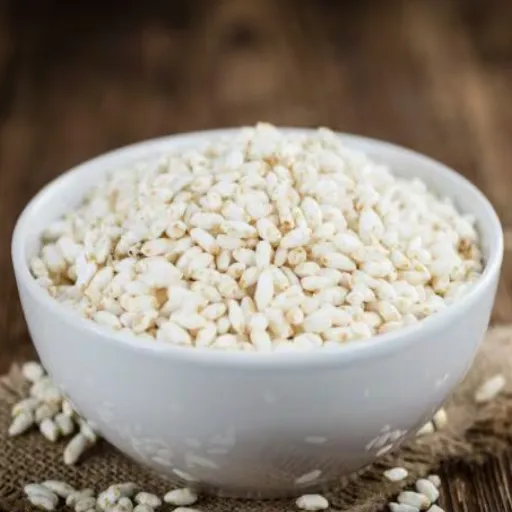
Comparing Puffing Methods: Which Approach Fits Your Needs?
| Feature | Home Frying | Hot Air Popping | Gun Puffing | Twin-Screw Extrusion |
|---|---|---|---|---|
| Raw material | Cooked whole grains | Cooked whole grains | Whole grains | Rice flour / dough |
| Expansion ratio | 2-3x | 2-5x | 15-20x | 3-5x (adjustable) |
| Oil required | Yes | No | No | No (frying optional after) |
| Production mode | Batch | Batch | Batch | Continuous |
| Typical throughput | 1-2 kg/hour | 1-2 kg/hour | 20-100 kg/hour | 200-500+ kg/hour |
| Shape control | None (irregular) | None (irregular) | None (irregular) | Custom shapes via die |
| Fortification | Not applicable | Not applicable | Limited | Easy and uniform |
| Best suited for | Home cooking, experiments | Health-focused small batches | Premium rice cakes, tradition | Mass-market cereals, snacks |
Choose your method based on scale, product goals, and budget. Home cooks should stick with frying or hot air. Small commercial producers making premium rice cakes might still favor gun puffing for its unmatched lightness. But any operation aiming for high volume, custom shapes, or fortified formulations will find that twin-screw extrusion is the clear winner.
From Recipe to Production Line: Scaling Puffed Rice Manufacturing
There comes a time in the life of every glorious cake, cookie or puff when it necessarily leaves the kitchen. In other words, your products are so popular that on the spot sale at a weekend market cannot satisfy the demand, how much more when the test subscription is secured by a major distributer again. For whichever applicable reason, scaling up means transitioning from hand stitched operations to conveyor based production.
The first thing to know is throughput. What is the desired weight per hour? Victories of small tube plants begin from 100 kilo grams per hour. Working in a small factory you can produce 200 to 300 kg anywhere in a period of an hour. In industrial cereal facilities additionally on one line runs for 500 kg per hour.
The next issue is related to product quality and its uniformity. When frying puffed rice manually: each cycle process is accompanied by considerable changes. The changes e.g temperature increase are quite natural. The drying process is dependent on moisture level. This does not happen in industrial extrusion with ‘ closed loops ‘ implementing automatic control over the temperature and speed of the screw and the knives.
The third question one must ask concerns food safety compliance. Commercial equipment has a requirement to comply with the international standards for food contact. This is achieved by the use of stainless steel, with SUS 304 or 316 being the most common, as it does not corrode, and allows the use of aggressive cleaning substances and does not contaminate food. Good equipment should be constructed from such material with all joints and weldings being smooth and safe for food.
Finally, think about the total cost of ownership of the machine. It may be that a cheap machine saves cash in the purchase, but when downtime, spare parts, and energy costs are considered for a period of five levels, it turns out more expensive. The modular designs are lenses, with the help of which the components such as the flavoring drum, extra dryers, packaging interface can be added allowing the business expansion to take place without replacing entire lines.
Mini-Story: PT Nusantara Snacks in Indonesia started with a single secondhand gun puffing unit in 2019. By 2024, they supplied puffed rice crisps to three major supermarket chains across Southeast Asia. Their turning point came when they replaced the gun with a puff snack production line built around a twin-screw extruder. Throughput jumped from 80 kilograms per hour to 350. Energy cost per kilogram dropped by 25 percent. And their quality rejection rate fell from 8 percent to under 1 percent because the extruder held temperature within a 2-degree window.
Flavoring and Coating Options for Puffed Rice Products
Basic puffed rice is tasteless and boring on its own as it tastes like dry corn or dry wheat. Nevertheless, this negative side from the point of view of the consumer is easily remedied by puffing.
Sugary kinds of bars can include honey, malt syrup, chocolate, caramel and sugared fruit glazes. Most of these have the consistency of warm liquids poured over inflated rice inside a rotator drum and then cooled to harden it. Appearance-wise, the light coating of icing sugar or cocoa is applied most appropriately afterward.
Leisurely courses consist of chaat masala, curry powder, dried cheese, dried soya sauce, nori (seaweed)… and the like. Powdered oil seasonings need a short burst of binding spray to make the powder own to the puffed corn. Plain seasoning without any oil will only slide off because puffed rice is not very greasy.
Nutritional enhancements such as protein powder mixtures, vitamin granule and fiber are also used. These are applied better during extruding-mixing and not as surface toppings. Thus the material is firm and uniform upon chewing as each bite consists of the same level of nutrients.
The merging of descriptive visual elements and structural components including textures can be seen in the use of a mixture of various snacks. The puffed rice grains, also known as crispies, can beand roasted nuts, seeds or dried fruits or even roasted pulses added. The insuffacions are such that the weak puff structure will not be destroyed in such protective industrial blending drums.
The moisture content of shelf items is determined mainly by the moisture barrier ability of the package. In the case of puffed rice at 2‐4% of final moisture, it can be kept crispy from 6 to 12 months closed in a special moisture-barrier bag. Finally, the vacuum or nitrogen packing helps even more.
Frequently Asked Questions
Can you make puffed rice in a popcorn popper?
Some people have success using hot-air popcorn poppers with raw black rice or specially conditioned grains. However, standard white rice generally does not puff well in a popcorn maker because the kernel structure is harder and denser than corn. For reliable results, dry the cooked rice thoroughly first, or use a purpose-built rice puffing device.
What is the best rice for making puffed rice?
Parboiled rice is the top choice for home puffing because the parboiling process pre-gelatinizes the starch. Long-grain white rice, jasmine, and basmati also work well. Brown rice can puff but requires longer drying. Arborio and other short-grain varieties tend to become sticky rather than puffy.
Is puffed rice healthy?
Plain puffed rice is low in calories and fat but also low in protein, fiber, and most micronutrients. It has a high glycemic index. The health profile improves significantly when producers fortify extruded puffed rice with protein, vitamins, or fiber during manufacturing. The coating or seasoning you add also determines the final nutritional value.
How do factories make puffed rice so consistently?
Factories rely on twin-screw extruders with programmable logic controllers that monitor and adjust temperature, pressure, screw speed, and cutting rate in real time. This automation removes the human variability that affects home methods. Every batch meets the same density, moisture, and expansion specifications.
How much does a commercial puffed rice production line cost?
Entry-level semi-automatic puffed snack lines typically range from USD 500,000 to 1.5 million depending on capacity and features. High-end fully automatic lines with integrated flavoring, drying, and packaging can reach 2 to 5 million. The investment pays back through higher throughput, lower labor costs, and reduced waste.
Conclusion
You already possess the knowledge of how to make puffed rice by either using the traditional frying method or opting for the less-oily hot air method. You grasp the culinary science behind the creation of these puffs; starch gelatinization, moisture assurance, and the abrupt need for a pressure drop to convert water in the kernel into steam. You have observed how the gun creates such light texture in the puffs, but understand why the twin-screw extrusion is the standard in the cereals and snack industries.
You remember, however, that the choice will depend on the purpose of the task. A home cook doesn’t require more than a pot of hot oil and time. Small scale traditional caterers might still ‘appreciate’ the gun puffing for its classic texture. But if your aim is to serve larger regional or even international markets, there is extrusion. Extrusion has the capacity, quality, resilience and profusion required by today’s food manufacturing industry.
The global market share of puffed snacks consumption is registered to increase by more than 3 percent on an annual basis, whereas consumers’ craving for unique, healthy, and easy-to-use packaged puffed products is not likely to decrease anytime soon. It doesn’t matter if you want to improve puffed rice at home or engage in its mass production for the first time. The method is still the same for everything and one thing is sure, it starts with water. Water must be controlled. Heat must be introduced. Subsequent reduction of pressure is necessary. Plus, those small ordinary seeds will turn into something entirely different but better than the available materials forever.
Ready to scale your puffed snack production? Contact our team to discuss tailored food production line configurations that match your capacity, product specifications, and growth targets. We design modular systems that grow with your business.