
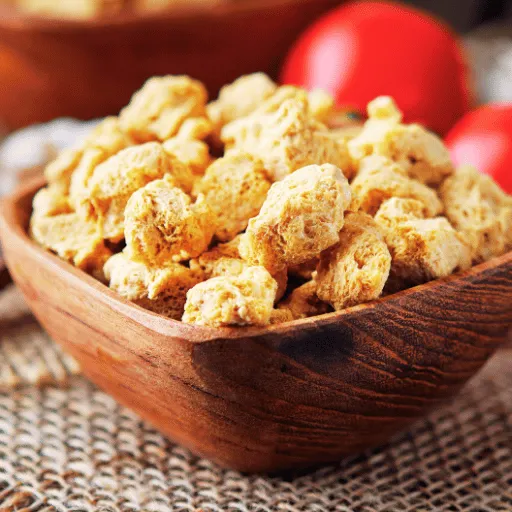
From Bean to Protein: The Industrial and Culinary Science of Making Soya Meat

To make soya meat—commonly known as textured vegetable protein (TVP)—you must first rehydrate the dry granules to achieve a fibrous, meat-like consistency. By simmering the soya chunks in a seasoned broth or soaking them in boiling water for approximately 10 to 15 minutes, the proteins expand and soften. Once hydrated, squeezing out excess moisture allows the soya to better absorb marinades and savory spices during the final sautéing or braising process.
What exactly is the “meat” in soya meat?
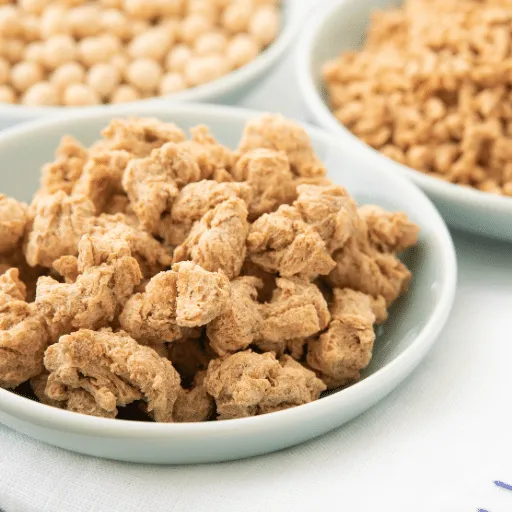
Soya meat isn’t a single biological product, but rather the result of a high-pressure mechanical process known as extrusion. At its core, the “meat” is defatted soy flour—a byproduct of soybean oil extraction. In an industrial setting, this flour is fed into an extruder where it is subjected to temperatures often exceeding 145°C. This intense heat and friction force the globular soy proteins to uncoil and realign into long, linear strands.
The result is a fibrous, spongelike matrix that mimics the muscle architecture of beef or chicken.
Industry observations suggest that the quality of the final “bite” depends almost entirely on the protein-to-fiber ratio during this phase. If you look closely at a rehydrated chunk, you’ll see tiny longitudinal ridges; these are the physical pathways that allow the material to trap up to three times its weight in liquid. Without this specific structural realignment, you would just have a soft soy paste rather than a satisfying, chewy protein.
The Essential Pre-Processing Phase
Before any extrusion happens, the raw soybean must undergo a total physical transformation. You cannot simply grind a bean and expect it to behave like meat; the chemical composition is too heavy in fats and fibers that interfere with the texturization process. In industrial lines, this phase is a high-speed sequence of purification and refinement.
Consistency starts here. If the initial processing is sloppy, the final soya chunks might turn out crumbly or fail to hold a marinade. Manufacturers often monitor moisture levels with extreme precision—sometimes down to a variance of only 0.5%—to ensure the raw material is primed for the mechanical stress of the extruder.
Cleaning and Dehulling the Beans
The process begins by stripping away everything that isn’t pure protein. Raw soybeans arrive with dirt, stems, and a tough outer skin called the hull. If left in the mix, these hulls create dark specks and a gritty mouthfeel that ruins the “meat” illusion.
Powerful magnets first pull out metallic debris, followed by vibrating screens that sift out stones. Once clean, the beans are slightly cracked. This cracking makes the hulls brittle enough to be sucked away by air aspiration. It’s a loud, violent stage, but it leaves behind the “meaty” yellow cotyledons that contain the essential building blocks for the final product.
Oil Extraction and the Creation of Defatted Soy Flour
This is where the bean loses its identity as a vegetable. Soybeans naturally contain about 18.5% oil, which is far too much for making soya meat. If you tried to texturize a full-fat bean, the oil would act as a lubricant in the machine, preventing the proteins from stretching and bonding.
To solve this, the cracked beans are flattened into thin flakes to increase their surface area. These flakes go through a solvent extraction process—or occasionally a mechanical press—to pull the oil out. What remains is a high-protein “white flake.”
Once the residual solvent is toasted off, the flakes are milled into a fine, defatted soy flour. This powder is the actual raw material for soya meat. It is incredibly thirsty and protein-dense, usually boasting a protein content of 50% or higher. Without this rigorous removal of fats, the fibrous, chewy “muscle” structure we expect simply wouldn’t form during the cooking process.
4 Critical Stages of the Extrusion Process
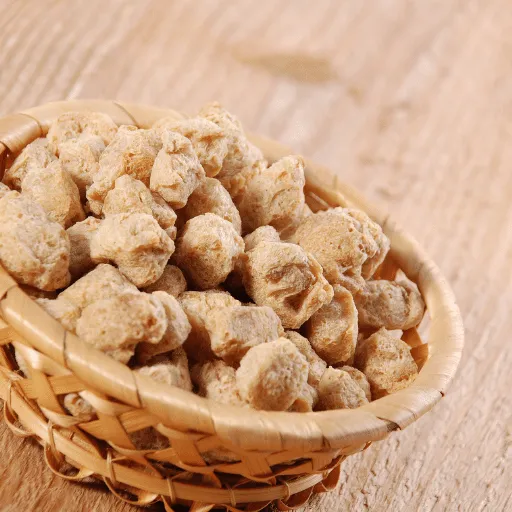
The extruder is essentially a high-pressure digestive system for plant proteins. It takes the dry, defatted soy flour and subjects it to a brutal combination of moisture, heat, and mechanical shear. This isn’t just mixing; it’s a structural overhaul. In most industrial setups, the flour enters the barrel with a water injection rate calibrated to reach a moisture content of roughly 22% to 28%.
Once inside, a rotating screw—sometimes two in a “twin-screw” configuration—forces the material through a tightening corridor. This restricted flow creates friction, which rapidly elevates the temperature without the need for traditional heating elements. This is where the magic of texturization happens. If the pressure drops even slightly, the “meat” may end up soft and porous rather than dense and chewy.
Thermoplastic Transformation
As the soy dough travels down the extruder barrel, it undergoes thermoplastic transformation. This is a fancy way of saying the proteins melt and fuse. Under extreme heat—often peaking around 162°C—the globular soy proteins physically uncoil.
Imagine it like a ball of yarn being pulled into single, straight threads. These threads then realign into a parallel orientation. This process, often called “cross-linking,” creates the longitudinal fibers that give soya meat its characteristic “pull.” Without this specific thermal event, the end product would have the crumbly texture of a cookie instead of the fibrous resistance of a steak. It is a delicate balance; if the temperature climbs too high, the protein can scorch, leading to a bitter, burnt aftertaste that no amount of marinade can fix.
Shaping via Die Plates
The final hurdle is the die plate. This is a heavy metal disc at the very end of the extruder with specific holes drilled into it. As the molten soy mass is forced through these openings, it experiences a massive, instantaneous drop in pressure.
This sudden “flash” causes the internal moisture to turn into steam, expanding the product into its final airy, cellular structure. The shape of the hole determines whether you get “chunks,” “mince,” or “slices.” Practical examples from the factory floor show that the speed of the rotating cutter blade at the die face is what dictates the length. A blade spinning at 2,400 RPM will produce fine granules, while a slower rotation results in the larger chunks typically found in stews.
Achieving the Fibrous Texture That Mimics Animal Muscle
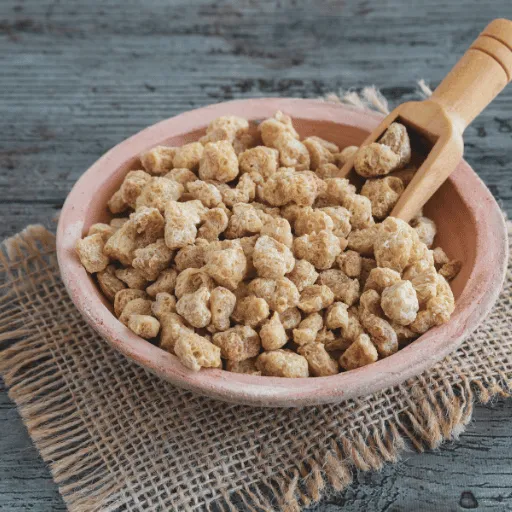
To get that distinct, stringy resistance associated with a piece of chicken or beef, the soy protein must undergo a total architectural redesign. It isn’t enough to just heat the dough; you have to physically stretch the molecules. In the world of industrial extrusion, this is governed by “laminar flow.” As the soy mass moves through the cooling die, the outer layers of the dough move slower than the core due to friction against the metal walls. This velocity gradient forces the protein chains to align in parallel rows.
Without this alignment, the texture would be spongey or rubbery—a common failure in lower-end production lines. Industry observations suggest that maintaining a specific moisture-to-pressure ratio is the only way to prevent the fibers from snapping. If the internal pressure deviates by as little as 4.2 bars, the “muscle” strands may fail to knit together, resulting in a product that dissolves into mush when boiled.
Consider a practical scenario: a manufacturer wants to create a “pulled pork” analogue. They will specifically tune the extruder to create long, distinct striations. This is achieved by using a specialized “long cooling die” that can extend over 2 meters. By gradually lowering the temperature while the material is still under high pressure, the protein strands “set” into a permanent, fibrous state. This ensures that when the end consumer shreds the product, it peels apart in natural-looking layers rather than breaking into geometric cubes. It’s a delicate mechanical dance that turns a humble bean into something that behaves remarkably like animal tissue.
Post-Extrusion: Drying and Cooling
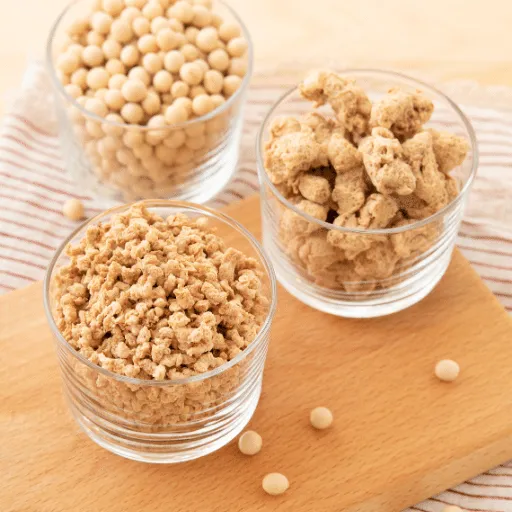
The moment the soya meat leaves the die, it is vulnerable. It emerges as a hot, puffed material with a moisture content often hovering around 25%. If you were to package it immediately, the residual heat would create a breeding ground for mold, ruining the entire batch within days. Instead, the product is moved onto a continuous multi-stage dryer.
Here, forced air—usually heated to between 82°C and 94°C—circulates around the chunks. This isn’t just about removing water; it’s about structural integrity. As the moisture drops, the cellular walls of the soya meat harden, transitioning from a soft, pliable foam into a shelf-stable, crunchy solid. Only after the temperature is brought down to ambient levels via cooling fans is the product ready for the scale.
Moisture Stabilization
Getting the water content down to a precise 8% or 10% is the industry standard for long-term storage. This specific range is narrow for a reason. If the product is too dry (below 5%), it becomes brittle and shatters into “fines” during shipping, leaving the customer with a bag of dust. Conversely, anything above 12% moisture risks spoilage. Stabilization ensures that when the soya meat is eventually rehydrated, the internal pores open up uniformly, preventing the center from remaining hard while the outside turns mushy.
Culinary Application
Once the soya meat reaches the kitchen, the manufacturing process pays off. Because the extrusion process created those specific longitudinal fibers, the dry chunks behave like a thirsty sponge.
In a practical scenario, a cook might simmer these chunks in a dark, seasoned vegetable stock for 12 minutes. During this time, the “meat” can absorb roughly 2.7 times its weight in liquid. Because the proteins were cross-linked under high pressure, they don’t dissolve. Instead, they swell, reclaiming the chewy, elastic texture developed in the extruder. Whether you are flash-frying them for a crispy exterior or slow-braising them in a curry, the structural “memory” of the extrusion phase ensures the bite remains satisfyingly firm.
Common Industrial Challenges: Why some soya meat turns out spongy rather than chewy
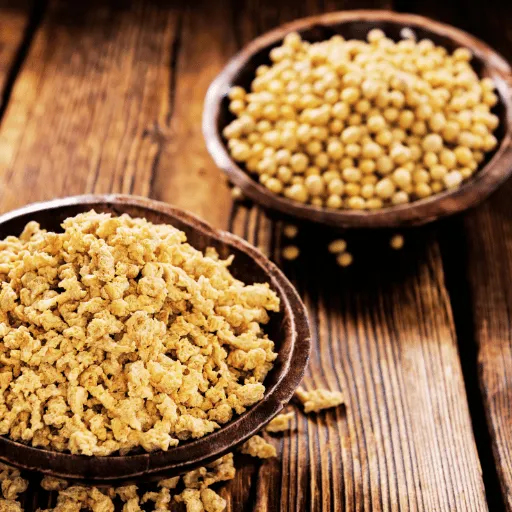
Achieving that elusive “meat-like” bite is a delicate balance of physics and chemistry. When the process fails, you end up with a porous, sponge-like material that collapses under the tooth. This lack of resistance usually points to a breakdown in the fibrous matrix. If the proteins don’t knit together tightly enough, they form large, erratic air pockets instead of organized strands. Industry observations suggest that even a minor deviation in raw material quality—such as using soy flour with an inconsistent particle size—can prevent the dough from reaching the necessary viscosity for proper texturization.
Managing Protein Denaturation
For the soy to behave like muscle, the proteins must denature at just the right moment. This is a heat-dependent transformation. In a realistic scenario, if the barrel temperature lingers too low—perhaps around 115°C instead of the target 140°C—the globular proteins only partially uncoil. They remain “clumpy” rather than forming long, linear chains. Conversely, excessive heat can lead to “over-denaturation,” where the protein bonds become so brittle they snap during the expansion phase. This results in a product that feels sandy or gritty. Finding that specific thermal sweet spot is what separates premium soya chunks from budget-grade fillers.
Pressure Fluctuations
Stability is everything inside the extruder. If the internal pressure drops by as little as 3.8 bars, the melt loses its “laminar flow,” which is essential for aligning those fibers. These dips often occur due to inconsistent feeding of the dry flour or a worn-out screw tip. When pressure fluctuates, the product emerges with an uneven density—some parts might be pleasantly chewy, while others are hollow and fragile. This inconsistency is a nightmare for commercial packaging, as the lighter, spongier pieces tend to break during transport.
The Role of Steam Injection
Steam isn’t just for heat; it’s a plasticizer. By injecting precise amounts of saturated steam directly into the pre-conditioner or the extruder barrel, operators can control how much the “dough” expands as it exits the die.
Too much steam injection tends to over-inflate the product, creating a structure that is far too airy—basically a soy marshmallow. However, if the steam is insufficient, the product may fail to expand at all, turning into a hard, indigestible nugget. Professionals carefully calibrate the steam-to-water ratio to ensure the cellular walls of the soya meat are thick enough to provide a realistic, chewy resistance when bitten.
FAQ
Q: Is soya meat the same as tofu or tempeh?
While all three originate from soybeans, they differ significantly in texture and production. Tofu is a coagulated soy milk curd, and tempeh is a fermented whole-bean cake. Soya meat, however, is a highly processed “textured vegetable protein” created through extrusion. This mechanical process realigns soy proteins into long, fibrous strands that mimic animal muscle, providing a chewy, steak-like resistance that tofu and tempeh simply cannot replicate.
Q: How long does dry soya meat stay shelf-stable?
Because industrial drying reduces the moisture content to below 10%, dry soya meat is incredibly resilient. When stored in a cool, dark environment within an airtight container, it can remain perfectly safe and flavorful for 12 to 24 months. Its lack of fats—removed during the oil extraction phase—prevents the product from going rancid, making it an ideal long-term pantry staple for plant-based cooking.
Q: Can you make soya meat at home without industrial extruders?
Strictly speaking, you cannot replicate the fibrous, “muscle” texture of commercial soya meat in a standard kitchen. The specific “chew” requires an extruder to apply extreme pressure and temperatures exceeding 140°C. You can create soy-based “seitan” or boiled soy flour doughs at home, but these will lack the longitudinal fibers and airy, sponge-like pores that allow industrial soya meat to absorb large amounts of broth or marinade.
Q: What is the difference between TVP and TSP?
These terms are often used interchangeably in culinary contexts, but they refer to the same fundamental product. TVP stands for Textured Vegetable Protein, a trademarked name, while TSP stands for Textured Soy Protein. Both are produced from defatted soy flour via extrusion. The only practical difference you might encounter in the market is the specific shape—granules, chunks, or slices—rather than any variation in the underlying chemical or nutritional composition.
Q: Does the protein content change during the extrusion process?
The total amount of protein remains largely the same, but its physical structure is permanently altered. During extrusion, the globular proteins denature and cross-link into a fibrous matrix. This makes the protein more bioavailable in some cases, though the high heat can slightly reduce the levels of heat-sensitive amino acids like lysine. Generally, the finished product remains a protein powerhouse, consisting of roughly 50% to 52% protein by weight.