
Crafting the Perfect Infusion: A Technical Guide to Mastering Industrial and Artisanal Tea Blending

Mastering how to make tea blends requires a deliberate balance between a structural base leaf and specific aromatic accents. The process begins by selecting a foundation—such as a robust black or delicate green tea—and layering it with botanical catalysts that bridge disparate flavor notes. Achieving batch consistency depends on using precise weight-based ratios and aligning particle sizes to ensure the final infusion delivers a uniform sensory profile in every cup.
The Architecture of a Blend
Think of a tea blend as a three-dimensional structure rather than a simple mixture. It is an exercise in structural engineering where the goal is to ensure that the top, middle, and base notes do not collapse into a muddy profile the moment hot water hits the leaves. Industry observation reveals that many initial blending attempts fail because of “flavor crowding”—adding too many high-intensity ingredients that compete for the same space on the palate.
Identifying the base, accent, and catalyst notes
Most professional formulations rely on a tiered hierarchy to maintain consistency. The base typically constitutes 60% to 85% of the total weight. This is your “workhorse” leaf—perhaps a bold Assam or a grassy Sencha—that provides the caffeine and body.
Next are the accents, the ingredients that give the blend its specific name and personality, such as dried cornflowers or citrus peel. Finally, the catalysts act as the “connective tissue.” These are ingredients like a hint of dried ginger or a fraction of peppermint. They may not be identifiable by name in the final cup, but they serve to brighten the accents. A practical example is using a tiny amount of hibiscus; it often isn’t there for the flavor, but to provide the acidity necessary to make a dull berry note “pop.”
Balancing astringency with botanical sweetness
Astringency is often confused with bitterness, but in blending, it provides the necessary “grip” or structure on the tongue. However, high-tannin teas need a counterweight to remain palatable. Botanical sweetness does not involve sugar; rather, it utilizes ingredients like licorice root, fennel, or honeybush.
These components tend to have a coating effect that softens the sharp edges of a brisk tea. In a realistic scenario, if a second-flush Darjeeling feels too “thin” or biting, a 5% inclusion of rose petals can introduce a perceived sweetness. This rounds out the mouthfeel without obscuring the tea’s natural terroir. It’s about creating a tension between the dry and the lush that feels intentional and complete.
Selecting the Foundation
Selecting the foundation isn’t just a matter of taste; it’s a matter of physics. Your base leaf provides the “ballast” for the entire blend. Industry observation suggests that most commercial failures stem from a mismatch in leaf grade rather than a clash of flavors. If you choose a delicate, high-grown leaf as your primary component, it may be completely overwhelmed by even a small percentage of peppermint or citrus oil.
A practical example: a robust CTC (Crush, Tear, Curl) black tea from Assam, often making up around 68% of a chai formulation, provides the necessary “tannic backbone.” This specific grade ensures the blend doesn’t disappear when the customer adds milk. Conversely, when working with white teas, the foundation is fragile. Using a Silver Needle base requires a lighter hand with accents—perhaps only 12% to 15% inclusions—to keep the tea from losing its identity. You aren’t just mixing ingredients; you are balancing the extraction rates of diverse materials to ensure they peak at the same moment in the cup.
4 Critical Steps to Achieving Batch Consistency in Commercial Blending
Moving from a kitchen scale to a 500kg batch introduces variables that can ruin a brand’s reputation overnight. Commercial blending isn’t just about the recipe; it’s about mechanical repeatability. If your Tuesday batch tastes different from your Friday batch, you lose the customer. The goal is to eliminate the “human element” of estimation and replace it with rigorous, data-driven protocols that account for the physical behavior of organic materials.
Volumetric vs. weight-based measurements
Many beginners try to measure by the “cup” or “scoop.” This is a recipe for failure. A liter of fluffy White Peony weighs significantly less than a liter of dense Gunpowder green tea. Industry observation shows that even ambient humidity can change leaf volume by 3.2% to 4.8% without changing the weight. Professional operations stick strictly to mass. Scales calibrated to 0.1g precision are standard for high-value botanical inclusions, ensuring that a 25kg sack of base tea receives the exact milligram count of concentrated flavoring or dried blossoms required for a uniform profile.
Managing particle size and “The Sifting Problem”
This is perhaps the most overlooked technical hurdle in the tea world. If you blend a large-leaf Oolong with fine-cut peppermint, physics will work against you. During shipping and vibration, smaller particles migrate to the bottom—an effect known as granular segregation or “the sifting problem.”
A realistic scenario: the top of the retail tin tastes like pure Oolong, while the bottom is an overwhelming mint silt. To prevent this, professional blenders aim for particle size parity. They may use a specialized mill to break down larger botanicals to match the leaf size. In some cases, a “sticky” binder—often a liquid flavor carrier—is utilized to help smaller bits adhere to the larger leaves, effectively “locking” the blend in place.
The 70-20-10 Ratio Rule for Balanced Formulations
Think of this as a structural heuristic for creating a repeatable flavor. 70% is your base (the tea leaf), 20% is your supporting botanical (e.g., lemongrass), and 10% is your high-impact highlight (e.g., lavender). This 10% is where the danger lies; ingredients like hibiscus or cloves can easily hijack the profile if they creep toward 15%. This specific ratio tends to offer the most stability across diverse water types—from soft mountain water to hard municipal taps—ensuring the “signature” taste remains intact regardless of where the customer brews it.
How does industrial mixing equipment prevent leaf breakage during the blending cycle?
Maintaining the visual integrity of a whole-leaf tea while introducing heavy botanicals like dried apple pieces or cinnamon sticks is a mechanical tightrope walk. If you use a standard high-speed ribbon blender, the metal paddles often act like shears, pulverizing the delicate tea leaves into “fannings” or dust. This ruins the premium aesthetic and causes the tea to over-extract and turn bitter almost instantly. To solve this, industry observation points toward low-impact, tumble-style mixing.
A practical example is the use of a rotating drum or a “V-blender.” These machines rely on gravity rather than mechanical force. As the vessel slowly rotates—typically at a controlled 5 to 12 revolutions per minute—the ingredients slide and fold over one another. This gentle cascading motion ensures a homogenous mix without the bruising associated with high-shear blades.
In a realistic scenario, a processor might even utilize “gentle-flow” baffles inside the drum. These internal fins are polished to a mirror finish to reduce friction. They lift the product and let it drop softly, ensuring that even brittle cornflower petals remain intact. By prioritizing “diffusion” over “convection,” manufacturers can produce massive 450kg batches that look as if they were hand-mixed in a small ceramic bowl.
Sensory Validation
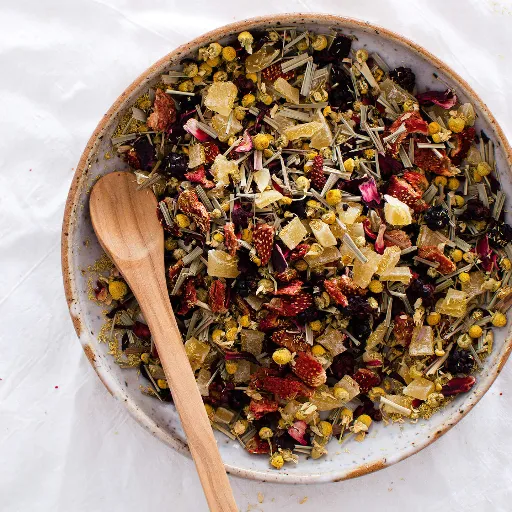
Data and ratios only get you halfway; the final arbiter is always the palate. In a professional setting, sensory validation isn’t about whether a tea tastes “good,” but whether it is technically accurate to the target profile. Industry observation suggests that even a minor 2% shift in the moisture content of a dried botanical can radically alter the volatile aromatics during infusion. You are looking for flaws—specifically, “flavor gaps” where the transition from the mid-palate to the finish feels hollow.
A realistic scenario involves testing the blend against different water hardness levels. A blend that shines in a soft-water lab might taste metallic or flat in a city with high calcium carbonate levels (e.g., 210 mg/L). Validation ensures the structure holds up under real-world brewing conditions, where the consumer might ignore steep times or use water that is slightly off-boil.
The professional cupping protocol for new formulations
Unlike a casual tea party, the protocol requires consistency: exactly 2.8g of tea per 150ml of water, infused for precisely 3 to 5 minutes depending on the base.
A practical example of this rigor is the “slurp.” By forcefully inhaling the tea from a shallow spoon, you aerate the liquid, spraying it across all taste receptors simultaneously. This high-velocity oxygenation helps identify if a floral accent is too “soapy” or if the base tea’s astringency is overpowering the delicate notes. Testers often wait for the liquor to cool to roughly 42°C; as the heat dissipates, subtle off-notes or clashing oils that were masked by steam become much more apparent.
Essential Considerations for Flavor Sequestration and Shelf-Life Extension
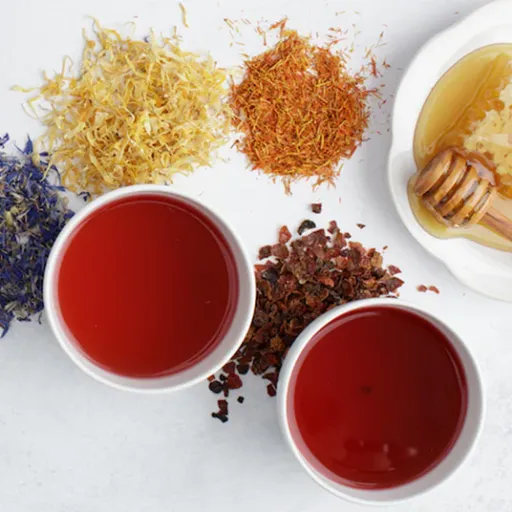
Creating a masterpiece blend is only half the battle; keeping those volatile aromatics from migrating or dissipating is the technical “endgame.” Tea is highly hygroscopic. It acts like a sponge, pulling moisture and stray odors from its environment. Industry observation suggests that the primary cause of flavor degradation isn’t actually age, but cross-contamination between ingredients within the same bag. When you mix a high-intensity oil, like bergamot, with a porous base leaf, the oil begins to penetrate the cellular structure of the tea immediately.
Sequestration is the process of locking these flavors down. A practical example is the use of encapsulated flavor granules instead of liquid sprays. These microscopic beads only dissolve when they hit 80°C water, preventing the “scent bleed” that often occurs in warehouse storage. In a realistic scenario, an improperly sealed jasmine blend stored near a pungent smoked Lapsang Souchong will be ruined within 48 hours.
Maintaining a stable shelf life requires a moisture content typically between 3.4% and 5.7%. Anything higher risks mold; anything lower makes the leaves brittle and “dusty.” High-barrier packaging, such as tri-laminated foil with a one-way degassing valve, tends to be the gold standard. This prevents oxygen from turning the delicate fats in botanical inclusions—like dried nuts or cocoa nibs—rancid, ensuring the 50th cup from the batch tastes exactly like the first.
FAQ Section
Q: What is the best base tea for a floral blend?
Selection depends on the desired “weight” of the infusion. For ethereal, light profiles, a White Peony (Bai Mu Dan) or a light-oxidized Baozhong Oolong provides a subtle, creamy canvas that doesn’t compete with delicate petals. If you want a punchier, “English Garden” style, a bright Nilgri or a woody Keemun black tea offers the necessary tannins to anchor heavy aromatics like rose or lavender without muddying the floral high notes.
Q: How do you keep ingredients from separating in the bag?
This is primarily a physics problem known as the “Brazil Nut Effect.” To prevent smaller botanicals from sifting to the bottom, you must match the particle size of your accents to the leaf grade of your base. If the sizes are mismatched, adding a tiny amount of food-grade vegetable glycerin or a liquid flavor carrier can act as a light adhesive. This helps the smaller herbs “stick” to the larger tea leaves during transit.
Q: Can you use fresh herbs in dry tea blends?
Generally, no. Fresh herbs possess high water activity levels that will inevitably lead to mold growth and spoilage within the sealed environment of a tea tin. For a shelf-stable product, all inclusions must be dehydrated to a moisture content below 10%. If you want that “fresh” impact, look for freeze-dried botanicals; they retain the vibrant color and volatile essential oils of the living plant while remaining safe for long-term dry storage.
Q: How long should a new blend rest before its first tasting?
Patience is a technical requirement in blending. After mixing, a batch should “marry” for at least 24 to 48 hours in an airtight container. This resting period allows the essential oils and varied aromatics to migrate and stabilize across the base leaves. If you cup the tea immediately after mixing, the flavors often taste disjointed or “top-heavy.” A two-day rest ensures a more cohesive, rounded profile that reflects the true final character.
Q: What prevents essential oils from clumping in large-scale tea mixing?
Industrial processors utilize “intensifier bars” or high-speed choppers within a low-speed tumble mixer to atomize liquid additions. By spraying the oils through a fine pressure-nozzle while the tea is in a state of “fluidized” motion, the liquid is distributed as a microscopic mist. This prevents localized saturation—where one clump of leaves is soggy while others are dry—ensuring that the flavor remains uniform across a 500kg production run.
Q: Is there a limit to how many ingredients you should include in one blend?
While there is no hard law, industry wisdom suggests a “Rule of Five.” Once you exceed five distinct ingredients, the individual characteristics begin to blur into a generic “botanical” flavor. Sophisticated blending is about clarity and intent. Usually, one base, two primary accents, and one or two “catalysts” (like a pinch of ginger or hibiscus for acidity) create a much more memorable and repeatable sensory experience than a crowded recipe.