
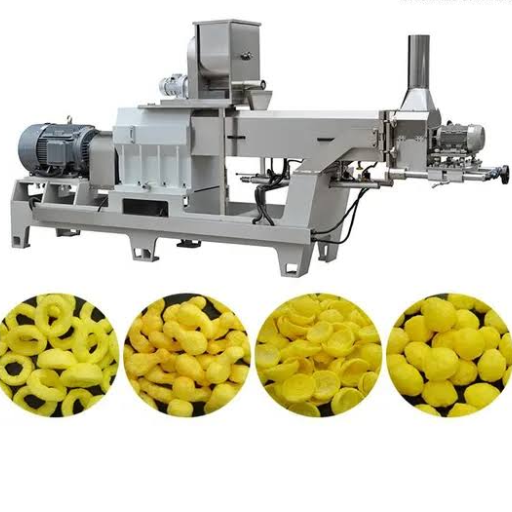
Industrial Food Extrusion Line: Equipment & Setup Guide

An industrial food extrusion line is a continuous production system built from six connected stages: mixing, feeding, extrusion, drying or frying, flavoring, and packaging. Here’s how each stage fits together, how to size the line, and how to lay it out so it runs food-safe and on schedule.
Key Takeaways
- A complete line follows a six-stage chain: mixer, feeder, extruder, dryer or fryer, flavoring drum, and packaging, with conveying between each stage.
- Size the dryer and packaging around the extruder output, not the other way around. Downstream stages are the most common bottleneck.
- Layout is material flow, not just floor space. Linear, U-shaped, and L-shaped patterns each suit different workshop shapes and product volumes.
- Food-safe stainless steel (SUS 304 or 316) must cover every product-contact stage, not just the extruder.
- A turnkey line from one manufacturer cuts integration risk, warranty gaps, and commissioning delays compared to assembling components from multiple vendors.
Introduction
Imagine this: your new extrusion line is installed, the operator presses start, and everything works, until the dryer. The extruder is putting out 300 kilograms an hour, but the dryer can only handle 200. Within a week, product is backing up on the conveyor, and the line that was supposed to double your output is running at two-thirds speed.
That scenario plays out in food plants more often than most project managers admit. The extruder gets all the attention during specification, while the rest of the line is treated as an afterthought.
But an industrial food extrusion line is a system, not a list of machines. Get the material flow right, and the individual machines take care of themselves. Get it wrong, and every stage drags down the one after it.
This guide walks you through the complete equipment chain, shows you how to plan capacity, design the layout, and keep the line hygienic and compliant. By the end, you’ll know exactly what belongs in your line and how to spec it with confidence.
What Is an Industrial Food Extrusion Line?
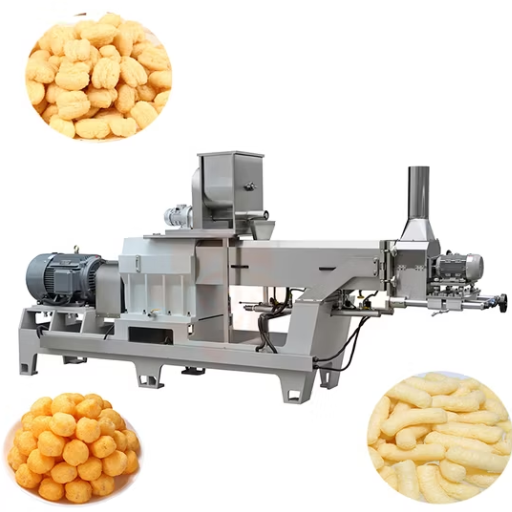
Think of an industrial food extrusion line as a continuous, automated production system that turns raw ingredients into cooked, shaped food through a sequence of integrated machines, typically a mixer, feeder, extruder, dryer or fryer, flavoring drum, and packaging unit, arranged in one flow from raw material handling to finished product.
The key word is continuous. Unlike batch processing, where each step happens in a separate vessel and material moves in stops and starts, a modern extrusion line keeps product moving. Ingredients enter one end, and finished, packaged product leaves the other, often without ever stopping.
That continuous flow is why extrusion lines scale so well. A single-screw line suits simple, high-starch, low-fat products like puffed corn snacks. A twin-screw line handles more complex recipes, including high-protein pet food, textured plant protein, and modified starch, because it mixes and cooks more uniformly across a wider moisture window.
Want a refresher on the difference? See our single screw vs twin screw extruder comparison before you commit to a line type.
The Complete Extrusion Line: Six Stages, From Mixer to Packaging
Every complete food extrusion line follows the same skeleton, with product-specific stages added in the middle. Here’s the chain, stage by stage.
- Raw material handling and mixing. Flours, grains, and dry ingredients are metered into a powder mixer with water and additives. Uniform mixing here decides texture, moisture, and cooking quality downstream.
- Feeding and conveying. Volumetric or loss-in-weight feeders deliver a steady stream into the extruder, with screw elevators or air conveyors moving material between stages.
- Extrusion and shaping. The single- or twin-screw extruder cooks, plasticizes, and shapes the product through a die, then a cutter sets the piece size. This is the process heart.
- Drying, baking, or frying. Multi-layer hot-air dryers, roasters, or continuous fryers remove moisture and crisp the product. This is where most lines bottleneck.
- Flavoring and coating. A rotary flavoring drum applies oil, syrup, or powder seasoning evenly across the pieces.
- Cooling and packaging. Cooling conveyors bring the product to room temperature before it enters an integrated packing machine.
| Stage | Machine | Function | Key consideration |
|---|---|---|---|
| Mixing | Powder mixer, dosers | Blend dry ingredients, water, additives | Uniform preconditioning sets downstream quality |
| Feeding | Loss-in-weight feeder, elevators | Meter steady material flow | Consistent feed rate avoids surging |
| Extrusion | Single- or twin-screw extruder, die, cutter | Cook, shape, cut the product | Core of the line; size first |
| Drying/frying | Multi-layer dryer, roaster, fryer | Remove moisture, crisp texture | Most common throughput bottleneck |
| Flavoring | Rotary coating drum | Apply oil, syrup, seasoning | Even coating, minimal waste |
| Packaging | Packing machine | Seal and package finished product | Match speed to line output |
Here is how a real project comes together. When a Southeast Asian snack producer scaled from a single twin-screw extruder to a complete fried snack production line, the engineers sized a shared dryer and flavoring drum to absorb the output of two extruders running 400 kilograms an hour combined. The result was one coordinated line instead of two half-finished ones.
Capacity Planning: Sizing Your Food Extrusion Line
The single most common mistake in food extrusion line design is sizing equipment in isolation. A buyer specifies the extruder by its rated output, then picks a dryer and packaging machine that “should be fine.” They rarely are.
The rule is simple: start from your required finished-product output, then size every upstream and downstream stage around the extruder’s real throughput.
Think about the numbers. A compact snack food extrusion line might run 100 to 150 kilograms per hour with around 70 kilowatts of installed power. An industrial cereal or pet food line can push 400 to 500 kilograms per hour or more, drawing 200 kilowatts and spanning 20 to 49 meters in length.
The bottleneck is almost never the extruder. It’s the dryer, which needs residence time to remove moisture, or the packaging machine, which can only seal so many bags a minute.
Consider Mike, an operations director at a midwestern breakfast cereal plant. He specified a twin-screw extruder rated for 450 kilograms an hour, then bought a dryer sized for 300. “I figured I would run the extruder a little slower,” he said. Six months later, the dryer was still the ceiling on every shift, and the expensive extruder spent a third of its time idle. The fix was a larger dryer and a packaging line matched to the real output, plus modular headroom to expand later.
Planning your first line? Our how to choose a twin screw extruder guide covers the sizing decisions that feed into capacity planning.
Food Extrusion Line Layout and Space Design
Food extrusion line layout is where good lines succeed and average lines leak money. A well-designed layout shortens material-handling distance, keeps operators safe, and leaves room for washdown and maintenance.
Three patterns cover most installations:
- Linear flow. Machines arranged in one straight line. Simple and predictable, ideal for long, narrow workshops and single-product lines.
- U-shaped flow. The line folds back on itself so the raw-material inlet and finished-product outlet sit near each other. This cuts walking distance and works well in square or wide rooms.
- L-shaped flow. A right-angle bend fits a line into an awkward footprint or separates wet and dry process areas for hygiene.
The flow should follow the material, not the wall. Raw materials enter at one end, travel through each stage without doubling back, and exit as finished product. Utilities, power, water, steam, and compressed air, run along the line’s path, while operators need clear access aisles and a dedicated washdown zone.
Space adds up fast. A modest pellet line might stretch 32 meters, while a large twin-screw cereal line can run 48 meters or more. Before you commit, have your supplier produce a scale layout drawing that plots equipment, utilities, and both material and personnel flow. This step is the heart of how to set up a food extrusion line that runs clean and on schedule.
A dairy-coproduct manufacturer in Europe learned this the hard way. Their first layout was a straight line that barely fit the building, leaving the flavoring drum unreachable for cleaning. Re-engineering it into a U-shape reclaimed 30% of the floor and cut material-handling time by a quarter, all without changing a single machine.
Hygiene, Materials, and Compliance Across the Line
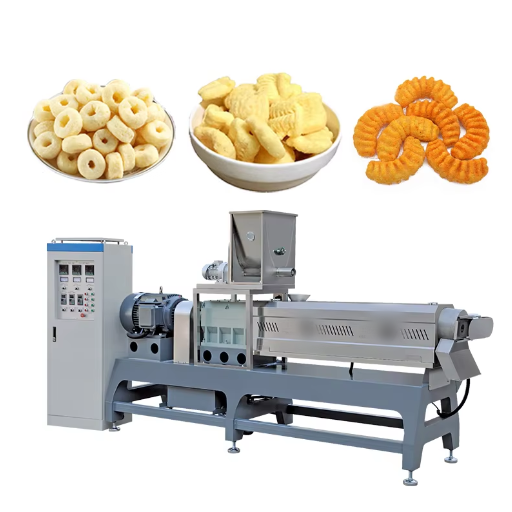
Hygiene is not an extruder problem. It’s a food extrusion line problem. Product touches the mixer, the feeder, the conveyor, the dryer belt, and the flavoring drum, and every one of those surfaces has to be cleanable.
Food-contact surfaces should use food-safe stainless steel throughout. SUS 304 stainless is the workhorse for general food contact, offering corrosion resistance and cleanability at a sensible cost. SUS 316 adds molybdenum for better resistance to salt and acid, which makes it the right choice for high-salt snack seasoning or acidic product streams.
Beyond materials, look for sanitary design at every stage: smooth, crevice-free welds, sloped surfaces that drain, and no dead zones where product or water can pool. Compliance flows from the same logic. CE marking and ISO alignment are not extras bolted on at the end; they are engineered into the frame, controls, and documentation from day one.
Ask any supplier two questions before you sign: which stages use SUS 316 versus SUS 304, and how is each stage cleaned, by washdown, CIP, or both? If the answer is vague, keep looking.
Integrating the Line: Control, Installation, and Scalability
A modern industrial food extrusion line is only as coordinated as its control system. Central PLC control with recipe management lets operators change product, temperature, and speed settings across the whole line from one panel, while variable-frequency drives keep every stage running in sync.
That integration is where turnkey delivery earns its cost. A turnkey supplier handles process-flow design, layout drawings, installation, commissioning, and operator training under one scope. Instead of juggling four vendors and wondering whose machine is out of sync, you have one team accountable for the whole line.
Scalability should be designed in, not retrofitted. Modular equipment and spare capacity headroom let you add a second extruder, a larger dryer, or an extra packaging lane later without ripping out the line. The cheapest time to build in that headroom is before the concrete is poured.
Ready to see how a complete line comes together? Explore our food extrusion solutions or request a custom line layout and quote.
Turnkey Line vs. Assembling Components Yourself
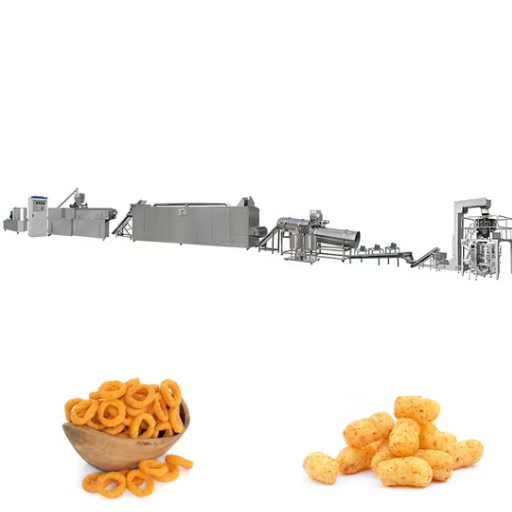
There’s a real decision between buying a turnkey food extrusion line and assembling one from separate vendors, and it’s not just about price.
A turnkey line from one manufacturer means compatible equipment, a single warranty, one control platform, and a supplier who owns the whole result. Assembly from multiple vendors can save money up front, but you absorb the integration work, and when the dryer and extruder do not communicate, each vendor points at the other.
For high-volume, high-stakes production, the turnkey route usually wins. For a small pilot or a niche product, a carefully assembled line built around a strong extruder can work if you have engineering resources in-house.
The founder of a plant-based protein startup put it bluntly: “We saved 15% assembling the line ourselves, then spent 18% of that on integration consultants and three weeks of downtime.” For their second facility, they bought the line complete.
If you are still weighing the options, start from the core machine and work outward. The twin screw extruder machine guide is the right place to begin.
FAQ
What equipment makes up an industrial food extrusion line?
A complete line typically includes a mixer, feeder, single- or twin-screw extruder, dryer or fryer, flavoring drum, and packaging machine, connected by conveyors.
How much does an industrial food extrusion line cost?
Cost depends on capacity, line length, automation, and materials. Small lines run from tens of thousands of dollars, while high-capacity turnkey systems can exceed several hundred thousand. A custom quote based on your output and product is the only reliable figure.
How much space does a food extrusion line need?
Compact lines can fit in 20 meters or less, while large cereal or pet food lines can span 48 meters or more. Layout pattern and product volume determine the final footprint.
What is the difference between a single-screw and twin-screw extrusion line?
A single-screw line suits simple, high-starch products like puffed snacks. A twin-screw line handles complex, high-protein or high-fat recipes with better mixing and a wider moisture window.
How do I plan the capacity of my extrusion line?
Start from required finished-product output, then size the dryer and packaging to match extruder throughput, with headroom for future expansion.
Conclusion
An industrial food extrusion line is a system, and the companies that treat it that way get more output, fewer breakdowns, and cleaner compliance from the same equipment.
Here is the whole picture in five points. First, build the line as six connected stages, from mixing through packaging. Second, size the dryer and packaging around the extruder, because that is where bottlenecks hide. Third, design the layout as material flow, using the linear, U-shaped, or L-shaped pattern that fits your space. Fourth, extend food-safe stainless steel and sanitary design to every product-contact stage. Fifth, decide deliberately between a turnkey line and self-assembly, knowing that integration risk has a real price.
If you are planning a new line or upgrading an existing one, the next step is a conversation about your product, your target output, and your facility. A custom layout and quote turns the concepts in this guide into a line on your floor.
Ready to design your line? Contact us for a custom industrial food extrusion line layout and quote.