
The Industrial Blueprint: Reverse-Engineering the Perfect Instant Noodle Recipe

Developing a professional instant noodle recipe requires a precise balance of wheat protein development, alkaline salts ($Kansui$), and a controlled dehydration process. The goal is to create a porous noodle structure that can withstand long-term shelf storage while rehydrating into a firm, elastic texture in under three minutes. Success hinges on a sequential flow of steaming, waving, and flash-frying to lock in the starch matrix for rapid water absorption.
The Chemistry of “Instant” Rehydration

The “instant” nature of a modern instant noodle recipe isn’t just about cooking speed; it is a structural engineering feat. To achieve a 3-minute rehydration, the noodle must be incredibly porous. During production, moisture is rapidly driven out—either through flash-frying or high-heat air drying—leaving behind a microscopic skeletal network. When you add boiling water, these empty pathways act like tiny straws, pulling liquid into the center of the strand through capillary action. If the starch matrix is too dense, the water bounces off the surface, leaving the core hard and “wire-like.” Industry observation suggests that achieving a moisture content of exactly 10% to 12% in the final dried brick is the sweet spot for both shelf stability and rapid water uptake.
Role of Alkaline Salts in Noodle Elasticity
The distinct yellow hue and springy “snap” of an instant noodle come from Kansui, a specific blend of potassium carbonate and sodium carbonate. These alkaline salts shift the pH of the dough, which physically alters the wheat gluten.
In a practical example, this alkalinity tightens the protein network, making the noodles slippery and resistant to becoming mushy in hot broth. Without these salts, the dough tends to behave like standard pasta—expanding and softening too quickly. Cautious formulation is required here; too much carbonate can lead to a soapy aftertaste, while too little results in a fragile noodle that breaks during the packaging process.
Starch Retrogradation: Why Precision Cooling Matters
After the noodles are steamed but before they are dried, they enter a critical phase where temperature dictates texture. This is the window of starch gelatinization. If the noodles cool too slowly or unevenly, the starch molecules begin to realign into a rigid, crystalline structure—a process known as retrogradation.
A realistic scenario: if a production line’s cooling fans fail, the noodles may become excessively brittle or develop a “stale” mouthfeel even before they are packaged. Maintaining a controlled cooling environment, often around 22°C to 25°C, ensures the starch remains in a semi-flexible state. This precision allows the noodle to survive the “shock” of frying or drying without losing the ability to soften back into a silky, palatable strand once it hits your bowl.
Anatomy of the Dough

The foundation of any commercial instant noodle recipe isn’t just flour; it is a high-protein matrix designed to survive extreme industrial processing. Unlike a standard pasta dough that relies on slow drying, instant noodle dough must be extensible enough to be stretched into 0.7mm sheets without tearing. This requires a specific blend of wheat flour—usually a “semi-hard” variety—with a protein content hovering between 10.5% and 12.5%.
Industry observation suggests that if the protein drops below 10%, the noodles lack the “bite” or koshi required for a premium mouthfeel. Conversely, exceeding 13% can make the dough too tough to pass through the high-speed slitter rollers.
A practical example of formulation precision is the water absorption rate. In a large-scale facility, the hydration level is kept remarkably low, often between 32% and 35%. This creates a crumbly, “shaggy” mass rather than a smooth ball. This low-moisture approach is intentional; it prevents the dough from sticking to the rollers during the multiple sheeting stages and ensures the final steam-cooking step doesn’t turn the starch into a gummy paste. Cautious management of this ratio is what allows the noodles to hold their distinct, wavy shape throughout the frying and packaging stages.
The Flash-Frying vs. Air-Drying Debate
The defining characteristic of an instant noodle recipe is how it loses its water. In the industrial world, this isn’t just a drying step; it is a structural transformation. Flash-frying—the traditional method pioneered in the 1950s—submerges the noodle brick in oil at approximately 140°C to 160°C for about 100 seconds. This violent, rapid heat causes the water inside the dough to turn to steam and blast outward.
Air-drying, or “non-fried” processing, takes a more patient approach. The noodles travel through a high-velocity hot air chamber for 30 to 60 minutes. Industry observation suggests that while air-dried noodles are often perceived as “healthier” due to their lower fat content (typically around 1% to 2% compared to the 15% to 20% found in fried varieties), they lack the distinct savory depth that oil-immersion provides. Furthermore, the air-drying process often results in a denser noodle that requires a longer steeping time, sometimes up to five minutes, to fully soften.
Achieving 3-Minute Rehydration via Porosity
The secret to that iconic three-minute window is porosity. When noodles are flash-fried, the escaping steam leaves behind a labyrinth of microscopic “tunnels” where the water once resided. This makes the noodle brick behave like a dry sponge.
In a realistic scenario, a manufacturer adjusting their instant noodle recipe for a premium “quick-cook” line might increase the frying temperature by just a few degrees to create larger pores. However, they must be cautious; if the pores are too large, the noodles become fragile and shatter during shipping. A practical example of this balance is seen in cup-style noodles, which are often fried at slightly higher temperatures than bag-style noodles to ensure they rehydrate perfectly with just a pour of hot water, even without the residual heat of a stovetop boil.
4 Critical Variables for Scale-Ready Flavor Packets

A successful instant noodle recipe is often judged by the soup, but the engineering behind that powder is incredibly complex. Converting a liquid-based culinary tradition into a shelf-stable sachet requires a deep understanding of ingredient stability. Flavorists must account for how salt, MSG, sugar, and yeast extracts interact over an 18-month shelf life. If the seasoning isn’t perfectly balanced, the high-heat water used for rehydration can cause certain top-notes—like fresh ginger or scallion—to vanish or turn bitter. Industry observation suggests that the particle size of the salt itself can even affect how quickly the flavor “blooms” in the bowl.
Managing Moisture Activity in Dehydrated Aromatics
The biggest threat to a flavor packet isn’t time; it’s water. Even in a seemingly dry powder, “water activity” ($a_w$) must be kept below a specific threshold, typically 0.60 or lower, to prevent microbial growth and caking.
A realistic scenario: if the dehydrated chives in your mix have a slightly higher moisture content than the surrounding salt, they will migrate moisture until the entire packet clumps into a hard brick. To prevent this, manufacturers often use anticaking agents like silicon dioxide. A practical example of high-end formulation involves “plateauing” the moisture levels of different ingredients—garlic powder, chili flakes, and soy sauce solids—so they reach a state of equilibrium before they are ever sealed in the foil.
Emulsifiers: The Secret to a Silky Instant Broth
Ever wonder why some instant broths feel “thin” while others have a luxurious, creamy mouthfeel? The difference is usually a tiny amount of emulsifiers like lecithin or mono-and diglycerides. These additives bridge the gap between the water in your bowl and the tiny droplets of seasoning oil or fat included in the recipe.
In a professional instant noodle recipe, these agents ensure that the oil doesn’t just float in a single slick on top. Instead, they create a stable micro-emulsion that coats the noodles as you pull them from the broth. Without this subtle chemical help, the soup often tastes disjointed, with the saltiness hitting the tongue separately from the richness of the fats.
Why Steam Pre-Cooking is a Non-Negotiable Step

Steaming is the precise moment an instant noodle recipe transitions from a raw dough to a stabilized food product. Without this step, the subsequent drying or frying would simply result in a brittle, uncooked wheat stick. By exposing the noodle strands to saturated steam—typically at temperatures ranging from 98°C to 102°C—the starch granules within the flour undergo gelatinization. This physical change “sets” the noodle’s shape and internal structure, ensuring it doesn’t dissolve into a cloudy mess when you finally add hot water at home.
Industry observation suggests that a dwell time of approximately 120 to 180 seconds is standard for most thin-gauge noodles. In a realistic scenario, if the steam pressure drops even slightly, the core of the noodle remains raw. This “undercooked” center creates a phenomenon known as “white heart,” where the noodle stays hard and chalky regardless of how long it steeps in the bowl.
A practical example of the steam tunnel’s importance is the creation of the noodle “wave.” As the strands emerge from the slitter and hit a slower-moving conveyor belt, the steam softens them just enough to allow them to fold into that iconic zig-zag pattern. This wave isn’t just for looks; it creates the air gaps necessary for uniform drying and rapid rehydration. Failing to achieve the right degree of “cook” during steaming means the waves won’t hold, leading to a flat, dense brick that resists water penetration.
From Flour to Fork: The Sequential Manufacturing Flow
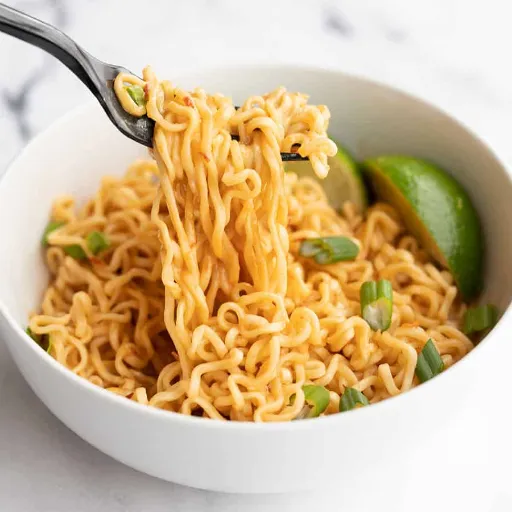
The journey of an instant noodle recipe through a factory is a race against starch degradation. Once the raw materials enter the vacuum mixer, the timeline is strict. The dough moves through a series of reduction rollers—usually six or seven pairs—that gradually compress the “shaggy” mass into a continuous, elastic sheet. This isn’t just about thinning the dough; the mechanical pressure aligns the gluten strands into a uniform direction. Industry observation suggests that skipping even one roller stage results in a “ragged” edge on the final noodle, which can break off and create “dust” in the packaging, leading to a poor consumer experience.
Slitting and Waving: Creating the Noodle “Brick”
The transition from a flat sheet to the familiar block happens at the slitter. A pair of grooved revolving cutters slices the sheet into thousands of individual strands. However, the speed of the conveyor belt immediately following the cutter is set significantly slower—often by a factor of 1.3 to 1.5—than the speed of the rollers themselves.
This speed differential forces the noodles to bunch up against each other, creating the “wave” or “curl.” In a realistic scenario, if the belt speed is too high, the noodles remain straight, which drastically reduces the surface area available for the steam tunnel to penetrate. The wavy structure ensures that the finished brick is mostly air, allowing boiling water to reach every strand simultaneously during rehydration.
Final Packaging and Atmospheric Control
Once the noodles are dried and cooled to roughly 28°C, they are ready for sealing. This is where the shelf-life of your instant noodle recipe is actually determined. Moisture is the enemy, but so is oxygen. To prevent the residual frying oils from going rancid, many high-speed lines use a nitrogen-flush system.
A practical example of this is the “pillow” feel of a noodle bag; that gas isn’t just for cushioning. It displaces oxygen to keep the fats stable for up to 12 months. Cautious monitoring of the seal integrity is vital, as even a microscopic puncture of 0.2mm can lead to a stale, “cardboard” flavor within weeks of the product hitting the retail shelf.
Common Formulation Failures in High-Speed Production
In a high-speed instant noodle recipe, even a minor deviation in raw material specs can cause a catastrophic line stoppage. Industry observation suggests that “noodle breakage” is the most frequent culprit, often occurring when the dough lacks sufficient extensibility. This usually happens if the flour’s protein quality fluctuates by as little as 0.5% to 0.8% between batches. If the gluten network isn’t strong enough to support the weight of the “wavy” brick as it travels through the fryer, the strands snap, leading to excessive waste and clogged oil filters.
A realistic scenario: an operator notices the noodles are developing a “grey” or dull tint after steaming. This often points to an issue with the Kansui alkalinity or high ash content in the flour. A practical example of a save involves adjusting the pH of the mixing water mid-run, though this is a delicate maneuver. Cautious monitoring of the “steaming degree” is also vital; if the starch doesn’t reach roughly 85% gelatinization before entering the dryer, the final product will have a chalky, brittle core that shatters during shipping, regardless of how sturdy the outer packaging seems.
FAQ Section
Q: What is the specific flour-to-water ratio used in industrial noodle dough?
Commercial production typically relies on a remarkably low hydration level, often hovering between 32% and 35% water relative to the weight of the flour. Unlike bread dough, which requires high moisture for elasticity, an instant noodle recipe uses just enough liquid to create a “shaggy” crumble. This drier consistency is vital for the sheeting process; it allows the rollers to compress the gluten without the dough sticking to the machinery, ensuring the strands remain distinct and wavy rather than merging into a solid mass.
Q: Why are instant noodles traditionally wavy instead of straight?
The iconic curl isn’t just for aesthetics—it’s a functional engineering choice. As strands leave the cutter, they hit a slower-moving conveyor belt that forces them to fold and bunch. This “waving” creates essential air pockets within the noodle brick. These gaps allow steam to penetrate evenly during pre-cooking and, more importantly, enable boiling water to reach every surface simultaneously during rehydration. Without these waves, the brick would be too dense, resulting in a core that remains hard while the exterior becomes mushy.
Q: How do manufacturers prevent the noodles from becoming soggy in the package?
Stability comes from reducing the moisture content to a critical threshold, usually below 12%. By flash-frying or high-heat air drying, the water is replaced by air or a trace amount of stable fats. This low water activity (aw) prevents microbial growth and stops the starch from softening prematurely. Additionally, nitrogen-flush packaging is often used to displace oxygen, which keeps the fats from oxidizing and ensures the noodle maintains its structural “snap” until the moment it is submerged in hot broth.
Q: What is the difference between Kansui and regular baking soda in recipes?
While both are alkaline, Kansui is a specific blend of potassium carbonate and sodium carbonate that provides a more aggressive pH shift than standard baking soda. This alkalinity is what gives the noodles their characteristic yellow tint and slippery, firm bite. In professional formulations, these salts tighten the protein matrix, preventing the starch from leaching out into the soup. If you only use baking soda, the noodles may lack the necessary “spring” and can develop a crumbly texture once boiled.
Q: Can a home recipe truly replicate the shelf-stability of commercial noodles?
Replicating the 12-month shelf life of a factory-made brick is difficult without industrial dehydration equipment. Commercial lines use high-velocity tunnels to drop moisture levels to roughly 10% in seconds, a feat hard to mimic in a domestic oven. While you can recreate the flavor and “instant” rehydration by steaming and then deep-frying your own noodles, these homemade versions lack the specific cooling controls and atmospheric packaging required to stay fresh at room temperature for more than a few days.
Q: How does the frying oil temperature affect the final noodle shelf life?
Frying oil temperature, usually maintained between 140°C and 160°C, is the primary driver of moisture removal. If the oil is too cool, the noodles absorb excessive grease without losing enough internal water, leading to rapid rancidity. Conversely, if it is too hot, the exterior sears too quickly, trapping moisture in the core which later causes mold. Precise thermal control ensures the oil replaces the water evenly, creating a porous, dry structure that remains stable for months.