
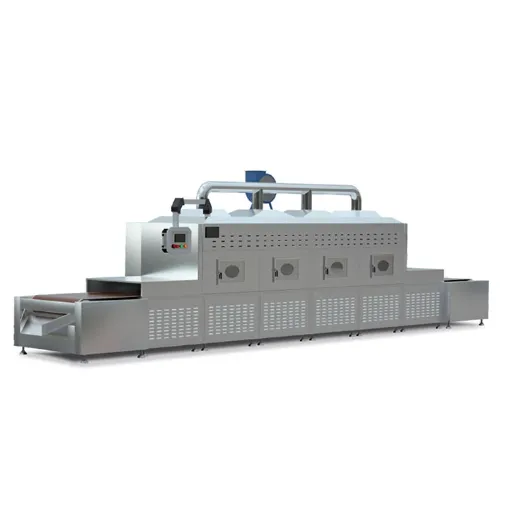
Tunnel Microwave Sterilizer Specifications: A Buyer’s Technical Checklist

A tunnel microwave sterilizer with the right specifications delivers continuous sterilization at throughputs ranging from 100 kg/h to 2,000+ kg/h, with power ratings from 12 kW to 200+ kW, belt widths from 500 mm to 2,000 mm, and tunnel lengths from 4 to 15 meters. The exact specifications your operation needs depend on product characteristics, target throughput, and integration requirements.
But here’s the problem most buyers face. Specification sheets list numbers without context. A 60 kW system, a 1,000 mm belt, and an 8-meter tunnel mean little if you cannot connect those figures to your actual production goals.
When Raj Patel evaluated tunnel microwave sterilizers for his spice facility in Gujarat, he requested quotes from three manufacturers. Each quoted a 60 kW system. Only one asked about his product bulk density. That single question changed everything.
Raj’s mixed seasoning powder had a bulk density of 0.4 g/cm³. Most manufacturers assumed 0.8 g/cm³, the industry default. That assumption would have cost Raj dearly. His “standard” 60 kW system would have struggled to hit 800 kg/h. He needed a wider belt. He needed adjusted power distribution. The right questions saved him from a costly mismatch.
This guide breaks down every critical specification of tunnel microwave sterilizers. You will learn what each parameter means, why it matters for your operation, and how to build a specification checklist that prevents costly mismatches.
Key Takeaways
- Power ratings from 12 kW to 200+ kW map to throughput targets; right-sizing matters more than maxing out.
- 2450 MHz suits powders and thin layers; 915 MHz penetrates 3x deeper for dense or bulk products.
- Belt width (500–2,000+ mm) and tunnel length (4–15 meters) must match dwell time requirements for your specific product.
- SUS 316 stainless steel outperforms SUS 304 in high-salt or acidic environments but costs 20–35% more.
- A thorough specification checklist prevents the most common buyer error: undersizing power for actual throughput needs.
What Is a Tunnel Microwave Sterilizer?
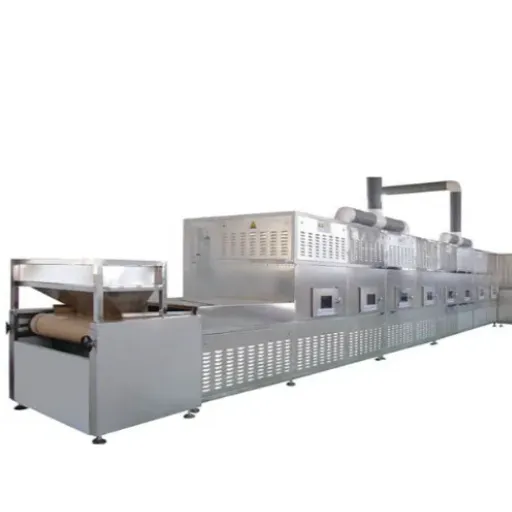
A tunnel microwave sterilizer is a continuous conveyor-based system. Products move through a microwave cavity on a belt. Electromagnetic energy sterilizes them in a single pass. There is no stopping and starting. Product flows in, gets treated, and flows out ready for the next step.
This design offers three clear advantages. Throughput stays steady. No loading. No unloading. No cycle delays. Integration is easier, too. The conveyor bridges naturally between upstream and downstream equipment. Labor costs drop as well. Operators do not handle individual batches.
Tunnel systems work best for high-volume, limited-SKU operations. Think spice powders. Pet food kibble. Grains. Ready-to-eat meals. Batch systems fit different needs. R&D labs. Specialty products. Any operation where frequent changeovers make continuous flow impractical.
Wondering whether a tunnel or batch system fits your line? Our industrial microwave equipment specialists can assess your product characteristics and throughput targets to recommend the right configuration.
Power Rating and Microwave Frequency Specifications
Power rating is the first spec buyers look at. It determines throughput. But the link between power and output is not as simple as it seems.
Understanding Power Ratings (12 kW to 200+ kW)
Industrial tunnel microwave sterilizers range from 12 kW pilot systems to 200+ kW industrial installations. A useful rule of thumb: low-moisture products like spice powders process about 1–2 kg per kW. For high-moisture or dense products, expect roughly 0.5–1 kg per kW.
Typical industrial categories break down as follows:
- 12–30 kW: Pilot scale and R&D applications, or small commercial operations processing 50–200 kg/h
- 30–60 kW: Small to mid-scale commercial production, typically 200–600 kg/h
- 60–120 kW: Mid-scale to large industrial lines, handling 600–1,500 kg/h
- 120–200+ kW: Large industrial installations for 1,500+ kg/h throughput
Run your system at 70–80% of rated capacity. This extends magnetron life. It also gives you flexibility for product variations. Running at 100% power nonstop wears magnetrons faster. Most industrial magnetrons last 5,000–8,000 hours before replacement.
915 MHz vs. 2450 MHz Frequency Selection
Frequency determines how microwave energy penetrates your product. Most food sterilizers use either 2450 MHz or 915 MHz. The choice matters.
2450 MHz is the standard frequency for most food sterilization applications. It offers good energy coupling with water and polar molecules. Penetration depth is approximately 3–5 cm in typical food products. This frequency works well for powders, thin layers, smaller products, and applications where product bed depth stays under 5 cm.
915 MHz penetrates about 3 times deeper. Expect 10–15 cm into typical food materials. Individual magnetrons at this frequency deliver up to 100 kW each. That makes 915 MHz ideal for bulk products and dense materials. The trade-off is size. These systems need larger waveguides and bigger cavities. Footprint increases accordingly.
Pick the wrong frequency, and you get uneven heating. Cold spots. Inconsistent results. A spice processor with a 2 cm powder bed gets excellent uniformity at 2450 MHz. That same processor trying to sterilize 10 cm of bulk grain at 2450 MHz would hit serious cold spot problems.
Multi-Magnetron Power Distribution
High-performance tunnel sterilizers distribute power across multiple magnetrons arranged in zones. This architecture provides two critical benefits.
First, zone-based control lets you stage the process. An initial zone might apply lower power for gentle pre-heating. The middle zone delivers full sterilization energy. A final zone maintains hold temperature. This staging prevents thermal shock and improves product quality.
Second, redundancy matters. If one magnetron requires service in a multi-magnetron system, the remaining units continue operating at reduced capacity. A single-magnetron architecture means full shutdown for maintenance.
Conveyor and Cavity Dimensions
Physical dimensions determine how much product fits on the belt, how long it stays in the microwave field, and whether the equipment fits your facility.
Belt Width Specifications (500 mm to 2,000+ mm)
Belt width directly impacts throughput because it defines the maximum product spread across the conveyor. Standard widths range from 500 mm for compact systems to over 2,000 mm for high-capacity industrial lines.
Selecting belt width requires understanding your product spread and desired layer depth. A spice powder spread at 2 cm depth across a 1,000 mm belt carries significantly more mass per meter than the same powder at 1 cm depth. Side rails and guide systems prevent product migration at wider belt widths.
Tunnel Length and Cavity Staging
Total tunnel length typically ranges from 4 meters for compact systems to 15 meters for large industrial installations. The total length breaks into functional zones:
- Infeed transition: Product enters and spreads evenly on the belt
- Microwave cavity(ies): One or more enclosed sections where sterilization occurs
- Cooling section: Brings product to safe handling temperature
- Outfeed transition: Product exits for downstream handling
Cavity length determines dwell time at a given belt speed. A 6-meter microwave cavity running at 1 meter per minute gives 6 minutes of exposure. That same cavity at 2 meters per minute gives only 3 minutes. Matching dwell time to your product’s sterilization requirements is essential.
Belt Speed Range and Dwell Time Control
Belt speeds in industrial tunnel sterilizers typically range from 0.5 to 6 meters per minute, controlled by a variable frequency drive (VFD). This adjustability lets operators fine-tune dwell time without changing physical tunnel length.
The dwell time formula is simple but critical:
Dwell time (minutes) = Microwave cavity length (meters) ÷ Belt speed (meters per minute)
A chili powder might require 4–5 minutes at 80°C for validated microbial reduction. A pet food kibble with lower moisture might need only 2–3 minutes. Belt speed flexibility lets one system handle multiple products by adjusting the time-temperature profile.
Belt Material and Construction
Food-grade PTFE coated fiberglass is the standard conveyor material. It resists temperatures up to 260°C. It is non-stick. Powders do not cling to it. It is also microwave-transparent. Energy passes through the belt to the product instead of being wasted.
Open mesh belts allow airflow and moisture escape. Solid belts suit fine powders that might sift through mesh openings. Belt loading capacity and proper tensioning systems prevent sagging under heavy loads.
Temperature and Process Control Specifications
Temperature control makes or breaks sterilization results. Modern tunnel sterilizers use advanced monitoring and feedback systems to stay on target.
Operating Temperature Ranges
Sterilization cavity temperatures typically operate between 70°C and 120°C, depending on the product and target microbial reduction level. The cooling section uses ambient or chilled air to bring product down to safe handling temperature, typically below 40°C, before packaging.
Temperature uniformity across the belt width should stay within ±2–5°C for most applications. Tighter tolerances (±2°C) suit heat-sensitive products like nutraceuticals. Wider tolerances (±5°C) are acceptable for more robust materials like grains.
Temperature Monitoring and Feedback Systems
Modern systems use multiple sensor types for comprehensive temperature monitoring.
Infrared (IR) pyrometers provide non-contact surface temperature measurement across the belt width. They are fast, require no product contact, and work well for powders and granular materials.
Fiber-optic temperature sensors penetrate the product bed for internal temperature readings. Surface readings alone can miss cold spots within thick product layers.
Real-time feedback loops connect sensors to the PLC. Temperature drifts from the setpoint? The system adjusts power or belt speed automatically. This closed-loop control keeps sterilization consistent. Even when product characteristics shift slightly.
PLC and HMI Control Specifications
The control system is the brain of your tunnel sterilizer. Most industrial units use PLCs from established manufacturers like Siemens, Mitsubishi, or Omron.
A touchscreen HMI (Human-Machine Interface) should provide:
- Recipe storage for different products and parameters
- Real-time trend visualization of temperature, power, and belt speed
- Alarm logging for deviations and maintenance alerts
- User access levels to prevent unauthorized changes
Data logging supports validation and compliance. Certifications like HACCP or FSMA require proof. You need records showing every batch hit its parameters. Industry 4.0-ready systems go further. They offer Ethernet connectivity. Remote monitoring. SCADA integration for centralized plant management.
Construction Materials and Sanitary Design
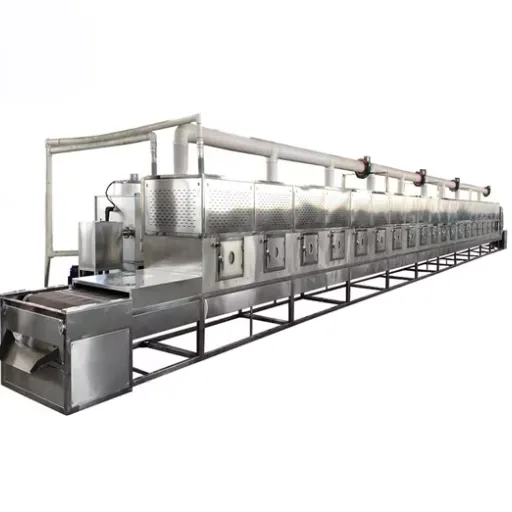
Material specifications determine corrosion resistance, cleanability, and regulatory compliance. Cutting corners here leads to premature equipment failure and food safety risks.
Stainless Steel Grades (SUS 304 vs. SUS 316)
SUS 304 is the standard stainless steel for most food applications. It provides excellent corrosion resistance against water, mild acids, and typical food environments. It is cost-effective and widely available.
SUS 316 contains molybdenum, which provides superior resistance to chlorides, salts, and aggressive cleaning chemicals. Specify SUS 316 when you process high-salt products (some spice blends, marine feed), use caustic washdown procedures, or operate in corrosive environments.
The cost premium for SUS 316 is typically 20–35% over SUS 304. For many applications, that premium pays for itself through longer equipment life and reduced maintenance.
When Maria Santos upgraded her seafood seasoning line in Lisbon, she picked SUS 304 to save money. It was a mistake. Within 18 months, corrosion attacked the weld joints. Salt-heavy residue was the culprit. Replacing those sections with SUS 316 cost more than doing it right the first time. Her advice is simple: “Match the steel to your worst-case product. Not your average one.”
Internal Surface Finish Requirements
Surface finish matters for cleanability and microbial harborage prevention. Standard food-grade finishes specify Ra ≤ 0.8 μm. High-sanitary applications like infant nutrition or pharmaceutical processing may require Ra ≤ 0.4 μm with electropolish.
Welds must be smooth and crevice-free. Cracks, pits, and rough welds trap product residue and bacteria. A sterilizer with poor surface finish cannot be truly cleaned, no matter how rigorous your CIP protocol.
Microwave Leakage and Safety Standards
Safety standards limit microwave leakage. The IEC 60519-6 and GB 5959.6 standards set the ceiling at 5 mW/cm² measured 5 cm from the surface. Quality manufacturers aim lower. They target 2 mW/cm² or less. That wider safety margin protects operators day after day.
Door interlock systems prevent operation when access panels are open. Emergency stop buttons must be within easy reach of operators. Regular leakage testing, typically quarterly, verifies that seals and gaskets maintain their integrity over time.
Cooling and Ventilation System Specifications
Cooling is not an afterthought. It protects your magnetrons, manages product moisture, and maintains a safe working environment.
Magnetron Cooling Requirements
Magnetrons generate significant heat and require active cooling. Two approaches dominate the market.
Air-cooled magnetrons use fans to dissipate heat. They are simpler, require less maintenance, and suit lower-power systems (under 60 kW). However, they are less efficient in hot ambient environments.
Water-cooled magnetrons circulate chilled water through the housing. They are required for high-power systems (60+ kW). Air cooling cannot keep up at those power densities. Water cooling needs a chiller. Deionized water. Careful attention to flow rates and temperature.
Cavity Exhaust and Condensate Management
Microwave sterilization releases moisture from the product. Without proper extraction, that moisture condenses on cavity walls, drips onto the product, and creates inconsistent results.
Exhaust fans sized to the cavity volume remove moisture-laden air. Ducting routes exhaust outside the production area or to filtration systems. Condensate collection systems with sloped floors and sanitary drains prevent pooling.
How to Match Specifications to Your Production Needs
Selecting specifications without a systematic approach leads to mismatched equipment. Follow this four-step framework.
Step 1: Define Your Product Characteristics
Document these parameters before contacting any manufacturer:
- Bulk density: How much mass per unit volume? Light powders (0.3–0.5 g/cm³) behave differently from dense grains (0.8–1.2 g/cm³).
- Moisture content: Higher moisture absorbs more microwave energy, affecting power requirements.
- Particle size and layer depth: Fine powders at 2 cm depth heat differently from whole grains at 10 cm.
- Heat sensitivity: Maximum allowable temperature before quality degradation.
- Target microbial reduction: Commercial sterilization typically targets SAL 10^-6.
Step 2: Calculate Required Throughput
A practical power estimation formula:
Required power (kW) ≈ [Throughput (kg/h) × Specific energy requirement (kJ/kg)] ÷ [3,600 × Efficiency factor]
Specific energy needs vary by product. Spice powders typically need 300–600 kJ/kg. High-moisture products may need 600–1,200 kJ/kg. System efficiency ranges from 0.6 to 0.8. Some energy is always lost. Not every watt reaches the product.
Worked example: Processing 500 kg/h of chili powder at 10% moisture, with a specific energy requirement of 500 kJ/kg and 70% system efficiency:
Required power ≈ (500 × 500) ÷ (3,600 × 0.70) ≈ 99 kW
A 100 kW system would handle this comfortably with some reserve capacity.
Step 3: Select Tunnel Dimensions
Match belt width to your product spread and desired layer depth. Match tunnel length to your required dwell time at a practical belt speed. A belt speed below 0.5 m/min creates bottlenecks. Above 5 m/min, infeed and outfeed transitions become challenging.
Step 4: Determine Customization Needs
Standard configurations work for standard products. Most food products are not standard. Common customizations include:
- Extended cooling sections for heat-sensitive products
- Multiple infeed heights for integration with upstream equipment
- Integrated metal detection for food safety
- Nitrogen purging for oxidation-sensitive products like spice oils
- Special belt coatings for sticky or abrasive materials
Chen Wei runs a pet food facility in Zhejiang. He started with a standard 60 kW tunnel sterilizer for dry kibble. Business grew. Two years later, he added an aquatic feed line. Higher salt content. Different requirements. Instead of replacing the whole system, Loyal engineers retrofitted it. New SUS 316 contact surfaces. A water-cooled magnetron upgrade. An extended cooling section. The modular approach saved 40% versus a full replacement. Chen put it best: “The original system was built with expansion in mind. That foresight paid off.”
Ready to specify a tunnel microwave sterilizer for your production line? Contact our engineering team for a customized specification assessment based on your product characteristics and throughput targets.
Common Specification Mistakes to Avoid
Even experienced buyers make these errors. Avoid them to protect your investment.
Undersizing power for throughput targets. This is the most common mistake. Buyers pick a 30 kW system because it fits the budget. Then they discover it cannot hit 600 kg/h. Calculate power from product data. Not from budget limits.
Ignoring cooling infrastructure. Water-cooled systems need chillers, deionized water loops, and drainage. Failing to plan for this infrastructure adds hidden costs and delays commissioning.
Overlooking belt width relative to layer depth. A narrow belt with thick product layers creates uneven heating. A wide belt with thin layers wastes energy and floor space.
Neglecting uniformity validation. Specifications on paper mean nothing without validation. Plan for temperature mapping studies during commissioning.
Specifying SUS 304 when SUS 316 is needed. The upfront savings disappear when corrosion forces early replacement.
Failing to plan for electrical infrastructure. A 120 kW system at 380V/3-phase draws serious current. Check your facility first. Major electrical upgrades add cost and delay commissioning.
Ignoring future expansion. A system sized for today’s needs may constrain tomorrow’s growth. Modular designs let you add microwave zones or extend the tunnel as throughput increases.
Conclusion
Specifications are more than numbers on a page. Each one affects your daily operation. Power rating. Frequency. Belt width. Tunnel length. Material grade. Control system. Get them right, and your line runs smooth. Get them wrong, and you face shortfalls. Quality problems. Expensive retrofits.
The key takeaways are straightforward. Match power to your actual product throughput, not a generic rule. Select frequency based on product density and layer depth. Choose materials for your most challenging product environment. Validate uniformity before accepting commissioning. And plan for the future, because production requirements evolve.
The specification process starts with your product. Not a catalog. Our engineering team at Shandong Loyal Industrial Co., Ltd. has commissioned tunnel microwave sterilizers across dozens of applications worldwide. We build systems to your specifications. Not the other way around.
Request a customized tunnel microwave sterilizer specification assessment →