2D vs 3D Pellet Production Line: Which Is Right for Your Business?

A 2D pellet production line is best for high-volume, budget-conscious snack manufacturers focused on flat products like fryums, rings, and papad. A 3D pellet production line is the better choice when you want premium, eye-catching shapes such as bugles, cones, and pani puri that can command higher margins. Choosing the right pellet snack production line aligns equipment cost, capacity, and product appeal with your target market from day one.
But that one-sentence answer hides a lot of nuance. Choose the wrong line, and you either overpay for complexity you do not need or miss the premium positioning that could transform your brand. Choose the right line, and you align equipment cost, capacity, and product appeal with your target market from day one.
The snack pellet market is expanding steadily. According to Future Market Insights, the global snack pellets market reached approximately USD 1.5 billion in 2025 and is projected to grow at a 4.3% CAGR through 2035. Within that market, 3D and double-layer pellets already account for 35.9% of form-segment demand, which tells us that dimensional snacks are no longer a novelty. They are a core product category.
In this guide, we will compare 2D vs 3D snack pellets and their production lines side-by-side. You will learn how the processes differ, what equipment each line requires, which products each format suits best, and how to calculate the true total cost of ownership. By the end, you will have a practical decision framework for choosing the line that fits your product goals and budget.
Key Takeaways
- A 2D pellet production line is simpler, faster, and less expensive; ideal for flat snacks like fryums, rings, and papad.
- A 3D pellet snack production line costs more and runs slower but enables complex shapes such as bugles, cones, and pani puri with premium pricing potential.
- A hybrid 2D/3D pellet production line lets one extrusion system switch between formats, making it ideal for diversified portfolios.
- A 2D line typically runs 300–400 kg/h and costs 100,000–100,000–200,000, while a 3D line runs 200–300 kg/h and costs 250,000–250,000–500,000.
- The right 2D vs 3D pellet production line choice depends on your target product, capacity needs, budget, and whether you prioritize volume or differentiation.
What Are 2D and 3D Pellet Snacks?
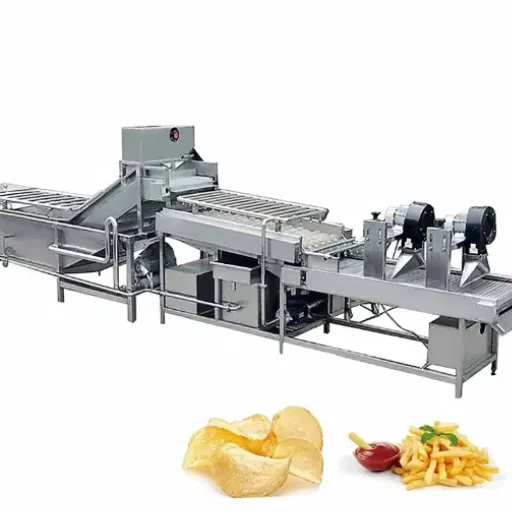
Before comparing a 2D pellet production line to a 3D pellet snack production line, it helps to understand what manufacturers actually mean by “2D” and “3D” pellets.
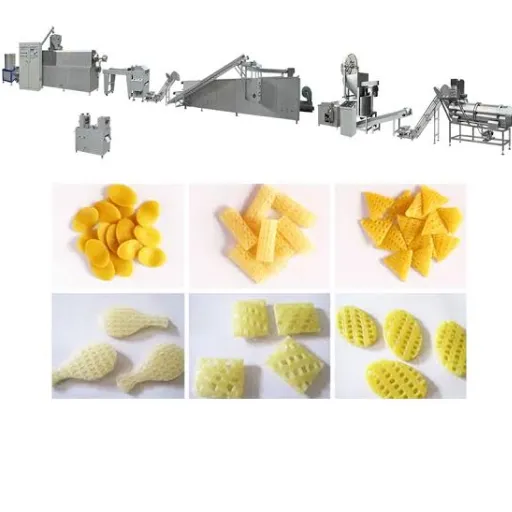
2D pellet snacks are flat, sheet-like products created in a single forming step. Think of rings, wheels, stars, flakes, strips, tubes, squares, and papad. Because the shape is produced directly at the die face, the process is relatively straightforward. A twin-screw or single-screw extruder pushes cooked dough through a die, a rotary cutter slices the ribbon into individual pieces, and the pellets move on to drying and final frying or baking.
3D pellet snacks are three-dimensional products with depth, hollow sections, or layered structures. Common examples include bugles, cones, pillows, goldfish, shells, balls, net crisps, and pani puri. These shapes usually require a two-stage forming process. The dough is first extruded into a flat sheet, then embossed, laminated, or compound-shaped so that internal moisture turns to steam during frying and expands the pellet into its final 3D form.
Both formats are often called “half-products” or “intermediate products” because they are not eaten straight from the line. They are dried, packaged, and later fried or baked by the manufacturer, distributor, or even the end consumer. This shelf-stable format is one reason snack pellets are so popular for export and private-label businesses.
For a broader overview of the full production workflow, see our complete guide to 2D 3D pellet production lines.
2D vs 3D Pellet Production Line: Side-by-Side Comparison
The fastest way to narrow your choice is to look at the core differences in one place.
| Factor | 2D Pellet Line | 3D Pellet Line | Hybrid 2D/3D Line |
|---|---|---|---|
| Typical shapes | Rings, wheels, stars, flakes, strips, tubes, papad | Bugles, cones, pillows, goldfish, shells, pani puri | All of the above via die/module change |
| Shaping method | Direct die extrusion + rotary cutting | Sheet extrusion + embossing/lamination + compound shaping | Same extruder with interchangeable forming modules |
| Extruder type | Single-screw or twin-screw | Twin-screw preferred | Twin-screw recommended |
| Typical capacity | 300–400 kg/h | 200–300 kg/h | 200–500 kg/h depending on product |
| Initial investment | 100,000–100,000–200,000 | 250,000–250,000–500,000 | 200,000–200,000–400,000 |
| Energy consumption | Lower baseline | 30–50% higher than 2D | Baseline to +30% depending on product mix |
| Maintenance cost | ~20% lower than 3D | 10–15% higher than 2D | Moderate; depends on product mix |
| Changeover time | 30–60 minutes | 45–90 minutes | 30–90 minutes |
| Product margin potential | Standard/value segment | 20–30% premium possible | Flexible: value + premium SKUs |
| Best for | Mass market, high volume, limited budget | Premium/niche, innovation, differentiation | Diverse portfolio, seasonal rotations |
If your goal is to produce large volumes of familiar snack shapes at the lowest cost per kilogram, the 2D path is hard to beat. If you want to stand out on the shelf with novel shapes and can absorb higher upfront and operating costs, the 3D path offers stronger differentiation.
Want to see how these differences play out in real equipment? Explore our configurable 2D/3D pellet production line and compare specifications for your product range.
Shape, Structure, and Consumer Appeal in 2D vs 3D Snack Pellets
2D pellets deliver the classic snack experience. Consumers recognize rings, wheels, and flakes instantly. These shapes are easy to flavor evenly and stack efficiently in packaging. For manufacturers running a 2D pellet production line, this predictability translates to consistent throughput and lower waste.
3D pellets create a different kind of value. A bugle, a hollow pani puri shell, or a net-shaped crisp looks more interesting in a bowl or on a shelf. That visual difference supports premium pricing and stronger brand recall, especially in markets where snack aisles are crowded. A 3D pellet snack production line invests in that visual differentiation to command higher margins.
Capacity and Throughput Differences
Because 3D forming involves extra steps, 3D pellet snack production lines usually run slower than 2D pellet production lines. A typical 2D line outputs 300–400 kg/h, while a comparable 3D line outputs 200–300 kg/h. The gap is not always dramatic, but it matters when you are planning daily output and labor shifts.
Energy Consumption and Operating Costs
3D pellet snack production lines use more energy than 2D pellet production lines. The additional shaping rollers, embossers, and compound-forming stations add mechanical load. Depending on the product and line design, a 3D line can consume 30–50% more energy than a 2D line. Maintenance is also more involved because there are more forming tools to inspect, clean, and replace.
Production Process Differences Explained
Understanding the process flow of a 2D vs 3D pellet production line helps explain why 3D lines cost more and where each format creates value.
2D Line Process Flow
A 2D pellet production line follows a relatively direct path from raw material to dried pellet.
- Mixing: Starches, flours, water, and additives are blended into a uniform dough with 25–30% moisture.
- Extrusion: The dough is cooked and formed under heat and pressure in a single-screw or twin-screw extruder.
- Cutting: A rotary cutter slices the extruded ribbon into individual flat pellets.
- Drying: Pellets pass through a multi-layer dryer at 45–60°C for 3–5 hours until moisture drops to 8–10%.
- Frying or Baking: The dried pellets expand and crisp at temperatures around 190°C.
- Seasoning and Packaging: Flavoring is applied in a rotating drum, followed by cooling and packing.
3D Line Process Flow
A 3D pellet snack production line adds forming stages after extrusion to create dimensional shapes.
- Mixing: The dough is prepared with slightly higher moisture, typically 28–35%, to support expansion.
- Sheet Extrusion: The extruder produces a continuous flat sheet rather than individual ribbons.
- Cooling and Embossing: The sheet is cooled and pressed with patterned rollers.
- Lamination and Compound Shaping: Layers are combined and cut so the pellet will expand into a 3D shape during frying.
- Drying: Similar to 2D, but complex shapes may need more careful drying to prevent case hardening.
- Frying or Baking: Internal moisture vaporizes and expands the pellet 2–3× its original size.
- Seasoning and Packaging: The same as 2D, though hollow shapes may need gentler handling.
The critical difference between a 2D pellet production line and a 3D pellet snack production line is that 2D pellets achieve their final shape directly at the die face, while 3D pellets use a two-stage forming process that relies on controlled expansion later in the line.
For a deeper look at each stage, read our step-by-step snack pellet production process guide.
The Role of the Extruder
Extruder choice matters for both formats, but especially for 3D. The core of any snack pellet production line is the extruder, and a twin-screw extruder offers better mixing, more precise temperature control, and greater flexibility with formulations. That is why it is the preferred choice for 3D lines and for most hybrid systems. A single-screw extruder can still handle simple 2D products and may lower initial cost, though it offers less recipe flexibility.
Future Market Insights notes that twin-screw extrusion already represents 58% of processing-method share in the snack pellets market. The technology has become the default for manufacturers who plan to produce varied or premium products.
Equipment and Investment Comparison: 2D vs 3D Pellet Production Line Costs
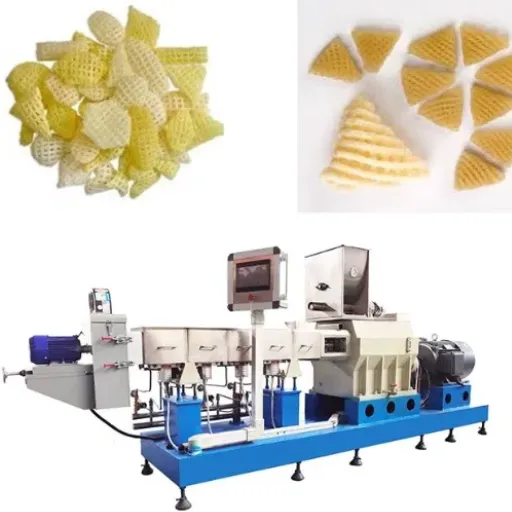
Your capital outlay for a 2D vs 3D pellet production line depends on more than the extruder. Here is how the major equipment categories differ.
Extruder and Shaping Systems
The extruder is the heart of any 2D vs 3D pellet production line.
- 2D line: Needs a die plate and rotary cutter. Tooling is relatively simple.
- 3D line: Needs sheet-forming dies, pattern rollers, embossers, laminators, and compound shapers. Tooling is more complex and more expensive.
Dryer, Fryer, and Flavoring Considerations
Both lines use multi-layer dryers, continuous fryers or hot-air ovens, de-oilers, and rotary flavoring drums. However, 3D products with hollow sections or thin walls can be more sensitive to drying temperature and airflow. Uneven drying can cause case hardening, where the outer surface seals before the center loses moisture.
CapEx and OpEx Comparison for 2D vs 3D Pellet Production Lines
| Cost Category | 2D Line | 3D Line | Hybrid Line |
|---|---|---|---|
| Initial equipment | 100,000–100,000–200,000 | 250,000–250,000–500,000 | 200,000–200,000–400,000 |
| Installation and commissioning | 10,000–10,000–25,000 | 20,000–20,000–50,000 | 15,000–15,000–40,000 |
| Annual energy (estimate) | Baseline | +30–50% | +10–30% |
| Annual maintenance | Baseline | +10–15% | +5–10% |
| Die/mold replacement | Lower | Higher | Moderate |
These figures are ranges based on industry estimates and supplier data. Actual prices depend on capacity, automation level, materials of construction, and regional factors.
Ready to test the difference against your budget? Request a detailed quotation and we will match a line configuration to your product and capacity targets.
Product Application Matrix: Choosing the Right Snack Pellet Production Line
One of the most practical ways to decide between a 2D pellet production line, a 3D pellet snack production line, or a hybrid system is to map your intended product to the line type.
Best Products for 2D Lines
These products are well-suited to a 2D pellet production line because they are flat, fry evenly, and support high throughput.
- Fryums: Flat, expanded snacks popular in South Asia and export markets.
- Papad: Thin, crisp discs common in Indian cuisine.
- Sala Chips: Flat, wavy chips that fry quickly and evenly.
- Rings, Wheels, Stars: Classic snack shapes with high consumer recognition.
- Tubes and Strips: Versatile formats for seasoning and flavor innovation.
Best Products for 3D Lines
These products justify the higher complexity of a 3D pellet snack production line through visual appeal and premium positioning.
- Bugles: Cone-shaped corn snacks with a distinctive crunch.
- Cones and Pyramids: Popular in premium snack mixes.
- Pillows: Filled or unfilled puffed shapes.
- Pani Puri / Golgappa: Hollow, round pellets that puff into crispy shells.
- Animal and Cartoon Shapes: Strong appeal in children’s snacks and novelty products.
- Net Crisps and Rackets: Eye-catching shapes for premium positioning.
When a Hybrid 2D/3D Line Makes Sense
A hybrid 2D/3D pellet production line uses the same twin-screw extruder with interchangeable downstream forming modules. This setup is ideal if you want to:
- Offer both value and premium SKUs from one facility.
- Test new 3D products without committing to a dedicated 3D line.
- Respond to seasonal demand by switching between shapes.
- Reduce the total floor space and labor needed for two separate lines.
For example, a manufacturer in Southeast Asia might run 2D rings for five days to satisfy a high-volume retail contract, then switch to 3D animal shapes for two days to supply a premium private-label order. The changeover typically takes 30–90 minutes, depending on the tooling.
Total Cost of Ownership and ROI Scenarios for 2D vs 3D Pellet Production Lines
The purchase price is only part of the equation. Here are two simplified 5-year scenarios to illustrate how 2D and 3D lines can play out.
Scenario A: 2D Line for High-Volume Fryums
This 2D pellet production line scenario shows how volume and simplicity drive payback.
- Initial investment: $150,000
- Capacity: 350 kg/h, running 16 hours/day
- Energy and maintenance: Baseline
- Product price: $2.50/kg
- Result: Lower margin per kilogram, but high volume and simple operations lead to predictable payback, often within 2–3 years.
Scenario B: 3D Line for Premium Bugles
This 3D pellet snack production line scenario shows how premium pricing can justify higher CapEx.
- Initial investment: $350,000
- Capacity: 250 kg/h, running 16 hours/day
- Energy and maintenance: +30–40% versus 2D
- Product price: $3.50/kg
- Result: Higher margin per kilogram and stronger brand positioning can offset the higher CapEx, with payback often within 3–4 years.
The 3D scenario only works if there is market demand for the premium price. If your customers are price-sensitive, the 2D line usually delivers better cash flow sooner.
Hidden Costs to Watch
- Dies and molds: Complex 3D tooling costs more and may need replacement sooner.
- Energy: A 3D line running continuously can add thousands of dollars per year to your utility bill.
- Labor: 3D changeovers and troubleshooting may require more skilled operators.
- Floor space: Some 3D forming stations are larger than simple 2D cutters.
Decision Checklist: How to Choose the Right Pellet Snack Production Line
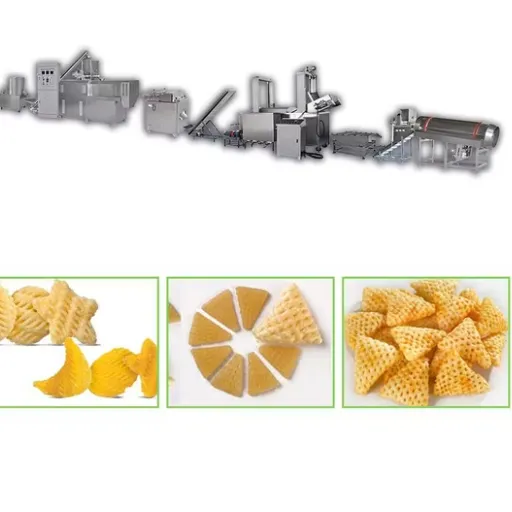
Use this checklist when evaluating suppliers and configurations for your 2D vs 3D snack pellet investment.
- What is your target product? Flat, familiar shapes favor a 2D pellet production line. Complex or premium shapes favor a 3D pellet snack production line.
- What is your daily capacity target? High volume favors 2D. Moderate volume with premium pricing favors 3D.
- Do you need product flexibility? If yes, a hybrid line may be the best long-term investment.
- What is your energy cost? In regions with expensive electricity, the 2D line’s lower consumption is a major advantage.
- Who is your end customer? Mass-market retailers often want low-cost SKUs. Premium channels and exports can support 3D pricing.
- What is your technical capability? 3D lines require more experienced operators and maintenance staff.
- What after-sales support does the supplier offer? Training, spare parts, and remote diagnostics matter more for complex 3D systems.
Key RFP Questions to Ask Suppliers
- What is the guaranteed throughput for my target product at my required moisture level?
- Can the line produce both 2D and 3D products, or is it dedicated?
- What is the average changeover time between shapes?
- What grade of stainless steel is used for food-contact surfaces?
- Do you provide installation, commissioning, and operator training?
- What is the lead time for spare dies and critical wear parts?
Frequently Asked Questions About 2D vs 3D Pellet Production Lines
What is the difference between 2D and 3D snack pellets?
2D snack pellets are flat shapes such as rings, wheels, and papad, produced directly at the extruder die. 3D snack pellets are three-dimensional shapes such as bugles, cones, and pani puri, produced through sheet extrusion, embossing, and controlled expansion during frying.
Which pellet production line is best for snacks?
The best snack pellet production line depends on your product goals. Choose a 2D line for high-volume, cost-sensitive products. Choose a 3D line for premium, differentiated shapes. Choose a hybrid line if you need both formats from one production system.
Can one production line make both 2D and 3D pellets?
Yes. Many modern pellet snack production lines can switch between 2D and 3D production by changing dies, shaping rollers, and cutting modules. Changeover typically takes 30–90 minutes.
Is a 3D pellet production line more profitable?
A 3D pellet snack production line can be more profitable if your market accepts premium pricing. 3D snacks often command 20–30% higher margins, but the line also has higher CapEx and operating costs. Profitability depends on product-market fit and volume.
What raw materials are used in 2D and 3D pellet production?
Common raw materials include potato starch, corn starch, wheat flour, cassava starch, and rice flour. Water and functional additives such as modified starches, proteins, and emulsifiers are added to control texture and expansion.
Which line requires more maintenance, 2D or 3D?
3D pellet snack production lines generally require more maintenance than 2D pellet production lines because they have more forming tools, rollers, and cutting stations. However, proper preventive maintenance and operator training can keep downtime low on either system.
Conclusion
The 2D vs 3D pellet production line decision comes down to a simple trade-off: volume and value versus differentiation and premium positioning.
If you serve price-sensitive markets and need high throughput for flat snacks like fryums, rings, and papad, a 2D pellet production line delivers the lowest cost per kilogram and the fastest path to predictable returns. If your strategy depends on eye-catching shapes, stronger shelf presence, and higher margins, a 3D pellet snack production line justifies its higher investment through premium pricing.
For many manufacturers, the smartest long-term choice is a hybrid 2D/3D line built on a twin-screw extruder platform. It protects your current volume business while giving you the flexibility to innovate into 3D products without buying a second complete line.
At Shandong Loyal Industrial Co., Ltd., we design configurable 2D, 3D, and hybrid snack pellet production lines for snack manufacturers worldwide. Whether you are launching your first line or expanding an existing plant, our engineers can help you match equipment to your product, capacity, and budget.
Request a custom quote today and let us recommend the right 2D vs 3D pellet production line for your business.