

Pet Food Packaging and Storage: A Manufacturer’s Guide from Extruder to Shelf

Effective pet food packaging and storage combines a high-barrier multilayer bag (oxygen transmission below 2 cc/m²/day), a controlled warehouse (under 27°C and 65% relative humidity), and a production line that hands off kibble at the right moisture and fat profile. Get those three layers aligned and you protect quality, extend shelf life, and reduce returns.
Picture this. Mei runs quality assurance for a mid-sized kibble plant in Southeast Asia. On a Monday in March, she pulled a retained sample from a 12 kg quad-seal bag, opened it, and smelled rancid fat. The production run was only four months old. The investigation pointed not to the extruder, not to the warehouse, but to a single mismatched decision: the packaging team had switched to a thinner laminate to cut costs, while the production line was still coating kibble at 8% added fat. The savings on film cost the plant a 40-ton recall.
This guide is built for engineers and plant managers who have lived a version of Mei’s story, or want to avoid it. We will walk through how packaging requirements are set by extrusion, which materials and formats actually work for dry pet food, how to handle bulk holding before bagging, and how warehouse conditions seal the deal. You will leave with a framework for matching packaging and storage decisions to your real production line.
Key Takeaways
- Pet food packaging and storage requirements begin at the extruder die, not the bagging line. Exit moisture, fat coating, and bulk density set barrier and format needs.
- Premium dry kibble needs packaging with an oxygen transmission rate below 2 cc/m²/day and a water vapor transmission rate matched to a target water activity under 0.65.
- Bulk storage in surge bins and silos is the most under-discussed stage. Pneumatic conveying and aeration choices directly affect fines, breakage, and moisture pickup.
- Warehouse targets of under 27°C, under 65% relative humidity, FIFO rotation, and pest exclusion protect a 12 to 18 month unopened shelf life.
- Aquatic feed, semi-moist treats, and wet pet food each demand specialty packaging. Floating fish feed in particular needs protection for buoyancy and density.
Why Pet Food Packaging and Storage Decisions Start at the Extruder
Most articles treat packaging as a downstream choice. In practice, the packaging spec is largely written the moment kibble leaves the die.
Three extrusion outputs drive the decision:
- Exit moisture: Industry guidance from the American Feed Industry Association places typical kibble exit moisture between 8% and 10% after drying. Higher residual moisture pushes water activity (aw) up, which then demands a tighter moisture barrier from the bag.
- Fat coating: A 6% to 12% surface fat application raises the stakes for oxygen barriers. Unsaturated fats oxidize quickly without an effective oxygen scavenger or low-OTR film.
- Bulk density and piece geometry: Dense, smooth pellets compact differently than airy puffed kibble. Density shapes bag fill weight, gusset design, and pallet stacking patterns.
A practical reference: if your extruder runs a premium recipe with 14% fat post-coating, a standard PE laminate is not enough. You need a foil or metallized layer to push oxygen transmission below 2 cc/m²/day. That is a packaging line decision driven by a production line reality.
Want a stronger handoff between extrusion and packaging? Our engineers map both stages together when configuring a complete pet food production line. The result is fewer surprises when bags hit the warehouse.
Core Packaging Materials for Dry Pet Food
Selecting pet food packaging materials is a balance between barrier performance, sustainability goals, and cost. Three structures dominate the market.
Multilayer Laminates (PET/Foil/PE)
Multilayer laminates remain the gold standard for premium dry kibble. A typical structure pairs an outer PET layer for print quality, a middle foil or metallized layer for barrier, and an inner PE layer for sealing.
These structures deliver:
- Oxygen transmission rate below 2 cc/m²/day
- Water vapor transmission below 1 g/m²/day
- Strong puncture and abrasion resistance for high fat coatings
The trade-off is recyclability. Mixed-material laminates are difficult to process in mono-stream recycling.
Recyclable Mono-Material Structures
Mono-PE and mono-PP structures are gaining ground as brands respond to sustainability mandates. Newer high-barrier mono-PE films, paired with EVOH barrier layers and oxygen scavengers, can approach the performance of traditional laminates for many mid-tier recipes.
Adoption is fastest in Europe under EU packaging directives, and it is rising in North America.
Choosing OTR and WVTR Targets
A simple decision rule helps. For dry kibble with surface fat above 10%, target oxygen transmission below 2 cc/m²/day. For mid-fat recipes, between 2 and 5 cc/m²/day is workable with an oxygen scavenger. Water vapor transmission should align with a target water activity below 0.65, per AAFCO guidance, to prevent mold growth.
Common Pet Food Packaging Formats and When to Use Them
Format selection is about more than aesthetics. It affects throughput, shelf appearance, and storage stability.
Quad-Seal and Gusseted Bags
Quad-seal bags are the workhorse for 5 kg and larger SKUs. They stand cleanly on retail shelves, accept high-quality print, and stack well on pallets. Gusseted bags remain common at the 11 kg to 20 kg sizes for value brands.
A quick mini-story. Carlos manages a private-label operation in Mexico producing dry dog food for three regional brands. He switched from pillow bags to quad-seal at the 7 kg size and saw two outcomes in the first quarter: pallet density rose by 14%, and slot fees in supermarket distributors dropped because the new bags fit standard shelf depths. The packaging line investment paid back in eight months.
Stand-Up Pouches
Stand-up pouches dominate the premium and treat segments below 2 kg. Their printable surface, resealable zippers, and shelf presence justify a higher film cost.
FIBCs and Bulk Bags
Flexible intermediate bulk containers (FIBCs), often called bulk bags, hold 500 kg to 1,500 kg. They are essential for private-label fulfillment, ingredient handling, and decoupling extrusion output from retail bagging schedules.
Sealing Systems
Three sealing approaches dominate:
- Heat seal for cost-effective production runs
- Ultrasonic seal for cleaner, more consistent seals on contaminated film surfaces
- Zipper closures for stand-up pouches and resealable SKUs
Seal integrity matters as much as film barrier. A 0.5 mm seal defect on a high-barrier laminate can wipe out the entire bag’s protection within days.
Bulk Storage Before Packaging: The Forgotten Stage
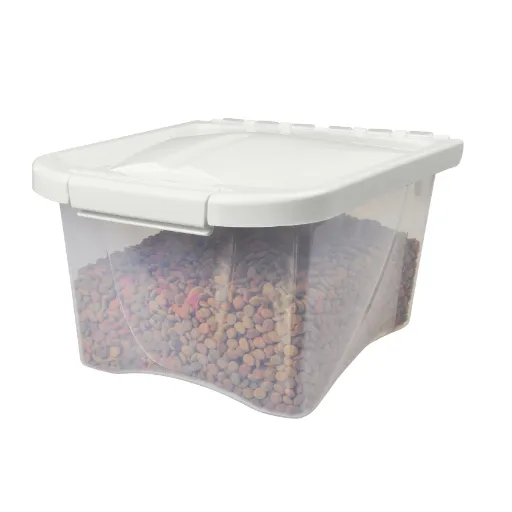
Walk through most pet food plants and you will find silos, surge bins, and totes between the extruder cooling section and the bagging line. This stage is rarely discussed in packaging articles, yet it has a direct impact on the kibble that ends up in the bag.
Silos, Totes, and Surge Bins
Surge bins act as buffers between continuous extrusion and batch packaging. A typical layout holds 30 minutes to 4 hours of extruder output. Sizing matters: undersized bins force production line stops, while oversized bins extend the time kibble sits exposed to ambient air.
Pneumatic vs Mechanical Conveying
Pneumatic conveying is fast and clean but generates fines through pellet-on-pellet abrasion. Mechanical conveying (drag chain, bucket elevator) is gentler but harder to clean between recipes.
Fines reduce consumer perception of quality. A bag with 4% fines looks dusty when opened, even if every pellet meets nutritional spec.
Aeration and Dehumidification
Conditioned air through the bulk holding step keeps water activity stable. In tropical climates, dehumidified air is essential. We have seen plants gain 18 days of effective shelf life simply by adding a dehumidification unit to a 6-ton surge bin.
This is why we treat bulk handling as part of the pet food extrusion technology system, not a separate concern.
Warehouse Storage After Packaging
Once the bag is sealed, warehouse conditions determine how much shelf life you actually deliver to the consumer.
Temperature, Humidity, and Light Targets
The widely accepted targets for finished dry pet food storage are:
- Temperature below 27°C (80°F)
- Relative humidity below 65%
- Minimal direct sunlight or fluorescent UV exposure
- No proximity to ammonia, fuel, or strongly scented chemicals
These conditions slow fat oxidation, suppress mold growth, and preserve vitamin potency, particularly fat-soluble vitamins A, D, and E.
Pallet Stacking, FIFO Rotation, and Pest Control
Best practices for warehouse pet food storage:
- Store bags on pallets, never directly on the floor
- Maintain at least 45 cm of space between pallets and exterior walls
- Use strict First-In, First-Out (FIFO) rotation tied to lot codes
- Implement an integrated pest management program with monthly inspections
- Keep all packaged product at least 60 cm below sprinkler heads
- Train forklift operators on bag handling to prevent puncture damage
- Document temperature and humidity logs daily
These seven practices form the backbone of a defensible storage program under FSMA preventive controls.
Shelf Life Expectations
For properly packaged and stored dry kibble:
- Premium recipes with high-barrier laminate: 12 to 18 months unopened
- Mid-tier with standard laminate: 9 to 12 months unopened
- Once opened, all dry kibble: 6 to 8 weeks
Wet pet food in retort cans or pouches typically delivers 24 to 36 months unopened.
Specialty Considerations: Wet Food, Treats, and Aquatic Feed
Not all pet food packaging and storage decisions follow the dry kibble playbook.
Retort Pouches and Cans for Wet Pet Food
Wet pet food at 70% to 85% moisture requires retort-stable packaging that withstands 121°C sterilization. Multilayer retort pouches (PET/foil/CPP) are replacing traditional cans in premium segments because they cook faster, retain texture better, and weigh less in shipping.
Semi-Moist Treats and Modified Atmosphere Packaging
Semi-moist treats sit in a tricky middle zone at 15% to 30% moisture. Modified atmosphere packaging (MAP) with nitrogen flush and oxygen scavengers extends shelf life from weeks to months without preservatives.
Floating Fish Feed: Buoyancy Preservation
Floating fish feed has a packaging requirement unique to aquatic feed: buoyancy preservation. Moisture absorption during storage causes pellets to sink, ruining the surface-feeding behavior the formulation was designed for.
A short story from our engineering team. Northwind Aqua, a tilapia feed producer, was losing accounts because customers reported that pellets sank after two months in tropical warehouses. The fix was twofold: we adjusted their floating fish feed production line to lower exit moisture from 9.5% to 8.2%, and we recommended a foil-laminate bag with nitrogen flush. Buoyancy at month six rose from 62% to 94%. The accounts came back.
Producing aquatic feed, treats, or wet formulas? Talk to our engineers about specialty packaging integration before you finalize your line layout. It is far cheaper to plan it in than to retrofit later.
Matching Packaging Throughput to Production-Line Capacity
A common bottleneck we see in plant audits: the extruder runs at 4 tons per hour, but the bagging line can only handle 3 tons per hour. The result is constant surge-bin overflow, off-spec batches, and frustrated operators.
A balanced layout aligns three throughput numbers:
- Extruder output (kg/hr at target recipe)
- Cooling and coating capacity (must match extruder output)
- Bagging line throughput (bags per minute multiplied by bag weight)
A simple example. If your extruder produces 4,000 kg/hr of 7 kg retail bags, you need a bagging line capable of 4,000 ÷ 7 = 572 bags per hour, or roughly 9.5 bags per minute. Adding a 20% safety margin pushes that to 11.4 bags per minute.
Plant managers who treat bagging-line capacity as an afterthought eventually pay for it in scheduled downtime and operator overtime. This is why we design dry dog food processing equipment lines with end-to-end throughput modeling, not just extruder specs.
Regulatory and Labeling Essentials
Compliance is the floor, not the ceiling, for a defensible pet food packaging and storage program.
Key Frameworks
- United States: FDA 21 CFR Part 117 preventive controls for animal food, plus AAFCO Official Publication labeling requirements
- European Union: Regulation 1935/2004 on food contact materials, plus EU 178/2002 general food law
- Globally exported brands: Pet Food Institute guidance is widely adopted across markets
Labeling Requirements That Affect Packaging
Pet food labels must include the guaranteed analysis, ingredient statement, AAFCO nutritional adequacy statement, feeding directions, and a best-by date tied to validated shelf-life testing.
Best-by dates are not arbitrary. They must be backed by accelerated and real-time shelf-life studies for the specific formula, packaging, and intended storage conditions. A change in packaging structure can invalidate prior dating.
Frequently Asked Questions
How long does dry pet food last in storage?
Properly packaged dry kibble in high-barrier laminate, stored at under 27°C and 65% RH, typically delivers 12 to 18 months of unopened shelf life. Mid-tier laminates deliver 9 to 12 months. Once opened, all dry kibble should be consumed within 6 to 8 weeks.
What is the best packaging material for premium dry kibble?
A PET/foil/PE multilayer laminate remains the gold standard, delivering oxygen transmission below 2 cc/m²/day and water vapor transmission below 1 g/m²/day. Recyclable mono-PE films with EVOH barrier and oxygen scavengers are catching up for mid-fat recipes.
Do pet food bags need to be airtight?
Yes, but not pressurized. The goal is a hermetic seal that excludes oxygen, moisture, and pests. Many premium SKUs add nitrogen flush or oxygen scavengers inside the bag to bring residual oxygen below 0.5%.
How should pet food be stored in a warehouse?
Store palletized bags below 27°C and 65% relative humidity, away from direct sunlight and strong odors. Maintain FIFO rotation by lot code, keep pallets 45 cm from walls, and run a documented integrated pest management program.
What causes rancidity in stored pet food?
Fat oxidation is the primary culprit. Oxygen permeating through inadequate packaging reacts with unsaturated fats, producing the characteristic rancid odor. Light and heat accelerate the reaction. A high-barrier bag plus controlled warehouse conditions slows it dramatically.
Putting It All Together
Pet food packaging and storage is not a downstream afterthought. It is a system that begins on the extruder, runs through bulk holding and bagging, and ends with a controlled warehouse delivering 12 to 18 months of shelf life to consumers.
Three takeaways for plant managers:
- Treat packaging as a production-line decision. Exit moisture, fat coating, and density set your barrier requirements before the bag is ever selected.
- Do not skip the bulk-storage stage. Surge bins, conveying choices, and aeration shape the kibble that ends up in the bag.
- Match throughput across the whole line. Mismatched extrusion and bagging capacity is the most common cause of off-spec product and missed delivery windows.
Loyal’s engineering team designs pet food production systems where extrusion, cooling, coating, bulk handling, and packaging are planned together, not in isolation. If you are scaling a new line or troubleshooting an existing one, this integrated view consistently delivers better shelf life, lower returns, and steadier throughput.
Ready to align your production line with the right packaging and storage strategy? Request a consultation with our engineers. We will help you map extrusion parameters to packaging specifications and storage conditions tailored to your products and markets.