

Dry Dog Food Recipe Formulation: A Complete Guide for Commercial Production

Designing healthy dry dog food is also known as dry dog food recipe formulation (or formulation of dry dog food) which means designing dry dog food recipes that contain necessary nutrients and pass through the twin-screw extrusion process. On the other hand, the Approach used in commercial formula/operation/food-processing reforms/protocols will rest on the proper proportion of the ingredients which should be mixed together to avoid such problems in the future during any further processing activities.
But here is a very interesting question which most of the manufacturers of the equipment used will not ask: That what happens in a case where a nutritionists come up with a perfect formula or recipe which an extruder cannot manufacture?
Upon her entrance into the market via her pet food establishment in Jakarta, Priya worked on developing a grain-less and high-protein formula for three months in conjunction with a board-certified animal nutritionist. Analysis provided undisputed results. The list of ingredients was perfect. However, once her manufacturing process using a twin-screw extruder began, she discovered that the kibble had fallen to pieces during extrusion. There was almost no expansion. Her measurements for moisture content did not match the protein percentage, the starch used was inappropriate for the type of die employed and premixed vitamins were inappropriate for extrusion temperature changes.
This is the case with many young entrepreneurs stories like Priya. The majority of formulation books deal with only nutrition – nutrition only, equipment only will be covered In most equipment guides. This is where this article comes in. I will show you how to develop recipes that meet AAFCO requirements and can be extruded without problems, consider cooking time as well, and addiste into every ingredient and understand how extruder or extruder properties affect the overall product.
Regardless of whether you are an R&D engineer, a manufacturing executive or a businessman developing a commercial line for the first time, this guide to pet food formulation provides a step by step approach to going from an idea for a recipe to getting a homogeneous kibbles product out of the line.
Key Takeaways
- Dry dog food recipe formulation requires balancing AAFCO nutrient targets with extrusion physics. A recipe that looks perfect on paper can fail in the barrel if moisture, starch, and protein ratios are not tuned to your extruder.
- Always calculate nutrients on a dry matter basis (DMB), not as-fed, and build overages of 15-25% for heat-sensitive vitamins and amino acids to compensate for extrusion losses.
- High-protein recipes (>30% DMB) require higher in-barrel moisture (28-32%) and lower screw speeds to achieve proper expansion. Low-starch recipes need precise die selection to compensate for reduced gelatinization.
- Post-extrusion coating is more effective than massive pre-extrusion overages for delivering heat-sensitive nutrients and palatants without disrupting expansion.
- AI-driven extrusion optimization software, launched in 2025, now enables real-time recipe-to-parameter adjustments that reduce changeover time and improve batch consistency.
What Is Dry Dog Food Recipe Formulation?
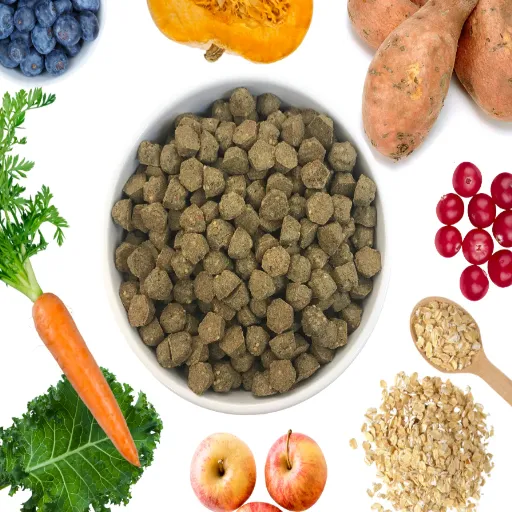
Dry dog food recipe formulation is the systematic design of ingredient blends, nutrient profiles, and processing parameters to produce extruded kibble that meets regulatory standards and performs consistently on commercial production equipment.
At its core, formulation answers three questions:
- What nutrients must the final product deliver, and in what quantities?
- Which ingredients provide those nutrients at the target cost and quality?
- How must the recipe be adjusted so the extruder can process it efficiently?
The third question is where most generic formulation guides fall short. A recipe designed only for nutritional compliance ignores the mechanical reality of extrusion cooking. High-protein formulas need more moisture. High-fat formulas reduce mechanical energy input. Certain starch sources expand differently under identical temperature and pressure conditions.
Understanding this connection between recipe and machinery is what separates laboratory formulations from commercially viable production recipes. For a complete overview of the manufacturing process itself, see our guide to the complete dry dog food manufacturing process.
AAFCO Nutrient Targets for Dry Dog Food Recipe Formulation
Every commercial dry dog food recipe formulation begins with a regulatory target. In the United States, the Association of American Feed Control Officials (AAFCO) establishes the nutrient profiles that define “complete and balanced” pet food. In Europe, the European Pet Food Industry Federation (FEDIAF) serves a similar function.
Adult Maintenance vs Growth and Reproduction
AAFCO dog food nutrient profiles provide the foundation for every commercial formulation. AAFCO publishes two primary nutrient profiles for dogs. The profile you choose determines every ingredient decision that follows.
| Nutrient | Adult Maintenance Minimum | Growth and Reproduction Minimum |
|---|---|---|
| Crude Protein (% DMB) | 18.0% | 22.5% |
| Crude Fat (% DMB) | 5.5% | 8.5% |
| Calcium (% DMB) | 0.5% | 1.2% |
| Phosphorus (% DMB) | 0.4% | 1.0% |
| Ca:P Ratio | 1:1 to 2:1 | 1:1 to 2:1 |
| Lysine (% DMB) | 0.63% | 0.77% |
| Linoleic Acid (% DMB) | 1.1% | 1.3% |
Values expressed on a dry matter basis (DMB). Data sourced from AAFCO Official Publication.
The growth and reproduction profile is stricter for a reason. Puppies require higher protein for tissue development, higher fat for energy density, and tightly controlled calcium levels to prevent developmental orthopedic disease. Exceeding the 1.8% calcium maximum for growth formulas can cause skeletal abnormalities in large-breed puppies.
Dry Matter Basis vs As-Fed Basis
Here is a calculation error that destroys formulations. AAFCO expresses all requirements on a dry matter basis. Pet food labels list guaranteed analysis on an as-fed basis, which includes moisture. If you formulate using as-fed percentages, your final product will be nutritionally deficient.
The conversion is simple but critical:
Dry Matter % = 100% – Moisture %
Nutrient % (DMB) = As-Fed Nutrient % / Dry Matter Decimal
For example, a kibble with 10% moisture and 24% protein as-fed contains 26.7% protein on a DMB (24 / 0.90). A canned food with 78% moisture and 9% protein as-fed contains 40.9% protein DMB (9 / 0.22).
Commercial dry kibble typically contains 8-11% moisture at packaging. Always formulate in DMB, then convert to as-fed for your final label.
Energy Density Adjustments
AAFCO profiles assume a caloric density of 4,000 kcal ME per kilogram. If your recipe exceeds this energy density, dogs will eat less volume to meet their caloric needs. Therefore, nutrient concentrations must be proportionally higher to ensure adequate intake.
Conversely, a less energy-dense formula (for example, a weight management recipe at 3,200 kcal/kg) does not require nutrient adjustment. Dogs simply consume more volume.
Ingredient Selection for Dry Dog Food Recipe Formulation
With your nutrient targets established, the next step is selecting ingredients that deliver those nutrients efficiently and cost-effectively.
Core Ingredient Categories
Commercial dry dog food recipes typically contain five core ingredient categories. The inclusion rates below represent typical ranges for standard adult maintenance formulas.
| Category | Typical Inclusion | Primary Function | Common Sources |
|---|---|---|---|
| Protein | 25-35% | Amino acids, muscle maintenance | Poultry meal, fish meal, meat and bone meal, pea protein |
| Carbohydrate | 30-40% | Energy, starch gelatinization, binding | Corn, rice, wheat, barley, potato starch |
| Fat/Oil | 8-12% | Energy, palatability, coat health | Poultry fat, fish oil, canola oil |
| Fiber | 3-5% | Digestive health, satiety | Beet pulp, cellulose, pea fiber |
| Vitamin/Mineral Premix | 1-3% | Micronutrient compliance | Commercial premixes, synthetic additions |
Protein quality matters as much as quantity. Eggs have the highest biological value for dogs, followed by skeletal meats and organ meats. Plant proteins like pea or soy must be combined carefully to ensure all ten essential amino acids are present at adequate levels.
Sample Recipe: Standard Adult Maintenance Kibble
The following pet food extrusion recipe illustrates a commercially viable adult maintenance formula designed for twin-screw extrusion. All percentages are on an as-fed basis.
| Ingredient | Inclusion Rate | Purpose |
|---|---|---|
| Chicken Meal | 28.0% | Primary protein source |
| Ground Yellow Corn | 22.0% | Starch base, energy |
| Brewers Rice | 18.0% | Secondary starch, digestibility |
| Chicken Fat | 10.0% | Energy, palatability |
| Beet Pulp | 4.0% | Fiber, digestive health |
| Fish Meal | 3.5% | Omega-3 fatty acids, flavor |
| Vitamin/Mineral Premix | 2.0% | Micronutrient compliance |
| Chicken Digest | 1.5% | Palatability enhancer |
| Salt | 0.5% | Sodium, chloride |
| Mixed Tocopherols | 0.3% | Natural preservative |
| Water/Steam | 10.2% | Processing aid (extrusion moisture) |
This formula delivers approximately 26% protein DMB, 16% fat DMB, and 3.5% fiber DMB. It meets AAFCO adult maintenance requirements with a caloric density of approximately 3,850 kcal/kg.
Sample Recipe: High-Protein Grain-Free Formula
Grain-free and high-protein recipes present unique extrusion challenges. With reduced starch content, achieving adequate expansion and binding requires careful moisture management and die selection.
| Ingredient | Inclusion Rate | Purpose |
|---|---|---|
| Salmon Meal | 25.0% | Primary protein source |
| Chicken Meal | 18.0% | Secondary protein |
| Peas | 15.0% | Starch, plant protein |
| Lentils | 10.0% | Starch, fiber |
| Salmon Oil | 8.0% | Omega-3, energy |
| Chicken Fat | 5.0% | Energy, palatability |
| Potato Starch | 4.0% | Binding starch |
| Beet Pulp | 3.0% | Fiber |
| Vitamin/Mineral Premix | 2.5% | Micronutrient compliance |
| Natural Flavor | 1.0% | Palatability |
| Water/Steam | 8.5% | Processing aid |
This formula delivers approximately 32% protein DMB with limited starch. On a twin-screw extruder, it will require higher preconditioning moisture (30-32% in-barrel) and a lower screw speed (250-300 RPM) to achieve acceptable expansion. The die plate should feature smaller diameter holes (2-3mm) to increase back pressure and compensate for reduced starch gelatinization.
Need equipment that handles recipe-specific adjustments? Our twin-screw pet food production line is engineered with customizable barrel profiles, variable screw configurations, and recipe memory systems that let you switch between standard and high-protein formulas without mechanical downtime.
Extrusion Processing Losses: Building Effective Overages
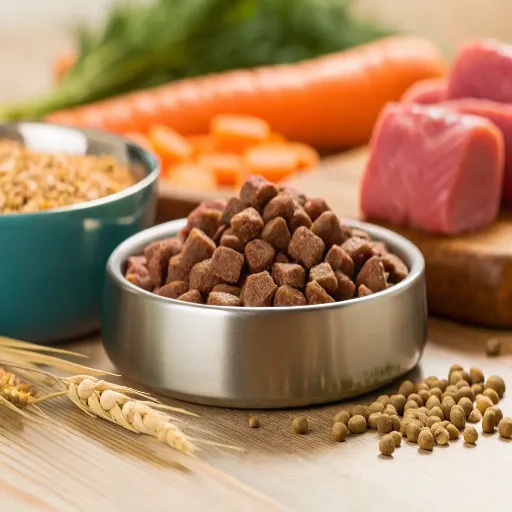
A critical reality of any pet food extrusion recipe is that extrusion cooking subjects ingredients to high heat (120-180°C), shear, and pressure for 20-60 seconds. These conditions improve starch digestibility and eliminate pathogens, but they also degrade heat-sensitive nutrients.
Typical Nutrient Loss Rates by Extrusion Temperature
The table below shows average loss percentages for common nutrient classes at three extrusion temperature ranges. These values inform your overage strategy.
| Nutrient Class | Loss at 120°C | Loss at 150°C | Loss at 180°C | Primary Control Method |
|---|---|---|---|---|
| Vitamin A | 8-12% | 15-20% | 25-35% | Post-extrusion coating, stabilized forms |
| Vitamin E | 5-8% | 10-15% | 20-25% | Post-extrusion coating |
| Thiamine (B1) | 10-15% | 20-30% | 35-50% | Overformulation, thiamine mononitrate |
| Riboflavin (B2) | 3-5% | 5-10% | 10-15% | Moderate overage |
| Lysine | 5-8% | 10-15% | 15-20% | Overformulation, lower barrel temps |
| Omega-3 Fatty Acids | 2-5% | 5-10% | 10-15% | Post-extrusion application |
| Natural Pigments | 10-20% | 25-40% | 40-60% | Post-extrusion coating |
Data compiled from peer-reviewed extrusion research including PubMed vitamin stability studies.
Carlos of Mexico City who works in a moderate sized pet food plant has had that experience as well. Carlos’s team used to add a uniform 10% vitamin overage to all diets. When they took delivery of a higher extrussing capacity pressure extruder that works in the barrel at 160 o C, an analysis of dry extrudates indicated the loss of 28% in Vitamin A activity and 18% in lysine content. The particular batch did not pass the American Association of Feed Control Officials (AAFCO ) tests.
Carlos came up with one of the top three strategies to deal with this problem. I. The vitamin overage content was increased by 20% in all formulas that were processed at a temperature above 150°C. II. Vitamin B1, which had been thiamine hydrochloride was switched to thiamine mononitrate due to its much higher thermal resistance. III. Fat based vitamins and fish oil were shifted to a vacuum coating step post extrusion. The subsequent three batches that he produced were even analyzed with tolerances that were exceeded.
Practical Overage Strategies
Not all nutrients require the same approach. Here is how to handle the three most common scenarios:
Heat-Sensitive Vitamins (A, E, B1, B6): Build overages of 15-25% above your final target. Use stabilized forms where available. Consider post-extrusion coating for the most sensitive nutrients.
Amino Acids (Lysine, Methionine): Build overages of 10-15%. Use crystalline amino acids rather than relying solely on protein-bound sources, which are less predictable under shear.
Fats and Oils: Limit pre-extrusion fat to 8-10% of the formula. Apply remaining fats, oils, and omega-3s post-extrusion via drum or vacuum coating. This preserves fatty acid integrity and improves palatability.
Post-Extrusion Coating Formulations
Coating is where you recover what extrusion destroys. A typical post-extrusion coating application includes:
- Fats and Oils: 6-10% of final product weight. Poultry fat, fish oil, or blends.
- Palatants: 1-3% of final product. Digests, hydrolyzed proteins, or natural flavors.
- Heat-Sensitive Nutrients: Fat-soluble vitamins, probiotics, and certain minerals applied at 0.2-0.5%.
- Functional Additives: Glucosamine, chondroitin, or antioxidants at 0.1-0.3%.
Vacuum coating is the gold standard for nutrient retention. By drawing a vacuum in the coating drum, oils and palatants penetrate the kibble structure rather than simply adhering to the surface. This improves uniformity and reduces dust.
Connecting Recipe Design to Extruder Parameters
This is the section most pet food formulation guides ignore. Your ingredient ratios directly determine your extruder settings. Ignoring this connection is why dog food formulations that pass nutritional analysis still fail on the production floor.
How Protein Level Affects Extrusion Settings
Protein content is the single biggest variable in extruder behavior.
Standard Protein (22-28% DMB): This is the most forgiving range. Standard moisture targets of 25-28% in-barrel work well. Screw speeds of 300-450 RPM deliver adequate mechanical energy input. Expansion is predictable, and die selection is flexible.
High Protein (>30% DMB): High-protein formulas absorb more water, bind less effectively, and expand less readily. You will need:
- Higher in-barrel moisture: 28-32%
- Lower screw speed: 250-350 RPM to reduce shear and prevent protein denaturation
- Higher preconditioning temperature: 95-100°C to fully hydrate proteins before extrusion
- Smaller die holes: 2-3mm to increase back pressure and force expansion
Low Protein (<20% DMB): Low-protein recipes can over-expand and become too porous. Reduce moisture to 22-25% and consider a larger die diameter (4-5mm) to control puffing.
How Starch Source Affects Expansion and Density
The carbohydrate base you choose determines your kibble texture as much as your die plate does.
| Starch Source | Expansion Ratio | Bulk Density | Extrusion Behavior | Best For |
|---|---|---|---|---|
| Corn | 2.5-3.5x | 200-280 g/L | Highly forgiving, strong binding | Standard recipes, economy brands |
| Rice | 1.8-2.2x | 280-350 g/L | Lower expansion, denser kibble | Premium brands, sensitive stomach formulas |
| Wheat | 2.0-2.8x | 240-320 g/L | Good binding, gluten adds structure | Mid-range recipes |
| Potato Starch | 3.0-4.0x | 160-220 g/L | Very high expansion, fragile structure | Grain-free recipes (with care) |
Corn is the most forgiving extrusion starch. Its amylopectin content gelatinizes readily under standard extrusion conditions, producing consistent expansion. Rice produces a denser, harder kibble that some manufacturers prefer for dental health positioning. Potato starch expands aggressively but requires precise moisture control to prevent a fragile, crumbly final product.
How Fat Content Affects Processing
Fat lubricates the extruder barrel, reducing mechanical energy input and shear. This sounds beneficial, but excessive pre-extrusion fat disrupts starch gelatinization and reduces expansion.
The practical limit for pre-extrusion fat is approximately 8-10% of the formula. If your recipe requires higher fat content for nutritional or palatability reasons, split the fat addition. Add 6-8% pre-extrusion and apply the remainder post-extrusion via coating.
Recipe-Specific Parameter Recommendations
The matrix below connects common recipe types to practical extruder settings for a mid-capacity twin-screw system.
| Recipe Type | In-Barrel Moisture | Barrel Temp Profile | Screw Speed | Die Hole Diameter |
|---|---|---|---|---|
| Standard Adult Maintenance | 25-28% | 50°C → 70°C → 90°C | 350-450 RPM | 3-4mm |
| High-Protein Grain-Free | 28-32% | 50°C → 65°C → 85°C | 250-350 RPM | 2-3mm |
| Weight Management (High Fiber) | 26-30% | 50°C → 70°C → 95°C | 300-400 RPM | 3-4mm |
| Puppy Growth Formula | 25-28% | 50°C → 70°C → 90°C | 350-450 RPM | 2-3mm (smaller kibble) |
| Economy/Value Brand | 22-25% | 50°C → 75°C → 95°C | 400-500 RPM | 4-5mm |
These are starting points. Your specific extruder model, screw configuration, and die plate design will require fine-tuning. The critical principle is that every recipe change demands a corresponding parameter adjustment. Treating the extruder as a fixed machine and only adjusting the recipe is a recipe for inconsistent output.
For a deeper exploration of twin-screw extrusion mechanics, see our advanced food extrusion solutions.
Cost-Effective Formulation Without Compromising Quality
Not every dry dog food recipe formulation targets the premium market. Economy and mid-tier brands still need reliable extrusion performance and consistent kibble output.
Ingredient Cost Hierarchy
Protein sources vary dramatically in cost per unit of digestible amino acids. For budget-conscious formulation:
- Poultry By-Product Meal typically offers the lowest cost per percent protein. It is highly digestible and extrudes well.
- Meat and Bone Meal is cheaper than pure meat meals but has variable quality. Source from reputable suppliers with consistent ash and calcium levels.
- Plant Proteins (Pea, Soy) are cost-effective but require careful amino acid balancing. Lysine supplementation is usually necessary.
- Fish Meal is the most expensive common protein source. Reserve it for premium positioning or specific omega-3 claims.
Cost-Optimized Sample Recipe
| Ingredient | Inclusion Rate | Notes |
|---|---|---|
| Poultry By-Product Meal | 22.0% | Cost-effective protein base |
| Ground Yellow Corn | 28.0% | Lowest-cost starch source |
| Wheat Middlings | 12.0% | Low-cost filler with moderate protein |
| Poultry Fat | 8.0% | Rendered fat, economical energy source |
| Beet Pulp | 4.0% | Affordable fiber source |
| Vitamin/Mineral Premix | 2.0% | Standard commercial premix |
| Salt | 0.5% | Sodium, chloride |
| Natural Preservative | 0.3% | Mixed tocopherols or rosemary extract |
| Water/Steam | 23.2% | Processing aid |
This formula delivers approximately 22% protein DMB and 14% fat DMB, meeting AAFCO adult maintenance minimums at a significantly lower ingredient cost than premium salmon-based recipes. It extrudes predictably on standard twin-screw systems with moderate moisture targets.
The key insight for any dry pet food formulation is that AAFCO compliance is a floor, not a ceiling. A recipe that meets AAFCO minimums at a lower cost per kilogram can be commercially successful if palatability, digestibility, and extrusion consistency are maintained.
Quality Control in Dry Dog Food Recipe Formulation
Formulation does not end when the recipe is written. Validation ensures that what you designed is what the extruder actually produces.
Laboratory Analysis Checklist
Every new recipe should pass a three-phase analysis before full production:
Phase 1: Proximate Analysis
- Moisture: Target 8-11% at packaging
- Crude Protein: Verify within 2% of DMB target
- Crude Fat: Verify within 1.5% of DMB target
- Crude Fiber: Verify within 1% of target
- Ash: Monitor for mineral overages, especially calcium and phosphorus
Phase 2: Amino Acid Profile
- Lysine and methionine are the most commonly deficient amino acids in commercial formulations
- Verify all ten essential amino acids meet or exceed AAFCO minimums
- Check cystine levels if methionine is marginal
Phase 3: Mineral Analysis
- Calcium and phosphorus are critical. The Ca:P ratio must fall between 1:1 and 2:1
- For growth formulas, calcium must not exceed 1.8% DMB
- Verify selenium, iodine, and zinc levels, as these are commonly over- or under-formulated
Extrusion Quality Metrics
Beyond nutrition, monitor these physical parameters:
- Expansion Ratio: Measure kibble diameter vs die hole diameter. Standard recipes should expand 2.0-3.0x. High-protein recipes may only reach 1.5-2.0x.
- Bulk Density: Target 200-350 grams per liter depending on recipe positioning. Premium dense kibble is 280-350 g/L.
- Kibble Hardness: Use a texture analyzer. Adult maintenance kibble typically measures 15-25 kgf compression force.
- Moisture Uniformity: Sample across the batch. Coefficient of variation should be under 5%.
Palatability and Digestibility Testing
Nutritional compliance means nothing if dogs will not eat the food or cannot digest it.
- Two-Bowl Preference Test: Offer your new formula against a control diet to 20+ dogs over two days. A 65% or higher consumption ratio indicates acceptable palatability.
- Apparent Digestibility: Measure fecal output vs intake for protein, fat, and dry matter. Target >80% dry matter digestibility for standard formulas.
- Stool Quality Scoring: Use a 1-5 scale. Target average scores of 3.5-4.5 (firm, well-formed stools).
Modern Technology: AI-Optimized Recipe-to-Extrusion Workflows
The dry dog food recipe formulation landscape changed in 2025. Two major technology shifts now connect recipe design directly to twin-screw extruder pet food performance in real time.
AI-Driven Extrusion Optimization
By early 2025, Wenger & Extru-Tech launched EXPRO AI in collaboration with an artificial intelligence system to predict kibble fish outcomes before processing by analyzing past extruder data alongside current sensor inputs.
The whole system acts as an electronic copy of your extrusion process. It understands how input elements (protein content, starch properties, moisture content) influence outputs (degree of expansion, density, distribution of moisture) in your machinery. If a new recipe is incorporated, the screwing speed, barrel temperature, and moisture Content are automatically adjusted to avoid tedious testing methods.
Dry dog food recipe formulation requires the inclusion of all oil, fat and liquid within 12% as well as all moisture content within 10%. Now, with the application of pre-gelatinized starch-based BindTech FBD, it is possible to completely eliminate the addition of any moisture lowering liquid binders.
Integrated Recipe Management
Modern extrusion control systems now store complete recipe profiles that include both ingredient targets and machine setpoints. When an operator selects “Recipe A,” the system automatically loads:
- Ingredient dosing ratios for the batching system
- Preconditioner steam and water targets
- Extruder barrel temperature profile
- Screw speed and feeder rate
- Die configuration and cutter speed
- Dryer zone temperatures and belt speed
Elena, the R&D director at a Brazilian pet food co-manufacturer, reduced her new product development timeline from six weeks to ten days after implementing an integrated recipe management system. Previously, her team spent two weeks manually dialing in extruder settings for each new formulation. Now the system recommends starting parameters based on similar recipes in the database, and her operators only need two or three fine-tuning runs to achieve target specifications.
At Shandong Loyal, our food processing equipment range includes pet food production lines with PLC/SCADA control systems, recipe memory, remote diagnostics, and real-time parameter monitoring. This means your formulation team can design recipes in the lab, upload them directly to the production floor, and maintain consistent output across shifts and facilities.
Conclusion
Dry dog food recipe formulation is where nutritional science meets extrusion engineering. A recipe that excels on paper but fails in the barrel serves no one. The manufacturers who succeed are those who treat formulation and extrusion as a single integrated process.
Your formulation workflow should follow this sequence:
- Establish AAFCO nutrient targets on a dry matter basis
- Select ingredients that deliver those targets at your target cost
- Calculate processing overages for heat-sensitive nutrients
- Map recipe variables to specific extruder parameters
- Validate the finished product through laboratory, physical, and palatability testing
- Store the complete recipe-profile combination for consistent replication
The gap between nutrition and machinery is real. But it is also bridgeable. With the right framework, your formulation team and your extrusion operators can speak the same language.
Ready to turn your recipe into a production line? Contact our engineering team for a customized consultation. We design twin-screw extrusion systems with recipe-specific adjustments, from standard adult maintenance to high-protein grain-free formulas, with the automation and control systems to keep your output consistent batch after batch.