
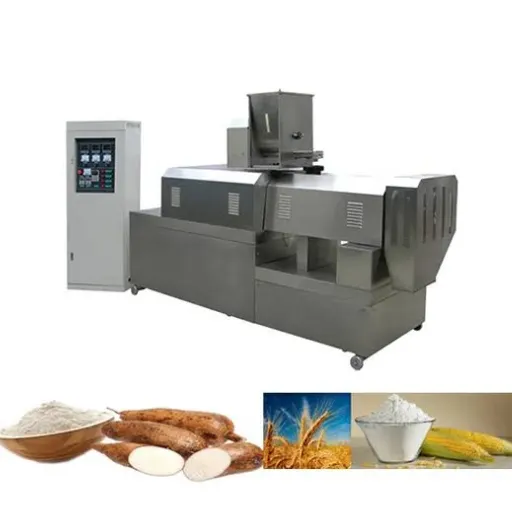
Pregelatinized Starch Production Line: Complete Buyer’s Guide

A pregelatinized starch production line converts native starch from corn, cassava, potato, or wheat into a cold-water-soluble powder that thickens, binds, or gels without extra cooking. For food manufacturers, pharmaceutical suppliers, and industrial processors, choosing the right line means balancing production method, capacity, and end-product specifications from the start.
Key Takeaways
- A pregelatinized starch production line gelatinizes native starch, then dries and mills it into a cold-water-soluble powder.
- Twin-screw extrusion is the dominant continuous method, though drum drying and spray drying suit specific viscosity and purity needs.
- Typical lines range from 100 kg/h pilot systems to 2,500 kg/h industrial installations.
- Food, pharmaceutical, oil drilling, and construction applications each demand different equipment materials, controls, and certifications.
- Buyers should evaluate method, capacity, energy use, compliance, and supplier support before requesting a quote.
What Is Pregelatinized Starch?
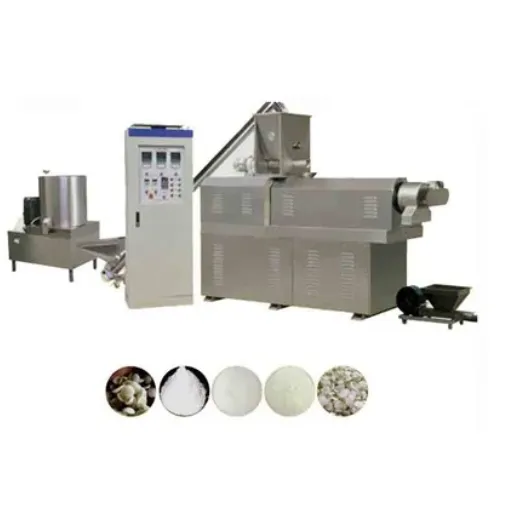
Pregelatinized starch is native starch that has already been cooked, or gelatinized, and then dried into a powder or flake. Because the starch granules have ruptured under heat, moisture, and shear, the finished product can absorb cold water and develop viscosity without a separate cooking step.
Common raw materials include:
- Corn starch, the largest source, accounting for roughly 47% of the market
- Cassava / tapioca starch, popular in Asia-Pacific and Latin America
- Potato starch, valued for high viscosity and clarity
- Wheat and rice starch, niche uses in food and pharma
Quality is usually measured by water solubility index (WSI), water absorption index (WAI), final moisture, particle size, and viscosity. These properties determine whether the product works better in instant soup, pharmaceutical tablets, or oil drilling mud.
When Priya, a procurement manager at a Mumbai-based instant-food company, first researched pregelatinized starch, she assumed all starches behaved the same. Her team learned that extruded starch gave fast cold-water dispersion for instant noodles, while drum-dried starch delivered the higher viscosity their sauce line needed. Matching the product spec to the process saved them from buying the wrong equipment.
Applications Driving Demand for Pregelatinized Starch
The same functional properties that make pregelatinized starch convenient also make it valuable across very different industries.
Food and Beverage
Instant soups, sauces, gravies, puddings, and bakery fillings rely on pregelatinized starch for quick thickening without a stovetop cook step. It also appears in gluten-free baked goods, processed meats, and surimi products where texture and moisture retention matter.
Pharmaceuticals
Pregelatinized maize starch is a common tablet binder, disintegrant, and diluent. Colorcon notes that it can improve flow and compression in direct-compression formulations, often at use levels of 5–20% as a binder.
Industrial Uses
- Oil drilling, fluid-loss control additive in water-based drilling muds
- Construction, binder and water-retention agent in tile adhesives, wall putty, and dry-mix mortar
- Paper and textiles, sizing and coating additive
- Animal feed, pellet binder
With Asia Pacific holding roughly 38–39% of global market share in 2025, demand for regional production capacity is rising fast. Latin America is the fastest-growing region, projected to expand at around 8.9% CAGR.
Production Methods: Drum Drying vs. Extrusion vs. Spray Drying
Not every pregelatinized starch production line uses the same technology. The three main methods differ in moisture, energy, capital cost, and finished-product properties.
Twin-Screw Extrusion
Extrusion is the most common method for continuous pregelatinized starch production. A twin-screw extruder heats and shears a moistened starch feed under pressure, then releases it through a die. The sudden pressure drop causes expansion, rapid drying, and structural change.
Typical parameters:
- Moisture: 15–20%
- Barrel temperature: 120–200°C
- Pressure: 3–10 MPa
- Product: porous, high solubility, lower viscosity
Extrusion lines are compact, energy-efficient, and easy to automate. They are ideal for instant cold-water dispersible starches and high-volume industrial grades.
Drum / Roller Drying
In drum drying, a starch slurry of about 40% solids is spread onto heated rotating drums. The starch gelatinizes and dries simultaneously, then is scraped off as flakes or powder.
Typical parameters:
- Roll temperature: 150–180°C
- Final moisture: ~5%
- Product: higher viscosity, more intact starch molecules, flake-like structure
Drum drying is often preferred for high-viscosity food and pharmaceutical grades where texture and clarity are critical. However, it requires more floor space and higher capital investment than extrusion.
Spray Drying
Spray drying atomizes starch milk into a hot-air chamber. It produces fine, hollow spherical particles with uniform gelatinization.
Typical parameters:
- Feed: low-viscosity starch milk
- Product: fine powder, fast dissolution
- Trade-off: high energy consumption
Spray drying is best for specialty applications or when particle morphology is especially important.
| Method | Moisture Input | Typical Temp | Product Viscosity | Best For |
|---|---|---|---|---|
| Twin-screw extrusion | 15–20% | 120–200°C | Lower | Instant foods, industrial binders |
| Drum/roller drying | ~40% slurry | 150–180°C | Higher | Sauces, pharma excipients |
| Spray drying | Low-viscosity milk | Hot air | Low to moderate | Specialty powders |
Choosing the right method depends on your target application, raw material, and budget. Shandong Loyal’s food extrusion solutions are engineered for processors who want continuous, scalable pregelatinized starch output.
Equipment Configuration for a Pregelatinized Starch Production Line
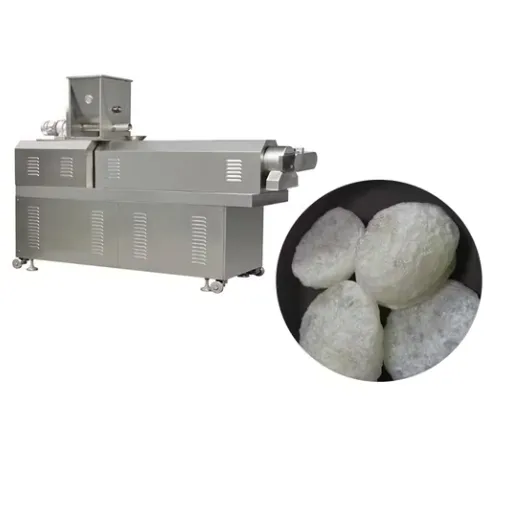
A typical extrusion-based pregelatinized starch production line follows a clear material flow:
- Flour / starch mixer, blends native starch with water and additives
- Screw conveyor, feeds conditioned starch into the extruder
- Twin-screw extruder, gelatinizes the starch under heat, pressure, and shear
- Cooling conveyor / cutter, reduces temperature and sizes the extrudate
- Air conveyor / hoister, transfers product to the dryer
- Dryer, electric, gas, oil, or steam heated; reduces moisture to stable levels
- Pulverizer / mill, grinds dried flakes into powder
- Vibrating sieve / classifier, controls particle size distribution
- Packaging machine, weighs, fills, and seals bags in moisture-barrier packaging
Key specifications to compare across suppliers:
- Capacity: 100 kg/h for pilot lines up to 2,500 kg/h for industrial plants
- Installed power: roughly 72 kW for smaller lines to 240+ kW for large systems
- Materials: food-grade SUS 304/316 stainless steel contact surfaces
- Automation: PLC control, variable frequency drives, independent temperature zones
- Safety: dust collection and explosion-proof components for starch handling
Optional modules include pre-conditioning units, additive dosing systems, metal detectors, cooling systems, and upgraded dust extraction. A well-configured pregelatinized starch production line should be modular, so you can scale capacity or add functions without replacing the entire system.
When Marcus, a project engineer at a Brazilian construction-additives plant, upgraded from a batch drum dryer to a continuous extrusion line, his output jumped from 800 kg/day to 1,200 kg/day on the same shift pattern. The new line also gave him tighter moisture control, which reduced rejected batches by nearly half.
How to Choose the Right Pregelatinized Starch Production Line
Selecting a line is not just about capacity. The right choice aligns product requirements, process technology, and long-term operating costs.
Define the end product first. Food-grade instant starch, pharmaceutical excipient, and oil-drilling additive each demand different WSI/WAI targets, particle sizes, and contamination controls.
Match the method to the spec. High-viscosity sauces and pharma tablets often favor drum drying. Cold-water instant starches and industrial binders usually favor twin-screw extrusion.
Size for growth. Buy a line rated for current demand plus 20–30% headroom. A line that is maxed out on day one becomes a bottleneck within months.
Check materials and compliance. Food and pharma applications need SUS 304/316 stainless steel, HACCP- and GMP-friendly design, and easy cleanability. Industrial grades may allow different materials but still need robust dust control.
Evaluate supplier support. Installation, commissioning, operator training, spare parts, and remote troubleshooting matter as much as the machine itself. A low purchase price loses its appeal if downtime stretches for weeks waiting for support.
Want to see how a customized pregelatinized starch production line fits your product goals? Explore our modified starch production line options and request a tailored configuration.
Cost, ROI, and Operational Considerations
No supplier lists exact prices publicly, but understanding cost drivers helps you compare quotes accurately.
Capital cost factors:
- Production method (extrusion is generally lower capital than drum drying)
- Capacity and line size
- Materials of construction (SUS 316 adds cost over SUS 304)
- Automation level and control systems
- Optional modules (dosing, dust collection, cooling)
Operating cost factors:
- Energy source and kWh/kg consumption
- Steam or thermal oil requirements
- Labor (automated lines reduce headcount)
- Maintenance and spare parts
- Raw material yield and rework rates
ROI improves quickly when the line runs at high utilization and the finished product commands a premium over native starch. Many processors recover their investment within two to four years, depending on local energy costs and market prices.
Compliance, Safety, and Quality Control
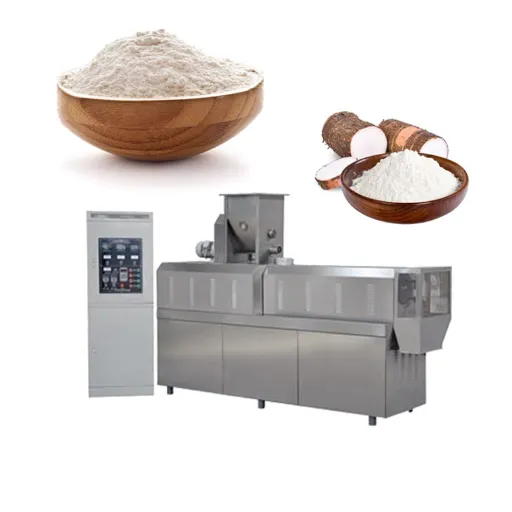
A pregelatinized starch production line must meet both product-quality standards and workplace safety rules.
Food-grade standards:
- HACCP and GMP design principles
- Food-safe SUS 304/316 stainless steel
- Smooth welds, sloped surfaces, and clean-in-place compatibility
Pharmaceutical standards:
- Excipient-grade documentation
- Contamination control
- Validation support for FDA or USP-NF requirements
Industrial standards:
- CE, ISO, or GMP certifications as required by destination market
- Robust dust collection to manage starch explosion risk
Quality control checkpoints:
- Incoming starch moisture and purity
- In-process extrusion temperature and pressure
- Final product moisture, WSI/WAI, viscosity, and particle size
- Microbiological testing for food and pharma grades
A pharmaceutical manufacturer in Eastern Europe found that switching to a GMP-compliant pregelatinized starch production line cut their audit findings by 60%. The new equipment had full batch traceability, validated cleaning protocols, and stainless-steel contact surfaces that met USP-NF expectations.
Conclusion
A pregelatinized starch production line turns native starch into a high-value functional ingredient for food, pharmaceutical, and industrial markets. The best investment comes from matching the production method to your end-product requirements, sizing for future growth, and choosing a supplier who can support commissioning, training, and spare parts over the life of the equipment.
Whether you need an extrusion-based instant starch system or a higher-viscosity drum-dried line, focus on WSI/WAI targets, material compliance, and total cost of ownership. Shandong Loyal designs tailored production lines with food-grade stainless steel construction, PLC automation, and scalable configurations to match your application.
Ready to configure a pregelatinized starch production line for your plant? Contact our team for a detailed proposal, layout drawing, and quote.
FAQ
What is a pregelatinized starch production line?
A pregelatinized starch production line is an integrated system that cooks native starch, dries it, and mills it into a cold-water-soluble powder used in food, pharmaceuticals, and industrial applications.
What equipment is included in a pregelatinized starch production line?
A typical extrusion-based line includes a mixer, screw conveyor, twin-screw extruder, cooling conveyor, dryer, pulverizer, vibrating sieve, and packaging machine.
What is the difference between drum drying and extrusion for pregelatinized starch?
Drum drying uses a heated roll to gelatinize and dry a starch slurry, producing higher-viscosity flakes. Extrusion cooks moistened starch under pressure and shear, producing porous, highly soluble particles at lower capital cost.
How much does a pregelatinized starch production line cost?
Pricing depends on capacity, method, materials, and automation. Small extrusion lines start in the low tens of thousands of dollars; large industrial drum-drying or extrusion systems can reach several hundred thousand dollars.
What industries use pregelatinized starch?
Major users include food and beverage, pharmaceuticals, oil drilling, construction adhesives, paper and textiles, and animal feed.