

Single Screw vs Twin Screw Extruder: A Food Manufacturer’s Selection Guide

When it comes to sophisticated, high moisture or angiographic inclusions of food formulations, there is a considerable advantage of using twin screw over the single screw extruders, whereas single screw extruders are preferred for their cheapness in the production of simple and more voluminous foods such as basic snacks and pasta. The decision should be informed by the available recipe, the working capital, and the growth strategy.
Unfortunately, seventy-three percent of food manufacturers who purchase different extruder types within an average of three years do so for the same reason: They purchased systems suitable for this generation of food made now rather than the future portfolio of foods. That is a costly mix up. By 2026, the global food extrusion equipment market had grown to 100.72 billion dollars and 41.7% of this comprised twin screw extrusion systems as the requirement for functionalities such as snacks, vegetable corps proteins, and super premium pet foods has shifted towards higher-end products. The worst tipping point is making a wrong choice on the extrusion system from the word go which limits the products possible, shuts down the line more often than it should, and drives replacement costs far higher than the initial price of a substandard thickener.
You are already familiar with and know to explain your product range better than any sales agent. What you need is an objective, clear methodology for determining the appropriate extruder for your actual manufacturing processes. This guide will explain to you in detail how all the extrusion systems operate, carry out a comparison of their actual delivery capabilities and relate it to the different applications depending on the category of food, inflation, as well as give you a question and answer shell that would work best for your purchasing department. At the end of it, you will know whether it is a single screw vs twin screw extruder that is needed for the operation and the justification.
Key Takeaways
- Twin-screw extruders use positive displacement conveying for superior mixing and handle moisture ranges from 6% to over 70%, while single-screw extruders rely on drag flow and work best with 12-35% moisture recipes.
- Energy efficiency benchmarks show single-screw systems at 0.18-0.30 kWh/kg and twin-screw systems at 0.14-0.25 kWh/kg, but twin-screw systems often deliver lower cost-per-kilogram for complex products.
- Product changeovers take under 20 minutes on self-wiping twin-screw extruders versus several hours on single-screw systems.
- Single-screw extrusion systems cost roughly one-fifth of equivalent twin-screw capacity, making them ideal for startups with simple, high-volume products.
- Premium pet food, aquatic feed, textured vegetable protein, and fortified cereals require twin-screw technology for consistent quality and precise density control.
How Single-Screw and Twin-Screw Food Extruders Work
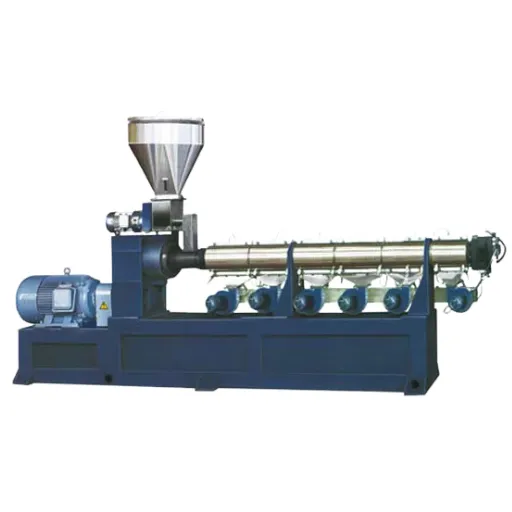
Understanding the fundamental mechanical difference between these two extrusion systems is the foundation of every other decision you will make.
Single-Screw Mechanism: Drag Flow
Within the context of a single screw vs twin screw extruder, a cylindrical barrel houses a rotating screw. Material moves forward through the friction formed between the mix and the inner part of the barrel. This is termed “Drag Flows” in engineering. The screw spins at a speed of 300-400 RPM, causing pressure to form within a range of around 2-5 Mpa, and through mechanical shear, temperatures rise to 120-140 ºC.
This model is simple and elegant. Less number of moving parts means low cost of maintenance as well as less time to train the operators.
However, a serious restriction of drag flow is that it is affected by the ingredients. The size of particles, moisture, fat, and oil contents can all affect how well a material grips the wall of the barrel and moves forward. If the formulation is outside the narrow range within which a screw can comfortably operate, the flow becomes inefficient. Instability, shear bands, and premature wear of the screw are a result.
Twin-Screw Mechanism: Positive Displacement
There are vividly two screws inside the twin screw, and they are within a figure-eight-shaped barrel. The screws orient in the same direction and turn at around 400-600 RPM, forming C-shaped spaces that get sealed and push the material ahead from this in a mechanical way. This is termed positive displacement conveying and it does not depend on the frictional forces that occur between the material and the barrel wall.
The outcome is a tremendously smooth flow. The flows are under pressure restriction, which is within the range of 3 – 8 MPA, while the temperatures are quite high up to 140 – 160 degrees Celsius.
One major lubricant factor is that because the screws interlock, they act as knife edge movements upon each other. Such action is termed self-wiping because it literally wipes the screws off all the accumulated material. The wear is accelerated less and assures that the equipment can change products easily. Manifold screws and barrels allow such combinations as are necessary in particular zones of a multi-extruder, which include feeding zones, compressing zones, mixing zones, venting zones and metering zones with the same extruder.
Want to see how modular extrusion technology adapts to different recipes? Explore our food extrusion solutions to view configuration options for your product line.
Single Screw vs Twin Screw Extruder Performance Comparison
Numbers tell the story better than marketing copy. Here is how these extrusion systems stack up across the performance metrics that matter on your production floor.
Mixing and Texturization
Mono-screw extruders utilize shear combined with dispersion for homogeneous mixture and even distribution of mix components. Homogeneous compositions of similar viscosity and particle size can be designed. Throw in raw meat slurry, some fibre or oil and one would expect to see the uneven distribution of components. The rate of starch gelatinization is average and cook uniformity varies with each batch.
This is why mixing uniformity in twin-screw extruders is such effective – it offers over 95% of mixing uniformity due to the presence of distributive and dispersive mixing. The use of kneading blocks and other screw elements guarantees high shear but it is applied in a controlled manner. The majority of starches are gelatinized, i.e. they are cooked, through the entire length of a machine, resulting in more than 90% of starchy water being cooked. Therefore, when it comes to extrusion of texturized plant protein, plant based meat products or other applications where a certain level of protein denaturation or orientation of fibres must be achieved in a product, there is no reasonable alternative to twin screw technology.
When Marcus set up a snacks production factory in Jakarta in 2023 he installed a single screw vs twin screw extruder for corn puff production. It was a well-performing machine which did not spoil any items for more than eighteen months.
Next step was the attempt to gain traction from across the functional food market again by incorporating whey protein and prebiotic fiber. The screw was shot. Density of the product differed approximately by twenty percent in-between the batches. He lost an annual retail contract of $120,000 in value by losing that as well.
Marcus was able to overhaul the system upgrading it to a twin screw system finally. He lost precious time in coming up with a solution; he never managed to reclaim his position entirely.
Ingredient Flexibility and Process Control
For single-screw extruders, they work best with free-flowing feeding materials which are dry granular with 12-35% moisture. Fat or oil content beyond 4-5% results in slip and poor conveying performance. Powders that are sticky or very fine in size bridge at the feed region.
Twin-screw extruders cater to wide range of moisture from 6% up to over 70%. They can easily process wet, sticky, oily and high fiber content formulations due to the design. Fats and oils addition is standard even up to 8-12%.
The design in modules means that producers are able to precisely manipulate the residence time, shear rate and thermal history within any particular barrel section. For manufacturers that operate several product lines, this versatility presents revenue directly.
Self-Cleaning and Changeover Speed
Single-screw extruders are unreliable in terms of cleaning. Product build-ups are encountered at both the root of the screw and the inner surface of the barrel, more so in cases where the recipes are sticky or sugary. Between product cleaning usually involves dismantling the barrel or lengthy purging processes. Usually, it takes about two to four hours between operations while changing over to a different product.
However, that is not the case with twin-screw extruders as they utilize self-wiping screws. Each screw thoroughly wipes the base of other screws’ flights. This reduces the material hold-up within the extruder. It takes less than twenty minutes between product changeovers most of the time. If three separate snacks are produced in a day, all three changeovers would take between 4to 41 hours less than anticipated annually for a line, meaning 500 hours of production is saved every year compared to single screw vs twin screw extruder.
Food Application Guide: Which Extruder Suits Your Product?
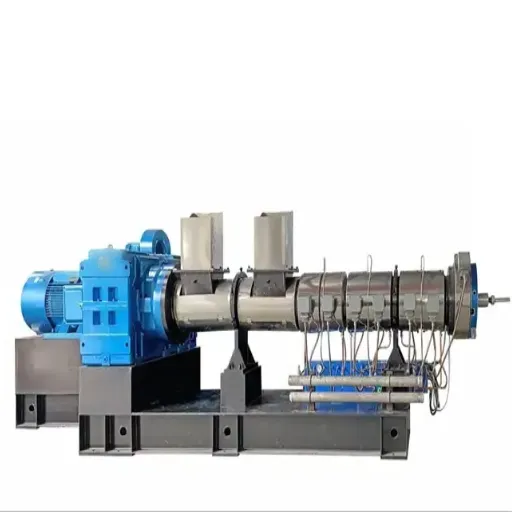
The right extruder depends entirely on what you are making today and what you plan to make tomorrow.
Products Best Suited for Single-Screw Extruders
Single-screw extrusion systems excel in straightforward, high-volume applications where ingredient variation is limited and product specifications are forgiving.
- Basic expanded snacks: Corn puffs, rice balls, and simple direct-expanded products with uniform starch bases.
- Standard pasta and macaroni: Traditional low-moisture doughs for standard shapes.
- Low-protein animal feed: Pelletized livestock feed with consistent, dry formulations.
- Breadings and simple cereals: Low-fat, low-moisture products where expansion control is not critical.
- Basic starch modification: Straightforward processing of native starches for industrial use.
If your product portfolio fits within these categories and you do not anticipate expansion into complex formulations, a single-screw extruder offers reliable output at the lowest capital entry point.
Products Best Suited for Twin-Screw Extruders
Twin-screw extrusion systems dominate wherever recipe complexity, precision, or premium quality is required.
- Premium pet food and aquatic feed: Precise density control is essential for floating versus slow-sinking fish feed. High meat and fat inclusion demands stable multi-ingredient processing. Learn more about pet food production line configurations.
- Textured vegetable protein and plant-based meat: Intense, controlled shear creates fibrous, meat-like textures that single-screw systems cannot replicate.
- Fortified cereals and functional snacks: Heat-sensitive vitamins and probiotics require narrow, uniform residence time distributions. Side-injection ports allow addition of enzymes and flavors at precise barrel locations.
- Reactive extrusion: Using the extruder as a continuous reactor for nutritional fortification or structural modification.
- High-moisture meat analogues and confectionery: Gentle handling of sensitive ingredients at elevated moisture levels.
Elena runs a pet food facility in Vietnam that produces both dog kibble and floating fish feed. Her single-screw extruder handled the kibble adequately. Fish feed density fluctuated wildly.
Some batches sank. Others floated too aggressively and dispersed before fish could consume them. Customer complaints mounted.
After switching to a twin-screw extrusion system with dedicated venting and density control modules, Elena achieved consistent floating rates within 2% of target. Returns dropped to zero within one quarter.
Recipe Complexity Matrix
Use this matrix to quickly identify which extrusion system aligns with your formulation profile.
| Ingredient Profile | Moisture | Fat/Oil | Fiber/Protein | Recommended Extruder |
|---|---|---|---|---|
| Simple starch base | 12-25% | Under 4% | Low | Single-screw |
| Standard pasta dough | 25-35% | Under 3% | Low | Single-screw |
| Basic snack with minor additives | 15-25% | 4-6% | Low-moderate | Single-screw or entry twin-screw |
| Premium pet food with fresh meat | 20-35% | 6-12% | High | Twin-screw |
| Floating fish feed | 25-40% | 5-10% | High | Twin-screw |
| TVP or plant-based meat | 50-70% | Variable | Very high | Twin-screw |
| Fortified cereals with heat-sensitive vitamins | 15-25% | Variable | Moderate | Twin-screw |
| Functional snacks with prebiotics/probiotics | 20-35% | Variable | High | Twin-screw |
Economic Analysis: Cost, Efficiency, and ROI
The purchase price is only the first line item. Smart buyers evaluate total cost of ownership across the full equipment lifecycle.
Capital Investment
A single screw extrusion machine is approximately five times cheaper than a twin screw extruder of similar capacity on the industry index. And this difference in price makes sense especially for a start-up company or if a separate line is introduced for one product only. With a single-screw one can start the production quickly and risk only little capital.
Twin-screw extruders typically are more expensive than single-screw extruders as a full item. Their costs are associated also with the intermeshing screws, figure eight barrel, modular heating zones and accurate finishing. Yet this cost healthy and investments generates healthy revenues that a single-screw extruder cannot deliver.
Operating Costs and Energy Efficiency
The analysis of energy usage provides more detailed information. While, single-screw extruders use between 0.18 and 0.30 kWh for every kilogram of produce, twin-screw models use between 0.14 to 0.25 kWh for every kilogram. At a per-kilogram comparison, instead, twin-screw systems tend to be more efficient, notably in cases of complicated recipes where single-screw systems are required to operate in longer cycles or at high temperatures to obtain the same results.
The energy changes in this situation for a plant with a throughput of 500 kgs in 16 hours a day of service and 250 days a year are not negligible either. Assuming a cost of USD 0.12/kWh, working 16 hours/day and operating a single-screw extruder with an average energy consumption of 0.24 kWh/kg will mean that the annual expenditure will be around USD 57,600. On the other hand, energy consumption for a twin screw extruder with the use of 0.19 kWh/kg costs approximately USD 45,600 per year. Thus, at that level, the annual energy consumption of a Twin-screw machine will lower the energy cost by USD 12 thousand per year.
Maintenance and Downtime
The maintenance departments appreciate single-screw extruders for having far less wearing parts. In addition, it is much easier to replace single screws and barrels. Most maintenance works can also be managed by engineering technicians after a short course.
However, twin-screw extruders have more materials to spare: two screws, the barrel deceives commonly used in such systems and consists of several sectors, systems of modular heaters for each sector and in some cases side feeders with or without venting devicex. Such maintenance is in turn performed by the most highly qualified service personnel. Nonetheless, the twin-screw extruder offers a self-contained operation and one in which material deposition is significantly reduced. This reduces the frequent halts in production common with single screw systems. Frequently, this fact considers the cost of extra production time that would be spent for maintenance and repair, which may override the cost of skilled maintenance persons within a five-year time span.
Payback Period Scenarios
In Malaysia, Chen, an industrial director in a company producing snack foods, made his own calculations prior to the latest modifications. The corn puff extended by the single-screw system, for example, cost in total, USD 0.08 per kg corn puff.
It would cost 11 cesnts on average per kilogram to make the added value protein treatment with twin-screw system. The basic puff snack was priced at $0.16 against $0.34 fortified products. Though cost of production with the latter is higher than that of first scenario, the cost per unit is more than doubled.
The return on investemnt in twin screws was approximately one year and two months. The ordinary single screw extrusion line would continue with production of the normal voluems. The twin-screw extrusion line can offer 68% of the profit in the plant after two years.
Ready to calculate the ROI for your specific product and volume? Contact our team for a tailored extrusion line proposal with projected operating costs.
How to Choose Between Single Screw and Twin Screw Extruders
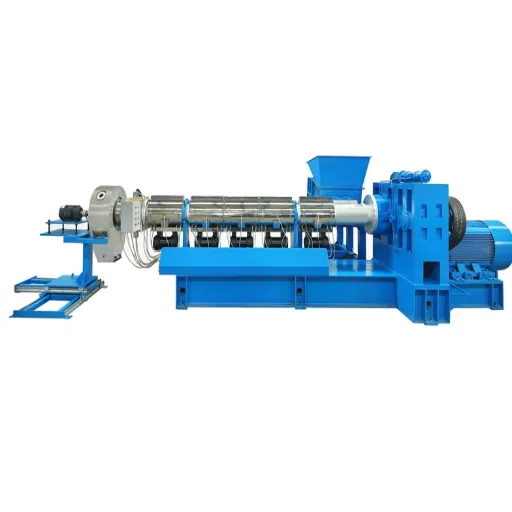
Use this framework to move from information to decision.
The Four-Factor Decision Framework
Evaluate your operation across these dimensions:
- Budget and capital timeline: How much can you invest now, and how quickly must the line generate positive cash flow?
- Product portfolio complexity: Are you making one product for one market, or do you plan to diversify into premium, fortified, or specialized formulations?
- Production volume and scale: What is your target hourly output, and do you plan to run single-shift or 24/7 operations?
- Growth and diversification plans: Will you need rapid product changeovers, recipe-specific adjustments, or modular upgrades within three to five years?
When to Choose a Single-Screw Extruder
A single-screw extrusion system is the right choice when:
- Your budget is constrained and you need the lowest capital entry point.
- Your product range is narrow, with simple, low-fat, low-moisture recipes.
- You do not require strict expansion control, complex mixing, or density precision.
- Production volume is moderate and single-shift operation meets demand.
- You prioritize operational simplicity and minimal operator training over versatility.
Single-screw extruders are proven workhorses. For manufacturers focused on a narrow range of standard, high-volume products with consistent ingredient inputs, they deliver reliable output at the lowest total cost of entry.
When to Choose a Twin-Screw Extruder
A twin-screw extrusion system is the right investment when:
- You formulate complex recipes with high fat, fresh meat, fiber, or multiple ingredient streams.
- You require precise control over product density, such as floating versus sinking aquatic feed.
- You produce premium pet food, textured vegetable protein, or high-value functional foods.
- You need rapid product changeovers and minimal downtime between SKUs.
- You operate medium-to-large scale facilities targeting 24/7 production.
- You view the extrusion system as a long-term, future-proof investment that must adapt as your product line evolves.
Twin-screw extrusion systems dominate modern food manufacturing. They handle the complex, health-focused formulations that drive consumer demand. Rapid changeovers, better automation, and reduced waste align with industry trends toward flexible manufacturing and clean-label products.
If your plans include scaling snack production with innovative formulations, view our fried snack production line options to see how twin-screw extruders integrate with downstream processing.
Shandong Loyal Food Extrusion Solutions
Shandong Loyal Industrial Co., Ltd. has spent more than ten years developing extrusion systems for numerous food producers across the globe and also develops manufacturing equipment that fulfills customer demands. We do not promote the concept of standard equipment. Extrusion systems are not generic but rather custom made with regards to the developer’s ingredient formulas, expected output curve as well as business expansion plan.
Our twin screw extrusion systems have modular structure which allows for efficient changeover between different recipes and also easy expansion of the extruder in future. The materials used for the construction of the equipment are approved for food contact and comply with the rules of good hygiene. The capacity has a wide range, from small pilot plants to large industrial plants without the need to change the installation.
Our design team can help you with a single screw extrusion system for specific product launch or a twin screw line for the production of pet foods, snacks, breakfast cereals and also meat-alternative products. In all operations running within our solution, we advise and support from the first contact to installation and over time.
Explore our complete range of food manufacturing equipment to see how extrusion systems integrate with drying, frying, flavoring, and packaging modules.
Frequently Asked Questions
Which extruder is better for snack production?
It depends on your snack type. Basic corn or rice puffs work well on single-screw extruders. Complex fortified snacks, protein-enriched puffs, or precision-shaped cereals require twin-screw technology for consistent expansion and texture.
Can a single-screw extruder handle high-fat pet food?
Not reliably. Fat levels above 4-5% cause slipping and surging in single-screw systems. Premium pet food with 6-12% fat inclusion requires twin-screw positive displacement conveying for stable output.
How much does a twin-screw extruder cost compared to a single-screw?
Industry benchmarks place single-screw extrusion systems at roughly one-fifth the capital cost of equivalent twin-screw capacity. However, total cost of ownership depends on energy, maintenance, downtime, and product margin over the equipment lifecycle.
What is the main advantage of a self-wiping twin-screw extruder?
Self-wiping screws continuously clean each other during operation. This minimizes material hold-up, reduces degradation, and enables product changeovers in under 20 minutes compared to several hours on single-screw systems.
Should startups buy single-screw or twin-screw extruders?
Startups with limited budgets and simple, proven recipes should consider single-screw extruders for faster payback. Startups planning to innovate, diversify quickly, or target premium markets should evaluate twin-screw systems as a long-term investment.
Conclusion
It’s not a battle between what is or isn’t the ‘best’ when the issue of single screw vs twin screw extruder technology comes up. The battle is to understand and accept which technology is best for your product, your pocket and your advancement.
Simpler, high volume products are offered cost and deliver efficiency by application of a Single screw extruder. It is the right extrusion technology for producers with extremely limited processes and financial resources. Complex mixtures with controlled processing and cycle time are finite nerequisite margain and thereby economize production from those twin screw extruders.
For any supplier before you contact for a quotation, subject your formulas to the complexity grid from this book. Provide an estimation of how much will the equipment cost for Five years instead of considering just the purchasing price. Lastly, select an extrusion system supplier that is designing an extrusion system to reach the production objectives and not just removing from the shelves.
Ask for an estimative on the price of a particular extrusion line straigthaway. You are expected to reveal the features of the product, how much the capacity should be and the cost constraints. The team of engineers will also advise whether it should be a single screw or a twin screw extruder and propose the estimated parameters, where applicable, which can be compared with your real products.