
Starch Raw Materials Selection: A Practical Guide for Food Extrusion

Selecting the right starch raw materials depends on matching the starch source to your target product texture, extrusion process, and cost constraints. You need to consider the amylose/amylopectin ratio and gelatinization temperature. Corn, tapioca, potato, rice, and wheat starches each behave differently under heat, moisture, and shear. Choosing the wrong base starch is one of the fastest ways to create expansion, binding, or texture problems on an extrusion line.
Last year, a snack plant in Vietnam kept producing dense, uneven cheese puffs even though the extruder settings looked correct. The team had always used 100% corn flour. After a starch trial, they switched to a corn-tapioca blend with slightly higher amylopectin. Expansion improved immediately, breakage dropped, and the line ran more steadily. The extruder did not change. The starch did.
That story is more common than most manufacturers admit. Many plants choose starch based on habit, local price, or supplier convenience. Then they fight with inconsistent product quality, rework, and off-spec batches. This guide will give you a practical framework for selecting starch raw materials so your extrusion line delivers the texture, expansion, and binding you need without unnecessary trial and error.
Key Takeaways
- Starch selection is the foundation of extruded product quality; the wrong source causes expansion and texture defects that extruder adjustments alone cannot fix.
- Amylopectin drives expansion and crispness, while amylose adds binding strength and denser texture; most expanded snacks perform best with 5–20% amylose.
- Corn, tapioca, potato, rice, wheat, and pea starches each suit different products, from light puffs to dense pet kibble to chewy pellets.
- Moisture content, particle size, screw speed, barrel temperature, and die design must be matched to the starch source for consistent results.
- Always validate starch choices with extrusion trials and simple quality tests such as WAI, WSI, bulk density, and expansion ratio before scaling up.
What Is Starch Raw Materials Selection for Extrusion?
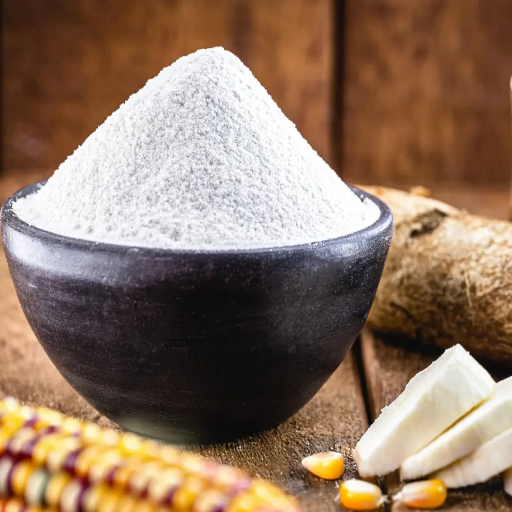
Starch raw materials selection is the process of choosing the right starch source, grade, and blend for a specific food extrusion application. In most extruded foods, starch is the dominant structure-forming ingredient.
During extrusion, starch absorbs water, swells, and gelatinizes under heat and mechanical shear. That gelatinized starch matrix traps steam at the die. It then expands and sets into the final product structure. These raw materials for extrusion cooking therefore determine how the product expands, binds, and finishes.
Because starch drives so much of the final result, ingredient selection is not just a purchasing decision. It is a process-design decision. The same extruder can produce a light crispy puff, a dense chewy pellet, or a firm kibble depending mainly on what starch enters the barrel.
Effective starch raw materials selection weighs five dimensions:
- Product texture and expansion target: Do you need a light airy puff, a crunchy cereal, a dense pellet, or a binding binder?
- Process conditions: What barrel temperatures, moisture levels, screw speeds, and die pressures will you use?
- Label and market requirements: Is clean-label important? Do you need gluten-free, grain-free, or non-GMO claims?
- Cost and availability: Which starches are economical and reliably supplied in your region?
- Equipment compatibility: Will your extruder handle the viscosity, particle size, and shear requirements of the chosen starch?
If you are also producing modified or pregelatinized starch, the same principles apply. The raw starch source determines the final viscosity, solubility, and texture of the finished ingredient. Our guide to pregelatinized starch production line explains how source starch becomes cold-water-soluble powder on a twin-screw extrusion line.
How Starch Behaves During Extrusion: Gelatinization and Selection
To select starch well, you need to understand what happens inside the extruder barrel. This knowledge is the foundation of sound starch raw materials selection. Extrusion cooking applies heat, moisture, pressure, and shear at the same time. Starch granules go through three main changes: hydration, gelatinization, and molecular fragmentation.
Gelatinization and Melting
Starch gelatinization during extrusion is the point where starch granules absorb water, swell, and lose their crystalline structure. In extrusion cooking, this happens at moisture and temperature combinations far beyond normal cooking. ScienceDirect’s overview of food extrusion notes that barrel temperatures can reach 140–180°C under significant pressure. This causes both gelatinization and partial melting of starch polymers.
The degree of gelatinization directly affects expansion, digestibility, and final texture. Under-gelatinized starch gives poor expansion and a gritty mouthfeel. Over-sheared starch can lose too much structure and produce weak, collapsed products. Understanding starch gelatinization extrusion behavior helps you set the right moisture, temperature, and screw speed.
Amylose vs. Amylopectin
Starch is made of two glucose polymers:
- Amylopectin is highly branched. It holds water strongly and forms a viscous elastic melt. It promotes high expansion with fine, uniform air cells. Waxy corn starch is almost pure amylopectin.
- Amylose is linear. It forms a firmer, more brittle network after cooling. It adds binding strength. Too much amylose restricts expansion because the matrix cannot stretch as far when steam expands at the die.
For most directly expanded snacks, an amylose content of 5–20% gives the best balance of expansion and texture. Higher-amylose starches such as normal corn, wheat, sago, or pea starch are better suited to dense, chewy, or binding applications.
The Role of Moisture and Shear
Moisture acts as a plasticizer. It softens the starch, reduces melt viscosity, and helps heat transfer. Typical feed moisture ranges from 12–18% for low-fat extruded snacks and up to 25–40% for wet extrusion or pet food processes.
Shear is measured indirectly as specific mechanical energy (SME). Higher screw speeds and smaller die openings increase shear, which raises gelatinization and can break starch molecules. Each starch source responds differently, so switching starches usually means adjusting screw speed and barrel temperature, not just the recipe.
Key Starch Raw Materials Selection Criteria for Extrusion
Good starch raw materials selection goes beyond picking a botanical source. Here are the practical criteria that determine how a starch will perform on your line.
Botanical Source and Composition
Corn, potato, tapioca, wheat, rice, and pea starches differ in amylose/amylopectin ratio, granule size, gelatinization temperature, and lipid/protein content. These differences change how the starch cooks, expands, binds, and tastes. We will compare the main sources in detail in the next section.
Native Starch vs Modified Starch for Extrusion
- Native starches are extracted directly from plants without chemical alteration. They are cost-effective and clean-label friendly, but they break down more easily under heat, acid, and high shear.
- Modified starches are treated physically, chemically, or enzymatically to improve process tolerance, texture, shelf life, or cold-water solubility. Extrusion itself is a physical modification method that produces pregelatinized starch.
When deciding between native starch vs modified starch for extrusion, choose modified or functional native starches if the process involves retort processing, freeze-thaw cycles, or aggressive shear. Our modified starch manufacturing process page explains how twin-screw extrusion turns native starch into a functional ingredient.
| Factor | Native Starch | Modified Starch |
|---|---|---|
| Cost | Lower per kg | Higher per kg |
| Process tolerance | Limited heat, acid, and shear resistance | High heat, acid, and shear resistance |
| Clean-label appeal | Strong; simple ingredient declaration | Varies; may carry E-numbers |
| Expansion control | Less predictable | More consistent and controllable |
| Best for | Mild processes, short shelf life, natural positioning | UHT, retort, freeze-thaw, extruded snacks, instant foods |
Particle Size and Purity
Particle size affects flow, mixing uniformity, and die performance. A common rule is that the largest particle should be no more than one-third of the die opening. Large particles can cause uneven cooking, block small dies, and create rough product surfaces.
Purity matters too. Ash, protein, fat, and fiber levels influence starch behavior. For example, wheat starch may contain traces of gluten, and some native starches carry higher lipid content that can affect expansion.
Moisture Content and Storage
Incoming starch moisture should generally be below 10–12% before extrusion. Higher moisture can cause steam bubbles, inconsistent gelatinization, and accelerated degradation in storage. Starches are also hygroscopic, so storage conditions affect flowability and performance.
Cost, Availability, and Certifications
Regional availability and price volatility matter at production scale. Corn starch is usually the most economical globally, while tapioca and potato prices fluctuate with harvests. Certifications such as HACCP, ISO, non-GMO, organic, or halal may be required depending on your market.
Starch Source Comparison for Extrusion
The table below summarizes how the main commercial starches behave in typical extrusion conditions, so you can use it as a practical starch raw materials selection reference.
| Starch Source | Typical Amylose | Gelatinization Temp | Expansion | Binding Strength | Best Suited For |
|---|---|---|---|---|---|
| Corn / maize | ~25% | 60–75°C | Moderate | Moderate | Puffed snacks, cereals, cost-driven formulations |
| Waxy corn | Very low | 60–70°C | Very high | Low | Light airy puffs, high-expansion products |
| Tapioca / cassava | 11–17% | 60–65°C | High | Good | Gluten-free snacks, third-generation pellets |
| Potato | ~20% | 55–65°C | High | Strong | Crispy snacks, veggie puffs, strong binder at low use |
| Rice | ~20% | 65–75°C | Low–moderate | Good | Premium baby snacks, delicate textures |
| Wheat | ~25% | 55–85°C | Moderate | Strong (with gluten) | Crackers, pellets, wheat-based cereals |
| Pea | ~35% | 60–75°C | Low | Very strong | Grain-free pet food, plant-based products |
Corn and Waxy Corn
Corn starch is the world’s most widely used extrusion base. It gives moderate expansion, acceptable binding, and a neutral flavor at low cost. Normal corn with ~25% amylose produces harder, crunchier textures. Waxy corn, which is almost entirely amylopectin, produces much lighter, more expanded products.
Tapioca and Cassava
Tapioca starch has low amylose, high purity, and a very clean taste. It expands well and creates smooth, crispy textures, which is why it is popular in gluten-free snacks and third-generation pellet formulations.
Potato
Potato starch gelatinizes at a lower temperature than most cereal starches and binds strongly even at low inclusion levels. It is excellent for crispy snacks, veggie puffs, and any product where you need strong cohesion without a heavy starch load.
Rice
Rice starch has very fine granules and a clean flavor. It expands less than corn or tapioca but creates delicate, easy-to-digest textures. It is common in premium baby snacks, rice crackers, and products marketed for sensitive diets.
Wheat
Wheat starch benefits from functional gluten, which adds elasticity and binding. It is widely used in crackers, pellets, and wheat-based cereals. It is not suitable for gluten-free products.
Pea
Pea starch is high in amylose and creates very firm, dense structures. It is increasingly used in grain-free pet foods and plant-based products where strong binding and lower expansion are needed.
Want to see how these starches perform on real production equipment? Our food extrusion solutions cover snack, cereal, and pet food lines configured for corn, cassava, potato, rice, wheat, and pea-based recipes. The right starch raw materials selection for each line depends on the product target and regional ingredient availability.
Matching Starch to Product Type
Different extruded products need different starch behaviors, so starch selection for extrusion always starts with the product type. Use this section as a quick matching guide.
Directly Expanded Snacks (2nd Generation)
Directly expanded snacks puff immediately at the die exit. They need starches that form an elastic, gas-holding melt. This is one of the most common applications for starch raw materials selection in snack manufacturing.
- Preferred starches: waxy corn, tapioca, potato, high-amylopectin blends
- Target moisture: 12–18%
- Typical result: light, crispy, low bulk density
A corn-tapioca-potato blend is a common industry pattern and often the best starch for extruded snacks when you need a balance of cost, expansion, and crispness. The corn keeps cost down, the tapioca improves expansion, and the potato adds binding and crispness.
Indirectly Expanded Snacks / Pellets (3rd Generation)
These products are extruded as dense pellets, dried, and then expanded by frying, hot-air puffing, or microwaving.
- Preferred starches: potato granules or flakes, wheat starch, modified potato starch
- Target moisture during extrusion: lower, often 18–25%
- Typical result: dense, shelf-stable pellets that expand uniformly later
Pet Food and Aquatic Feed
Starch in pet food acts as a binder, expansion agent, and digestible carbohydrate source. Starch raw materials selection for pet food must balance nutritional formulation with extrusion performance.
- Typical starch levels: ~30–40% for cat food and high-meat dog foods; ~40% for standard adult dog foods; >60–70% in the carbohydrate portion for strong expansion
- Preferred starches: corn, rice, tapioca, potato, pea
- Special note: floating aquatic feeds usually need at least 20% starch for expansion; sinking feeds use ~10% mainly as a binder
A pet food producer in Thailand recently replaced part of its corn with tapioca and pea starch in a grain-free kibble formula. The initial trials showed poor binding because pea starch gelatinizes at a higher temperature than corn. By raising preconditioning temperature and adding more mechanical energy through the twin-screw configuration, the team achieved the same expansion and binding without grain ingredients.
If you produce pet food, our pet food production line page explains how extruder configuration supports high-meat, grain-free, and standard kibble recipes.
Breakfast Cereals
Cereals need crunch, bowl life, and shape retention. Starch raw materials selection for cereals often favors corn, wheat, and rice blends.
- Preferred starches: corn, wheat, rice blends
- Common addition: small amounts of modified starch for improved stability in milk
- Target: crisp texture that resists sogginess
Textured Vegetable Protein and Meat Analogs
High-moisture extrusion of soy, pea, or wheat protein creates fibrous structures. Here starch is not the main expansion driver; it acts as a binder and plasticizer.
- Preferred starches: wheat starch, pea starch, small amounts of native potato starch
- Goal: support fiber formation without unwanted expansion
Pregelatinized and Modified Starch Production
When you extrude starch specifically to sell as a functional ingredient, the source determines the final viscosity and solubility.
- Corn starch: most common, economical, moderate viscosity
- Cassava/tapioca starch: clean flavor, smooth paste
- Potato starch: high viscosity, good clarity
- Wheat/rice starch: niche food and pharmaceutical uses
Formulation and Extruder Settings for Starch Selection for Extrusion
Starch does not work alone in starch raw materials selection. Proteins, fats, fibers, sugars, and salts all change how the starch matrix behaves. Here is how to balance the formulation and adjust the extruder when you change starch sources.
Blending Starches
Most commercial formulations use blends rather than a single starch. Blending lets you balance cost, texture, expansion, and supply security. A typical snack blend might be:
- 50–60% corn flour or starch
- 20–30% tapioca starch
- 10–20% potato starch or flakes
For grain-free pet food, a common pattern is:
- 40–50% pea starch or pea flour
- 20–30% tapioca starch
- 10–15% potato starch
Adjusting for Proteins, Fats, and Fibers
Higher protein, fat, and fiber levels generally reduce expansion and create denser, harder textures. They act as diluents in the starch matrix. To compensate:
- Increase amylopectin-rich starch
- Raise SME through higher screw speed or smaller die
- Adjust moisture to maintain proper melt viscosity
- Add fat after extrusion by coating rather than in the pre-extrusion mix
Extruder Settings to Match Starch
When you switch starch sources, these are the levers to adjust. Getting this right is a practical part of starch raw materials selection on the production floor.
- Barrel temperature profile: lower-gelatinization starches such as potato need less heat; higher-gelatinization starches such as pea or rice may need more
- Screw speed: higher speeds increase shear and gelatinization but can damage heat-sensitive ingredients
- Feed moisture: higher moisture softens the melt and reduces shear; lower moisture increases friction and SME
- Die design: die diameter, length, and open area control expansion ratio and back pressure
- Cutter speed: must match die swell and product shape
The team at a breakfast cereal plant in Turkey learned this lesson when they switched from a corn-wheat blend to a rice-dominant recipe. The rice starch created a stickier melt that overloaded the motor. They lowered feed moisture by 2% and opened the die slightly, which restored stable throughput while keeping the desired crisp texture.
Quality Control and Testing
Starch raw materials selection is only the first step. You also need to verify that the chosen starch performs consistently in your process.
Incoming Raw Material Checks
Before a starch batch enters production, check:
- Moisture content
- Ash, protein, fat, and fiber levels
- Particle size distribution
- Microbiological limits
- Certificate of Analysis (COA) against your specification
In-Process and Finished Product Tests
Testing is the final validation step in starch raw materials selection. During and after extrusion, monitor:
- Water Absorption Index (WAI): indicates how much water the extrudate absorbs; related to gelatinization
- Water Solubility Index (WSI): indicates starch breakdown and dextrinization
- Degree of gelatinization: often measured by enzymatic or differential scanning calorimetry methods
- Bulk density and expansion ratio: direct measures of product texture
- Texture analysis: hardness, crispness, and fracture behavior
These tests help you confirm whether a new starch source will match your current product before you commit to a full production run.
Procurement and Sourcing Best Practices
Starch raw materials selection does not end in the lab. It continues through purchasing and supplier management. A robust starch raw materials selection process also includes clear specifications, supplier evaluation, and backup sourcing.
- Define functional specifications first. State the required amylose range, moisture limit, particle size, purity, and certification before requesting quotes.
- Evaluate supplier consistency. A low price means little if batch-to-batch variation forces you to re-tune the extruder every week.
- Consider regional availability and price cycles. Corn is usually stable globally; tapioca and potato prices move with harvests.
- Request samples and run trials on your actual line. Lab results are useful, but real extrusion behavior can differ.
- Plan backup sources. Having two approved starches for the same function protects you from supply disruptions.
- Ask for technical support. Good starch suppliers will help you tune formulations and recommend grades for extrusion.
Frequently Asked Questions
What are the raw materials used in extrusion cooking?
The most common raw materials are starch-rich cereals and tubers such as corn, wheat, rice, potato, cassava, and tapioca. Legumes such as peas and soy are also used, especially in pet food, aquatic feed, and textured vegetable protein.
How do I choose the right starch for extrusion?
Match the starch to your product texture goal, process conditions, label requirements, and cost. For light crispy puffs, choose high-amylopectin starches such as waxy corn or tapioca. For dense chewy products or strong binding, choose higher-amylose starches such as pea, potato, or wheat starch. Good starch raw materials selection always balances these four factors.
What is the best starch for extruded snacks?
There is no single best starch. Waxy corn and tapioca give the highest expansion for light puffs. Potato starch adds crispness and binding. Corn is the most economical base. Most successful snack formulations use blends. The best starch raw materials selection for your snack line depends on your target texture, cost, and equipment setup.
What is the role of amylose and amylopectin in extrusion?
Amylopectin promotes expansion and creates fine, uniform air cells. Amylose adds firmness and binding but can restrict expansion if levels are too high. A 5–20% amylose range works well for many directly expanded snacks.
What moisture content is needed for extrusion?
Feed moisture is typically 12–18% for low-fat directly expanded snacks, 20–25% for pellets, and 25–40% for wet extrusion processes such as pet food or textured vegetable protein.
Can I replace modified starch with native starch in extrusion?
Sometimes, but not always. Native starch is cheaper and cleaner-label. However, it breaks down more easily under heat, acid, and shear. For mild processes and short shelf-life products, native starch may work. For retort, freeze-thaw, or high-shear applications, modified starch is usually necessary.
Which starch is best for pet food extrusion?
Corn and rice are common for standard kibble. Tapioca, potato, and pea starches are popular for grain-free and high-meat formulas because they bind well and support controlled expansion.
What is the most important factor in starch raw materials selection for extrusion?
The most important factor is matching the starch source to the product texture and process conditions. Amylose/amylopectin ratio, gelatinization temperature, and moisture content together determine expansion, binding, and final product quality.
Conclusion
Starch raw materials selection is one of the most important decisions in extruded food manufacturing. The right starch gives you consistent expansion, the texture your customers expect, and a process that runs smoothly shift after shift. The wrong starch creates defects that no amount of extruder tuning can fully fix.
Remember the four pillars of good starch raw materials selection: match the starch source to your product type, balance amylose and amylopectin for your texture target, adjust extrusion parameters to the starch’s gelatinization behavior, and validate every change with real production trials and quality tests.
If you are planning a new snack, cereal, pet food, or modified starch line, our engineers can help you select the right raw materials and configure the extrusion system around them. Explore our fried snack production line and broader food production line solutions, or contact Shandong Loyal today for a tailored starch raw materials selection and equipment consultation.