
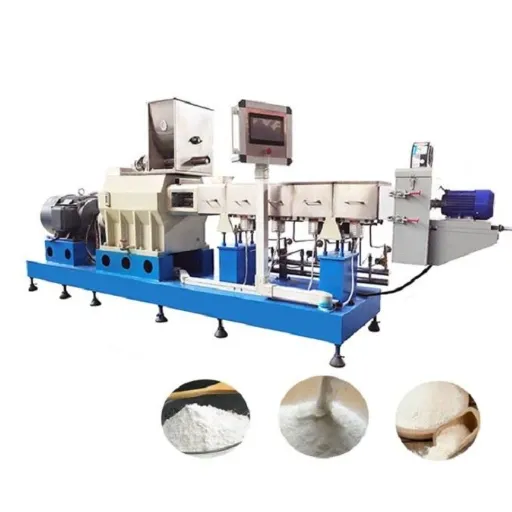
Twin Screw Extruder Modified Starch: A Complete Production Guide

A twin screw extruder is the most efficient continuous reactor for producing modified starch because it combines mixing, heating, pressurizing, and high-shear modification in a single pass. Food manufacturers use these systems to turn native corn, cassava, potato, or wheat starch into pregelatinized, oxidized, esterified, or cationic starches with controlled viscosity, solubility, and texture.
But buying the wrong line can cost you more than the machine price. Last year, a snack producer in Southeast Asia installed a generic extruder for modified starch and quickly discovered the screws could not maintain a stable temperature profile. Batch-to-batch viscosity swung by 30%, instant soup thickeners clumped, and the plant lost a major retail contract. The fix was not a bigger motor; it was a twin-screw design built for starch modification.
That story is more common than most buyers expect. This guide explains how twin screw extruder modified starch production works, which process parameters control quality, and how to choose a line that matches your recipe, capacity, and long-term growth plans.
Key Takeaways
- Twin-screw extruders modify starch through controlled heat, pressure, and shear in one continuous pass, making them ideal for pregelatinized and chemically modified starches.
- Key quality metrics include water solubility index (WSI), water absorption index (WAI), degree of gelatinization, and final paste viscosity.
- Process parameters such as moisture content, barrel temperature, screw speed, and feed rate determine whether the final starch performs in soups, snacks, or oil drilling fluids.
- Twin-screw systems outperform single-screw units for starch modification because of superior mixing, self-cleaning action, and stable residence time.
- A well-specified modified starch production line typically handles 100 kg/h to 2,000 kg/h and should be built with food-safe stainless steel, modular screws, and responsive technical support.
What Is Twin Screw Extruder Modified Starch?
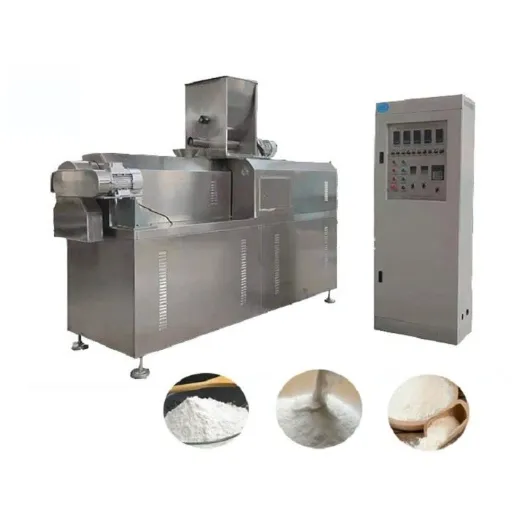
Twin screw extruder modified starch is starch that has been physically or chemically altered inside a co-rotating twin-screw extruder. The process changes the starch’s native properties, such as gelatinization temperature, paste viscosity, solubility, and freeze-thaw stability, so it performs better in industrial applications.
Native starch granules are semi-crystalline. When they pass through a twin-screw extruder, the combination of mechanical shear, heat, and moisture disrupts that crystalline structure. The result is a modified starch that can swell in cold water, thicken without cooking, or bind water under harsh processing conditions.
Common Types Produced
- Pregelatinized starch, cold-water soluble; used in instant soups, sauces, and baby cereals.
- Oxidized starch, lower viscosity, improved clarity; common in paper and textile sizing.
- Esterified starch, better stability and film-forming; used in sauces and dressings.
- Cross-linked starch, resists breakdown under heat, acid, or shear; ideal for canned and frozen foods.
- Cationic starch, carries a positive charge; widely used in papermaking and water treatment.
The same machine can often produce several types simply by changing screw configuration, temperature profile, and additives. That flexibility is one reason food manufacturers prefer twin-screw systems over batch reactors.
How a Twin Screw Extruder Modifies Starch
Inside the extruder, starch is not just cooked. It is transformed. The screws rotate in the same direction at high speed, pushing the material through barrel zones that get progressively hotter.
The Thermomechanical Environment
Three forces work together:
- Thermal energy from heated barrel jackets and friction raises the starch temperature, often to 120–200 °C.
- Shear stress from the intermeshing screws tears apart starch granules and breaks molecular bonds.
- Pressure builds as the material moves toward the die, typically reaching 10–60 bar depending on the recipe.
This environment gelatinizes starch in seconds rather than the minutes required by traditional batch cooking. The high-temperature short-time (HTST) approach preserves more functional qualities while reducing energy use.
Standard Process Flow
A typical modified starch manufacturing process follows this sequence:
- Mixing, native starch is blended with water and any additives.
- Conveying, a screw feeder moves the mix into the extruder hopper.
- Extrusion, the twin screws cook, shear, and modify the starch.
- Cooling / drying, moisture is reduced to 8–14%.
- Grinding, the extrudate is milled to the desired particle size.
- Packaging, finished modified starch is bagged for shipment.
Role of Screw Configuration and Barrel Zones
Modular screw elements let engineers tune the process. Kneading blocks increase shear for gelatinization, while conveying elements control residence time. Barrel zones can be heated or cooled independently, so the temperature profile matches the starch source and modification type.
Die design also matters. A smaller die increases back-pressure and shear, which can raise the degree of gelatinization. A larger die reduces residence time and preserves more granular structure for partially pregelatinized products.
Twin Screw vs Single Screw Extruder for Starch Modification
Not every extrusion job needs a twin-screw machine. For simple, high-volume products with stable recipes, a single-screw extruder can be cheaper to buy and operate. But for modified starch, the technical demands usually favor twin-screw technology.
| Factor | Twin Screw Extruder | Single Screw Extruder |
|---|---|---|
| Mixing efficiency | Excellent, self-wiping, intermeshing screws | Good, limited by single rotor |
| Powder feeding | Stable, even with fine starch powders | Can slip or surge with powders |
| Residence time | Narrow, predictable distribution | Broader, less consistent |
| Heat transfer | Uniform across the barrel | Less uniform |
| Self-cleaning | Yes, screws wipe each other | Limited |
| Complex formulations | Handles high-fat, high-moisture, additives | Less flexible |
| Capital cost | Higher | Lower |
| Best for | Modified starch, reactive extrusion, precision products | Simple extrusion, snack pellets, stable recipes |
When Maria, a procurement manager at a Brazilian food ingredients company, compared quotes, the single-screw line was 20% cheaper. Her engineering team pushed back. They needed consistent cold-water solubility for an instant noodle seasoning thickener. The twin-screw line delivered a WSI variation under 3%, while test runs on the single-screw unit exceeded 12%. She chose the twin-screw system and later credited it with helping her win a three-year supply contract.
Key Process Parameters That Control Quality
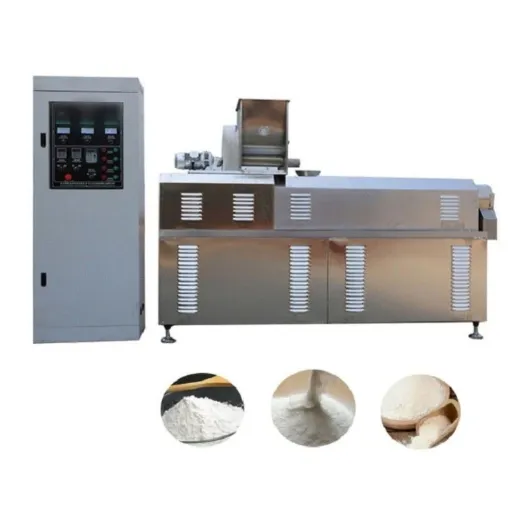
The same raw material can produce very different starches depending on how the extruder is set. Understanding these parameters helps you troubleshoot problems and optimize recipes.
Moisture Content
Moisture acts as a plasticizer. Typical extrusion moisture ranges from 15% to 40% for physical modification and up to 40% or more for reactive extrusion.
- Lower moisture increases shear and mechanical energy input, which can dextrinize starch and reduce viscosity.
- Higher moisture improves gelatinization but requires more drying energy downstream.
Barrel Temperature Profile
Most modified starch extruders use three to seven barrel zones. The first zones preheat and compress the feed. Later zones reach peak temperature for modification. According to process data, the maximum water absorption index (WAI) is often reached around 180–200 °C, after which WAI falls and WSI rises as starch molecules break down further.
Screw Speed and Specific Mechanical Energy (SME)
Screw speed controls shear rate. Higher speeds increase SME, which can raise gelatinization but also cause excessive molecular breakdown. SME is calculated from torque, screw speed, and throughput. It is one of the most useful control variables for consistent quality.
Feed Rate and Residence Time
Throughput must match screw speed and barrel capacity. Too much feed reduces residence time and leaves starch under-modified. Too little feed overheats the material and creates dark, burnt particles. Typical residence times in twin-screw starch extrusion range from 10 to 60 seconds.
How Parameters Affect Final Properties
| Parameter Increase | Typical Effect on WAI | Typical Effect on WSI | Typical Effect on Viscosity |
|---|---|---|---|
| Higher temperature | Rises to a peak, then falls | Rises | Falls |
| Higher moisture | Rises | Falls slightly | Rises |
| Higher screw speed | Complex, depends on throughput | Rises | Falls |
| Lower feed rate | May fall due to overheating | Rises | Falls |
Quality Metrics for Extruded Modified Starch
You cannot control what you do not measure. Food manufacturers and ingredient suppliers track several key metrics to verify that each batch meets specification.
Water Solubility Index (WSI)
WSI measures the percentage of starch that dissolves in water. High WSI means the starch is highly gelatinized or dextrinized. Instant food applications usually need moderate to high WSI for quick dispersion.
Water Absorption Index (WAI)
WAI measures how much water the starch absorbs and retains. It indicates swelling power and is critical for thickening applications. A high WAI starch will create a viscous paste at low concentration.
Degree of Gelatinization
This metric tells you how completely the crystalline starch structure has been disrupted. Fully gelatinized starches are transparent and cold-water soluble. Partially gelatinized starches retain some granular structure and are used as filler-binders.
Viscosity and Paste Stability
Rapid Visco Analyser (RVA) or Brookfield viscosity tests show how the starch behaves during heating, holding, and cooling. Stable viscosity under shear and temperature changes is essential for sauces, gravies, and canned foods.
Particle Size and Moisture
Final moisture should typically be 8–14% for storage stability. Particle size affects dispersion rate and mouthfeel. Instant applications usually require finer grinds than industrial binders.
Applications of Twin Screw Extruder Modified Starch
The demand for modified starch keeps growing. According to Future Market Insights, the global modified starch market is projected to reach approximately USD 9.8 billion in 2026, expanding at a CAGR of about 3.8% through 2036. Straits Research notes that corn starch leads raw-material share at roughly 46.4%, while physically modified starch is expected to account for 52.1% of the market in 2026 because of clean-label demand.
Food Industry Uses
Modified starch made on twin-screw extruders appears in a wide range of products:
- Soups, sauces, and gravies, thickening and freeze-thaw stability.
- Instant noodles, over 22% of dietary modified starch application share.
- Bakery products, moisture retention and soft crumb structure.
- Snack foods, expansion, crispness, and adhesion of seasonings.
- Dairy and desserts, gelling, stabilizing, and creaminess.
- Meat and fish products, water binding and texture improvement.
- Powdered beverages and instant cereals, cold-water solubility.
- Frozen foods, resistance to retrogradation and syneresis.
Non-Food Industrial Uses
Beyond food, extruded modified starch serves several industries:
- Oil drilling, pregelatinized starch controls fluid loss in water-based drilling muds, stable up to about 120 °C.
- Paper manufacturing, cationic starch improves strength and retention.
- Textile sizing, starch films protect yarn during weaving.
- Pharmaceuticals, pregelatinized starch works as a tablet binder and disintegrant.
- Biodegradable plastics, thermoplastic starch blends with PBAT, PBS, or PLA.
- Adhesives and construction, binders for wallpaper paste, corrugated board, and wall coatings.
Emerging Trends
Clean-label starches are reshaping buyer priorities. Food brands want ingredients consumers recognize, which favors physical modification over chemical modification. Plant-based meat and dairy alternatives also drive demand for starches that mimic fat mouthfeel and bind water under high-shear processing.
Choosing a Modified Starch Production Line
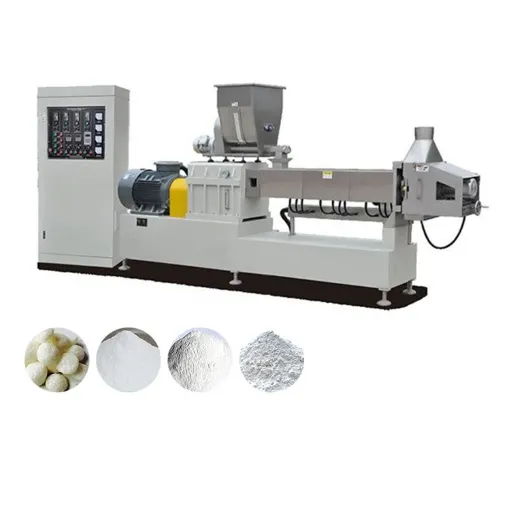
Selecting the right equipment means balancing capacity, flexibility, materials, and support. Here is what experienced buyers evaluate.
Capacity Planning
Industrial lines commonly range from 100 kg/h for pilot or small-batch work up to 2,000 kg/h for large ingredient plants. Match capacity to your current demand plus 20–30% headroom for growth. Common model ranges include:
| Model Size | Typical Capacity | Typical Installed Power |
|---|---|---|
| DSE-65 / JY65 | 100–160 kg/h | 72–79 kW |
| DSE-70 / JY70 | 200–260 kg/h | 92–110 kW |
| DSE-85 / JY85 | 300–600 kg/h | 108–190 kW |
| DSE-100 / SY100 | 300–1,000 kg/h | 133–210 kW |
Screw and Barrel Materials
Starch is abrasive, especially at high moisture and temperature. Barrels and screws should be made from wear-resistant alloy steel or nitrided steel. For chemically aggressive modifications, higher-corrosion-resistant materials extend service life.
Temperature Control and Automation
Look for independent barrel-zone temperature control, water-cooled sections, and a programmable logic controller (PLC) with recipe storage. Automated systems reduce operator error and make recipe changes faster.
Downstream Equipment
A complete modified starch production line includes mixers, dryers, grinders, and packaging machines. Make sure the dryer airflow and grinder capacity match the extruder output. A bottleneck downstream can starve the whole line.
After-Sales Support
Downtime in an ingredient plant is expensive. Ask potential suppliers about spare parts availability, remote diagnostic support, and on-site commissioning. At Shandong Loyal, we design modular lines so you can upgrade capacity or add new functions without replacing the entire system.
Buyer Checklist
Use this checklist when comparing quotations:
- Capacity matches current and projected demand.
- Screw configuration can be changed for different starch types.
- Barrel zones offer independent heating and cooling.
- Construction uses food-safe stainless steel where product contact occurs.
- Control system stores recipes and logs process data.
- Downstream dryer and grinder are sized for the extruder output.
- Supplier provides installation, training, and spare parts support.
- Line can handle your target raw materials: corn, cassava, potato, wheat, or rice.
Why Twin-Screw Extrusion Fits Shandong Loyal’s Approach
Our food extrusion solutions are built around the idea that no two production lines should be identical. A starch plant in Nigeria processing cassava faces different raw-material behavior than a plant in the U. S. Midwest running corn starch. Recipe-specific adjustments, modular screw designs, and flexible capacity options let us tailor each line to those differences.
We also see growing interest in linking modified starch production directly to downstream operations. For example, a manufacturer making instant noodles can integrate a modified starch line with an instant noodle production line to control ingredient quality and supply chain costs.
Frequently Asked Questions
What is the main advantage of a twin screw extruder for starch modification?
The main advantage is continuous, controlled thermomechanical treatment in one machine. Twin-screw extruders deliver uniform mixing, stable residence time, and precise temperature control, which produces consistent modified starch quality at high throughput.
Can one extruder make both pregelatinized starch and chemically modified starch?
Yes. By changing screw configuration, barrel temperature, moisture, and additives, the same twin-screw extruder can produce pregelatinized starch, oxidized starch, esterified starch, and other modified types.
What moisture level is best for extruding modified starch?
Typical moisture ranges from 15% to 40%. Lower moisture increases shear and reduces viscosity. Higher moisture improves gelatinization but increases drying load. The best level depends on the starch source and target application.
How do I know if my modified starch is fully gelatinized?
Measure the degree of gelatinization, WSI, and WAI. Fully gelatinized starches show high WSI and WAI, dissolve in cold water, and produce clear pastes. Partially gelatinized starches retain some granular structure.
What capacity should a new modified starch plant target?
Start with current demand plus 20–30% growth headroom. Pilot plants often begin at 100–160 kg/h, while commercial ingredient plants commonly run 300–1,000 kg/h or more.
Conclusion
Twin screw extruder modified starch production gives food manufacturers and ingredient suppliers a fast, flexible way to create starches with precise functional properties. The technology is not just about cooking starch; it is about controlling heat, moisture, shear, and residence time to produce consistent quality batch after batch.
The manufacturers who get the best results treat the extruder as a continuous reactor, not a simple cooker. They monitor WSI, WAI, viscosity, and gelatinization. They match screw design and barrel temperature to each recipe. And they choose equipment partners who can support scaling and recipe changes over time.
If you are planning a modified starch production line, start by defining your end product and quality targets. Then work backward to the extruder specification. Contact our engineering team today for a tailored twin-screw extruder solution designed around your starch source, capacity, and application goals.