
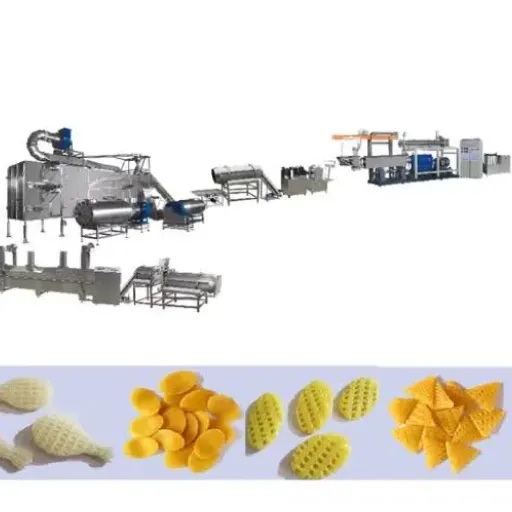
3D Pellet Snack Production Line: Complete Equipment Buyer’s Guide

A 3D pellet snack production line is an automated manufacturing system that turns starches and flours into three-dimensional snack pellets. These pellets are dried into a shelf-stable intermediate and then fried or baked to create crispy, shaped snacks like bugles, cones, net crisps, and goldfish. Manufacturers often compare these systems to broader snack pellet production lines when planning a new facility.
If you are a snack manufacturer looking to move beyond flat chips and basic puffs, this equipment is one of the smartest capital investments you can make. According to Future Market Insights, 3D and double-layer formats now account for 35.9% of the snack pellet form segment. Strong consumer demand for eye-catching shapes and premium textures is driving this growth. Yet most buyers struggle to compare machines because supplier pages list capacities and certifications but rarely explain the forming technology that separates a good 3D line from a mediocre one.
In this guide, you will learn how a 3D pellet snack production line works, what equipment you actually need, how the shaping technology creates complex forms, and how to choose a system that matches your capacity, product mix, and budget.
Key Takeaways
- A 3D pellet snack production line uses a twin-screw extruder plus specialized forming equipment to create shaped, shelf-stable pellets that expand during frying or baking.
- The core difference from 2D lines is the shaping stage: compound shapers, pattern presses, or rotary moulders create volumetric shapes like bugles, cones, and net crisps.
- Typical capacity ranges from 80 kg/h for pilot lines to 800+ kg/h for industrial systems, with investments starting around 50,000andreaching50,000andreaching500,000+ for large automated lines.
- Buyers should evaluate extruder torque, die and shaper quality, dryer uniformity, fryer temperature control, and supplier after-sales support before purchase.
- Common 3D defects like shape loss, seam cracking, and uneven expansion are usually traceable to moisture control, die wear, or incorrect frying temperature.
What Is a 3D Pellet Snack Production Line?
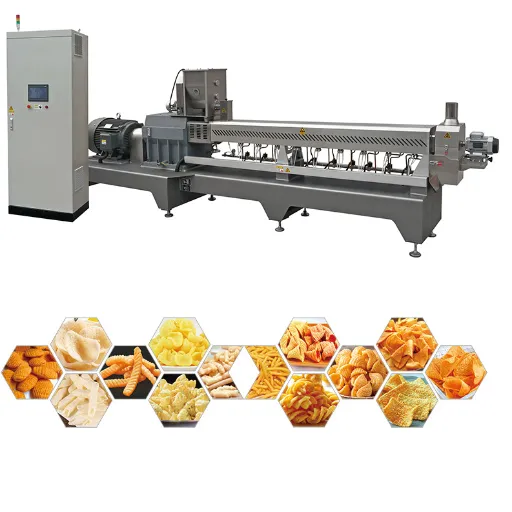
A 3D pellet snack production line is a complete manufacturing system designed to produce three-dimensional snack pellets. It is also called a 3D snack pellet production line or 3D pellet snack making machine when referring to the full integrated system. Unlike direct-expanded puffs that expand instantly at the extruder die, 3D pellets are cooked and shaped into a dense intermediate product. They are then dried, stored, and finished later by frying, hot-air expansion, or baking.
The “3D” distinction comes from the final product geometry. While 2D pellets are flat or simple extruded shapes like rings, wheels, and strips, 3D pellets have depth, hollow sections, or double-layer structures. Think of bugles, cones, pillows, goldfish, shells, and net crisps. These shapes are visually distinctive, feel premium in the hand, and often command higher retail prices. For a direct comparison of line types, see our 2D vs 3D pellet production line guide.
GEA’s snack pellet processing white paper describes the two-stage nature of pellet production clearly: first you create a stable half-product, then you expand it. This separation gives manufacturers enormous flexibility. You can ship dense pellets long distances, store them for 12 to 18 months, and fry them close to market for maximum freshness.
For a broader overview of how 2D and 3D systems fit together, see our complete guide to 2D 3D pellet production lines.
How Does a 3D Pellet Snack Production Line Work?
The production process follows a logical sequence. Each stage builds on the previous one, and the 3D shaping stage is where the magic happens.
Step 1: Raw Material Batching and Mixing
Starches and flours are weighed and blended with water, salt, colorants, and functional additives. Common bases include potato starch, corn starch, wheat flour, cassava starch, and rice flour. The mixer must produce a uniform dough with controlled moisture, typically 25% to 35%, depending on the recipe.
Step 2: Extrusion and Cooking
The dough enters a twin-screw extruder. Inside the barrel, mechanical shear, heat, and pressure cook the starch in a process called gelatinization. This transforms the raw flour into a plasticized mass that can be shaped and will later expand predictably when reheated.
Twin-screw extruders dominate 3D production because they offer better mixing, more precise temperature control, and higher torque than single-screw units. According to Future Market Insights, twin-screw technology represents roughly 58% of snack pellet processing methods.
Step 3: 3D Shaping and Cutting
This is the stage that separates a 3D line from a standard pellet line. The cooked dough passes through forming equipment such as:
- Compound shapers for double-layer or hollow shapes
- Pattern pressing machines for bugles, cones, and pillows
- Rotary moulders for net crisps and complex geometries
A rotary or reciprocating cutter then separates the continuous ribbon into individual pellets. Precise cutter alignment is critical. Even a small gap between the blade and die face can cause tailing or misshapen pieces.
Step 4: Drying
Fresh pellets contain 20% to 25% moisture. They enter a multi-layer tunnel dryer where warm air gradually reduces moisture to 8% to 12%. Low-temperature, long-time drying prevents case hardening, a surface crack that traps internal moisture and causes the pellet to break during frying.
Step 5: Frying or Baking for Expansion
Dried pellets are fed into a continuous fryer at roughly 180°C to 190°C. The rapid heat flash turns residual moisture into steam, expanding the gelatinized starch structure. A 3D pellet typically expands 2 to 3 times its dried size, though the ratio depends on wall thickness and formulation. For finished snack frying and seasoning integration, a complete fried snack production line may be the better long-term investment.
Hot-air expansion and baking are lower-oil alternatives that appeal to health-conscious markets.
Step 6: Seasoning, Cooling, and Packaging
After frying, the snacks pass through a de-oiling conveyor, a flavoring drum for seasoning application, and a cooling conveyor. Finally, a vertical form-fill-seal machine packages the product, often with nitrogen flushing to extend shelf life.
For a deeper explanation of the end-to-end process, read our step-by-step snack pellet production process guide.
Key Equipment Components of a 3D Pellet Snack Production Line
A complete 3D pellet snack production line is more than an extruder. Each component must be matched to the others for stable output and consistent product quality. The same is true for any automatic 3D pellet snack production line, where PLC control ties the components together.
Flour/Starch Mixer and Screw Conveyor
The mixer blends raw materials into a uniform dough. Look for variable-speed agitation, a hygienic SUS 304 stainless steel bowl, and precise water metering. A screw conveyor then transfers the dough to the extruder feed port without segregation or bridging.
Twin-Screw Extruder
The extruder is the heart of any 3D snack pellet machine. For 3D production, prioritize:
- High-torque gearbox for stable operation under load
- Modular screw configuration so you can adjust shear and cooking profiles
- Multiple heating/cooling zones for precise temperature control
- Vacuum degassing option to reduce air bubbles in dense pellets
- PLC touchscreen control for recipe storage and alarm logging
Twin-screw units cost more upfront than single-screw extruders, but they deliver the consistency and flexibility that 3D shapes demand.
3D Compound Shaping Machine or Pattern Press
This is the equipment that creates volumetric shapes. A compound shaper presses two layers of dough together while cutting and embossing. A pattern press forms bugles, cones, and pillows by pressing dough against shaped rollers. The quality of these rollers and dies directly determines shape definition and product uniformity.
When Raj Patel, a snack producer in Gujarat, upgraded from a basic 2D line to a 3D compound-shaping system, his team spent three days fine-tuning roller pressure and cutter timing. The result was a hollow pani puri pellet with consistent wall thickness. Within six months, the new SKU accounted for 20% of his export revenue because buyers paid a premium for the uniform shape.
Cutting Machine and Die Systems
Rotary cutters mounted at the extruder die face slice the extruded ribbon into individual pellets. Die inserts and cutter blades are wear parts. Budget for spares and ask your supplier about expected blade life and replacement cost.
Multi-Layer Tunnel Dryer
Dryers for 3D pellets need even airflow and controllable humidity. Multi-layer designs save floor space and allow longer residence times. Key specifications include temperature range, number of zones, belt width, and residence time.
Continuous Fryer or Hot-Air Expansion Oven
The fryer must hold oil temperature within a tight range. Look for automatic oil level control, filtration systems, and energy-efficient heating. Hot-air ovens use forced convection to expand pellets without oil, producing a lower-fat snack.
De-Oiling, Flavoring, Cooling, and Packaging Equipment
After frying, a vibratory de-oiling conveyor removes excess surface oil. A seasoning drum evenly coats the product with powder or oil-based flavors. A cooling conveyor brings the snacks to ambient temperature before packaging to prevent condensation and sogginess.
Want to see how the extruder fits into the bigger picture? Explore our industrial food extrusion solutions to learn how twin-screw technology supports snack, pet food, and protein applications.
3D Shaping Technology in a Pellet Snack Production Line
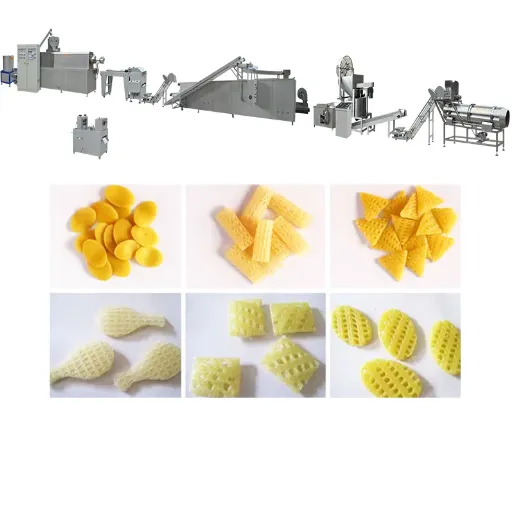
The shaping stage is where most buying decisions are won or lost. Not all 3D lines use the same forming method, and each has strengths and ideal product types.
Compound Shaping
Compound shapers are the defining feature of a 3D pellet snack making machine. They press two sheets of cooked dough together while simultaneously cutting and embossing. This method is ideal for double-layer chips, hollow shapes, and products with internal cavities. Pani puri balls and some pillow snacks are common examples.
The advantage is structural complexity. The challenge is precise synchronization between the two dough sheets and the cutting die. Misalignment creates weak seams or incomplete shapes.
Pattern Pressing
Pattern pressing uses engraved rollers to press dough into shapes like bugles, cones, and curved chips. The rollers can be changed to produce different products, making this approach flexible for brands with multiple SKUs.
Pattern pressing tends to be faster than compound shaping and works well for products with uniform wall thickness. It is the technology behind many of the bugles and cone-shaped snacks found in retail stores.
Rotary Moulding
Rotary moulders are used for intricate geometries such as net crisps, wheels, and animal shapes. The dough is fed into a rotating drum with shaped cavities. Excess dough is scraped away, and formed pieces are released onto a conveyor.
This method offers excellent shape detail but requires careful dough consistency. Too wet, and the pieces stick in the mould. Too dry, and the surface cracks during drying.
Die Design and Maintenance
Regardless of the forming method, die and roller maintenance determines long-term quality. Worn dies produce fuzzy edges, inconsistent sizes, and poor expansion. Ask suppliers about:
- Material hardness and coating of dies and rollers
- Expected service life under your planned operating hours
- Cost and lead time for replacement tooling
- Whether recipe changes affect die wear
What Shapes Can a 3D Pellet Snack Production Line Make?
One of the biggest advantages of a 3D pellet snack production line is product variety. By changing dies, rollers, or shaper configurations, the same extruder can produce a wide range of snacks.
Common 3D Shapes
- Bugles and cones, classic curved, cone-shaped snacks
- Pillows and puffed squares, light, airy pockets
- Goldfish and animal shapes, popular in children’s snacks
- Shells and spirals, textured surfaces that hold seasoning well
- Balls and spheres, uniform round pellets
- Net crisps and wheel nets, intricate lattice structures
- Triangles, rackets, and hexagons, geometric novelty shapes
Regional and Specialty Products
3D pellet technology is used worldwide for regional specialties:
- Pani puri balls, hollow, round pellets used in Indian street food
- Fryums, expanded, flavored shapes popular in South Asia
- Papad snacks, crisp, seasoned discs and curls
- Prawn crackers, seafood-flavored, starch-based chips
When Maria Santos launched a snack brand in São Paulo, she chose a 3D line specifically because one machine could produce bugles for the mass market and custom geometric shapes for a premium retail line. Quick die changeovers, typically 30 to 60 minutes, let her run small batches without long downtime.
How to Choose the Right 3D Pellet Snack Production Line
Selecting equipment requires more than comparing price lists. Use this framework to evaluate suppliers and configurations.
Define Target Capacity and Product Mix
Start with realistic volume targets. A startup testing market demand may only need 80 to 120 kg/h. A regional producer supplying multiple SKUs might need 200 to 350 kg/h. Large industrial plants often run 400 to 800 kg/h or more.
Also define your priority products. If bugles and cones are your main SKU, a pattern press is ideal. If you plan hollow or double-layer products, insist on compound shaping capability.
Evaluate Extruder and Shaping Capabilities
Ask suppliers for:
- Screw diameter, L/D ratio, and motor power
- Torque reserve at maximum output
- Number of independent temperature zones
- Shaper type and maximum forming complexity
- Quick-change die systems and tooling inventory
Consider Drying and Frying Technology
Drying uniformity is often underestimated. Request dryer airflow diagrams and evidence of moisture uniformity across the belt. For frying, check oil turnover rate, filtration design, and energy efficiency.
Check Automation Level and Control Systems
Modern lines use PLC control with touchscreen HMIs. Useful features include recipe storage, production data logging, remote diagnostics, and alarm history. These features reduce operator error and simplify scaling.
Assess After-Sales Support and Spare Parts
A production line is a long-term investment. Confirm that the supplier offers:
- Installation and commissioning support
- Operator and maintenance training
- Spare parts stocking or fast delivery
- Technical documentation in your language
- Recipe and process consulting
Ready to compare configurations for your facility? Contact our team for a custom 3D pellet snack production line proposal based on your capacity, product goals, and layout.
3D Pellet Snack Production Line Price and Investment
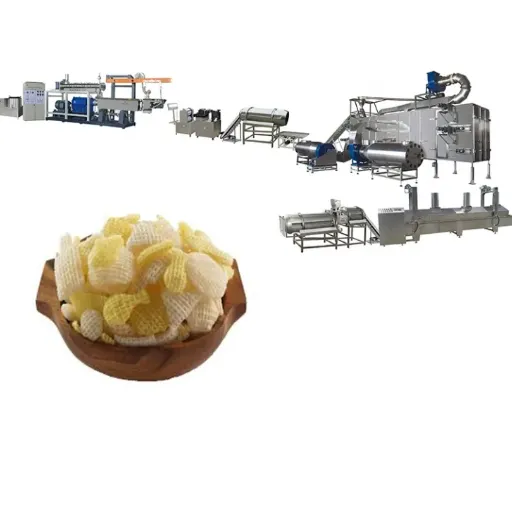
Pricing varies widely based on capacity, automation level, and forming complexity. Here are typical ranges based on market research and supplier quotations for 3D pellet snack equipment.
Entry-Level Lines
- Capacity: 80 to 120 kg/h
- Investment: approximately 50,000to50,000to150,000
- Best for: Startups, pilot plants, and market testing
Mid-Range Automatic Lines
- Capacity: 200 to 350 kg/h
- Investment: approximately 150,000to150,000to400,000
- Best for: Growing regional producers and co-manufacturers
Large Industrial Lines
- Capacity: 400 to 800+ kg/h
- Investment: approximately 400,000to400,000to800,000+
- Best for: Large snack brands and export-focused manufacturers
According to Amindus Consulting, dedicated 3D lines typically fall in the 250,000to250,000to500,000 range, while hybrid 2D/3D systems offer flexibility at a moderate premium.
Total Cost of Ownership
Beyond purchase price, factor in:
- Energy costs: 3D lines can consume 30% to 50% more energy than 2D lines due to forming and cutting complexity.
- Maintenance: Dies, cutters, and shaper rollers are wear parts.
- Labor: Automated lines reduce operator count but require skilled technicians for changeovers.
- Floor space: Industrial lines can stretch 30 to 45 meters in length.
The business case for a 3D pellet snack production line usually rests on premium pricing. If your market pays 20% to 30% more for shaped, differentiated snacks, the higher CapEx can recover faster than a basic 2D line selling commodity products.
Common 3D Pellet Snack Defects and Troubleshooting
Even with good equipment, defects happen. The table below connects common 3D pellet problems to their most likely causes and corrections.
| Defect | Likely Cause | Correction |
|---|---|---|
| Loss of shape definition | Worn die, low extruder pressure, shaper misalignment | Replace die; increase screw speed; realign shaper |
| Surface cracking or seam splitting | Case hardening from drying too fast | Lower dryer temperature; extend drying time; improve airflow |
| Uneven expansion | Inconsistent pellet moisture or fryer temperature fluctuation | Standardize drying; inspect die; stabilize fryer |
| Excessive oil absorption | Low pellet density or over-frying | Optimize drying target; reduce frying time; adjust recipe |
| Blistering | Surface moisture too high before frying | Extend drying stabilization; lower initial fryer temperature |
| Die blockage | High fiber or fat content; dough too dry | Adjust formulation; increase dough moisture; pre-screen materials |
| Surging or inconsistent output | Uneven feed or worn screw/barrel | Check feeder consistency; inspect screw and barrel wear |
When a Nigerian bugles producer named Adebayo noticed his cones were collapsing after frying, the root cause turned out to be inconsistent dryer airflow. Some pellets retained 14% moisture while others reached 9%. After upgrading to a multi-zone dryer with humidity control and adding inline moisture sampling, his rejection rate dropped from 12% to under 3%.
Frequently Asked Questions
What is the difference between a 2D and a 3D pellet snack production line?
A 2D line produces flat or simple extruded shapes like rings, wheels, and strips. A 3D line adds compound shapers, pattern presses, or rotary moulders to create volumetric shapes with depth, hollow sections, or double layers. For a full comparison, see our 2D vs 3D pellet production line guide.
Can one production line make both 2D and 3D pellets?
Yes. Many twin-screw extruder lines can switch between 2D and 3D products by changing dies, shaper rollers, and cutter configurations. Changeover typically takes 30 to 60 minutes.
How much does a 3D pellet snack production line cost?
Entry-level lines start around 50,000.Mid−rangeautomaticsystemsrangefrom50,000.Mid−rangeautomaticsystemsrangefrom150,000 to 400,000.Largeindustriallinescanexceed400,000.Largeindustriallinescanexceed500,000 depending on capacity and automation.
What raw materials are used in 3D pellet snacks?
Common materials include potato starch, corn starch, wheat flour, cassava starch, tapioca starch, and rice flour. Functional additives such as modified starches, proteins, fibers, emulsifiers, and colorants are added as needed.
What shapes can a 3D pellet snack machine produce?
Typical shapes include bugles, cones, pillows, goldfish, shells, balls, net crisps, triangles, and hollow products like pani puri balls.
Why do 3D pellets crack during drying?
Cracking usually results from case hardening, which happens when the surface dries too quickly and traps internal moisture. The fix is low-temperature, long-time drying with controlled humidity and even airflow.
Is a 3D pellet snack line profitable?
It can be highly profitable if your market values shaped, premium snacks. 3D products often command 20% to 30% higher margins than flat 2D products, but the line requires higher capital investment and energy use.
Conclusion
A 3D pellet snack production line gives manufacturers a clear path to product differentiation and premium positioning. The technology is not fundamentally different from 2D pellet production until you reach the shaping stage. That is where compound shapers, pattern presses, and rotary moulders turn ordinary starch dough into the bugles, cones, net crisps, and hollow specialties that stand out on retail shelves.
Success depends on choosing equipment matched to your product goals, maintaining tight moisture control through drying, and working with a supplier who understands both the machinery and the recipes behind it. The global snack pellet market is growing steadily, and 3D formats are leading the form segment. For manufacturers ready to invest, the opportunity is significant.
If you are planning a new 3D pellet snack production line or upgrading an existing one, start with a clear product roadmap and capacity target. Then request detailed quotations that include extruder specs, shaper technology, dryer parameters, and after-sales support. The right line will not only produce better snacks, it will give you the flexibility to adapt as consumer tastes evolve.
Ready to design your line? Contact Shandong Loyal Industrial for a tailored 3D pellet snack production line proposal, complete with equipment layout, capacity matching, and recipe support.