
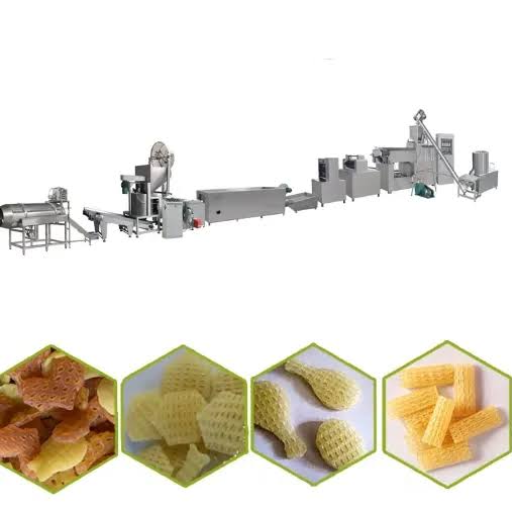
2D Pellet Snack Production Line: Process, Equipment & Capacity Guide

A 2D pellet snack production line is an automated system that mixes starch-based dough, extrudes it through a flat die into flat shapes, dries the semi-finished pellets, and then fries or bakes them into crispy finished snacks. These lines are the backbone of high-volume categories like fryums, papad, sala chips, and rings.
The global snack pellets market is valued at roughly $3.35 billion in 2025 and is growing at 4.3–5.8% CAGR, according to Market Research Future. Yet most buyers struggle to find guidance focused specifically on 2D flat-pellet production. Most manufacturer pages lump 2D and 3D together, leaving equipment buyers guessing about die selection, drying parameters, and real throughput.
If you’re evaluating a 2D pellet snack production line, this guide will show you exactly how the process works, what equipment you need, which products you can make, and how to match capacity to your business goals.
Key Takeaways
- A 2D pellet snack production line produces flat, single-layer snack pellets such as rings, wheels, sala chips, papad, and fryums.
- Standard capacity ranges from 80 kg/h for entry-level lines to 500+ kg/h for industrial systems, with installed power from 50 kW to 260 kW.
- Single-screw extruders are often preferred for dense, translucent 2D pellets; twin-screw extruders offer more formulation flexibility.
- Critical process parameters include 25–30% mixing moisture, 45–60°C drying for 3–5 hours, and final pellet moisture of 8–10%.
- Typical investment for a medium-capacity 2D line is 100,000–100,000–200,000, with turnkey installations exceeding $800,000.
What Is a 2D Pellet Snack Production Line?
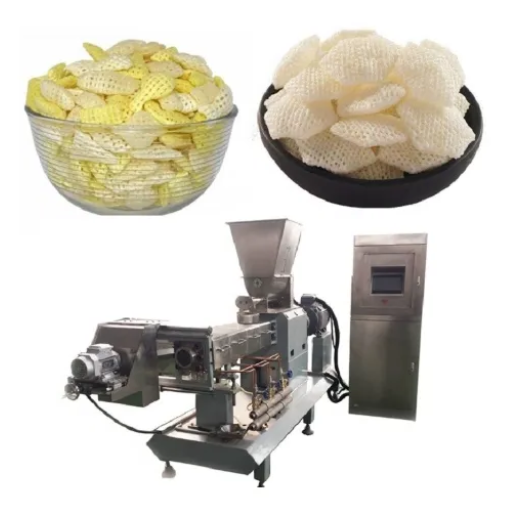
A 2D pellet snack production line manufactures flat, single-layer snack pellets, also called “half-products” or “intermediate products”, that are fried or baked just before sale. Unlike 3D pellets, which use compound shaping to create cones, bugles, or hollow balls, 2D pellets are formed by pushing cooked dough through a flat die plate and cutting it into thin, uniform shapes.
These pellets are popular because they are dense, shelf-stable, and cheap to ship. With a bulk density around 600 kg/m³ and a shelf life of 12–18 months when dried to 8–10% moisture, manufacturers can ship large volumes to regional frying or seasoning partners before final processing.
Want to see how 2D lines fit into the broader pellet snack landscape? Read our complete guide to 2D 3D pellet production lines for a side-by-side comparison of equipment and applications.
How 2D Pellets Differ from 3D Pellets and Finished Snacks
| Feature | 2D Pellet | 3D Pellet | Finished Fried Snack |
|---|---|---|---|
| Shape | Flat (rings, wheels, flakes) | Volumetric (bugles, cones, balls) | Any expanded, flavored form |
| Shaping method | Direct die + cutter | Compound shaping / lamination | Fryer or hot-air expansion |
| Shelf life (dry) | 12–18 months | 12–18 months | Weeks to months |
| Shipping efficiency | Very high | High | Low |
| Typical investment | Lower | Higher | Depends on full line |
This distinction matters for procurement teams. If your target market wants simple, high-volume shapes, a dedicated 2D pellet snack production line usually delivers faster payback than a 3D or hybrid system.
Why 2D Pellets Dominate Export and B2B Supply
Rajesh, a snack distributor in Mumbai, learned this the hard way. In 2023 he was importing finished fried rings from three different suppliers. Freight costs ate 18% of his margin, and breakage during shipping ran another 7%.
After switching to a local 2D pellet supplier, he fried the pellets in his own plant. His freight costs dropped by roughly 60% because dried pellets pack far more product per container. Breakage fell too, because the pellets were fried locally just before retail.
That’s why 2D pellets are the preferred format for export, co-packing, and regional frying operations.
How a 2D Pellet Snack Production Line Works
The production flow follows a clear sequence: mixing → extrusion → shaping/cutting → drying → frying or baking → seasoning → cooling → packaging. Each stage has specific targets that determine pellet quality and consistency.
Step-by-Step Process Flow
- Mixing: Starches, flours, water, salt, and additives are blended into a uniform dough at 25–30% moisture.
- Screw conveying: The dough is transferred steadily into the extruder feed throat.
- Extrusion and cooking: Heat, pressure, and shear gelatinize the starch. Product temperature reaches 90–120°C.
- Shaping and cutting: The cooked dough is forced through a die plate and cut into flat shapes.
- Drying: A multi-layer dryer reduces moisture from 20–25% down to 8–10% over 3–5 hours at 45–60°C.
- Cooling: Pellets cool to room temperature and stabilize.
- Frying or baking: Dried pellets expand 3–4× when fried at roughly 190°C, or puff in a hot-air oven.
- De-oiling: Excess surface oil is removed on a vibratory conveyor.
- Seasoning: Oil and powder flavoring are applied in a rotating drum.
- Cooling and packaging: Pellets are cooled again and packed for distribution.
For a deeper walkthrough of every stage, see our step-by-step snack pellet production process.
Critical Parameters for 2D Pellets
| Stage | Parameter | Target |
|---|---|---|
| Mixing | Dough moisture | 25–30% |
| Extrusion | Product temperature | 90–120°C |
| Post-extrusion | Pellet moisture | 20–25% |
| Drying | Temperature / time | 45–60°C / 3–5 hours |
| Finished pellet | Moisture | 8–10% |
| Frying | Oil temperature | ~190°C |
| Expansion | Size increase | 3–4× |
Flat pellets are less forgiving than 3D shapes. If drying is too fast, the surface hardens while the center stays wet, causing case hardening and cracks during frying. If the die is worn or misaligned, shapes become uneven and break during packaging.
Single-Screw vs Twin-Screw Extrusion for 2D Products
For classic 2D pellets, especially dense, translucent fryums and papad, single-screw extruders are often the better choice. They generate gentle, consistent shear that produces a tight, glassy pellet structure. Twin-screw extruders offer more recipe flexibility and faster changeovers, which makes them attractive if you plan to run multiple shapes or formulations on the same line.
The choice depends on your product mix. If you’re focused on one or two high-volume 2D shapes, a single-screw line usually costs less and uses less energy. If you need frequent changeovers or want the option to run 3D shapes later, a twin-screw system may be worth the premium.
Our pellet snack extruder machine selection guide breaks down this decision in more detail.
Core Equipment in a 2D Pellet Snack Line
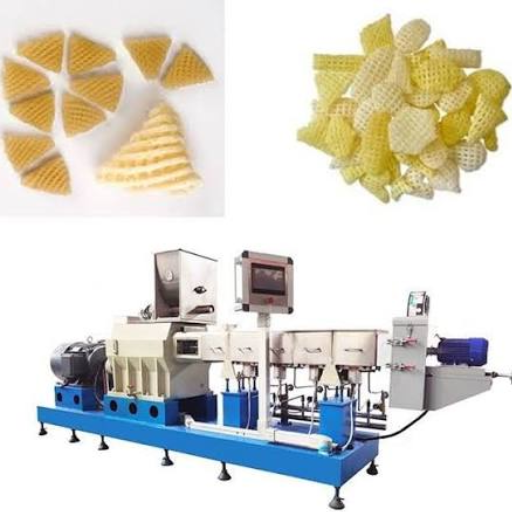
A complete 2D pellet snack machine setup is more than an extruder. Each piece of equipment plays a role in product quality, throughput, and operating cost.
Mixer and Screw Conveyor
The mixer blends dry ingredients with water to form a uniform dough. Inconsistent hydration causes streaks and weak spots in the final pellet. A screw conveyor then moves dough into the extruder at a controlled rate, which stabilizes output and prevents surging.
Single-Screw Extruder and Die Plate
The extruder cooks the dough and builds the pressure needed to push it through the die. For 2D pellets, the die plate contains multiple identical apertures arranged in the target shape. Changing the die plate changes the product, rings one hour, wheels the next. This modularity is one reason 2D lines are so versatile.
Cutting and Shaping Systems for Flat Pellets
After extrusion, a rotary cutter or angle cutter slices the continuous dough ribbon into individual pellets. Blade sharpness and cutter speed must match line throughput. Dull blades create ragged edges that fry unevenly and break easily.
Multi-Layer Dryer
Low-temperature, long-time drying is essential for 2D pellets. A 5-layer mesh-belt dryer gives the pellets enough residence time to dry evenly without cracking. Air temperature and humidity must be controlled zone by zone.
Fryer, De-Oiler, and Flavoring Drum
The fryer expands and crisps the dried pellets. A continuous deep-fat fryer with precise temperature control is standard. After frying, a vibratory de-oiler removes excess oil, and a rotating flavoring drum applies seasonings evenly.
Cooling Conveyor and Packaging
Finished pellets cool on a conveying system before packaging. Proper cooling prevents condensation inside bags, which extends shelf life and preserves crunch.
What Shapes and Products Can a 2D Line Make?
One of the biggest strengths of a 2D pellet snack production line is shape flexibility. By swapping the die plate and cutter, the same line can produce a wide range of flat products.
Common 2D Shapes
- Rings, wheels, and stars, party snacks and children’s treats
- Sala chips and sala sticks, wheat-flour crispy snacks popular in Africa and the Middle East, a common output for any sala chips production line
- Papad, thin, flat pellets served as a meal accompaniment or starter, the main product of a papad pellet production line
- Fryums, deep-fried, seasoned pellets widely consumed in India, the Middle East, and Africa
- Prawn crackers / shrimp chips, tapioca- or potato-starch pellets for home or industrial frying
- Nets and flakes, decorative toppings and crunchy garnishes
Product Application Matrix
| Product | Primary Raw Material | Typical Shape | Target Market |
|---|---|---|---|
| Fryums | Potato / tapioca starch | Wheels, rings, stars | India, Middle East, Africa |
| Papad | Lentil / wheat / rice flour | Thin flat discs | South Asia, global diaspora |
| Sala chips | Wheat flour | Strips, squares | Africa, Middle East |
| Prawn crackers | Tapioca starch, shrimp | Flat discs, nets | Southeast Asia, East Asia |
| Rings | Corn / potato starch | Rings, wheels | Global mass market |
If fryums are your main product, our fryums production line equipment guide covers recipe, die, and business-model specifics for any fryums making machine setup.
2D Pellet Snack Production Line Specifications and Capacity
Capacity depends on extruder size, dryer length, and automation level. Below are typical ranges for Shandong Loyal Industrial 2D lines and comparable market benchmarks.
Capacity and Power Ranges
| Scale | Capacity | Installed Power | Typical Footprint |
|---|---|---|---|
| Small | 80–120 kg/h | 50–77 kW | ~18–22 m line length |
| Medium | 200–300 kg/h | 95–150 kW | ~24–32 m line length |
| Large industrial | 300–500+ kg/h | 160–260 kW | ~32–45 m line length |
Shandong Loyal Model Benchmarks
| Model | Extruder Type | Capacity | Total Power | Dimensions (L × W × H) |
|---|---|---|---|---|
| LY-100 | Single screw | 100–150 kg/h | 85 kW | 28 × 1.5 × 2.0 m |
| LY-120 | Single screw | 200–250 kg/h | 135 kW | 32 × 1.5 × 2.5 m |
| LY-3000 | Single screw | 400–500 kg/h | 260 kW | 45 × 2.0 × 3.0 m |
These figures are starting points. Final output depends on product density, raw-material composition, and operator skill. We always recommend a factory trial with your target recipe before finalizing specifications.
Choosing the Right 2D Pellet Line for Your Product
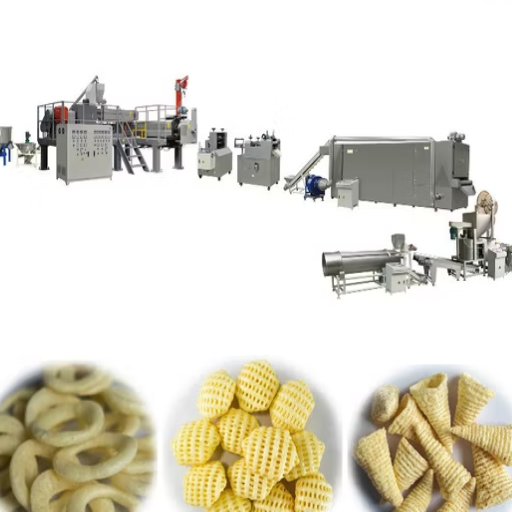
Selecting the right line means matching equipment to your product goals, not just buying the highest capacity.
Match Die Design to Target Shape
The die plate determines shape, wall thickness, and expansion behavior. Thin papad requires a different die geometry than thick fryum wheels. A well-matched die reduces defects and improves frying consistency.
Match Capacity to Demand and Export Volume
A common mistake is buying more capacity than the market can absorb. If you’re entering a new region, a medium line at 200–300 kg/h often provides enough volume to test products while leaving room to scale.
Single-Screw vs Twin-Screw Decision
Choose single-screw for:
- High-volume, simple 2D shapes
- Dense, translucent pellets like traditional fryums and papad
- Lower energy and maintenance costs
Choose twin-screw for:
- Frequent shape or recipe changeovers
- Plans to add 3D products later
- Complex formulations with high fiber or protein additions
Dedicated 2D Line vs Hybrid 2D/3D Line
A dedicated 2D line is usually the most cost-effective choice when you know your portfolio will stay flat. A hybrid 2D/3D line adds flexibility but raises initial investment and maintenance complexity. For a full side-by-side comparison, read our 2D vs 3D pellet production line comparison.
Common 2D Pellet Defects and How to Prevent Them
Even a well-specified line can produce defects if parameters drift. Here are the most common problems and their fixes.
Cracking and Case Hardening During Drying
Cracks usually mean the surface dried too quickly while the center remained wet. Fix this by lowering dryer temperature, increasing residence time, or improving airflow uniformity. Target a slow moisture drop from 20–25% to 8–10% over several hours.
Uneven Expansion During Frying
Uneven expansion points to inconsistent moisture, die wear, or oil-temperature fluctuations. Check that all pellets enter the fryer at the same moisture content and that oil temperature stays within ±5°C of setpoint.
Shape Distortion and Die Wear
Worn die openings produce irregular edges and inconsistent shapes. Dies are consumables; budget for replacement die sets and inspect them weekly on high-volume lines.
Moisture Control Best Practices
Moisture is the single most important variable in 2D pellet production. Track it at three points: after mixing, after extrusion, and after drying. Small deviations compound through frying and seasoning.
Frequently Asked Questions
What is a 2D pellet snack production line?
A 2D pellet snack production line is an automated system that mixes starch-based dough, extrudes it through flat dies into shapes like rings or sala chips, dries the pellets, and then fries or bakes them before seasoning and packaging.
How does a 2D pellet snack production line work?
It works by blending starches and water, cooking the dough in an extruder, cutting it through a die, drying the pellets to 8–10% moisture, and then frying or baking them to expand and crisp.
What shapes can a 2D pellet machine make?
Common shapes include rings, wheels, stars, strips, squares, flakes, tubes, nets, sala chips, papad discs, and fryums. Most shapes are created by changing the die plate.
What is the production capacity of a 2D pellet snack line?
Small lines produce 80–120 kg/h, medium lines 200–300 kg/h, and large industrial lines 300–500+ kg/h.
How much does a 2D pellet snack production line cost?
A standard medium-capacity 2D line typically ranges from 100,000to100,000to200,000. Entry-level lines can start below 50,000,whileturnkeyindustrialinstallationscanexceed50,000,whileturnkeyindustrialinstallationscanexceed800,000.
What raw materials are used in 2D pellet production?
Potato starch, corn starch, wheat flour, cassava or tapioca starch, rice flour, water, salt, colorants, emulsifiers, and seasonings.
Can a 2D line also make 3D pellets?
A dedicated 2D line is optimized for flat shapes. A hybrid 2D/3D line with interchangeable forming modules can produce both, but at higher cost and complexity.
How long do 2D snack pellets need to dry?
Drying typically takes 3–5 hours at 45–60°C, depending on pellet thickness and initial moisture.
Conclusion
A 2D pellet snack production line is one of the most efficient ways to enter or scale mass-market snack manufacturing. Flat pellets such as fryums, papad, sala chips, and rings offer lower equipment costs, higher throughput, and strong export economics compared to many 3D alternatives.
Success comes down to four factors: the right extruder and die design, precise moisture control, adequate low-temperature drying, and a line capacity that matches real demand. Get those right, and you produce consistent, shelf-stable pellets that fry into crispy, profitable snacks.
At Shandong Loyal Industrial Co., Ltd., we design 2D pellet snack production lines with modular dies, food-safe stainless steel construction, and recipe-specific adjustments to match your product goals. Request a detailed quotation today and let our engineers recommend the right line for your capacity, product, and budget.