Fryums Production Line: Complete Equipment, Process & Business Guide
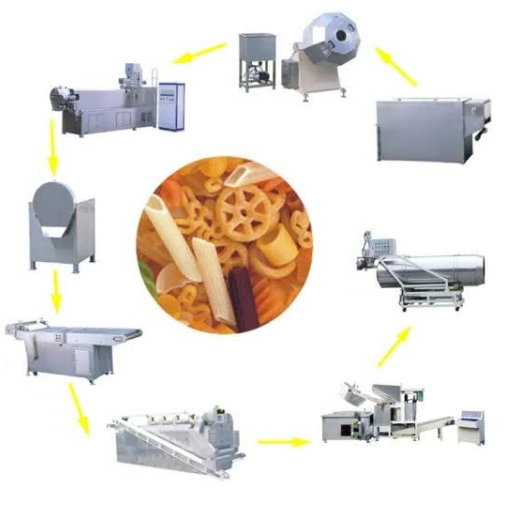
A fryums production line is an integrated system of mixers, extruders, dryers, fryers, and packaging machines that turns starches and flours into crispy, puffed snack pellets. The right line can produce anything from simple 2D wheels and rings to complex 3D pani puri balls and bugles, often at capacities from 80 kg/h to more than 1,000 kg/h.
Yet most buyers we speak with start from the same place: confusion. Supplier brochures list capacities and prices, but they rarely explain how the process actually works, why drying temperature matters, or whether a 2D line can later produce 3D shapes. That gap is expensive. The wrong extruder wastes raw material. The wrong dryer cracks pellets. And the wrong fryer soaks products in oil.
This guide closes that gap. You will learn the complete fryums manufacturing process, the equipment that matters, the difference between 2D and 3D production, realistic price ranges, and the business fundamentals you need before placing an order. Whether you are launching a snack startup or expanding an existing plant, the sections below will help you ask better questions and make a smarter investment.
Key Takeaways
- A fryums production line mixes starch-based dough, extrudes and shapes it, dries the pellets, then fries, seasons, and packages them.
- Global snack pellet demand is growing at roughly 4.3%–5.6% CAGR, with fried pellets leading the category.
- 2D fryums use simple dies; 3D fryums need compound forming units that press two dough sheets together.
- Indicative prices range from ₹3–10 lakh for a basic extruder to ₹35–65+ lakh for a fully automatic 300–1,000 kg/h line.
- Buyers should evaluate extruder technology, dryer uniformity, fryer safety, oil management, and after-sales support before signing a contract.
What Are Fryums and Why Do They Matter?
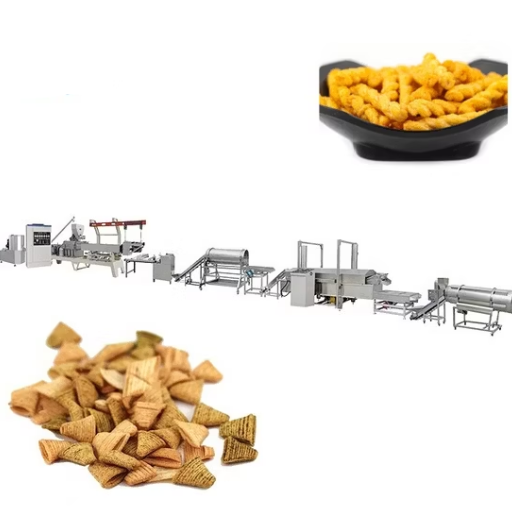
Fryums are puffed, crispy snacks made from starch-heavy dough that is extruded, dried, and then fried or baked. They are also called frymes, papad fryums, and snack pellets depending on the region. In India, they sit next to chips and peanuts on nearly every retail shelf. In Africa and the Middle East, they are sold as affordable, long-shelf-life snacks and party foods.
The base recipe is simple: wheat flour, corn starch, potato starch, tapioca starch, rice flour, or urad dal flour mixed with water, salt, and spices. Some producers add shrimp, beef, or chicken powder for flavored varieties. The dough is cooked under heat and pressure, shaped, dried to 8–10% moisture, and then packed as hard pellets. Those pellets expand three to four times their size when they hit hot oil at around 190°C.
That long shelf life is one reason fryums travel well. Dried pellets have a bulk density of roughly 600 kg/m³, so a single truck carries far more finished product potential than bags of already-fried snacks. For exporters and distributors, that density cuts freight costs dramatically.
Fryums also offer manufacturers flexibility. The same production line can produce dozens of shapes simply by changing dies and forming rollers. A producer can run wheels and rings for the domestic market in the morning and switch to pani puri balls for an export order in the afternoon. That versatility makes fryums an attractive entry point into snack manufacturing.
For a broader look at the technology behind these lines, see our complete guide to 2D 3D pellet production line equipment and selection.
How a Fryums Production Line Works
Every fryums production line follows the same fundamental sequence. The difference between a smooth operation and a headache is usually found in the details: temperature control, moisture targets, and dwell time.
Mixing and Dough Preparation
The process begins in a ribbon or paddle mixer. Operators load flour or starch, water, salt, and seasonings into the bowl. The target moisture content is 25–30%. Too dry, and the extruder struggles; too wet, and the pellets will stick together in the dryer. Consistency matters because the extruder is sensitive to feed variation.
Extrusion Cooking and Gelatinization
The mixed dough travels by screw conveyor into the extruder. Inside the barrel, heat and mechanical shear cook the starch. For fryums, producers typically use a two-stage approach: a twin-screw extruder for pre-cooking, followed by a single-screw extruder for final gelatinization and shaping. The product temperature at the die usually sits between 90°C and 120°C.
Gelatinization is the critical chemical change. It turns raw starch into a pliable, translucent dough that sets into a dense pellet when cooled. Without proper gelatinization, the pellets will not puff evenly during frying.
Shaping, Cutting, and Die Selection
After extrusion, the dough passes through a die plate or forming unit. Interchangeable dies create wheels, rings, stars, screws, fingers, and strips. For 3D products, two sheets of dough are pressed together with compound rollers to form hollow shapes like pillows, bugles, and pani puri balls. A pulling conveyor and cutter then slice the continuous strip into uniform lengths.
Drying Parameters and Moisture Targets
Freshly extruded pellets carry 20–25% moisture. They enter a multi-layer belt dryer running at 45–60°C for three to five hours. The goal is 8–10% final moisture. This step is non-negotiable. Under-dried pellets fry unevenly and spoil quickly. Over-dried pellets become brittle and crack during transport.
Frying, De-oiling, and Seasoning
Dried pellets are fried in a continuous belt fryer at 160–200°C, typically around 190°C. They puff within seconds. A de-oiling unit, either a vibration screen or centrifugal spinner, removes excess surface oil. Then a rotary seasoning drum coats the snacks with salt, spices, masala, cheese powder, or other flavors.
Cooling and Packaging
Finally, the fryums pass over a cooling conveyor to reach room temperature. Hot product packed too quickly sweats inside the bag and loses crispness. Once cooled, an automatic packing machine weighs and seals pouches or bulk bags.
For a deeper explanation of each stage, read our step-by-step overview of the snack pellet production process.
Core Equipment in a Fryums Production Line
A complete fryums production line is not one machine. It is a coordinated system. Understanding each component helps you compare quotes and avoid paying for equipment you do not need.
Flour Mixer and Screw Conveyor
The mixer creates a homogeneous dough with no lumps. Look for adjustable speed, a discharge gate that feeds the screw conveyor cleanly, and stainless-steel contact parts. The screw conveyor transfers dough to the extruder at a controlled rate, which protects the extruder from starvation or overload.
Single-Screw vs Twin-Screw Extruder for Fryums
Twin-screw extruders handle pre-cooking and high-moisture recipes well. Single-screw extruders are simpler, lower-shear, and often sufficient for shaping dense fryums pellets. Many lines use both: twin-screw for cooking, single-screw for forming. If you plan to experiment with recipes, a twin-screw unit gives more flexibility. If your recipe is stable and cost-driven, a single-screw line may be enough.
For detailed selection criteria, see our pellet snack extruder machine guide.
Forming, Embossing, and Cutting Machines
2D lines need only a die plate and cutter. 3D lines add an embossing or compound-forming unit that presses two dough webs together. The quality of the cutting blades and forming rollers directly affects product consistency. Dull cutters create ragged edges that fry unevenly.
Continuous Dryer and Cooling Conveyor
A multi-layer belt dryer with humidity control is the industry standard. Five-layer designs save floor space by folding the belt into a U-turn. After drying, a short cooling conveyor brings pellets down before packaging or temporary storage.
Continuous Fryer with Oil-Filtration System
The fryer is where the product becomes sellable. Key features include automatic temperature control, oil circulation, and a filtration system that removes particles down to at least 60 microns. Clean oil lasts longer and produces a better-tasting, more consistent fryum. Fuel options include electric, gas, diesel, LPG, wood, or pellet-fired heat exchangers.
De-oiler, Seasoning Drum, and Packaging Machine
A vibratory or centrifugal de-oiler reduces oil content by 10–20%. The seasoning drum tumbles fryums through flavor powder. Finally, a multi-head weigher and form-fill-seal machine packs products into retail pouches or bulk bags.
At Shandong Loyal Industrial, our food production line equipment is built with food-safe SUS 304 stainless steel and modular layouts that let you add capacity or new product formats later.
2D vs 3D Fryums Production Line
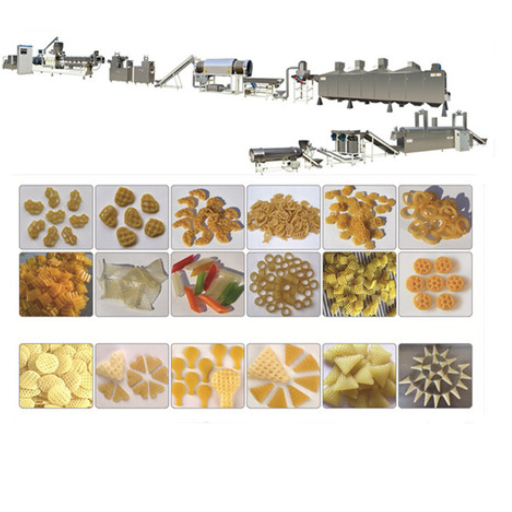
Not all fryums are created equal. The biggest technical split is between flat 2D shapes and dimensional 3D shapes.
How 2D Fryums Are Made
2D fryums are flat, die-cut products: wheels, rings, stars, screws, fingers, strips, and flakes. The extruder pushes dough through a flat die, and a cutter slices the sheet. The equipment is simpler, the tooling is cheaper, and changeovers are fast. For new producers, 2D is usually the lowest-risk entry point.
How 3D Fryums Are Made
3D fryums include hollow shapes like pani puri balls, bugles, pillows, nets, and rackets. They require a compound-forming unit that extrudes two separate dough sheets and presses them together around a mold. The wall thickness must be uniform; otherwise the product will collapse or fail to puff evenly during frying.
Equipment Differences and Cost Implications
A 2D-only line is cheaper because it skips the compound-forming module. A 3D line needs more forming rollers, precision cutters, and often a larger dryer to handle the added surface area. As a rough rule, expect a 3D or hybrid line to cost 30–50% more than a comparable 2D-only line.
When to Choose 2D, 3D, or a Hybrid Line
Choose 2D if you want low tooling costs, fast changeovers, and simple retail products. Choose 3D if you are targeting pani puri, bugles, or premium snack segments. Choose a hybrid line if you need the flexibility to serve multiple markets without buying two separate production lines. Hybrid lines are increasingly popular because they future-proof a plant against changing customer demands.
For more on 3D capabilities, read our guide to 3D pellet snack production line equipment.
Fryums Production Line Capacity, Specifications, and Price
When suppliers quote a fryums making machine, the first question is usually capacity. The second should be total cost of ownership.
Typical Capacity Ranges
Small semi-automatic lines produce 60–120 kg/h. Mid-size automatic lines reach 200–300 kg/h. Large industrial lines run 400–1,000 kg/h or more. Your target capacity should match your distribution channels, not just your dreams. A line that runs two shifts at 70% utilization is usually more profitable than a larger line that sits idle.
Power, Space, and Utility Requirements
| Scale | Capacity | Installed Power | Approx. Line Length |
|---|---|---|---|
| Small | 60–120 kg/h | 50–85 kW | 15–25 m |
| Medium | 200–300 kg/h | 95–150 kW | 25–35 m |
| Large | 400–1,000 kg/h | 160–280 kW | 35–50 m |
You will also need three-phase power, clean water, drainage, and ventilation around the fryer. Some dryers are long; a U-turn layout can halve the required workshop length.
Price Ranges by Capacity and Automation Level
| Line Type | Capacity | Investment Range (India) | Investment Range (Global) |
|---|---|---|---|
| Entry extruder only | 80–120 kg/h | ₹3–10 lakh | 4,000–4,000–12,000 |
| Small semi-automatic line | 60–100 kg/h | ₹8–15 lakh | 10,000–10,000–18,000 |
| Mid-size automatic line | 200–300 kg/h | ₹19–35 lakh | 25,000–25,000–50,000 |
| Large fully automatic line | 300–1,000 kg/h | ₹35–65+ lakh | 50,000–50,000–100,000+ |
| 3D/hybrid line | 200–500 kg/h | ₹25–50 lakh | 35,000–35,000–70,000 |
Prices vary with heating type, control system, number of dies, and shipping distance. Always ask whether installation, commissioning, and operator training are included.
Factors That Affect Final Cost
- Automation level: PLC-HMI control adds cost but reduces labor and inconsistency.
- Heating fuel: Electric is clean but expensive per unit; wood and pellet are cheaper where biomass is available.
- Dies and molds: Custom shapes cost more than standard dies. Budget for spare sets.
- Oil filtration: Automated filtration pays for itself in extended oil life and consistent product quality.
- After-sales support: Local service availability can be worth more than a lower upfront price.
Starting a Fryums Manufacturing Business
Equipment is only part of the story. A successful fryums business needs the right location, licenses, raw materials, and team.
Factory Space, Power, and Water Requirements
Plan for at least 200–300 square meters for a small line, including raw-material storage, production, packaging, and finished-goods areas. Ceiling height should accommodate the dryer and ventilation ducting. Confirm three-phase power capacity before ordering; underpowered facilities cause voltage drops that damage motors.
Licenses and Food-Safety Compliance
In India, you will need FSSAI registration and local trade licenses. Export-oriented plants should consider HACCP and ISO 22000. In the EU, CE marking is essential. In the United States, FDA registration and state-level food facility permits apply. Always verify local regulations before finalizing your layout.
Equipment should also meet food-contact standards. Food-safe SUS 304 or SUS 316 stainless steel is the baseline for any surface that touches dough or product.
Raw-Material Sourcing and Suppliers
The main inputs are starches and flours, edible oil, seasonings, and packaging film. Build relationships with at least two suppliers for each critical input. Price volatility in edible oil and starch can erase margins quickly, so lock in contracts where possible.
Labor Roles and Training Needs
A small automatic line needs an operator, a helper for packing, and a supervisor who understands extruder settings. Larger lines add quality-control staff and maintenance technicians. Make sure your supplier provides hands-on training during commissioning. A machine that no one knows how to tune will never reach its rated capacity.
Profitability Drivers and ROI Considerations
Profitability depends on throughput, yield, oil absorption, and packaging efficiency. Reducing oil absorption by even 2% through better de-oiling can save thousands of dollars per year on a busy line. Similarly, minimizing broken and misshapen pellets through proper drying and cutting directly increases sellable output.
When Priya Patel launched her snack company in Ahmedabad in 2023, she started with a manual batch fryer and a small extruder. Her daily output was 150 kg, and oil waste ate into her margins. After eighteen months, she invested in a 300 kg/h automatic fryums production line with oil filtration and a PLC control system. Her output tripled, oil consumption per kilogram fell by nearly 30%, and she was able to supply three new retail chains. The line paid for itself in just under two years.
How to Choose the Right Fryums Production Line Supplier
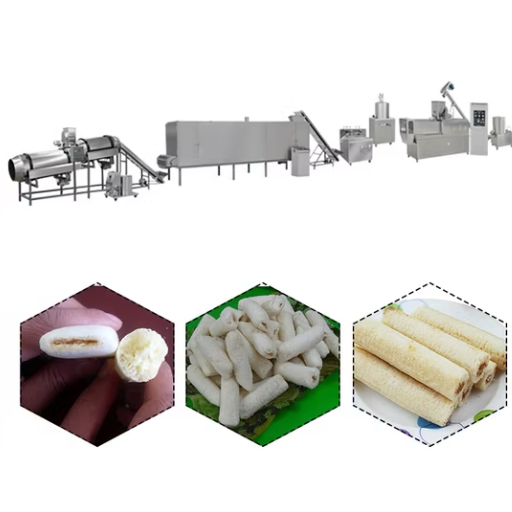
The supplier you choose matters as much as the machine itself. A low quote with no support can become the most expensive decision you make.
Verify Extruder Technology and Die Customization
Ask how the extruder handles moisture variation and what die materials are used. Hardened tool-steel dies last longer than standard steel. Confirm that the supplier can produce the specific shapes you want, and ask to see samples before placing an order.
Evaluate Dryer Design and Energy Efficiency
A dryer should offer uniform airflow, adjustable temperature zones, and easy cleaning. Inefficient dryers are hidden energy hogs. Ask for estimated kWh per kilogram of dried product.
Check Fryer Safety, Oil Management, and De-oiling
The fryer is the highest-risk unit. Look for automatic temperature control, oil-level sensors, fire-suppression readiness, and easy-access filtration. A good de-oiler should remove enough surface oil to keep your product crisp without breaking delicate shapes.
After-Sales Support, Spare Parts, and Commissioning
Find out where spare parts are stocked and how long replacements take. Ask whether the supplier provides on-site commissioning and operator training. Remote support is helpful, but someone should be available to visit your plant when a critical issue arises.
RFP Checklist for Fryums Equipment Buyers
- What is the guaranteed output for my target product mix?
- What is the power, water, and space requirement?
- Are dies and forming rollers included? How many shapes?
- What is the dryer temperature range and estimated drying time?
- What fuel options are available for the fryer?
- Is oil filtration automatic or manual?
- What food-safety certifications does the equipment carry?
- What is included in installation, commissioning, and training?
- What is the warranty period and spare-parts policy?
- Can the line be upgraded to 3D or higher capacity later?
Samuel Oduor ran a 2D fryums line in Nairobi for two years before deciding to add 3D bugles and pani puri to his catalog. His original supplier could not provide the compound-forming module he needed, so he faced a costly line replacement. When he eventually upgraded, he chose a modular hybrid line that could switch between 2D and 3D production. Today his plant runs five different shapes on the same extrusion platform, and he no longer worries about being locked into one product category.
Frequently Asked Questions
What are fryums made of?
Fryums are made from starch-heavy flours such as potato starch, corn starch, tapioca starch, wheat flour, rice flour, or urad dal flour. Water, salt, spices, colors, and sometimes shrimp or meat powder are added for flavor.
How are fryums manufactured industrially?
The industrial process is mixing → extrusion cooking → shaping/cutting → drying → frying → de-oiling → seasoning → cooling → packaging. Dried pellets are often fried later at 160–200°C, where they expand three to four times in size.
What is the difference between 2D and 3D fryums?
2D fryums are flat shapes cut from a single dough sheet. 3D fryums are hollow or compound shapes made by pressing two dough sheets together. 3D lines require more complex forming equipment and usually cost more.
What machines are needed for a fryums production line?
A complete line includes a flour mixer, screw conveyor, extruder, forming/cutting machine, dryer, continuous fryer, de-oiler, seasoning drum, cooling conveyor, and packaging machine. PLC control and oil filtration are recommended for automatic lines.
How much does a fryums production line cost?
Entry extruders start around ₹3–10 lakh (4,000–4,000–12,000). Mid-size automatic lines range from ₹19–35 lakh (25,000–25,000–50,000). Large fully automatic lines can exceed ₹35–65 lakh (50,000–50,000–100,000+).
How long should fryums be dried before frying?
Fryums are typically dried at 45–60°C for three to five hours until moisture reaches 8–10%. Under-dried pellets fry poorly and spoil faster.
What oil temperature is best for frying fryums?
Most fryums puff best at 160–200°C, with 190°C being a common set point. Temperature control is critical; too cool and the product absorbs oil, too hot and it burns.
Can fryums be made without deep frying?
Yes. Dried pellets can be baked or air-fried for a lower-oil product. This is becoming more popular as health-conscious consumers seek reduced-fat snacks.
Conclusion
A fryums production line is one of the most flexible investments a snack manufacturer can make. It turns simple starches into dozens of crispy products that travel well, store for months, and appeal to consumers across South Asia, Africa, the Middle East, and beyond.
Success comes down to understanding the process, matching capacity to real demand, and choosing equipment that can grow with your business. Do not chase the lowest quote. Instead, evaluate extruder reliability, dryer efficiency, fryer safety, oil management, and the supplier’s ability to support you after installation.
If you are planning a new fryums line or expanding an existing one, start with a clear product mix and a realistic production target. Then request a detailed proposal that includes equipment specs, layout drawings, utility requirements, and training terms. The right supplier will treat your questions as a partnership, not a sales obstacle.
Ready to configure your fryums production line? Contact our team for a customized quotation, process review, and factory layout recommendation tailored to your product goals.