
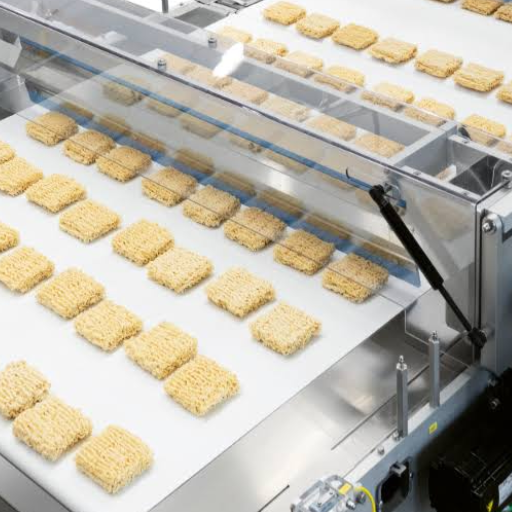
Types of Noodle Packing Machines: 8 Configurations Compared

The types of noodle packing machines used in commercial plants fall into eight configurations, from the horizontal pillow packer that wraps instant blocks to the case packer at the end of the line. Your product form and pack format decide which one you need, not the machine’s brochure speed.
Most buyers start with the machine. That is the expensive way round. A plant that orders a vertical form-fill-seal machine for rigid noodle cakes finds out at the first jam, then buys the pillow packer it needed all along.
Global demand reached 124.21 billion servings in 2025, so the packing stage runs at serious volume. This guide compares all eight on product fit, pack format, speed, and cost, with the selection matrix we use when scoping a line and the four mistakes that cost the most. For line design end to end, see our complete guide to automatic noodle packing machines.
Key Takeaways
- Eight configurations cover commercial noodle packing. Blocks, loose strands, fresh noodles, cups, and trays each force a different architecture.
- Published single-lane speeds run 50–200 packs/min for block packers, 30–65 bags/min for stick-noodle lines, and 60–100 packs/min for fresh noodles.
- Nameplate speed is not output. A 200 packs/min line at 85% OEE delivers about 170; at the 60% CPG average, about 120.
- Price bands run from 4,000–9,000forsemi−automaticunitsto4,000–9,000forsemi−automaticunitsto220,000+ for a turnkey line.
- Secondary packaging is part of the type decision. Reserve about 20% of line capital for bundlers, case packers, and palletisers.
What Are the Types of Noodle Packing Machines?
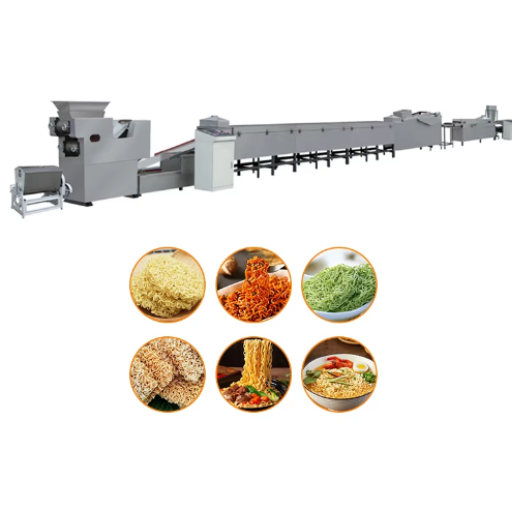
Noodle packing machines fall into eight types: horizontal pillow packers, multihead weigher plus VFFS lines, fresh-noodle VFFS, premade pouch machines, cup and bowl sealers, vacuum and tray packers, multipack bundlers, and case packers. The first six handle primary packaging; the last two handle case packing and palletising.
That split matters. Most guides stop at the sealed bag, but the primary type sets collation pitch, case count, and end-of-line labour. Buyers also search for types of noodle packaging machines; the words describe the same equipment.
The 8 Types of Noodle Packing Machines Compared
Here are the different types of noodle packing machines, in line order.
- Horizontal pillow packer (HFFS, horizontal form-fill-seal) for instant blocks and brick packs.
- Multihead weigher plus VFFS for loose, short-cut, and stick noodles.
- Fresh and wet noodle VFFS for udon, semi-wet, and cooked noodles.
- Premade pouch and rotary Doypack for premium and retort formats.
- Cup and bowl filling and sealing for cup and bowl noodles.
- Vacuum, tray, and MAP packers for chilled and ready-to-eat noodles.
- Multipack bundlers and strappers for 5-in-1 and 10-in-1 family packs.
- Case packers and palletisers for the secondary stage.
| Type | Best for | Pack format | Dosing | Published speed |
|---|---|---|---|---|
| Horizontal pillow packer | Instant blocks, cakes | Pillow, brick, 3D | Count and pitch | 50–200 packs/min |
| Multihead weigher + VFFS | Loose and stick noodles | Pillow, gusset, block-bottom | Combination weight | 30–65 bags/min |
| Fresh-noodle VFFS | Fresh, semi-wet, udon | Pillow, gusset, gas-flushed | Weight, anti-tangle tooling | 60–100 packs/min |
| Premade pouch | Premium dry, retort | Stand-up, zipper, flat | Weight or volumetric | 10–60 bags/min |
| Cup and bowl sealer | Cup and bowl noodles | Lidded cup or bowl | Count and position | 40–120 cups/min |
| Vacuum, tray, MAP | Chilled, ready-to-eat | Vacuum pouch, tray, skin | Weight or volumetric | Set by vacuum cycle |
| Multipack bundler | Family packs, bundles | Overwrap, shrink, strap | Count and collate | 20–60 multi-packs/min |
| Case packer | Secondary packaging | RSC, tray, wrap-around | Count and collate | ~20 cases/min |
These are supplier figures, not a promise for your product.
1. Horizontal Pillow Packer (HFFS)
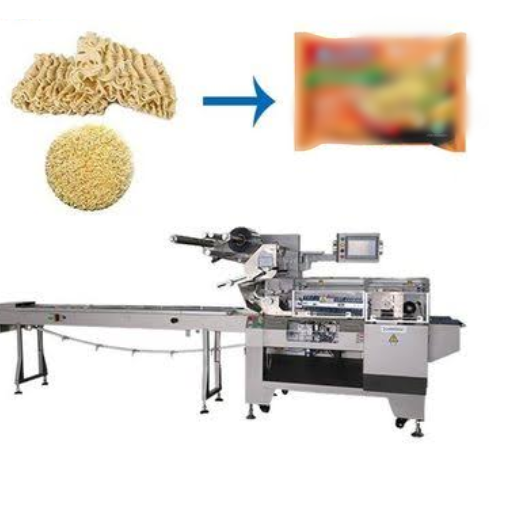
This pillow packing machine is the standard choice for instant noodle blocks, and the one most buyers picture when they search for noodle packing machine types. Cakes arrive in single file, a sachet drops onto each block, and a chain pushes the pair into a tube of film. End-sealing jaws close, seal, and cut.
Film travels horizontally, so the machine handles a rigid, pre-formed product well. The block sets the pitch. The packer counts and spaces it.
Published single-lane speeds run 50–200 packs/min. A dedicated Japanese model reaches 180 packs/min with three servos, and our FW-250 reaches 230 bags/min on narrower film.
Loose strands are the wrong product for this machine. It cannot portion what it cannot space.
If you are specifying a block line, our flow wrapper and VFFS range lists film widths and speeds.
2. Multihead Weigher + VFFS
Loose noodles are sold by weight, not by count. That changes the architecture.
A multihead weigher, also called a combination weigher, sits above a VFFS machine. The weigher weighs several hoppers at once, selects the combination closest to the target, and releases it into a forming tube. The bag forms around the tube, the bottom seals, the product drops, the top seals, and a cutter separates the bag.
Published output for stick-noodle lines runs 30–65 bags/min. A three-weigher line typically reaches 30–55; a four-weigher line reaches 50–65. Our VFFS-420 runs 15–70 bags/min, the VFFS-520 runs 15–60, and the VFFS-720 runs 10–50.
Tolerance is around ±2 g on 400–600 g packs. Strand length is the real constraint, with many systems capped near 300 mm.
3. Fresh and Wet Noodle VFFS
Fresh noodles are soft, sticky, and prone to tangling. A standard weigher bridges and crushes them.
Fresh lines use rotary rollers between feeder pans, memory hoppers, and steep 60° chutes. Many add a nitrogen flush, because the pack is not shelf-stable without it.
Published configurations run about 60–100 packs/min, with product lengths up to 300 mm. The machine is a VFFS at heart, but the tooling and gas system make it a different purchase. If your product needs a cold chain, that cost belongs in the same budget.
4. Premade Pouch and Rotary Doypack
Not every premium noodle belongs in a pillow bag. Premade pouch machines take a finished bag from a magazine, open it, fill it, and seal it. Formats include stand-up, zipper, flat, spout, and retort pouches.
Linear machines are the entry point at roughly 10–30 bags/min. Rotary machines index through 8 or 10 stations and reach 10–60 bags/min; a 10-station unit can touch 80 on light product.
The trade-off is film cost: a finished pouch costs more per pack than roll film. That premium pays back when shelf presence or retort performance earns it.
5. Cup and Bowl Filling and Sealing
Cup and bowl noodles use a different architecture. A denester drops cups onto a conveyor. A cooled cake and two or three sachets go in. A foil or laminate lid is heat-sealed to the rim, and the cup is coded and shrink-wrapped.
The package is rigid, so the machine controls rim alignment and lid tension rather than film forming. A bag machine cannot simply be adapted to cups.
Published single-lane speeds run 40–120 cups/min. Our cup line is rated 40–50 cups/min on a single lane, with output rising through four to eight rows or a rotary head; the LY-ROTARY-200 reaches 180,000–200,000 cups per eight-hour shift. Linear HTC-style machines publish 3,000–10,000 cups/hour across four to ten lanes.
For the full specification, see our cup noodle sealing machine guide.
6. Vacuum, Tray, and MAP Packers
Fresh, chilled, and ready-to-eat noodles need more than a sealed bag. They need air removed or replaced.
Four formats cover most of this work: vacuum pouch for dense, flat products; vacuum skin for portions held against a board; sealed trays for ready-to-eat meals; and gas-flushed VFFS for high-volume fresh noodles.
Speed is quote-only because the vacuum cycle dominates. Ask for the cycle time at your fill weight, not the headline rate.
7. Multipack Bundlers and Strappers
A 5-in-1 family pack is not a bigger bag. It is five finished packs collated and overwrapped, shrunk, or strapped.
Multipack machines run 20–60 multi-packs/min. A servo wrapper handling standard five-packs can reach about 55 multi-packs/min, roughly 275 individual packs.
This is a separate machine, not an option on the primary packer. Collation pitch, pack stiffness, and count all have to match. Buy it with the primary packer, or you will discover the mismatch when the line starts.
8. Case Packers and Palletisers
The last type is the one most first budgets forget.
A case packer collates finished packs into a shipper, seals it, and feeds a palletiser. Published figures show a 400 packs/min infeed producing about 20 cases/min, with pattern changeover under eight minutes on a servo collator.
The ratio is the point. Your primary packer can be twice as fast as the case packer and still be the bottleneck if collation is wrong. Reserve about 20% of line capital for this stage, and size it from real output.
Noodle Packing Machine Types: Speed, Format, and Cost
| Type | Published speed | Price signal (FOB China) | Typical scope |
|---|---|---|---|
| Semi-automatic weigh-packer | 15–30 packs/min | $4,000–9,000 | Operator-assisted, dry stick noodles |
| Horizontal pillow packer | 40–230 packs/min (Loyal FW series) | ~6,000–20,500forlightmodels; 6,000–20,500forlightmodels; 12,800 for a QNF450-class machine | Wrapper, infeed, sachet feeder optional |
| Multihead weigher + VFFS | 15–70 bags/min | $15,000–50,000 | Weigher, VFFS, elevator, conveyor |
| Stick-noodle flow-wrap | 30–65 bags/min | $30,000–40,000 | Multi-lane flow wrap with weighing |
| Cup and bowl line | 40–120 cups/min | $40,000–70,000 | Cup feed, dosing, lid seal, nitrogen |
| Multipack bundler | 20–60 multi-packs/min | ~$19,000 for a 5-bag servo wrapper; full lines quote-only | Collation, overwrap, shrink tunnel |
| Turnkey multi-stage line | Line-dependent | $220,000+ | Weighing, bundling, case packing |
These are factory-gate figures. Freight, duties, installation, and spares sit on top. Fresh-noodle VFFS, premade pouch, vacuum and tray, and case packing are quote-only because they are priced against your layout. For the full breakdown, see our noodle packing machine price guide.
Nameplate vs Sustained Output
Every figure above is a nameplate rating. Real output is lower, and the gap is where budgets fail.
Apply OEE, the product of availability, performance, and quality. World-class OEE is about 85%. The CPG packaging average sits nearer 58–62%, according to industry benchmarking published by TeepTrak.
A line rated 200 packs/min delivers about 170 at 85% OEE and about 120 at 60%. If your business case needs 150 packs/min, the second number is the one to plan around. Plan at 55–70% of rated speed; servo machines hold a higher share than older mechanical units.
Selection Matrix: Match the Type to Your Product
Start with the product, not the machine. This is the matrix we use to compare types of noodle packing machines when scoping a line.
| Your product | Primary type | Dosing | Pack format | Secondary stage |
|---|---|---|---|---|
| Instant noodle block (bag) | Horizontal pillow packer | Count and pitch | Pillow, brick, 3D | Multipack bundler, then case packer |
| Cup or bowl noodle | Cup and bowl filling and sealing | Count and position | Lidded cup or bowl | Shrink wrap, then case packer |
| Loose dried stick noodles | Multihead weigher + VFFS | Combination weight | Pillow, gusset, block-bottom | Bundler or strapper, then case packer |
| Fresh or semi-wet noodles | Fresh-noodle VFFS or premade pouch | Weight, anti-tangle | Gas-flushed bag or retort pouch | Chilled case pack |
| Instant rice noodles | Bowl line with dryer interface | Weight, about ±3 g | Bowl | Shrink wrap, then case packer |
| Premium dry noodles | Premade pouch or rotary Doypack | Weight or volumetric | Stand-up, zipper, flat | Cartoner, then case packer |
| Ready-to-eat noodles | Tray sealer or vacuum skin | Volumetric or weight | Sealed tray or skin pack | Chilled case pack |
If two rows fit, the tie-breakers are film cost per pack, changeover time across your SKU range, and floor space. Those three decide more purchases than speed does.
Four Expensive Mistakes Buyers Make
1. VFFS for rigid noodle blocks. A formed cake does not drop cleanly through a vertical tube. It bridges, skews, and jams. Blocks belong in a horizontal pillow packer. Some suppliers market large VFFS units for cakes; treat that as a format-specific exception.
2. Pillow packer for loose stick noodles. A flow wrapper spaces discrete items. It cannot portion a loose bundle. You need a weigher first, then a bag machine.
Consider a plant manager named Adaeze, scoping a line for 80 g blocks. A supplier quotes a VFFS at $22,000, well below the pillow packer. She buys it.
Within a month, the cakes jam at the forming tube three or four times a shift. The fix is a 35,000pillowpacker,andtheVFFSbecomesaspare.Thecheapermachinecost35,000pillowpacker,andtheVFFSbecomesaspare.Thecheapermachinecost57,000 and a month of output.
3. Buying the wrapper without the weigher, infeed, or secondary stage. The packer is one line item. Scope gaps are where the second $40,000 appears. Ask for a line drawing with every conveyor, elevator, checkweigher, and case packer marked.
4. Buying a dual-format machine to avoid changeover. Machines that claim both cup and bag capability usually compromise both. Different infeed, different sealing physics, different film path. Buy for the format you run 80% of the time, then change over deliberately.
How to Specify Each Type
The questions change with the architecture. Use this list as a starting point, then add the product-specific details.
- State the product form and dimensions. Block length, width, height, weight, strand length, moisture, and temperature at the packing head.
- Name the pack format and film structure. Pillow, brick, gusset, block-bottom, pouch, cup lid, or tray. Include film thickness and barrier requirement.
- Set the output basis. Packs per minute at what OEE, over what shift, at what reject rate. Never accept a bare nameplate figure.
- Define the dosing method. Count, combination weight, volumetric, or auger. State the tolerance and the giveaway you will accept.
- Map the secondary stage. Bundler, cartoner, case packer, palletiser. Confirm pitch and count match the primary machine.
- Fix the hygiene and compliance scope. SUS 304 contact surfaces, IP65 where washdown is required, CE, and food-contact compliance under EU 1935/2004 or FDA 21 CFR 177.
- Require a witnessed FAT. Run your product, your film, and your pack format. Record speed, reject rate, and seal strength.
For the supplier side of that checklist, see our guide to evaluating a noodle packing machine manufacturer.
Want the specification template we use for line scoping? Request the packaging line checklist and we will send it with a sample layout.
Why the Line, Not the Machine, Decides the Type
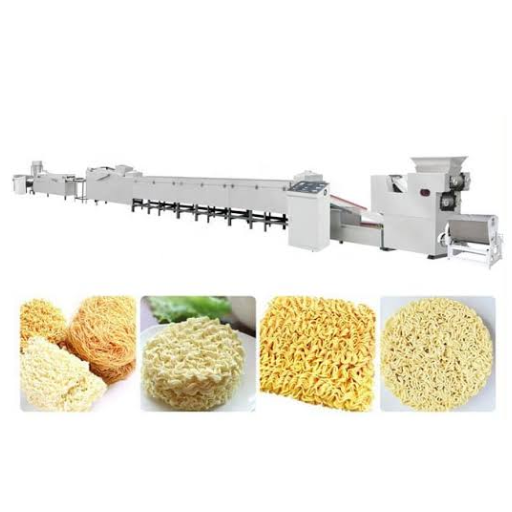
The machine type is only half the decision. The other half is the product state at the infeed.
A pillow packer works when the cake arrives at room temperature, at the right moisture, and square. A cake that is still warm condenses moisture on the inside of the film and softens the seal. A cake that is 10 mm too thick jams the former. A cake that is skewed prints crooked and packs badly.
Consider Priya, a production manager running a 120,000-bag shift. Her seal failures spike every time the line speeds up. The sealer is fine.
The cooling conveyor is not, so warm cakes reach the jaws and condense on the film. A $4,000 cooling fix solves a problem three sealer quotes could not.
Those conditions are set upstream in cooling, drying, and block forming, all part of the instant noodle production line. We build lines through those stages, so we see the hand-off from both sides. It is why we ask for a product sample before quoting a packer.
One honest caveat: if your line is stable and you only need a packer, a packaging specialist may be the better buy. The integrated argument only holds when the upstream stage is part of the problem.
Our flow wrappers and VFFS systems cover the bag formats in this guide. For cup and bowl formats, the cup noodle production line integrates filling, sealing, and shrink wrapping.
Conclusion
The eight types of noodle packing machines are not interchangeable. A pillow packer counts rigid blocks. A weigher and VFFS line portions loose strands. A fresh-noodle line manages stickiness.
A cup line handles a rigid package. Premade pouches buy shelf presence; vacuum and tray formats buy shelf life; a bundler makes the family pack.
Choose in that order: product form, then pack format, then dosing method, then machine type, then secondary stage. Check the nameplate against OEE before you sign. And budget the whole line, not the headline machine.
If you are scoping a noodle line and want a second opinion on the configuration, request a line consultation. We will tell you which type fits your product, including when the answer is a machine we do not sell.
Frequently Asked Questions About Noodle Packing Machine Types
How many types of noodle packing machines are there?
Eight configurations cover commercial production: horizontal pillow packers, multihead weigher plus VFFS lines, fresh-noodle VFFS, premade pouch machines, cup and bowl sealers, vacuum and tray packers, multipack bundlers, and case packers. Semi-automatic bench units and overwrappers are variants, not separate categories.
What is the difference between a pillow packer and a VFFS machine?
A pillow packer wraps product horizontally, so it suits rigid, spaced items such as instant blocks. A VFFS machine forms a bag vertically around a tube and fills by gravity, so it suits loose or weighed product such as stick noodles. The film path and the dosing method both differ.
Which type is best for instant noodle blocks?
An instant noodle packing machine of the pillow type is the standard. It counts and spaces pre-formed cakes, inserts a sachet, and seals a pillow or brick pack at 50–200 packs/min on a single lane. A VFFS machine is the wrong choice for a rigid block because the cake bridges in the forming tube.
Can one machine pack both cup and bag noodles?
Not well. Cup lines need a denester, rim alignment, and lid sealing. Bag lines need film forming and end-seal jaws.
Dual-format machines exist, but they usually compromise speed, changeover time, or both. Buy for your dominant format.
What is the cheapest type of noodle packing machine?
A semi-automatic weigh-packer starts around $4,000–9,000 and runs 15–30 packs/min with an operator. The cheapest machine is rarely the cheapest line once labour, giveaway, and secondary packaging are counted.
How fast should a noodle packing machine run?
Plan at 55–70% of the rated speed, then confirm at factory acceptance. A 200 packs/min machine at 85% OEE delivers about 170; at the 60% CPG average, about 120. Size the line from the sustained figure, not the brochure.