
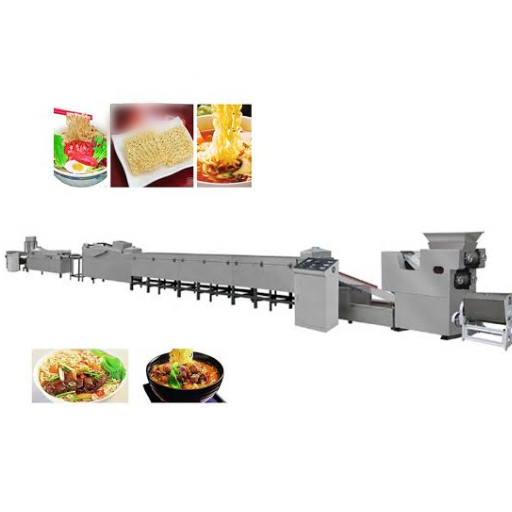
Instant Noodle Secondary Packaging: 5-Pack to Pallet Guide

Instant noodle secondary packaging is the stage that turns finished pillow packs or sealed cups into retail multi-packs, cartons, shipping cases, and pallets. It starts after the primary wrapper or cup sealer and ends at the stretch-wrapped pallet.
Global demand reached 123.07 billion servings in 2024, up 2.4% from 2023, according to the World Instant Noodles Association. Every one of those servings passed through a primary pack, and most passed through a secondary pack.
Most line budgets focus on the mixer, the fryer, the weigher, and the wrapper. The secondary stage often gets a single line in the quotation: “case packing, to be confirmed.” Then the line starts up, the wrapper runs at its rated speed, and the cases pile up at the end because one person cannot tape boxes fast enough.
This guide closes that gap. You will learn the four main formats, how to convert packs per minute into cases per minute, why collation is harder than it looks, what the machines cost, and how to test the stage before it ships. The goal is simple: size the whole line, not just the machine that makes the noise.
Key Takeaways
- Instant noodle secondary packaging covers multi-pack bundling, cartoning, case packing, and palletizing. It starts after the primary wrapper and ends at the pallet.
- Size the case packer from OEE-adjusted output, not the wrapper’s nameplate speed. At 65% OEE, a 450-pack/min line produces about 7.3 cases/min at 40 packs per case.
- Collation is the hard part. Pillow packs are flexible, light, and easy to crush, so count accuracy and pack orientation decide whether the line runs.
- A Chinese FOB secondary stage for a 200-450 pack/min line typically runs 60,000−150,000.Aturnkeymulti−bundlelineis60,000−150,000.Aturnkeymulti−bundlelineis220,000 or more.
- Changeover and case count affect real output more than top speed. A 90-minute changeover can erase a third of a year’s capacity.
What Counts as Instant Noodle Secondary Packaging?
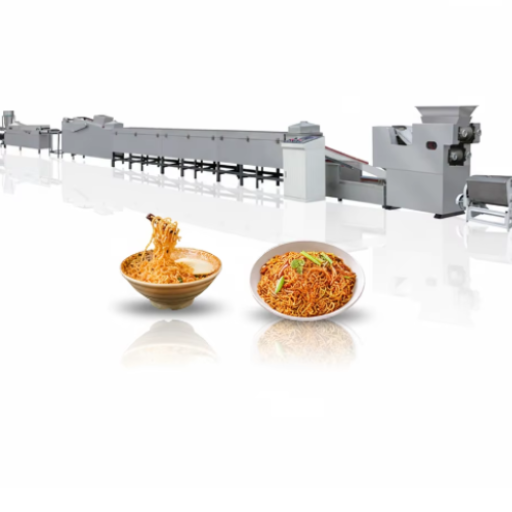
A secondary packaging machine groups primary packs into units that are easier to handle, display, and ship. It doesn’t touch the food. That’s the cleanest way to separate it from the wrapper and the fryer.
The packaging chain has three layers:
| Layer | What it touches | Instant noodle example | Typical equipment |
|---|---|---|---|
| Primary | The food | Pillow bag, cup with foil lid | VFFS, flow wrapper, cup sealer |
| Secondary | The primary pack | 5-pack bundle, carton, shipping case | Bundler, cartoner, case packer |
| Tertiary | The cases | Stretch-wrapped pallet | Palletizer, stretch wrapper |
The secondary stage does four jobs. It collates packs into a fixed count. It protects them from compression, moisture, and handling.
It identifies the unit with a barcode, date code, and lot code. And it unitizes packs into a case or pallet that a forklift can move.
Bagged and cup noodles do not share the same secondary playbook. A pillow pack is flexible and low in mass, so it needs gentle collation and often a shrink bundle. A cup or bowl is rigid but easy to scuff, so it needs different infeed tooling and usually a tray or carton. The primary stage decides what the secondary stage can handle.
That is why the secondary stage has to be planned alongside the rest of the instant noodle production line. A line designed from the mixer forward usually treats case packing as an afterthought.
If you are still choosing the primary machine, our guide to types of noodle packing machines explains the upstream options. If you want the broader packaging picture, see industrial food packaging equipment.
Planning a new noodle line? Send your pack dimensions, target pack count, and case count. Our line engineers will review the primary and secondary stages together. Talk to a line engineer →
The Four Instant Noodle Secondary Packaging Formats
The retail unit comes first. The machine comes second. A noodle multi-pack machine should follow the retail unit, not define it.
5-pack and 10-pack shrink bundles
The 5-pack is the default retail unit in many instant noodle markets. It is also a common inner bundle inside a master carton. A bundle typically uses POF shrink film, 12-30 µm, and a wrapper that collates five packs, wraps them, and shrinks the film in a tunnel.
A 5-pack noodle bundling machine usually runs 30-130 packs per minute, depending on the wrapper and pack size. The bundle is the retail-facing unit, so film registration, print position, and seal quality matter. A loose bundle looks cheap on the shelf. A tight bundle protects the packs and reduces film use.
In China’s hypermarket channel, five-packs have accounted for roughly two-thirds of instant noodle sales value in recent retail audits. That is a regional observation, not a global rule. In other markets, 4-packs, 10-packs, and single-serve cups dominate. Check your own retail data before locking the format.
Cartons and shelf-ready trays
A carton or tray gives the pack a sturdier shelf presence and can carry a premium or gift positioning. A cartoner erects the carton, loads the packs, and closes it with hot-melt glue or tuck flaps. Typical noodle cartoners run 30-60 cartons per minute and handle board from 250-450 g/m².
Shelf-ready trays add a perforated tear front so a retailer can set the whole tray on the shelf without unpacking it. That format is growing in modern trade, but it changes the case dimensions and the pallet pattern. Decide it before you order the cartoner, not after.
Shipping cases: RSC vs wrap-around
The shipping case is the transit unit. A regular slotted container (RSC) is the familiar top-load or side-load box. A wrap-around case forms the corrugated blank around the product, which can use 10-25% less board than an RSC.
A common master carton holds 40 packs: eight 5-pack bundles, about 3.2-4.1 kg depending on pack weight. That is a common format, not a standard.
Case counts of 24, 30, 48, and 52 also exist. The case count changes the case rate, the corrugated cost, the pallet pattern, and the freight cost. It’s a logistics decision as much as a packaging decision.
Palletizing and stretch wrapping
The pallet is the last secondary step before the warehouse. A low-level palletizer can handle 6-15 cases per minute and costs far less than a robotic cell. A robotic palletizer handles more complex patterns and runs 5-40 cases per minute. Above roughly 200-300 pallets per day, automated palletizing usually pays back faster.
Pallet pattern matters. A case that is 5 mm too tall can reduce the number of layers per pallet. A case that is 10 mm too wide can waste trailer space. Get the case dimensions and pallet pattern approved before the case packer is built.
Materials and retail requirements
Three material choices drive cost and performance:
- Film: POF is common for multi-packs because it is clear, strong, and shrinks tightly. Thinner film saves material but demands better tension control. Hugo Beck reports a noodle producer cut film from 35 µm to 12.5 µm, reduced plastic by 64%, and saved about 15% film while tripling capacity.
- Board: Noodle cartons typically use 250-450 g/m² board. Recycled board is more sustainable but behaves differently under vacuum and compression, so the cartoner needs adjustable pressure and vacuum zones.
- Closure: Hot-melt glue gives a strong, low-plastic seal at high speed. Tape is simpler and easier to maintain. The right choice depends on your speed, case value, and retailer requirements.
Do not claim a format is recyclable unless your local waste stream actually accepts it. “Less plastic” and “recycled content” are safer, more accurate claims than “recyclable.”
How to Balance an Instant Noodle Secondary Packaging Line
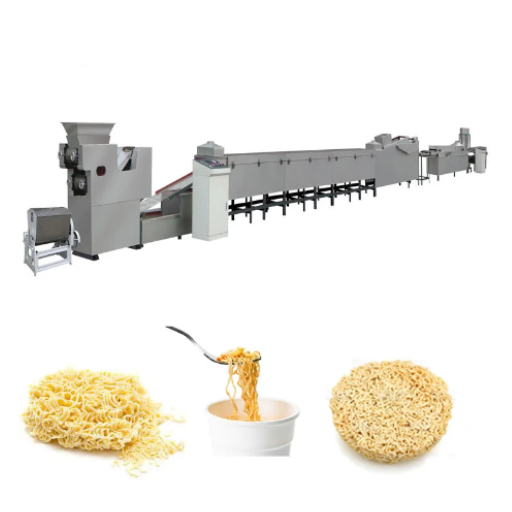
A typical instant noodle packaging line is sold on nameplate speed. That’s the wrong number. A wrapper rated at 200 packs per minute doesn’t deliver 200 packs per minute for a full shift. It delivers whatever the line OEE allows.
Use this four-step calculation:
- Actual packs/min = nameplate packs/min × line OEE
- Multi-packs/min = actual packs/min ÷ packs per multi-pack
- Cases/min = multi-packs/min ÷ multi-packs per case
- Pallets/hour = cases/min × 60 ÷ cases per pallet
Here is the same line at three nameplate speeds, using 65% OEE, 5 packs per bundle, 8 bundles per case (40 packs), and 48 cases per pallet:
| Nameplate | Actual at 65% OEE | 5-pack bundles/min | Cases/min | Pallets/hour |
|---|---|---|---|---|
| 200 packs/min | 130 | 26 | 3.25 | 4.1 |
| 450 packs/min | 292.5 | 58.5 | 7.3 | 9.1 |
| 600 packs/min | 390 | 78 | 9.75 | 12.2 |
Now compare those case rates with the machine you were quoted. A 6-15 cases/min case packer is ample for a 200-450 pack/min line at 40 packs per case. At 600 packs/min nameplate, the line needs 15 cases/min just to keep up at 100% OEE. A 15 cases/min case packer has no margin, and it fails the common buffer rule before any stops or pattern changes.
A plant manager we will call Ahmed learned this the expensive way. His team replaced an aging wrapper with a faster model and expected a 20% output gain. The wrapper delivered. The manual case-packing station did not.
Output rose about 9%, and eight operators per shift were still taping boxes by hand. The constraint had moved downstream, but nobody had measured it.
The fix is not always a bigger case packer. Sometimes it is a buffer. A common rule is to size the case packer at least 1.2 times the upstream maximum OEE-adjusted rate.
Add accumulation for at least two downstream faults. A case packer that stops for 60 seconds at 7 cases/min backs up seven cases. Without a buffer, that stop reaches the wrapper in under a minute.
If your line runs 10-packs instead of 5-packs, the bundle rate halves but the case rate stays the same for the same pack count. The bundler becomes the constraint, not the case packer. Run the math for every format you plan to sell.
Why Collation Is the Hard Part
Wrapping a pack is a known problem. Standing five flexible packs in a neat row, keeping the sachet on top, and pushing them into a case without crushing them is the part that separates a good line from a frustrating one.
A pillow pack has very little structural strength. It can bow, slide, and catch on a guide rail. The film memory changes after cooling. The sachet moves if it is not tucked or glued.
A pack that is 2 mm outside its nominal width can jam a fixed lane.
Cup and bowl lines have a different problem. The cups are rigid, but the rims scuff, and the stacks can nest too tightly. A cup denester that works at 40 cups/min may fail at 120 because the cups do not separate fast enough.
Most collation problems show up in four places:
- Count accuracy: five packs become four or six when a pack slides over a divider.
- Orientation: the sachet ends up on the bottom, or the print faces the wrong way.
- Compression: the bottom pack in a stack is crushed by the weight above it.
- Jam recovery: a single misaligned pack stops the line, and the operator cannot clear it without opening a guard.
Ask your supplier how the collator counts. Mechanical counts use a paddle or divider. Vision counts use a camera and reject system.
Mechanical is simpler and cheaper. Vision handles mixed formats and catches errors that a paddle misses. Neither replaces a good infeed.
The best test is not a brochure speed. It is a run with your own packs, your own film, and your own sachet. Ask for at least 1,000 packs in the FAT, with a count of every reject.
Choosing the Machines: Bundler, Cartoner, Case Packer, Palletizer
The machine list is short. The integration is not.
Shrink bundlers and multi-pack wrappers
A shrink bundler collates packs, wraps them in film, and shrinks the film in a tunnel. It is the lowest-cost way to make a retail multi-pack. Look for adjustable collation, independent temperature zones, and a film splice that does not stop the line.
Cartoners
An instant noodle cartoning machine erects, loads, and closes a carton. Horizontal end-load cartoners are common for retail packs. Vertical top-load cartoners suit bags and pouches.
Check the carton size range, board weight, and hot-melt system. A cartoner rated at 60 cartons/min may run 45 on recycled board with a tight carton.
Case packers
Four configurations cover most noodle lines:
- Top-load: packs drop into a case from above. Flexible patterns, gentle handling, moderate speed.
- Side-load: packs are pushed horizontally into an RSC or half-slotted case. Common for 15-20 cases/min.
- Wrap-around: the case forms around the product. Less corrugated, good for 15-30 cases/min.
- Robotic pick-and-place: flexible for complex patterns, higher cost, more controls and maintenance.
An instant noodle case packer is not a commodity. The infeed, collation, and case-erecting sections decide whether it runs at the rated speed. Ask for a line drawing with every conveyor, buffer, erector, and glue unit marked.
Palletizers
A low-level palletizer is a good fit for 6-15 cases/min. A robotic arm handles more patterns and can share a cell with other lines. A high-level palletizer suits high-volume, single-format plants. The palletizer is usually the easiest stage to defer, but the line layout must leave room for it.
Selection matrix
| Line output | Recommended secondary configuration | Why |
|---|---|---|
| Under 200 packs/min | Manual or semi-auto case packing, 5-pack bundler | Automation payback is slow at low volume |
| 200-450 packs/min | Automatic 5-pack bundler, cartoner or case packer, low-level palletizer | Balanced cost and labor savings |
| 450-600 packs/min | Servo bundler, automatic case packer with buffer, robotic palletizer | Speed and changeover flexibility |
| Over 600 packs/min | Multiple primary lanes, high-speed case packer, high-level palletizer | Line balancing and redundancy |
If you are comparing primary machines first, the automatic noodle packing machine guide covers the upstream decision. Our packaging equipment range covers VFFS, flow wrappers, and multihead weighers for the primary stage.
What Instant Noodle Secondary Packaging Costs
Prices vary more than any other part of the line because scope varies. A “case packer” can mean a bare machine or a complete cell with erector, sealer, conveyors, controls, and installation.
These are observed 2026 listing prices, not quotes:
| Stage | Observed range | What it usually includes |
|---|---|---|
| 5-pack shrink bundler | $14,000-18,000 | POF wrapper and tunnel, 30-130 packs/min |
| Cartoner | $25,000-55,000 | 30-60 cartons/min, basic or optioned |
| Case packer | $20,000-50,000 | 6-15 cases/min, wrap-around or RSC |
| Palletizer | $20,000-150,000 | Low-level from about $20,000; robotic higher |
| Conveyors, buffers, controls | 20-40% of machine cost | Often omitted from the first budget |
| Full secondary stage, 200-450 packs/min | $60,000-150,000 | Bundler, cartoner, case packer, basic palletizing |
| Turnkey multi-bundle line | $220,000+ | Weighing, bundling, case packing |
| Western integrated case-packing cell | $300,000-750,000 | Different scope and support model |
Don’t compare a 25,000Chinesecartonerwitha25,000Chinesecartonerwitha300,000 Western integrated cell. They are different products with different scope, compliance, and service. Always ask what is included: case erector, glue unit, conveyors, buffers, change parts, installation, commissioning, training, and spares.
A common planning rule among suppliers is to reserve about 20% of line capital for the secondary stage. The rule is guidance, not a benchmark.
On some lines the secondary stage costs as much as the wrapper. On others it is 10%. The only way to know is to scope it.
If you are still budgeting the primary stage, our noodle packing machine price guide covers wrappers, weighers, fryers, and turnkey line bands.
The ROI formula is straightforward:
Payback = total installed cost ÷ annual net benefit
Annual net benefit includes labor savings, recovered throughput, and quality savings, minus added maintenance, energy, and consumables. Use your own wage rates and margin. Do not assume the machine runs at nameplate speed all year.
Cama’s case study shows the scale of the labor prize. Its instant noodle line receives from three flow wrappers at 900 packs per minute, replaced eight operators per shift, and lets one operator oversee the line. The line uses RSC cases and hot-melt glue and kept the same box dimensions to avoid higher material and transport costs.
Not sure which stage is driving your budget? Send your current output, case count, and shift pattern for a scope review. Request a line review →
Changeover, SKU Proliferation, and OEE
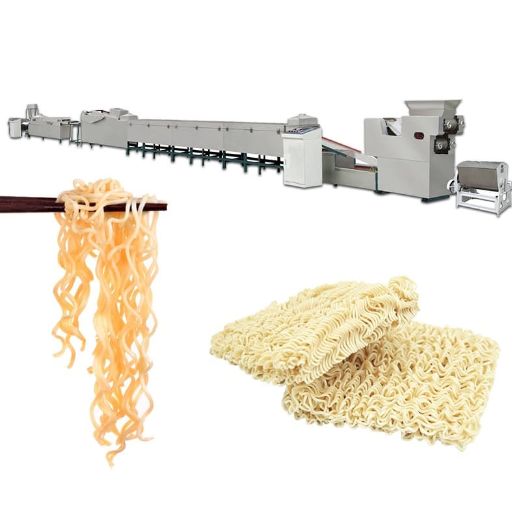
A line that runs one SKU at 300 packs per minute is a different business from a line that runs 15 SKUs at 200. Changeover is where the second line loses its advantage.
A production manager we will call Mei ran a plant with 15 active carton formats. Her cartoner was rated at 120 cartons per minute. In real production it averaged 85.
Each changeover took about 90 minutes and needed spanners, shims, and a trial run. Across a 12-month plan, the line lost about 35% of its capacity.
That pattern is common. The machine is fast enough. The changeover is not.
Tool-less, servo-adjusted changeovers can cut carton size changes to under 10 minutes. Recipe management can store the settings for each pack count, film, and case size. Neither helps if the operator cannot reach the adjustment points or if the change parts are not labeled.
Compare that with a servo line in Indonesia. SunAura reports a FAT result of 172 packs per minute and a 12-minute changeover from a single pack to a 5-pack bundle. The old cam-driven wrappers took 45-60 minutes.
The difference is not just speed. It is how many SKUs the plant can run profitably.
Line OEE and machine OEE are not the same number. A case packer can run at 85% machine OEE while the line runs at 55%. The gap comes from speed mismatch, micro-stoppages, and upstream starvation.
One packaging supplier puts typical line OEE at 40-60% against 70-85% for individual machines. Another puts many packaging operations at 60-75%, against a world-class target of 85%.
Measure the line, not the machine. Track micro-stoppages of 5-30 seconds. They are easy to miss and can hide 8-15% of OEE. If the case packer stops every few minutes, the problem may be the collator, the film splice, or the case erector, not the packer itself.
How to Specify and FAT a Secondary Packaging Line
A good quotation starts with data, not a price. Give every supplier the same pack:
- Pack dimensions, weight, film, and sachet position
- Pack count per bundle and per case
- Case dimensions, board grade, and closure method
- Pallet pattern and maximum pallet height
- Line speed, shift pattern, and number of SKUs
- Available floor space, power, air, and drainage
- Target changeover time and operator count
- Destination market, voltage, and compliance requirements
The Chinese national standard GB/T 41406-2022 is a useful checklist. It covers the automatic packaging line for bagged instant noodles, including the noodle-block feeder, seasoning-bag inserter, pillow wrapper, sorting and accumulating equipment, carton feeder, automatic case packer, printing equipment, metal and weight detectors, and conveyors. It also names optional hot-melt glue, print inspection, and foreign-body detection. The standard is recommended, not mandatory, but it gives you a common vocabulary with Chinese suppliers.
Before shipment, run a FAT that proves the whole stage, not just the wrapper:
- Count accuracy: 1,000 consecutive packs, zero undercounts or overcounts.
- Pattern and orientation: the 5-pack stack, sachet position, and print direction.
- Seal integrity: burst, drop, and compression tests on the bundle and case.
- Case seal: 30 cases checked for count, glue or tape, label, and date code.
- Changeover: time a real single-to-5-pack and 5-to-10-pack change with the operator.
- Reject handling: missing pack, open pack, underweight pack, and metal reject.
- Buffer recovery: stop the case packer for two minutes, restart, and confirm the upstream line does not stop.
- OEE run: four to eight hours at sustained speed, with output and stops recorded.
If a supplier will not run your product, your film, and your case, treat the quoted speed as a hypothesis.
Frequently Asked Questions
What is secondary packaging in instant noodle production?
Secondary packaging is the stage after the primary wrapper or cup sealer. It groups finished packs into retail multi-packs, cartons, shipping cases, and pallets. It includes collation, bundling, cartoning, case packing, and palletizing. It does not touch the food.
How many packs are in a case of instant noodles?
Most master cartons hold 24-48 packs. A common format is 40 packs: eight 5-pack bundles, about 3.2-4.1 kg. Case counts of 30, 48, and 52 also exist. The right count depends on your retail unit, freight cost, and pallet pattern.
How much does an instant noodle secondary packaging line cost?
For a 200-450 pack/min line, a Chinese FOB secondary stage often runs 60,000−150,000.Aturnkeymulti−bundlelineis60,000−150,000.Aturnkeymulti−bundlelineis220,000 or more. Western integrated case-packing cells can run $300,000-750,000. Scope, case count, and automation level move the number more than the brand.
What is the difference between a cartoner and a case packer?
A cartoner puts retail packs into a printed carton or tray. A case packer puts packs or bundles into a shipping case. Some lines use both: a 5-pack bundle goes into a carton for retail, then several cartons go into a shipping case. Others skip the carton and pack bundles directly into a case.
Can one line handle 5-pack and 10-pack formats?
Yes, if the collator, film path, and case packer are designed for both. The changeover may involve recipe selection, guide adjustment, and a different film roll. Ask for a timed changeover in the FAT, not a theoretical number. A line that claims both formats but takes two hours to switch is a single-format line in practice.
Do cup noodles need different secondary packaging?
Yes. Cups and bowls are rigid, so they need different infeed tooling, denesting, and often a tray or carton. Bagged noodles need gentle collation and shrink bundling.
The primary pack decides the secondary format. A cup noodle line can use a shrink wrapper, but the tooling and speeds are not the same as a pillow-pack line.
How much labor does automation replace?
It depends on the starting point. Cama’s case study replaced eight operators per shift with one line supervisor. A 600 packs/min line with three pillow packers, a case packer, and a palletizer may still need about eight operators per shift across the whole line. Automation usually redeploys labor rather than eliminating every role.
Conclusion
Instant noodle secondary packaging is not a box at the end of the line. It is a line-design decision that starts with the pack format and ends with the pallet pattern. The wrapper sets the input. The case packer, cartoner, bundler, and palletizer decide what the plant can actually ship.
Three numbers matter more than any brochure: your OEE-adjusted output, your case count, and your changeover time. Get those right, and the secondary stage becomes a profit center. Get them wrong, and a faster wrapper just fills the floor with packs.
That is why an instant noodle packaging line should be sized from the case backward. The pack format sets the bundle. The bundle sets the case. The case sets the pallet.
A line that starts with the wrapper and works forward will always leave a gap at the end.
Loyal’s packaging range covers the primary stage: VFFS, flow wrappers, and multihead weighers. On a turnkey noodle line, we size the secondary stage with the same pack data, case count, and output target, then integrate the right equipment for the project. If you are planning a new line or fixing a bottleneck in instant noodle secondary packaging, send your pack dimensions, target output, and case count. We will review the whole line with you.