
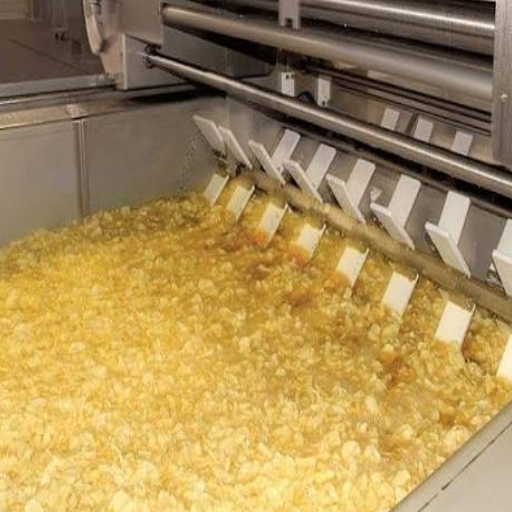
Kettle Style Potato Chip Fryer: How Batch Frying Creates Hard-Bite Chips

A kettle style potato chip fryer is a batch fryer that cooks thick, unwashed potato slices in separate loads instead of a continuous stream. That batch process, with its slower cook and swinging oil temperature, is what builds the dense, hard-bite crunch kettle chips are known for.
Think about the last kettle chip you ate. The snap was louder than a standard chip, and the texture was firmer, almost like a cracker. That difference isn’t marketing. It comes straight from the machine and the way it fries, one batch at a time, over roughly seven to nine minutes.
If you’re shopping for a kettle fryer, you’ve likely noticed that most suppliers show you a spec sheet but never explain why the equipment matters. You agree the crunch is the whole point; you just need to know how the fryer produces it and what to look for before you spend. This guide explains the kettle-fry process, the science behind hard-bite texture, and the specs that actually matter.
Key Takeaways
- A kettle style potato chip fryer cooks thick, unwashed slices in batches for 7-9 minutes, producing a denser, crunchier chip than a continuous line.
- The signature crunch comes from a U-shaped oil temperature profile, not from a constant, fixed temperature.
- Kettle chips finish at roughly 30% oil content versus 34-38% for conventional continuous chips.
- Batch kettles typically run 80-200 lbs per hour, while enterprise models like PPM’s BatchWright reach around 650 lbs per hour.
- Look for accurate temperature control, a working agitation system, SUS 304 or 316 steel, and inline oil filtration when you spec a fryer.
Prefer to see how a kettle fryer fits a full line? Browse our fried snack production lines.
What Is a Kettle Style Potato Chip Fryer?
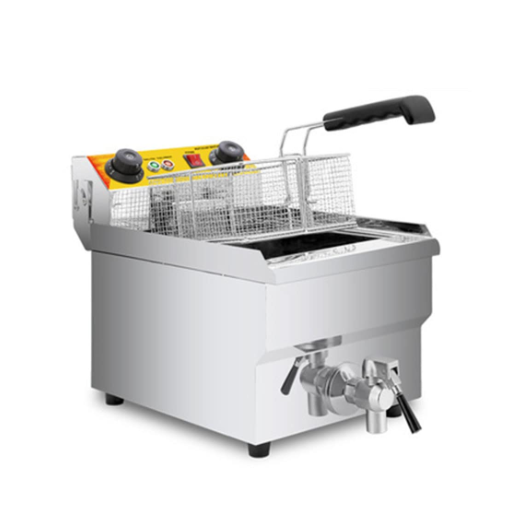
A kettle style potato chip fryer is a batch machine that lowers a measured load of potato slices into hot oil, fries them to a target color and moisture, then lifts and discharges the whole batch before the next one starts. It is the defining equipment for kettle cooked potato chips.
This stands apart from a continuous fryer, where slices feed in on a conveyor, pass through the oil at a steady rate, and exit on the other end without interruption. Both make potato chips. They just make very different chips, because the batch fryer lets you vary time, temperature, and agitation for every single load.
A standard kettle fryer has a few core components:
- Kettle or pot: the oil-holding vessel, built from food-safe stainless steel.
- Basket or carrier: holds the slices during frying and lifts out for discharge.
- Agitation system: paddles or a rocking motion that keeps slices from clumping.
- Heating source: direct-fire gas burners, electric elements, or a thermal-oil loop.
- Oil tank and filtration: stores heated oil and removes fines to extend oil life.
For a broader look at how the machine works and its other applications, see our batch fryer machine guide.
Why Kettle Chips Taste Different: The Hard-Bite Science
The crunch of a kettle chip isn’t an accident. Three process decisions, each tied to the fryer, create it.
Thicker, Unwashed Slices
Kettle chips start with slices that are noticeably thicker than standard chips, and those slices are not washed before frying. Washing strips surface starch; leaving that starch on the slice is deliberate. The retained starch browns during frying and helps form the denser, firmer texture. A continuous line, by contrast, usually works with thinner, washed slices that fry into a lighter, more uniform chip.
The U-Shaped Temperature Profile
This is the single most important difference, and it is the reason a kettle style potato chip fryer cannot simply be swapped for a continuous one. When cold, wet slices drop into the oil, the temperature plunges. The heating system then recovers and brings the oil back up. On a chart, that looks like a U or an inverted bell curve, a fast dip followed by a climb.
That temperature swing is a feature, not a flaw. It changes how water leaves the slice and how the surface sets, which produces the kettle chip’s harder bite. A continuous fryer holds oil at a steady temperature, so it never reproduces that profile.
Longer Fry Time and Lower Oil Content
Kettle chips fry for roughly seven to nine minutes, far longer than the two to three minutes a continuous line needs. The longer, cooler cook drives out more water and actually leaves the finished chip with less oil, around 30% versus 34-38% for conventional continuous chips.
Because of that lower oil and slower cook, kettle chips land on the “premium” side of the snack aisle. Want to reduce oil further through process design? Our guide on how to reduce oil absorption in fried snacks covers the levers.
How a Kettle Style Potato Chip Fryer Works
The Batch Cycle: Load, Fry, Discharge
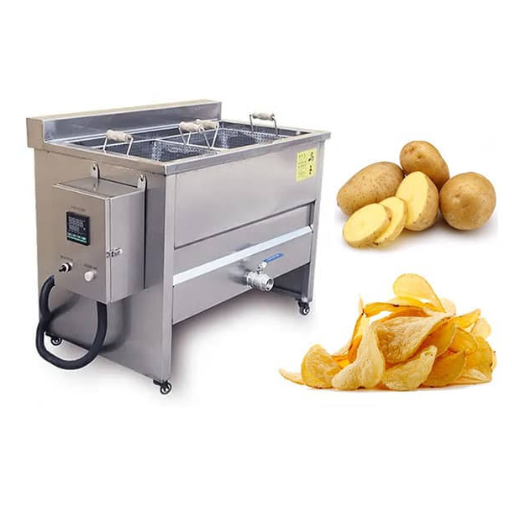
Every batch follows the same rhythm. An operator or automated feeder loads a measured amount of slices into the basket and lowers it into hot oil. The slices fry while the agitation system keeps them moving. Then the basket lifts out, drains, and discharges the finished batch so the cycle can repeat.
Agitation and Stirring Systems
Agitation is not optional. Without it, wet slices clump together, the ones on the bottom scorch, and the batch fries unevenly. A well-tuned stirring or rocking system keeps every slice exposed to oil for roughly the same time, which is how you get consistent color and moisture across a load.
Temperature Drop and Recovery
The engineering challenge sits in that middle step. Managing how fast the oil recovers after each cold load decides both fry time and final texture. If the heater recovers too slowly, the fry drags on and the chips come out soggy and oil-logged. If it overshoots, the oil scorches and degrades early. A good fryer pairs a responsive heating system with tight control, often within plus or minus 1-2 degrees Celsius.
Consider a batch line running a new kettle flavor. A plant supervisor loads a test batch and watches the temperature dip, then climb. On a machine with slow recovery, the first test run takes almost eleven minutes and the chips come out heavy. After the heating system is upgraded, the same batch recovers in time and the texture snaps back. That one control difference is often the whole story between a premium product and a reject.
Kettle Chips vs Regular Chips: A Direct Comparison
When buyers ask about kettle chips vs regular chips, the answer lives in four variables.
| Factor | Kettle Chips (Batch) | Regular Chips (Continuous) |
|---|---|---|
| Slice thickness | Thicker | Thinner |
| Wash step | Unwashed (starch retained) | Washed |
| Oil temperature | Swings (U-shaped profile) | Steady |
| Fry time | 7-9 minutes | 2-3 minutes |
| Texture | Dense, hard-bite, crunchy | Light, uniform |
| Color | Golden-brown, more variable | Consistent, lighter |
| Oil content | ~30% | ~34-38% |
| Throughput | 80-200+ lbs/hr | 200-5,000+ lbs/hr |
The tradeoff is texture versus volume. If you want the hard bite and a premium price, batch is the answer. If you want maximum output of a single uniform product, continuous wins. We break the decision down further in our batch fryer vs continuous fryer comparison.
What to Look for in a Kettle Style Potato Chip Fryer
Batch Size and Capacity
Capacity is usually quoted in kilograms or pounds per hour, but for a batch machine, batch size and oil volume matter just as much. Figure out how many finished kilos you need per shift, then work backward. A seven-to-nine-minute fry plus a couple of minutes for loading and discharge means roughly five cycles per hour. Your batch size has to deliver your hourly target in those five loads.
For reference, a dedicated kettle-chip batch fryer from Heat and Control’s Mastermatic line handles around 200-300 lbs per hour, while PPM Technologies’ BatchWright claims up to 650 lbs per hour. Most small and mid-size kettle lines sit well below that.
Heating System and Temperature Control
The heating system decides how well the fryer recovers from that temperature dip, and that recovery is what makes or breaks texture. Direct-fire gas is common and cheap per unit of heat. Electric induction gives the tightest control. Thermal oil transfers the most uniform, gentle heat and suits nuts and heat-sensitive products. Match the heating method to your local energy prices and your product.
Materials: SUS 304 vs SUS 316
Food-contact surfaces should be stainless steel throughout. SUS 304 is a sound minimum for most chips. SUS 316 resists salt and corrosive brines better, so it is worth the upgrade if you run salty or seasoned products. Smooth, crevice-free welds clean more easily and reduce harborage risk.
Oil Filtration and Agitation
Frying oil is usually the biggest variable cost on a kettle line. Inline filtration removes fines that would otherwise degrade the oil and shorten its life. Combined with steady temperatures, good filtration can nearly double oil life. Confirm the fryer has a working agitation system too, since both texture consistency and oil quality depend on it.
For a complete walkthrough of picking the right fryer for your product, read our potato chip fryer machine guide.
Ready to spec your kettle line? Tell us your output target and product type, and we’ll map the right fryer for your process.
True Batch vs Continuous Kettle Fry (CKF)
Here is a detail most suppliers won’t mention. The big brands know the batch temperature profile creates the crunch, and they also want continuous throughput, so they chase something called continuous kettle fry, or CKF.
The idea is to reproduce the U-shaped temperature curve inside a continuous fryer, typically by injecting cooler oil upstream so the slices experience a deliberate dip and recovery as they travel. PepsiCo and Frito-Lay hold several patents on this approach, and products like their “Red Sky” chips are cited as examples of it in practice.
The catch is that CKF still doesn’t taste exactly like a true batch kettle. For premium, small-batch, hard-bite chips, genuine batch frying remains the benchmark. CKF becomes interesting only at high volumes where a true batch line can’t keep up. Most buyers are better served by running real batch kettles, possibly several in parallel, until volume genuinely demands a continuous alternative.
Frequently Asked Questions
What is the difference between kettle chips and regular chips?
Kettle chips are fried in batches in a kettle, using thicker, unwashed slices and a swinging oil temperature. Regular chips are fried continuously on a conveyor at a steady temperature. That is why kettle chips are crunchier and firmer, while regular chips are lighter and more uniform.
How long does it take to fry kettle chips?
Kettle chips fry for roughly seven to nine minutes per batch, compared to two to three minutes for continuously fried chips. The longer, cooler cook drives out more water and builds the hard-bite texture.
Are kettle chips healthier than regular chips?
Kettle chips typically finish with slightly less oil, around 30% versus 34-38% for conventional chips, because the longer cook drives out more moisture. They are still a fried snack, so “healthier” is a small relative difference, not a health claim.
What fryer is used to make kettle chips?
A kettle style potato chip fryer, also called a batch fryer, is used to make kettle chips. It cooks slices in discrete loads in a kettle of hot oil, which is what produces the signature crunch.
How does a batch fryer work?
A batch fryer lowers a measured load of food into hot oil, fries it while agitating, then lifts and discharges the batch before the next one begins. The key challenge is recovering oil temperature after each cold load.
Conclusion
The crunch you taste in a kettle chip is not marketing. It is the direct result of a batch fryer cooking thick, unwashed slices over seven to nine minutes, with an oil temperature that deliberately dips and recovers.
If you remember three things, make them these. First, the hard-bite texture comes from the U-shaped temperature profile, not a constant temperature. Second, kettle chips actually finish with less oil, around 30%, even though the fry is longer. Third, the specs that matter are temperature recovery, agitation, stainless steel grade, and inline oil filtration.
Start with the texture your customers expect, then choose the fryer that produces it. A kettle style potato chip fryer is not a downgrade from a continuous line. It is a different tool for a premium job, and when the crunch is your brand, it is the only tool that delivers.
Shandong Loyal Industrial builds both batch and continuous frying systems, plus the de-oiling, flavoring, and packaging equipment that complete the line. Ready to spec your kettle line? Request a quote or schedule a pilot trial, and we’ll help you match the right fryer to your product and budget.