Noodle Packing Machine Manufacturers: How to Choose Wisely

Choosing among noodle packing machine manufacturers comes down to eight checks: a written specification, certifications, a witnessed factory acceptance test, spare parts, after-sales support, references, customization depth, and whether the supplier can own your whole line. Get those eight right and you buy a decade of uptime. Get them wrong and the cheapest quote quietly becomes the most expensive machine in your plant.
Here is the problem most buyers don’t see until it’s too late. Two suppliers can quote nearly the same number for a “noodle packing machine,” yet differ by $40,000 in the costs that actually matter: missing conveyors, a weigher that isn’t included, installation, tooling, and spare parts that take eight weeks to ship.
Take Daniel, a dry-noodle producer in Indonesia who runs three lines. In 2024 he picked the lowest of five quotes for a VFFS packing machine. The quotation omitted the infeed conveyor, the multihead weigher, and installation, so his “saving” of 9,000becamea9,000becamea23,000 overrun before the machine packed a single bag. Six months in, a proprietary sensor failed and the replacement part sat in customs for seven weeks.
Daniel’s mistake wasn’t choosing a bad machine. It was choosing a manufacturer without a method. This guide gives you that method: a neutral eight-point framework for evaluating noodle packing machine manufacturers, from the vendor that also builds the full production line.
Key Takeaways
- Choose noodle packing machine manufacturers on a written specification and a witnessed FAT, never on brochure speed or the lowest quote.
- The cheapest quote is usually the most expensive machine once conveyors, weighers, installation, and spare parts are added.
- Demand a factory acceptance test that runs your product and film for at least two hours at sustained speed, not a 30-second demo.
- Ask the question most buyers skip: should this supplier also own your extrusion and drying line?
- Most dedicated noodle-packing manufacturers cluster in Shandong and Guangdong, China, which changes how you plan inspections and support.
The Noodle Packing Machine Manufacturer Landscape
Noodle packing machine manufacturers fall into three broad groups, and knowing which group you are talking to changes everything about the conversation. The market behind this decision is large and growing: the food and beverage packaging machine market was valued at roughly USD 24.2 billion in 2025 and is projected to reach USD 41.5 billion by 2035, according to Global Market Insights.
Dedicated noodle-packing specialists build packaging machines and little else. Qingdao HKJ Packaging Machinery is the category leader by its own account, claiming around 80% of China’s domestic noodle-packaging market, more than 300 employees, and over 200 patents. These specialists tend to be strong on packing speed and format depth, but they stop at the packaging station.
General packaging OEMs sell form-fill-seal and weighing equipment across many food categories. They can configure a noodle line but rarely bring noodle-specific engineering depth or upstream process knowledge.
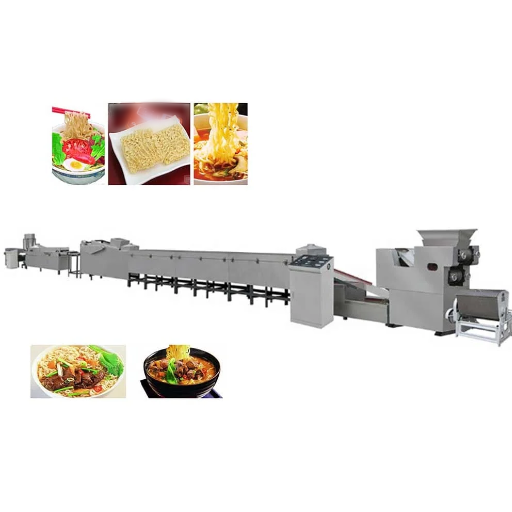
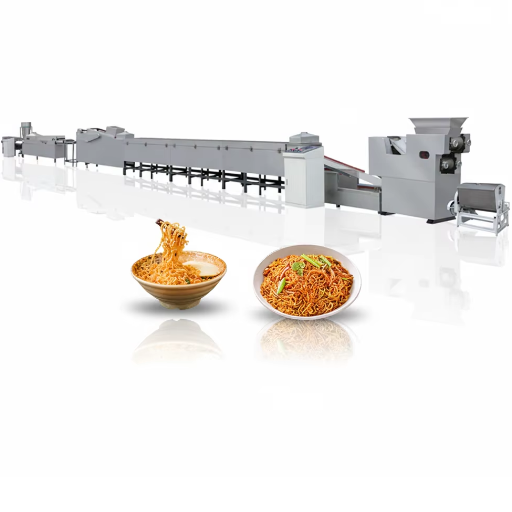
Turnkey line integrators build the whole flow, from extrusion and drying or frying through to packing. This is the group Shandong Loyal Industrial falls into. The integrator’s edge isn’t a faster bagger, it’s single-vendor accountability across the entire line.
Most of these manufacturers cluster in a few Chinese regions. Qingdao and the wider Shandong area dominate noodle and pasta packing. Guangdong, especially Foshan, contributes high-speed horizontal and flow-wrap machines. Zhejiang and Henan round out the field with lower-cost entry units. This matters for two practical reasons: inspections and lead times.
If you are buying from overseas, plan a factory visit or a third-party audit. A supplier an hour from a major port ships spare parts faster than one deep inland. And when you shortlist, ask each candidate the one question that reshapes everything: are you a packaging specialist, or the vendor that also builds my upstream line?
Want a head start on the machine types and costs before you evaluate suppliers? See our automatic noodle packing machine buyer’s guide and the 2026 price and cost guide.
How to Evaluate Noodle Packing Machine Manufacturers: The 8-Point Checklist
Here is the full framework in one view. Each point is expanded below.
- Start with a written user requirement specification, or URS.
- Verify certifications and food-contact materials.
- Demand a witnessed factory acceptance test with your product and film.
- Check the spare-parts strategy and lead times.
- Confirm after-sales service response in writing.
- Validate references with installations that match your noodle format.
- Assess customization and engineering depth.
- Ask the integrated-line question.
Most buyers complete points one through three badly and skip four through eight entirely. That is why the same mistake keeps repeating across the industry: someone buys a machine, not a supplier relationship.
Start with a Written URS
A user requirement specification is a document that says exactly what the machine must do, in measurable terms. It is the single highest-leverage step in supplier selection, because it forces you to decide what “good” means before a salesperson decides for you.
A strong URS covers at least seven things. First, product format: block noodle, strand, broken, wet, or cup, plus the package size and film you will run. Second, sustained speed, not rated speed. A wrapper rated at 230 packs per minute may hold only 130 to 150 packs per minute in real production, once you account for film splices, product variation, and stops. Poemy Machinery puts it bluntly: a 230 PPM wrapper is not a 230 PPM line.
Third, weighing accuracy and acceptable giveaway. Fourth, seasoning sachet count and type if you run instant noodles. Fifth, changeover time between SKUs. Sixth, utilities and footprint. Seventh, the destination market’s standards, which drives certification.
Then ask each supplier for a URS compliance matrix. This is a table where every line of your URS is marked Comply, Comply with deviation, or Non-compliant, each with an explanation. A manufacturer that resists filling one out, or returns it with vague answers, is telling you something useful. Do not pay a deposit until the matrix is signed. The engineering discipline behind the matrix is a stronger predictor of project success than any sales pitch.
Verify Certifications and Materials
Certifications are where supplier claims meet reality, so ask for certificates, not adjectives. The word “CE marked” in a brochure is meaningless until you see the actual declaration and the standard it cites.
Which certifications matter depends on your destination market. CE is required for the European market, and a genuine CE mark should reference the Machinery Directive and relevant safety standards. FDA compliance matters for the United States, mainly around food-contact materials and sanitary design. ISO 9001 signals a working quality system. HACCP or GMP alignment matters if your own plant is audited. Ask for the certificate numbers and verify them.
Materials are the quieter test. On the product-contact parts, the difference between SUS 304 and SUS 316 stainless steel is real. SUS 304 is standard food-grade stainless. SUS 316 adds molybdenum, which improves resistance to the salts and acids common in noodle processing. If a supplier cannot tell you which grade is used on the forming collar and weighing buckets, keep looking.
A manufacturer that is precise about its stainless grades, its weld finishes, and its cleaning access is almost always precise about everything else. That consistency is what you are paying for.
Demand a Witnessed FAT with Your Product and Film
This is where good buyers separate from lucky ones. A factory acceptance test, or FAT, is the moment the machine has to prove it works, and the quality of that test reveals more about the supplier than the machine.
A real FAT runs your product on your film, at sustained speed, with witnesses. It should include at least two hours of continuous running at the agreed rate, not a 30-second burst at maximum. It should test seal integrity, often with dye penetration or vacuum testing rather than a visual glance, as detailed in HIJ Machinery’s supplier-evaluation checklist. It should run an introduced-defect test, deliberately feeding a bad pack or a missing sachet and confirming the machine rejects it.
A real FAT also includes a timed changeover. If your URS requires a format change in under 20 minutes, the supplier should demonstrate it against a stopwatch, not promise it.
One packaging buyer we work with, Priya, learned this the hard way. She approved a machine from a video-call FAT, where the unit ran beautifully for two minutes. It arrived and failed on her actual film, which was a micron thinner than the demo stock. The supplier’s position was simple: it passed the FAT as agreed. Her position, after a six-week delay and a re-tooling bill, was that she had tested the wrong thing.
A video-call FAT proves a machine powers on. A witnessed FAT proves it can do your job. Insist on the second one, and agree the acceptance criteria in writing before the test date.
After the FAT comes site acceptance. Confirm who owns installation, commissioning, and training, and what the SAT criteria are at your facility. The handover should include the FAT report, manuals, electrical and pneumatic drawings, a spare-parts list, and PLC program access. A supplier that withholds the PLC password is a red flag for the life of the machine.
Check Spare Parts, After-Sales, and References
Spare parts and after-sales support decide what your machine costs in year three, not year one.
Split spare parts into five buckets. Consumables and wear parts you replace routinely. Commissioning spares the supplier ships with the machine. Critical stop-production parts that shut the line if they fail. Standard parts you can source locally. Proprietary parts only the supplier makes. For each proprietary part, get the lead time and price in writing.
After-sales is a promise until it is a contract. Ask for a service-level commitment in writing: response time for remote support, remote-access capability, parts dispatch time, and who covers shipping. “Responsive support” in a brochure means nothing. A stated four-hour remote response and 48-hour critical-part dispatch mean something.
Then validate it with references. Ask for installations that match your format. If you pack wet, fresh udon, references for dry instant blocks prove less than you might think. Speak to at least one reference who has run the machine for over a year, and ask about downtime, parts, and whether the supplier showed up when it mattered.
A factory visit or a third-party audit is worth the cost. One afternoon on the shop floor tells you more about build quality and quality control than a month of email.
The Packaging Specialist vs. Integrated-Line Decision
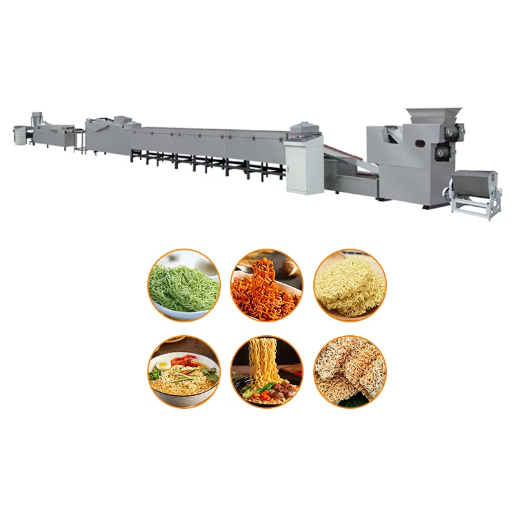
Here is the question most buyers never ask, and it may be the most important one on the list: should this supplier also own my upstream line?
A packaging-only specialist wins in specific situations. If you already have a modern, stable extrusion and drying line, and you need the fastest, most format-focused packing machine available, a specialist is often the right call. They live and breathe packaging.
An integrated-line vendor wins when the risk is integration. Noodle production is a chain: extrusion, then drying or frying, then packing. When packing comes from a different vendor than the upstream equipment, every interface is a place where responsibility blurs. If the weigher mis-feeds because the drying output is inconsistent, the packaging vendor blames the dryer, the dryer vendor blames the weigher, and you sit in the middle.
Miguel, who runs a mid-sized instant noodle plant in Mexico, spent a year in that middle. His extrusion line came from one supplier and his flow-wrap packing from another. Throughput stalled at 82% of target, and every troubleshooting call ended in finger-pointing. He consolidated to a single integrated supplier, and downtime dropped by roughly a third in the first quarter, largely because one team now owned the whole flow and one phone call fixed it.
The decision table below summarizes the trade-off.
| Your situation | Better fit |
|---|---|
| Stable, modern upstream line; want maximum packing speed | Packaging specialist |
| Building or replacing the whole line | Integrated-line vendor |
| Fresh, wet, or vermicelli noodles with tight process coupling | Integrated-line vendor |
| Multiple vendors already in place, frequent integration issues | Integrated-line vendor |
| Single high-volume dry format, packing is the bottleneck | Packaging specialist |
If you are weighing this trade-off, see how one vendor can own the entire noodle flow in our instant noodle production line overview, and how the same logic applies to pasta and macaroni packing.
Red Flags to Walk Away From
Some suppliers disqualify themselves early. Watch for these.
A manufacturer recommends a specific model before asking about your product. A machine that “does everything” for every noodle format usually does none of them well. A quotation with vague scope, where conveyors and weighers are implied but not itemized, is engineered to be lower than the real cost. A supplier that won’t test your product, won’t define FAT criteria, or offers a verbal-only warranty is telling you how the relationship will go.
The common thread is a refusal to be specific. Precision about scope, speed, materials, and acceptance criteria is the difference between a supplier that manages risk and one that transfers it to you.
FAQ
How do I choose a noodle packing machine manufacturer?
Start with a written URS, verify certifications and materials, demand a witnessed FAT with your product and film, check spare parts and after-sales, validate references, and ask whether the supplier can own your whole line. Compare a short list of three to five candidates against the same specification.
What is a factory acceptance test (FAT)?
A factory acceptance test is a structured demonstration, run before shipment, that the machine meets the agreed specification. A credible FAT runs your product and film at sustained speed for at least two hours with witnesses, and includes seal-integrity and reject tests.
What certifications should a noodle packing machine have?
It depends on your market. CE is required for Europe, FDA matters for the United States, and ISO 9001 signals a working quality system. Ask for certificate numbers and verify them, and confirm SUS 304 or 316 stainless on food-contact parts.
Should I buy from a manufacturer or a trading company?
Transparency of responsibility matters more than the label. A genuine manufacturer owns engineering and quality control, while a trading company resells and may not. Ask who designs, builds, and services the machine, and demand a factory visit or third-party audit either way.
Which country makes the best noodle packing machines?
China’s Shandong and Guangdong regions dominate noodle-packing manufacturing, led by dedicated specialists in Qingdao. Taiwan and Japan supply higher-end alternatives. The supplier’s process matters more than the country, so evaluate the manufacturer, not the origin.
Conclusion
Choosing among noodle packing machine manufacturers is a decision you get one clean shot at, and it compounds for years. The eight-point framework protects you: a written URS, verified certifications and materials, a witnessed FAT, a spare-parts strategy, after-sales in writing, matched references, real customization depth, and the integrated-line question.
The mistake to avoid is choosing on speed and price while skipping acceptance testing and support. Daniel’s 9,000″saving”becamea9,000″saving“becamea23,000 overrun. Priya approved a machine from a two-minute video and paid in downtime. Miguel found that one vendor owning the whole line removed the finger-pointing that had capped his throughput for a year.
Write the specification first. Then evaluate the manufacturer, not the machine. If you are weighing a packaging specialist against a vendor that also builds your extrusion and drying line, get in touch with Shandong Loyal for a consultation on a complete noodle production and packing line.