
Pasta Packing Machine: A Buyer’s Guide by Pasta Type

A pasta packing machine isn’t one machine. It’s at least four different systems, and the one you need depends entirely on the shape of pasta you make.
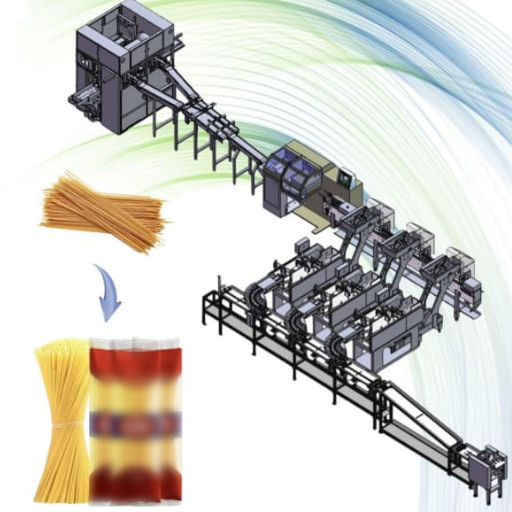
Long-cut pasta like spaghetti runs on a channel-aligning wrapper. Short-cut pasta like penne runs on a multihead weigher feeding a vertical bagger. Fresh pasta runs on tray sealers with modified atmosphere. Bulk pasta runs on big-bag fillers.
Buy the wrong one and you own a machine that can’t run your product at any speed.
That’s the trap. Search for a pasta packing machine and you’ll find hundreds of listings, most of them quoting a speed in bags per minute and a weight range in grams. Almost none of them tell you which pasta shape the machine was actually designed for.
Some listings contradict themselves outright. One spaghetti system advertises US30,000persetforonetofourunitsandUS30,000persetforonetofourunitsandUS10,000 per set for five or more. That’s backwards. Another claims 15 to 40 tonnes per day from a line rated at 25 to 35 bags per minute of 500-gram packs. Do the arithmetic and that claim is off by roughly double.
This guide sorts the market out. You will learn which machine family fits your pasta, how each one works, and the five problems that quietly cost pasta plants money. You will also see why the packing machine has to be specified together with your dryer.
We build pasta production lines through drying and cooling, so we see both sides of that handoff every week.
Key Takeaways
- “Pasta packing machine” describes four different architectures; long-cut, short-cut, fresh, and bulk pasta each need different equipment.
- Long-cut pasta is often dosed by channel volume rather than weighed, so accuracy depends on bulk density, not on a load cell.
- Published speeds run 25 to 35 bags/min for long-cut and up to 80 bags/min for short-cut multihead systems, but sustained output is always lower than nameplate.
- Starch dust in the seal zone is the leading cause of reject bags in dry pasta packing, and almost no one specifies dust extraction.
- Pasta packed warm from the dryer condenses inside the film and molds; cooling is part of the packing specification, not a separate concern.
What Is a Pasta Packing Machine?
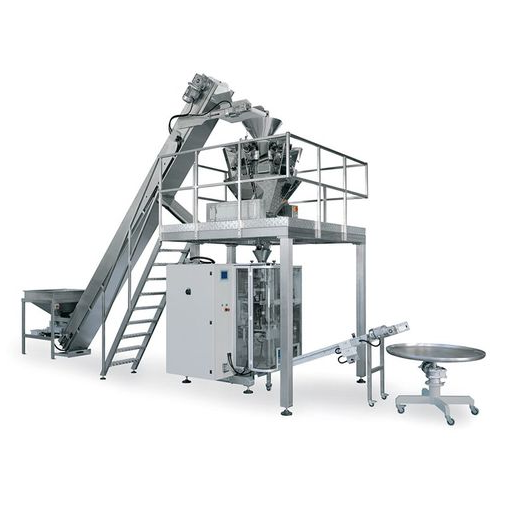
A pasta packing machine, also sold as a pasta packaging machine, portions dry pasta and seals it into retail or bulk packaging. It comes in four families: long-cut systems that align and channel-dose spaghetti, short-cut systems that weigh penne and macaroni, fresh-pasta tray sealers, and bulk big-bag fillers.
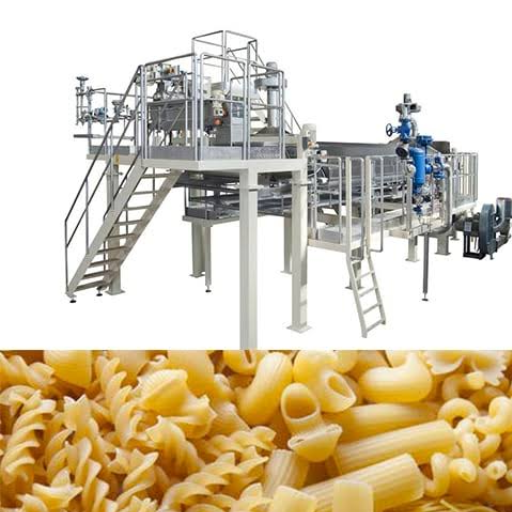
It’s worth being precise about what this equipment is not. A pasta packing machine doesn’t mix dough, extrude shapes, or dry the product. Those happen upstream on the pasta and macaroni production line, and they determine a great deal about how well the packer will perform.
The distinction matters because packaging-only suppliers will quote you a machine without ever asking what temperature your pasta is when it arrives.
The four machine families at a glance
| Pasta type | Machine architecture | Typical speed | Typical pack |
|---|---|---|---|
| Long-cut (spaghetti, linguine, fettuccine) | Channel alignment + volumetric dosing + horizontal or vertical bagger | 25 to 55 bags/min | 400 to 1,000 g pillow or gusset bag, or bundle |
| Short-cut (penne, fusilli, macaroni, shells) | Multihead weigher + VFFS | 30 to 80 bags/min | 250 to 2,500 g pillow, gusset, or doypack |
| Fresh and filled | Tray sealer with modified atmosphere, or flow wrapper | Varies by tray count | 250 to 500 g tray |
| Bulk and industrial | Big-bag or tote filler | Tonnes per hour | 5 to 25 kg bag or tote |
Most searches for a pasta packing machine are really searches for one of the first two rows. If you already know which row you’re in, skip ahead to the specifications section. If you’re not sure, the next section is the one that matters.
Match the Pasta Packaging Machine to Your Pasta Type
The single most expensive mistake in this category is buying a machine rated for the wrong pasta geometry. A long-cut wrapper can’t run penne, and a multihead weigher can’t align spaghetti.
That matters because dry pasta is where the volume sits. Dried pasta accounted for about 75.9% of pasta market revenue in 2025, so most buyers are specifying a dry-pasta line. Within that group, geometry decides the architecture.
Long-cut pasta: alignment and channel dosing
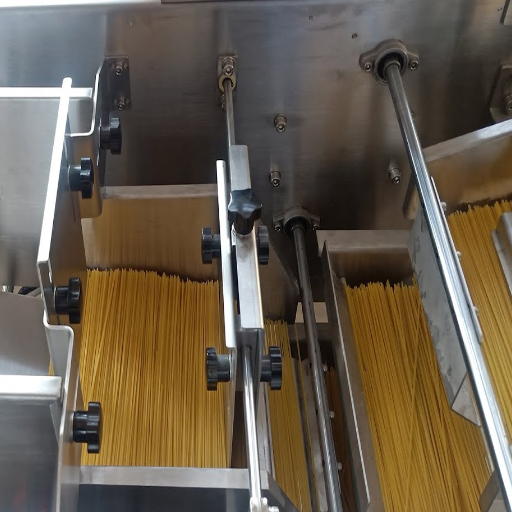
Spaghetti, linguine, fettuccine, and bavette are handled as aligned sticks, not as loose pieces. The machine vibrates the product into V-shaped or U-shaped channels so the strands lie parallel, then discharges a fixed bundle into the bag.
If you are searching for a spaghetti packing machine, this is the family you are in. Most buyers who ask for a long pasta packaging machine mean the same equipment.
Published figures from 2026 supplier listings give a realistic picture of the class. One long-pasta line runs 25 to 35 bags per minute at 400 to 600 grams per bag. It handles pasta 200 to 260 mm long, 0.6 to 1.4 mm thick, and 0.8 to 3.0 mm wide.
A heavier configuration with three weighers reaches 30 to 55 bags per minute at 500 to 1,000 grams. Four weighers push it to 50 to 65 bags per minute.
Notice what is missing from those specifications: pasta length is a hard constraint, and it appears in millimeters. If you make a 300 mm linguine, a machine rated to 260 mm won’t run it, no matter what the weight range says.
This is the specification buyers overlook most often. Weight range feels like the important number. Pasta length is the number that decides whether the machine works at all.
Short-cut pasta: weighing and vertical bagging
Penne, fusilli, macaroni, rigatoni, and shells behave like any other granular product. They fall, they flow, and they can be weighed accurately.
A macaroni packing machine and a short pasta packing machine are the same equipment. The shape changes the tooling, not the architecture.
The standard configuration is a multihead weigher feeding a vertical form-fill-seal machine. A representative 2026 listing pairs a 14-head weigher, each hopper 1.6 liters, with a bagger handling 10 to 2,500 grams at up to 80 bags per minute. It holds a weighing tolerance of ±1.5%.
It runs pillow and gusset bags on BOPP/CPP, BOPP/VMCPP, BOPP/PE, PET/VMPET/PE, and PET/PE film at 0.04 to 0.09 mm. It sells for around US$20,000.
That price is worth pausing on. A short-cut line at US20,000andalong−cutlineatUS20,000andalong−cutlineatUS18,000 to US$200,000 aren’t comparable purchases. They solve different problems for different plants.
Not sure which family fits your product? Send us your pasta dimensions and target output and we’ll tell you which architecture applies, even if the answer is that you need a specialist. Request a line consultation →
Fresh and filled pasta: a different business
Fresh pasta needs refrigeration, gas flushing, and barrier trays. The equipment is a tray sealer running modified atmosphere packaging, typically with a nitrogen and carbon dioxide blend, and it is usually rated in trays per minute rather than bags per minute.
We’re not going to pretend this is our specialty. If you make fresh or filled pasta, you need a tray-sealing specialist, and the rest of this guide will only partly apply. The drying and cooling logic that follows is specific to dry pasta.
Bulk and industrial formats
Above roughly 5 kg, the retail bagger stops being the right tool. Bulk pasta moves in big bags, totes, or lined cartons, filled by weight on a different class of equipment entirely. Some plants run both a retail line and a bulk line off the same dryer, which is worth planning for at the layout stage rather than retrofitting later.
How a Pasta Packing Machine Works
The mechanical sequence differs between the two main families, and understanding it explains most of the failures later in this guide.
Infeed and alignment versus weighing
On a long-cut line, pasta leaves the cooling conveyor and enters a distribution hopper above the channel bed. Vibration and gravity persuade the strands to lie flat and parallel. Poorly aligned sticks cause jams, broken ends, and short weight.
On a short-cut line, pasta drops into the weigher’s distribution cone and spreads across the hoppers. Each hopper weighs independently, and the control system combines hoppers to hit the target weight with the least giveaway.
Dosing: volumetric channels versus load cells
This is the distinction almost no buyer knows to ask about.
Long-cut pasta is frequently dosed by volume, not by weight. A channel of fixed length holds a predictable number of strands, and the machine discharges that volume. Accuracy therefore depends on bulk density, which shifts with shape, moisture content, and how many sticks are broken.
Short-cut pasta is dosed gravimetrically. The weigher measures, so density variation is corrected automatically.
If a supplier tells you their long-pasta machine holds ±2 grams, ask how. A volumetric system can hold tight tolerance only if the product is consistent. A gravimetric system holds it by design. Both answers can be legitimate; they carry different operating requirements.
Bag forming, sealing, and coding
Pillow bags form from roll film around a former. Gusset bags add side folds. Premade pouches skip forming entirely and are picked and filled, which costs more per bag but changes over faster.
The mechanics are shared with other dry goods lines, so if you already run a noodle operation, the automatic noodle packing machine guide covers the same bag-forming platform in more depth.
Sealing is heat and pressure over a dwell time. The three variables interact: raise temperature and you can shorten dwell, but you narrow the window before the film scorches or the seal becomes brittle.
Western OEMs such as PFM build horizontal flow-wrappers around long dwell times for fragile products, and the same principle governs pasta: a gentler, longer seal protects both the film and the product inside it.
Date coding and inspection follow the seal. On a well-specified line, a checkweigher sits after the bagger and rejects out-of-tolerance packs before they reach the case packer.
Dust extraction: the station nobody specifies
Dry pasta sheds fine starch dust at every transfer point. That dust settles on the sealing jaws, and a contaminated jaw produces a channel leak that a visual inspection won’t catch.
Dust extraction at the dosing head is not an optional accessory. It is the difference between a 0.5% reject rate and a 3% one. It also matters for safety, because airborne starch is a recognized combustible dust hazard. In the United States, NFPA 61 sets the relevant design expectations for grain and food processing facilities.
The Five Problems That Actually Cost You Money
Every pasta plant we speak to has at least two of these. None of them appear in a pasta packing machine brochure.
1. Starch dust in the seal
Symptom: bags that look sealed but leak, or that fail a leak test days later. Cause: starch on the jaw face or in the seal area. Fix: extraction at the dosing head, an air knife at the seal zone, static control, and a scheduled jaw cleaning routine.
This is the most common cause of reject bags in dry pasta packing, and it’s almost always blamed on seal temperature first.
2. Breakage in the drop
Long pasta breaks when it falls. Drop height, channel geometry, guide surfaces, and transfer points all contribute, and so does the pasta itself: cracks formed in drying become breaks in packing.
Measure broken-stick percentage at the bagger discharge, not at the end of the line. If breakage is high there, the problem is the packer’s infeed. If it climbs downstream, look at the case packer.
3. Weight giveaway
Set a target of 500 g and fill to 502 g and you’ve given away 2 g on every bag. At 40 bags per minute, 16 hours a day, 300 days a year, that’s 11,520 kg of pasta per year at 1 g of average overfill. At 2 g it doubles.
Value that at almost any finished-product price and the number runs into five figures annually. It is usually larger than the price gap between a good weigher and a cheap one, which is why giveaway belongs in the pasta packing machine specification rather than the finance review.
4. Condensation and mold
Pasta packed warm traps moisture. That moisture condenses on the inside of the film as the bag cools, and the result is mold, clumping, and a shelf-life claim you can’t support. The fix is upstream: cool the pasta properly before it reaches the bagger. More on that in the next section.
5. Changeover time
Switching from 500 g to 1 kg, or from pillow to gusset, costs production time. On a former-style bagger, a format change can take 30 to 90 minutes. Multiply that by the number of formats you run and the number of changes per week and it becomes a real capacity constraint.
Ask a supplier for a witnessed changeover during the factory acceptance test. Not a demonstration. An actual timed changeover with the tools the operator will really have.
Quick reference: symptom, cause, fix
| Symptom | Most likely cause | First fix |
|---|---|---|
| Bags leak days after packing | Starch dust in the seal zone | Dust extraction, air knife, jaw cleaning schedule |
| High broken-stick percentage | Drop height or channel geometry | Review infeed design, not the bagger |
| Weight drifting above target | Volumetric dosing with variable bulk density | Move to gravimetric, or tighten moisture control |
| Mold or clumping in the bag | Pasta packed warm | Extend cooling before the bagger |
| Long format-change downtime | Little or no tooling standardization | Timed changeover at FAT, quick-release tooling |
Why the Packer Has to Be Specified With the Dryer
Here is the part that packaging-only suppliers can’t tell you, because they never see it.
Dry pasta leaves the drying stage warm. It has to be cooled close to ambient before it can be bagged, and how well that cooling is designed determines three things downstream: how much the pasta breaks, whether condensation forms in the bag, and how stable the bulk density is when it reaches a volumetric doser. None of that appears on a pasta packing machine datasheet.
Loyal’s pasta line handles that handoff explicitly. Short-cut pasta runs across vibrating pre-dryers. Long-cut pasta hangs on racks. Both finish in multi-layer drying tunnels before the cooling and packing stage.
The line runs 100 to 600 kg per hour across four models, from the LY-100 at 100 to 150 kg/h to the LY-500 at 500 to 600 kg/h. Vacuum extrusion holds between −0.08 and −0.09 MPa.
That vacuum stage is relevant here for a reason buyers don’t expect. Extruding under vacuum removes air from the dough, which produces a denser, more uniform product with fewer internal cracks. Fewer cracks means less breakage when the pasta later falls into a bag. The benefit shows up in the packing reject rate two process stages later.
If you are buying a packer for an existing line, ask your dryer supplier for the exit temperature and moisture range at the cooling discharge. Then give those numbers to the packing machine supplier and require them to confirm the machine is specified for that product condition. A supplier who can’t answer that question hasn’t thought about your plant.
Building a new line or replacing a packing stage? We can review the dryer-to-packer handoff and tell you where the specification is likely to break. See how we configure a pasta line →
When a specialist packer is the better choice
We should be honest about the limits of the integrated-line argument. A line vendor isn’t automatically the best source for a packing machine.
Choose a specialist packer when your format is unusual, when you need a packaging innovation the line vendor doesn’t build, or when you’re packing a product the line vendor has never run. Choose the integrated route when the packing stage is standard for your product and you want one party accountable for the handoff.
| Factor | Integrated line vendor | Packaging specialist |
|---|---|---|
| Accountability for dryer-to-packer handoff | Single point | Split between two suppliers |
| Depth in one packing format | Broad, not deep | Deep |
| Unusual or novel formats | Limited | Strong |
| Line commissioning and ramp-up | Coordinated | Requires your project management |
| Spare parts logistics | One supplier | Multiple |
Pasta Packing Machine Specifications That Matter
When you compare quotes, put these on a single sheet. Suppliers rarely volunteer them in comparable form.
| Specification | Why it matters |
|---|---|
| Pasta dimensions (length, thickness, width) | Hard constraint for long-cut; a 20 mm miss can require a new bag former |
| Dosing method (volumetric or gravimetric) | Determines whether accuracy survives a product change |
| Weight range and tolerance | Drives giveaway cost; ask for tolerance at your target weight, not across the full range |
| Bag formats supported | Every format is a changeover and a set of tooling |
| Film structures accepted | Paper and mono-material need different jaw and tension settings |
| Speed at your product and pack size | Not the brochure maximum |
| Dust extraction provision | Determines reject rate |
| Control platform and servo count | Affects changeover speed and spare-part availability |
| Hygiene rating and materials | SUS 304 minimum; 316 in wet or salty areas |
| Certification and documentation | CE, ISO 9001, and food-contact compliance for your market |
How to check a supplier’s speed claim
Take the quoted bags per minute, multiply by grams per bag, then by 60 minutes and by your real operating hours. Compare the result to any tonnage claim on the same page. This works for any automatic pasta packing machine, whatever the vendor calls it.
A line rated 30 bags per minute at 500 g, running 16 hours, produces 14.4 tonnes per day. If the same page claims 15 to 40 tonnes per day, one of the two numbers is wrong. In our experience it’s the tonnage claim.
Then apply a reality factor. Sustained output typically lands well below nameplate once changeovers, stops, film splices, and cleaning are counted. Ask what sustained output the supplier will guarantee in writing, and make that the number in your acceptance criteria.
Film and the shift to paper
Film choice is no longer a purely technical decision. Brand owners are moving toward recyclable and paper-based packaging, and the shift changes machine settings.
Barilla reports that 99.7% of its global packaging is designed for recycling, and that roughly 71% of its packaging is paper or cardboard, with all packs sold in Italy designed to be recyclable. That is the direction the category is moving.
Paper laminates run differently from plastic. They tear more readily, they are less forgiving of jaw temperature variation, and they typically reduce line speed. If paper is on your three-year roadmap, specify a machine that can run it now, or at minimum confirm the jaws and film path can be converted.
Hygiene, dust, and compliance
Food-contact surfaces should be SUS 304 at minimum, with 316 in wet or salty areas. Electrical enclosures need an IP rating matched to your washdown practice. For export markets, confirm CE marking and the food-contact documentation your destination requires.
Dust handling deserves a line in the specification, not a footnote. Extraction capacity, filter type, and the disposal route all need to be agreed before the machine ships.
Pasta Packing Machine Price and Total Cost of Ownership
Published 2026 figures for pasta packing equipment range from roughly US7,000forabasicshort−cutverticalbaggertooverUS7,000forabasicshort−cutverticalbaggertooverUS200,000 for a long-cut line with multiple weighers. The wide spread reflects architecture, not quality.
| Configuration | Published price band (FOB, 2026) |
|---|---|
| Short-cut VFFS, basic | US7,000toUS7,000toUS25,000 |
| Short-cut multihead weigher + VFFS | Around US$20,000 |
| Long-cut line, single weigher | US18,000toUS18,000toUS200,000 |
| Long-cut line, three to four weighers | Quoted per project |
Treat every one of those figures as a starting point for a conversation, not a budget. The same machine quoted with and without conveyors, installation, and spares can differ by tens of thousands.
Four cost lines get left out of budgets repeatedly:
- Film. Consumable, continuous, and sensitive to both format and material choice.
- Spares. A proprietary sensor that ships in eight weeks is a production risk, not a line item.
- Changeover downtime. Multiply changeover minutes by changes per week by your contribution margin per hour.
- Commissioning. Installation, training, and the ramp-up period before the line hits rated output.
For a worked total-cost-of-ownership model with payback math, the noodle packing machine price breakdown applies the same method to a closely related product. The arithmetic transfers directly.
How to Choose a Pasta Packing Machine (8-Point Checklist)
- Write the user requirement specification first. Pasta dimensions, pack sizes, film types, output target, and operating hours. Everything else is measured against this document.
- Confirm the architecture fits your pasta. Long-cut needs alignment and channel dosing; short-cut needs a weigher. Do not let a supplier talk you into the wrong family.
- Set the output target as sustained, not nameplate. Derive it from your real annual volume and shift pattern.
- Agree the dosing method and its tolerance. Volumetric and gravimetric systems fail differently.
- Specify dust extraction explicitly. Capacity, filter type, and disposal route.
- Check certifications and food-contact documentation against your destination market.
- Demand a witnessed factory acceptance test running your product and your film for at least two hours at sustained speed, including a timed changeover and an introduced-defect reject test.
- Agree spares, service response, and training in the contract. Not in an email after the order.
Point seven is where most buyers gain the most. A two-hour run on your own product exposes alignment problems, dust behavior, and seal issues that a 30-second demonstration hides. The same discipline is set out in more detail in our guide to evaluating a packing machine manufacturer.
Conclusion
A pasta packing machine is a specification decision before it is a purchasing decision. Get the architecture right for your pasta geometry, and the rest of the buying process becomes ordinary. Get it wrong, and no amount of negotiation recovers the investment.
Five things to carry into your next supplier conversation:
- Long-cut and short-cut pasta need different machine families, and pasta length is a hard constraint on the long-cut side.
- Volumetric channel dosing and gravimetric weighing aren’t interchangeable; ask which one you are being quoted.
- Starch dust in the seal zone drives your reject rate, and dust extraction belongs in the specification.
- Pasta must be cooled to near ambient before bagging, which makes the dryer part of the packing decision.
- Sustained output, not nameplate speed, is the number to contract against.
The most useful next step is usually a written specification and a witnessed test on your own product. If you’re still working out where the packing stage fits into your line, start with the pasta and macaroni production line overview.
Then talk to us about the handoff. We’d rather tell you that you need a specialist than sell you the wrong machine.
Frequently Asked Questions
Can one pasta packing machine handle both long and short pasta?
Generally no. Long-cut pasta requires alignment channels and volumetric dosing; short-cut pasta requires a multihead weigher and a vertical bagger. A few flexible platforms claim both, but changeover between families is lengthy and the compromise usually shows in accuracy or speed.
How many bags per minute should I expect for 500 g packs?
Long-cut lines typically publish 25 to 55 bags per minute and short-cut multihead systems up to 80. Expect sustained output well below those figures once changeovers, stops, and cleaning are counted, and ask the supplier to guarantee a sustained number in writing.
Do I need a weigher or a volumetric doser?
Short-cut pasta is normally weighed. Long-cut pasta is often dosed by channel volume, which makes accuracy dependent on bulk density. If your product dimensions or moisture vary, a gravimetric system is easier to hold in tolerance.
Why are my bag seals failing?
Check starch dust on the sealing jaws before you touch the temperature. Contamination in the seal zone produces channel leaks that look like temperature faults. Dust extraction, an air knife, and a jaw cleaning schedule solve most of them.
What does a pasta packing machine cost?
Published 2026 figures run from roughly US7,000forabasicshort−cutverticalbaggertooverUS7,000forabasicshort−cutverticalbaggertooverUS200,000 for a long-cut line with multiple weighers. Budget for film, spares, changeover downtime, and commissioning on top of the machine price.
Why does my pasta clump or mold in the bag?
Almost always because it was packed too warm. Pasta leaving the dryer must be cooled close to ambient before bagging, or moisture condenses on the inside of the film as the bag cools.