
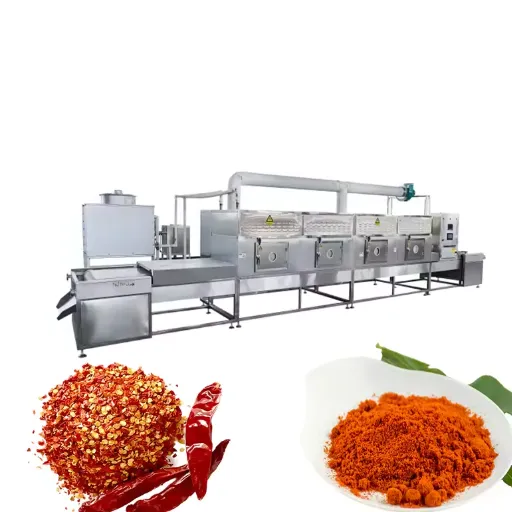
Spice Powder Microwave Sterilization: Process and Equipment Guide

Spice powder microwave sterilization is the fastest chemical-free method for eliminating pathogens while preserving volatile oils and natural color. It uses electromagnetic energy to heat spices internally, achieving microbial reduction in 3 to 5 minutes without the moisture addition that causes caking in steam systems.
The challenge most spice processors face is harder than it looks. You need to kill Salmonella, E. coli, and mold spores. But every solution creates a new problem.
Steam adds moisture. Fine powders turn into clumps. Ethylene oxide works at low temperatures, yet the EU banned it for food use. Residue detections have triggered mass recalls across Europe. Irradiation is effective, but consumers resist products bearing that label.
Microwave sterilization sits in the practical middle. It is fast enough for continuous production. It is gentle enough for heat-sensitive compounds. And it is clean enough for organic certification.
In this guide, you will learn how microwave sterilization works specifically for spice powders, how it compares to alternative methods, the exact process parameters for major commercial spices, and how to select equipment that matches your production targets.
Key Takeaways
- Microwave sterilization achieves effective microbial reduction in 3–5 minutes at 70–90°C, preserving volatile oils better than steam methods that can degrade them by 15–30%.
- The EU ban on ethylene oxide and consumer resistance to irradiation are pushing spice processors toward microwave as the preferred chemical-free, non-thermal alternative.
- Optimal process parameters vary by spice: chili powder at 75–85°C for 3–5 minutes, turmeric at 70–80°C for 3–4 minutes, black pepper at 80–90°C for 4–6 minutes.
- Pre-sterilization moisture content of 8–12% is ideal for microwave absorption; very dry powders below 5% may need light conditioning.
- Tunnel microwave systems range from 12 kW to 300 kW, with throughput scaling from roughly 100 kg/h to over 2,000 kg/h depending on power and spice bulk density.
Why Spice Powder Sterilization Matters
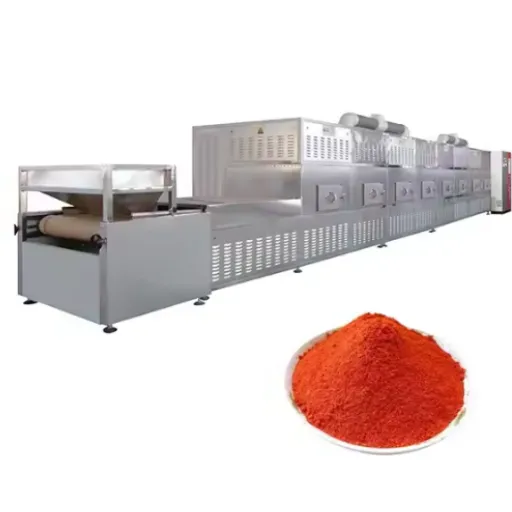
Microbial Risks in Spice Production
Spices carry a microbial load that surprises many buyers. The FDA has identified spices as one of the higher-risk food categories for Salmonella contamination, with detection rates in imported shipments running higher than many other dry ingredients. Black pepper, cumin, turmeric, and curry powder have all triggered Class I recalls in recent years. The problem starts at origin. Spices are often sun-dried on open ground, exposed to animal contact, and stored in conditions where mold and bacterial spores multiply freely.
Pathogens survive well in low-moisture environments. Salmonella can persist in dried spices for months. Mold spores, including aflatoxin-producing Aspergillus flavus, are common in chili and pepper powders from humid growing regions. Without a validated kill step between grinding and packaging, contaminated powder reaches manufacturers, retailers, and ultimately consumers.
Quality Challenges in Spice Sterilization
The sterilization step itself creates a second problem. Heat destroys microbes. But heat also destroys the very compounds that give spices their value.
Volatile oils are the first casualty. These molecules make cumin smell like cumin. They make black pepper taste pungent. Steam sterilization exposes spices to saturated vapor at 102–122°C. Studies show that steam treatment reduces volatile oil content by 15–30%. The loss depends on exposure time and temperature. For a premium spice processor selling on aroma intensity, that loss means downgraded product and lower pricing.
Color degrades next. Chlorophyll-based green herbs brown under heat. Carotenoids in red peppers and paprika fade. Turmeric’s vibrant yellow, driven by curcumin, is sensitive to prolonged thermal exposure. The result is a powder that is safe to eat but visually unappealing.
Moisture creates a third issue. Steam sterilization adds water vapor to the product. Fine powders above 12–14% moisture content begin to cake, flow poorly through packaging equipment, and provide a substrate for mold regrowth if not dried back down immediately. Many processors end up running a separate drying step after steam treatment, adding energy cost and processing time.
Regulatory and Market Pressures
The regulatory landscape is shifting fast. The European Union banned ethylene oxide for food sterilization in 1991, yet residue detections in imported spices triggered a wave of recalls starting in 2020 that affected over 1,000 products across the bloc. The EU’s Rapid Alert System for Food and Feed (RASFF) continues to flag EtO residues in sesame seeds, turmeric, and spice blends from multiple origins.
In the United States, the FDA Food Safety Modernization Act (FSMA) requires preventive controls for hazards in food manufacturing. Spice processors must implement validated kill steps or face inspection findings, import alerts, and mandatory product detention. The FDA’s spice risk profile specifically calls out Salmonella as the pathogen of concern and recommends validated sterilization processes.
Consumer preferences add another layer. Clean-label demand continues to grow. Organic certification prohibits both ethylene oxide and irradiation. Buyers want spices that are safe, natural, and minimally processed. Microwave sterilization fits this profile. It uses no chemicals, leaves no residues, and operates at lower temperatures than steam.
Want to see how industrial microwave systems fit into a complete food production line? Explore our food equipment solutions to view integrated processing configurations.
How Spice Powder Microwave Sterilization Works
Dielectric Heating in Low-Moisture Powders
Industrial microwave sterilizers operate at 2450 MHz. This is the standard frequency for food processing. The electromagnetic field penetrates the spice powder and excites polar molecules, primarily water. These molecules rotate and vibrate rapidly. The friction generates heat directly inside the material. Heat does not travel from the outside in.
The mechanism is called dielectric heating. Another name is volumetric heating. Unlike a conventional oven, hot air does not warm the surface first. Microwaves energize the entire mass at once. The center of a powder layer heats at nearly the same rate as the surface. Temperature gradients are smaller. Hot spots are reduced. Scorching is less likely.
Spices with residual moisture content in the 8–12% range absorb microwave energy efficiently. Water is a strong microwave absorber. Very dry powders below 5% moisture absorb less energy and heat more slowly. In practice, most spice powders exiting grinding and sifting operations carry enough residual moisture for effective processing without pre-conditioning.
Thermal and Non-Thermal Microbial Effects
Sterilization occurs through two simultaneous mechanisms. The thermal effect is straightforward. As the powder temperature rises, microbial proteins denature, cell membranes rupture, and enzymatic function ceases. Most spice powders reach target temperatures of 70–90°C within the first minute of microwave exposure, well above the thermal death point for vegetative bacterial cells.
The non-thermal effect is specific to electromagnetic fields. The oscillating electric field disrupts microbial cell membranes. It interferes with cellular signaling. Research shows that this electromagnetic disruption boosts kill rates beyond what temperature alone achieves. The combined effect allows microwave sterilization to hit validated reductions at lower temperatures than pure conductive heating requires.
For spice processors, this dual mechanism matters because it means effective sterilization without the high temperatures that degrade volatile oils. A steam system might need 10–15 minutes at 110°C to guarantee a 5-log reduction. A microwave system can achieve comparable results in 3–5 minutes at 75–90°C.
Simultaneous Drying and Sterilization
One of the operational advantages of microwave processing is that sterilization and drying happen in the same step. As the electromagnetic field heats the product, moisture evaporates from the surface. The continuous tunnel design moves powder through a heated cavity followed by a cooling section. By the time powder exits the system, moisture has dropped to a shelf-stable level, typically 6–8% for most ground spices.
This consolidation eliminates a separate drying step. Steam sterilization almost always requires post-treatment drying because it adds moisture to the product. Microwave adds no moisture. It removes what is already there. The energy savings from eliminating a drying stage, combined with faster overall processing, are significant drivers for processors evaluating equipment upgrades.
Microwave vs. Other Spice Sterilization Methods
Choosing a sterilization method is not about finding the perfect technology. It is about matching technology to product, market, and regulatory constraints. Each method has strengths and limitations.
| Method | Temperature | Time | Moisture Impact | Volatile Oil Retention | Regulatory Status | Consumer Acceptance |
|---|---|---|---|---|---|---|
| Microwave | 70–90°C | 3–5 min | None (dries) | High (95%+) | Widely accepted | High (no labeling) |
| Steam (HTST) | 102–122°C | 20–40 sec | Adds moisture | Moderate (70–85%) | Widely accepted | High |
| Ethylene Oxide | 20–50°C | 4–12 hr | None | Very high | Banned in EU | Very low |
| Irradiation | Ambient | Minutes | None | High | Restricted/labelled | Low |
Steam Sterilization
Steam is the most widely validated method in the spice industry. High-temperature short-time (HTST) systems expose product to saturated steam for 20–40 seconds, achieving a validated 5-log reduction of Salmonella. The technology is mature, accepted by regulators globally, and well understood by quality assurance teams.
The downside for powders is moisture. Steam condenses on the product surface, raising moisture content. Fine powders cake. Volatile oils suffer heat degradation. Many processors install fluidized bed dryers after steam treatment to bring moisture back down, adding capital cost, floor space, and energy consumption to the line.
Ethylene Oxide
Ethylene oxide gas penetrates deeply at low temperatures, making it effective for whole spices and seeds with minimal quality loss. Historically, it was the method of choice for heat-sensitive products. But EtO is classified as a human carcinogen. The EU banned it for food use decades ago. Major retailers in North America and Europe now test incoming spice shipments for EtO residues, and detections trigger rejections and recalls.
For spice exporters targeting global markets, EtO is increasingly a liability rather than an asset. The regulatory trajectory is clear. More restrictions, not fewer, are coming.
Irradiation
Gamma and electron-beam irradiation destroy microbial DNA without relying on heat. Efficacy is excellent, including against spores. Quality impact is generally low for most spices, though some studies have noted volatile compound changes in specific products like onion powder.
The barrier is commercial. Many countries require irradiated foods to carry a label. Consumers resist these products. Organic certification prohibits irradiation entirely. For natural, organic, or premium markets, irradiation is not viable.
Where Microwave Fits
Microwave sterilization occupies a unique position. It is chemical-free like steam, but without the moisture addition. It is low-temperature like EtO, but without the carcinogenic residue concerns. It requires no special labeling like irradiation.
For spice powders, this combination is compelling. Fast processing. Minimal quality loss. Clean-label compliance.
There is an honest limitation. Microwave processing requires more precise parameter control than steam. Power density, belt speed, layer thickness, and initial moisture content all influence heating uniformity. A well-designed system with PLC feedback control addresses these variables. A poorly configured system risks uneven treatment.
Curious about how microwave sterilization stacks up against retort systems across all food categories? Read our detailed microwave sterilization vs retort sterilization comparison for engineering data and decision frameworks.
Process Parameters for Major Spice Powders
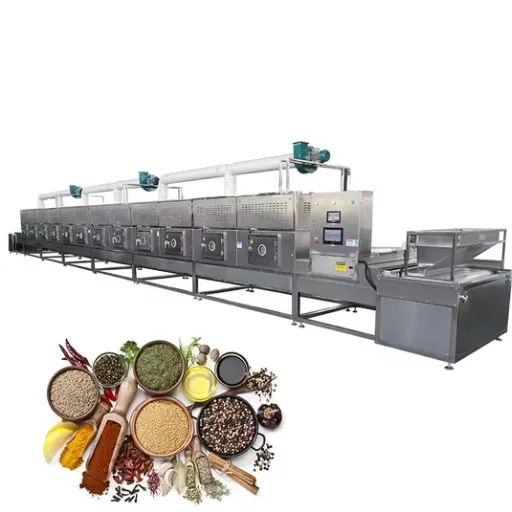
There is no single setting that works for every spice. Bulk density, oil content, particle size, and initial moisture all influence how a powder heats in a microwave field. The following parameters are starting points based on industrial tunnel microwave systems operating at 2450 MHz. Processors should validate final settings with microbial challenge studies for their specific products.
Chili Powder and Paprika
Chili powders and paprika are high-value products where color and heat level define commercial grade. The capsaicinoids that provide pungency and the carotenoids that provide red color are both heat-sensitive.
- Temperature range: 75–85°C
- Dwell time: 3–5 minutes
- Power density: Moderate to avoid surface scorching
- Quality targets: Maintain capsaicin retention above 95%, minimize browning
The relatively fine particle size of ground chili promotes uniform heating, which is an advantage. The risk is overheating the surface layer if belt loading is too thick or power is too high. A layer depth of 2–3 cm on the conveyor belt is typical for chili powder applications.
Turmeric Powder
Turmeric’s commercial value depends heavily on curcumin content and bright yellow color. Curcumin degrades under prolonged heat exposure. The good news is that turmeric powder heats relatively uniformly due to its fine texture.
- Temperature range: 70–80°C
- Dwell time: 3–4 minutes
- Power density: Moderate
- Quality targets: Minimize curcumin degradation, prevent browning at edges
Turmeric also benefits from microwave’s drying capability. Freshly ground turmeric often exits milling at 10–14% moisture. Microwave treatment brings this down to 6–8% while sterilizing, extending shelf life.
Cumin and Coriander Powder
These seeds contain high levels of volatile oils that define their aroma profiles. Cumin aldehyde in cumin and linalool in coriander are the primary markers. Steam sterilization can reduce these compounds measurably. Microwave processing at lower temperatures preserves them better.
- Temperature range: 75–85°C
- Dwell time: 3–5 minutes
- Quality targets: Preserve volatile oil profile, maintain free-flowing powder texture
Cumin powder has a lower bulk density than chili, meaning it occupies more volume per kilogram on the conveyor belt. Belt width and speed calculations need to account for this difference.
Black Pepper Powder
Black pepper presents a unique challenge. The piperine that provides pungency is relatively stable, but the complex volatile oil profile that gives pepper its aroma is not. Whole peppercorns are dense and require longer exposure. Ground pepper heats more quickly due to increased surface area.
- Temperature range: 80–90°C
- Dwell time: 4–6 minutes for whole peppercorns; 3–4 minutes for ground powder
- Quality targets: Maintain piperine content, preserve volatile oil balance
For whole peppercorn sterilization, some processors use a two-stage approach: a brief microwave pre-heating followed by a conditioning hold to allow heat penetration to the center of the kernel.
Mixed Seasonings and Curry Powder
Curry powder and mixed seasonings are blends with variable component densities. Some ingredients heat faster than others. Coriander may reach target temperature before fenugreek. This heterogeneity requires careful parameter selection, often favoring longer dwell times at moderate temperatures to avoid overheating the faster-heating components.
- Temperature range: 75–85°C
- Dwell time: 4–5 minutes
- Approach: Moderate power, longer time to balance component heating rates
Ready to explore equipment configurations for your specific spice products? Contact our engineering team for a customized microwave sterilization assessment including throughput calculations and power recommendations.
Equipment Selection for Spice Powder Sterilization
Tunnel vs. Batch Microwave Systems
The first decision is production mode. Tunnel microwave dryers for spices use a continuous conveyor belt that moves product through a microwave cavity. They are designed for high-volume commercial operations running the same or similar products for extended campaigns. Batch systems use a rotating tray or chamber that processes a fixed quantity per cycle. They suit R&D, specialty blends, and low-volume production.
For spice processors producing 500 kg or more per day, a tunnel microwave dryer for spices is the standard configuration. Throughput scales with power. A 30 kW tunnel system processing chili powder at standard layer thickness can handle approximately 150–200 kg per hour. A 100 kW system can exceed 600 kg per hour.
Power Rating and Throughput Matching
Industrial microwave sterilizers for spices range from 12 kW entry-level units to 300 kW high-capacity lines. Power selection depends on three variables: target throughput, product bulk density, and required temperature rise.
A useful rule of thumb for spice powders is that each kilowatt of microwave power can process roughly 5–8 kg of product per hour for a standard sterilization application. This assumes typical starting moisture, moderate temperature targets, and reasonable belt loading. Denser products or higher moisture targets require more energy per kilogram.
Belt and Cavity Design for Powders
Fine powders require specific belt and cavity features. The conveyor belt is typically PTFE-coated fiberglass, non-stick and microwave-transparent. Belt width ranges from 400 mm on smaller units to 1,200 mm on industrial lines. Wider belts enable higher throughput but require more uniform microwave field distribution across the width.
Some systems incorporate belt vibration or gentle stirring mechanisms to redistribute powder during transit, preventing channeling and ensuring that all particles receive equivalent exposure. This is particularly valuable for powders with a tendency to compact or stratify.
Control and Monitoring Systems
Modern systems use PLC-based control with touchscreen interfaces. Critical parameters, belt speed, microwave power level, cavity temperature, and cooling section airflow, are all adjustable and logged. Infrared temperature sensors monitor product surface temperature in real time. Feedback loops can adjust power or belt speed automatically if temperature deviates from the setpoint.
For spice processors, this level of control is essential. Different spices require different profiles. A system that can store and recall recipes by product name simplifies changeovers and reduces operator error.
Integrating Microwave Sterilization into Spice Production Lines
Typical Production Line Flow
A complete spice processing line moves from raw material through finished packaged product in a logical sequence:
- Receiving and cleaning: Remove foreign matter, stones, and metal
- Drying (if needed): Reduce whole spice moisture before grinding
- Grinding: Mill to target particle size
- Sifting: Separate fines and ensure uniform particle distribution
- Microwave sterilization: Kill step with simultaneous moisture reduction
- Cooling: Bring product to ambient temperature before packaging
- Packaging: Fill into bags, jars, or bulk containers under hygienic conditions
This same workflow applies to food powder microwave sterilization for nutraceuticals, protein powders, and baking ingredients.
The sterilization step sits between size reduction and packaging. This positioning is deliberate. Grinding introduces heat and can redistribute surface contamination into the interior of particles. Sterilizing after grinding treats the final product form.
Pre-Sterilization Preparation
Grinding consistency matters for microwave uniformity. A wide particle size distribution means some particles heat faster than others. Sifting to a narrow size band before sterilization improves heating consistency and reduces the risk of scorching fines while under-treating coarse particles.
Pre-sterilization moisture should ideally fall in the 8–12% range. Below 8%, microwave absorption drops and heating slows. Above 12%, the risk of caking increases and more energy is required to drive off excess moisture. Most properly dried and ground spices fall naturally into this range.
Post-Sterilization Handling
Product exits the microwave cavity warm, typically 60–80°C depending on the target setpoint. A cooling section, using ambient or chilled air, brings temperature down before packaging. This prevents condensation inside packaging, which would reintroduce moisture and create conditions for mold growth.
Packaging material compatibility is straightforward for microwave-sterilized product. Because the powder is treated loose and then cooled, standard spice packaging materials, multi-layer laminates, polypropylene, and polyethylene, are all suitable. There is no requirement for microwave-transparent packaging because the sterilization happens before filling.
Quality Preservation and Validation
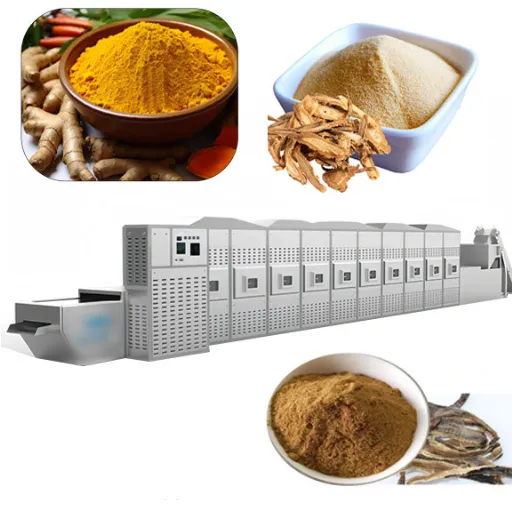
Preserving Essential Oils and Volatile Compounds
The business case for microwave sterilization of spices rests heavily on quality preservation. Volatile oils are the primary differentiator between premium and commodity grades. Gas chromatography analysis of microwave-treated cumin powder shows volatile oil retention above 95% when processed at 80°C for 4 minutes. Comparable steam-treated samples at 110°C show retention in the 70–85% range depending on exposure time.
For spice processors selling into flavor-sensitive markets, this difference matters. Pharmaceutical manufacturers, premium foodservice suppliers, and ethnic food producers all demand maximum aroma intensity. Better volatile oil retention can justify the investment in a microwave spice sterilizer before even counting energy savings.
Color and Appearance Stability
Color stability follows a similar pattern. Microwave’s shorter time-at-temperature minimizes Maillard browning and pigment degradation. Paprika processed by microwave at 80°C for 4 minutes maintains ASTM color values within 5% of pre-treatment baselines. Steam treatment at 110°C for 15 minutes can shift color values by 10–20%, moving product from premium to standard grade.
Microbial Validation Approaches
Validation is not optional. Food safety regulations require documented evidence that the sterilization process achieves the claimed microbial reduction. For spice powders, the standard target is a 5-log reduction of Salmonella, the most heat-resistant vegetative pathogen of concern in dry spices.
Validation typically involves three components. First, temperature mapping across the belt width and along the tunnel length to identify cold spots. Second, biological indicator studies using non-pathogenic surrogate organisms with known heat resistance profiles. Third, ongoing verification testing of production lots for total plate count, yeast and mold, and coliforms.
Microwave sterilization validation follows the same principles as thermal validation but requires attention to electromagnetic field uniformity in addition to temperature. A well-designed system with multiple magnetrons and mode stirrers provides field distribution that minimizes cold spots.
Common Challenges and Solutions
Uneven Heating in Fine Powders
Fine powders can develop temperature gradients if belt loading is uneven or if microwave field distribution is poor. The result is some portions overheating while others remain undertreated.
Solution: Maintain consistent layer thickness across the belt. Use systems with multiple magnetron feeds and mode stirrers to distribute energy evenly. Consider belt vibration for powders that tend to compact. Validate with temperature mapping across the full belt width.
Caking and Clumping
Any moisture migration during heating can cause fine particles to adhere. This is more common with powders that have high initial moisture or high natural oil content.
Solution: Control initial moisture before sterilization. Ensure adequate cooling after treatment to prevent post-process condensation. For very oily spices, a slightly thinner belt layer allows faster moisture release without trapping steam in the powder mass.
Overheating and Scorching
Excessive power density or slow belt speed can drive surface temperatures above the target range, causing browning or burning at the edges of the powder bed.
Solution: Start with conservative power settings and optimize upward based on temperature feedback. Use infrared sensors to monitor surface temperature in real time. Program automatic power reduction if temperature exceeds the set threshold.
Microwave Leakage and Safety
Industrial microwave systems are designed with interlocked doors, choke seals, and monitoring systems to prevent electromagnetic leakage. Regulatory limits typically specify maximum leakage of 2 mW per square centimeter at 5 centimeters from any surface.
Solution: Include leakage testing in the preventive maintenance schedule. Inspect door seals quarterly. Train operators to never bypass safety interlocks. Modern systems include automatic shutoff if door sensors detect an opening during operation.
Conclusion
Spice powder sterilization sits at the intersection of food safety, product quality, and regulatory compliance. The wrong method destroys the volatile oils and vibrant colors that define your product’s value. The right method eliminates pathogens while preserving what makes spices worth buying.
Spice powder microwave sterilization offers a practical path forward for processors who need chemical-free, fast, and quality-preserving treatment. It eliminates the moisture addition that causes caking in steam systems. It avoids the regulatory and consumer acceptance problems of ethylene oxide and irradiation. And it processes continuously at throughputs that match commercial production demands.
The key is matching equipment and parameters to your specific products. Chili powder does not behave like turmeric. Whole peppercorns do not heat like ground cumin. A system configured for one spice without adjustment will underperform for another.
At Shandong Loyal Industrial Co., Ltd., we design industrial spice sterilization equipment for processors worldwide. Our tunnel microwave systems range from 12 kW pilot units to 300 kW production lines. Every system includes PLC controls, customizable belt configurations, and recipe storage for multiple products.
Are you replacing an EtO system to meet EU requirements? We can help. Are you adding a kill step to a new line? We can configure that. Are you upgrading from batch steam to continuous microwave? We have done this for processors across Asia, Europe, and the Americas.
Request a Quote for Your Spice Sterilization Line →
Frequently Asked Questions
What is the best method to sterilize spice powder?
The best method depends on your product, market, and regulatory requirements. Microwave sterilization is increasingly preferred for spice powders because it kills pathogens in 3–5 minutes without adding moisture, preserving volatile oils and color better than steam. It is also chemical-free, making it compliant with organic certification and clean-label demands. Steam remains the most widely validated method but requires post-drying and can degrade quality. Ethylene oxide faces regulatory bans. Irradiation requires labeling that consumers often reject.
How does spice powder microwave sterilization work?
Microwave sterilization uses 2450 MHz electromagnetic waves to generate heat inside the spice powder through dielectric heating. Water molecules in the powder vibrate rapidly, creating friction that raises temperature uniformly throughout the material. This kills bacteria, mold, and spores through combined thermal and non-thermal effects. The process typically takes 3–5 minutes at 70–90°C.
Does microwave sterilization affect spice flavor?
Microwave sterilization preserves flavor better than steam because it operates at lower temperatures for shorter times. Studies show volatile oil retention above 95% for cumin processed at 80°C for 4 minutes. Steam treatment at 110°C can reduce volatile oils by 15–30%. The key is matching power density and dwell time to each specific spice.
What temperature is needed to sterilize spice powder?
Most spice powders achieve effective microbial reduction at 70–90°C in a microwave field. Chili and paprika process best at 75–85°C. Turmeric, which is more heat-sensitive, processes at 70–80°C. Black pepper tolerates slightly higher temperatures at 80–90°C. These temperatures are well below steam sterilization levels of 102–122°C.
What equipment is needed for industrial spice sterilization?
A tunnel microwave sterilizer is the standard for commercial spice processing. Key components include a PTFE conveyor belt, microwave cavity with multiple magnetron feeds, PLC control system with temperature feedback, cooling section, and stainless steel construction (SUS 304 or 316). Power ratings range from 12 kW for pilot operations to 300 kW for high-volume production lines. Systems should include recipe storage for different spice profiles and validation documentation support.
Is microwave sterilized spice compliant with FDA regulations?
Yes. Microwave thermal sterilization is an accepted food processing technology. The FDA has approved microwave sterilization for commercial pre-packaged foods. Spice processors must validate their specific process to demonstrate the claimed microbial reduction, typically a 5-log reduction of Salmonella, through temperature mapping and biological indicator studies. Compliance with FSMA preventive controls requirements is achieved through documented validation and ongoing verification testing.