
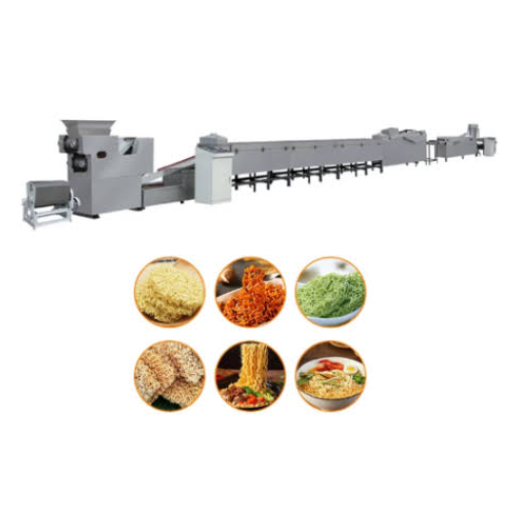
Wet Noodle Packing Machine: Fresh Noodle Buyer’s Guide

A wet noodle packing machine is a weighing, bag-forming, and sealing system built for fresh, high-moisture noodles. It portions sticky strands by weight, forms a pillow or pouch, flushes the headspace with gas, and seals the pack for chilled or frozen distribution.
Temperature decides how long that pack lasts. Fresh wet noodles lasted about five days at 4°C in one published study, one day at 15°C, and less than a day at 25°C.
Most “noodle packing machine” pages describe dry noodles or instant blocks. Wet noodles are a different handling problem. They stick, clump, tangle, and carry enough moisture to ruin a seal that looks perfect on the factory floor.
This guide covers four configurations, how to match the machine to product state, how to specify the seal and gas system, and the tests to run before acceptance. The plant scenarios are illustrative composites, not customer case studies. For the wider automation picture, see our complete guide to automatic noodle packing machines.
Key Takeaways
- A wet noodle packing machine is specified around product state and shelf-life target, not nameplate speed.
- Raw fresh noodles held about five days at 4°C and less than one day at 25°C in published tests. Cold chain is a food-safety control.
- Four configurations cover most plants: anti-tangle multihead plus VFFS, chain-bucket plus flow wrapper, premade pouch, and MAP tray sealer.
- A 60 packs/min nameplate at 60% OEE delivers 36 packs/min. A 5,000-pack day takes about 139 minutes.
- Test seals at 4°C and -18°C before you sign the acceptance report.
What Is a Wet Noodle Packing Machine?
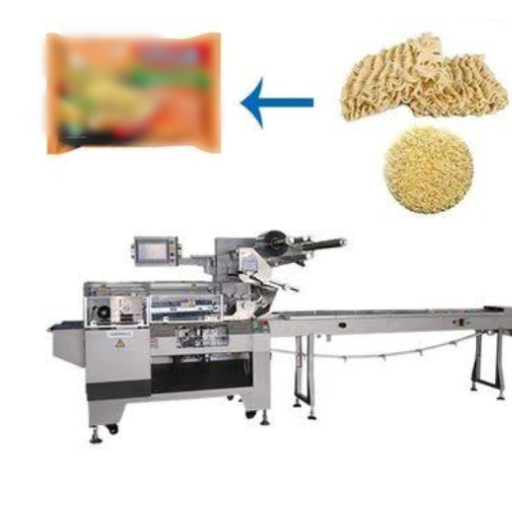
A wet noodle packing machine is the portioning and sealing end of a fresh noodle line. It separates and feeds sticky strands, builds a target weight, forms a bag or fills a premade pouch, gas-flushes the headspace, and seals the pack for chilled or frozen distribution. A checkweigher and metal detector usually sit downstream.
“Wet” is a trade term, not a single product. It covers raw fresh wheat noodles, cooked or par-cooked noodles, udon, rice noodles, and frozen fresh noodles. Buyers also search for a fresh noodle packaging machine, a fresh noodle packing machine, a wet noodle packaging machine, or a sticky noodle packing machine. The names describe the same handling problem.
The packer is not the extruder, steamer, chiller, or fryer. It is the last quality checkpoint. If the product arrives too warm, too wet, or too long, no machine can fix it.
For the mechanical sequence, see our guide to how a noodle packing machine works.
If your line produces leakers at 4°C, send us 30 sealed packs and a product sample. We will run a dye leak test and a seal strength test before you buy a new machine. Talk to our packaging team.
Why Wet Noodles Break Standard Packing Equipment
A standard weigher is built for dry, free-flowing pieces. Wet noodles are neither. The load cells are rarely the problem. The feed, the seal, and the cold chain are.
Sticky strands bridge and crush in a standard weigher
Surface starch, moisture, and pressure make strands mat together. They bridge the feed pans, hang in the chute, and crush under the hopper load. The machine then short-weights or stops.
You will see the symptoms before you see the cause. Weight drifts, packs per minute fall, and operators start clearing the infeed by hand. A standard multihead weigher can weigh sticky noodles. It cannot singulate them.
Moisture and starch contaminate the seal zone
A single strand across the jaw, or a film of starch in the seal area, creates a channel. The seal looks closed. The pack leaks. This is one of the most common causes of mold returns in fresh noodles.
The fix is mechanical. Give the bag headroom, let product settle before sealing, clean the jaws on a schedule, and use a jaw motion that holds pressure on the film.
Long noodles exceed the 300 mm handling ceiling
Most anti-tangle weighers top out around 300 mm of product length. Longer strands need a flow wrapper or manual handling. Measure the relaxed length after cooking or chilling, not the length at the extruder die.
This matters more than speed. A 200 packs/min machine that cannot handle your noodle length is a 0 packs/min machine.
Cold product meets warm air at the packing head
Cold noodles entering a warm packing room collect condensation. The film fogs, the seal zone wets, and seal strength drops. The machine is not at fault; the room is.
Specify a temperature-controlled packing room, keep product out of the chiller briefly, and use anti-fog film where condensation is unavoidable.
| Symptom | Likely cause | First fix |
|---|---|---|
| Weight drift and short packs | Strands bridging the feed pans | Anti-tangle tooling, lower hopper load |
| Leakers and mold returns | Starch or a strand in the seal zone | Bag headroom, settling gap, jaw cleaning |
| Crushed or broken strands | Drop height and hopper pressure | Gentle transfer, memory hoppers |
| Fogging and weak seals | Condensation on cold product | Temperature-controlled room, anti-fog film |
Elena, plant manager at a chilled noodle producer we will call Meridian Fresh, learned this the hard way. Her seals passed at 20°C on the factory floor. In distribution at 4°C, about 3% leaked.
A dye test found starch and a single strand in the seal zone. The fix was bag headroom, a settling gap, and a jaw cleaning schedule, not a new machine.
Guo and colleagues tested fresh wet noodles at four temperatures. Shelf life was about five days at 4°C, one day at 15°C, and under one day at 25°C and 37°C. Spoilage organisms also shift with temperature, from Pseudomonas and Acinetobacter in the chill chain toward Bacillus and Pantoea in warm storage. Read the study in Food Control.
That is why a wet noodle line is a cold-chain project. The packer protects the product; the chiller and the distribution chain decide whether the product is safe.
For a side-by-side comparison, see our guide to noodle packing machine types.
Four Wet Noodle Packing Machine Configurations
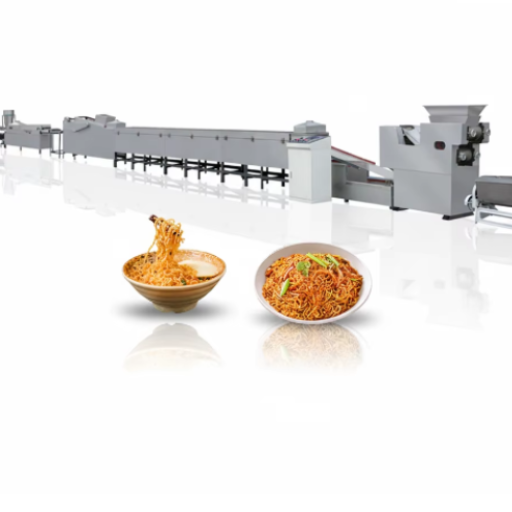
Four configurations cover most plants. Product state and pack format decide which fits. Speed comes last.
| Configuration | Best for | Dosing | Pack format | Typical output | Gas flush |
|---|---|---|---|---|---|
| Anti-tangle multihead plus VFFS | Raw fresh noodles, 200 to 500 g | Combination weight | Pillow or gusset | 30 to 100 packs/min | Optional |
| Chain-bucket plus flow wrapper | Long strands, high speed | Volume or chain bucket | Pillow | 20 to 230 bags/min | Optional |
| Premade pouch or rotary bagger | Premium, retort, stand-up | Weight or volumetric | Stand-up, zipper, flat | 10 to 60 pouches/min | Optional |
| MAP tray sealer | Cooked or ready-to-eat | Weight or volumetric | Tray | 2 to 3 cycles/min semi-auto | Essential |
1. Anti-tangle multihead weigher plus VFFS
This is the default for raw fresh noodles in 200 to 500 g pillow bags. It is also the configuration most buyers mean by an automatic wet noodle udon packing machine. The weigher uses rotary rollers, memory hoppers, dimpled contact surfaces, and a steep 60° discharge chute to keep strands moving.
Keypack publishes 30 packs/min for its KB-A10 and 60 packs/min for the KB-A14 and KB-AM14, with a 300 mm maximum length and IP65 construction. Category estimates for fresh-noodle lines run 60 to 100 packs/min. Treat the higher figure as a nameplate, not a guarantee.
The VFFS forms a pillow or gusset bag, fills it, gas-flushes if specified, and seals. A 10 to 14-head weigher and a 420 to 720 mm film-width VFFS cover most small and mid-volume plants.
2. Chain-bucket feeder plus flow wrapper
Long, sticky strands are easier to move in a chain bucket than in a multihead weigher. The bucket carries the portion to the film, and the flow wrapper seals around it.
Landpack publishes 20 to 230 bags/min across its LP-250 to LP-900 range, with a back-stretch film design for wet and sticky noodles. Film options include OPP, PE, CPP, and aluminum-coated structures.
It suits long noodles, high single-lane output, and products that tangle in a conventional feed. It is less flexible on pack weight and less precise than a combination weigher.
3. Premade pouch and rotary bagger
A premade pouch machine skips bag forming and takes a finished stand-up, zipper, or flat pouch. Rotary versions run 10 to 60 pouches/min and handle premium and retort formats.
Film costs more than rollstock, but shelf presence is better. For a premium brand, that trade can be worth it.
4. MAP tray sealer for cooked noodles
Cooked or ready-to-eat noodles are often sold in trays. A modified atmosphere packaging (MAP) tray sealer fills the tray, flushes the headspace, and seals a film lid.
A semi-automatic unit runs about 2 to 3 cycles/min. Automatic inline models run faster, but each tray still needs a full seal cycle.
This fits chilled ready meals and food service. It’s not a substitute for a pillow bag line.
Our flow wrappers and VFFS systems are the platforms we would review for the first two. If you are unsure which fits, send the product length, target weight, and pack format.
Match a Fresh Noodle Packaging Machine to Product State
Choose the shelf-life target first. The machine follows. A fresh noodle production line usually has more room to improve upstream than at the packer. A raw fresh noodle and a cooked noodle are not the same product, even when they look similar in the bag.
Raw fresh noodles, chilled
Raw fresh wheat noodles typically sit above 30% moisture. Moisture content tells you how much water is in the noodle; water activity tells you how much of it microbes can use. Fresh noodles typically sit above 0.95 aw, which is why temperature and gas flush carry most of the shelf-life load.
They are sold chilled and last about five days at 4°C in the published test. Use an anti-tangle weigher and VFFS, barrier film, optional gas flush, and an unbroken cold chain.
Cooked or par-cooked noodles
Cooking raises the moisture. High-moisture udon and rice noodles can reach 55 to 65%. Shelf life is hours to a few days, depending on pasteurization and chill.
Use a MAP tray or pouch, gas flush as standard, and a rapid chill. A cooked noodle packing machine usually pairs the tray sealer with that chill step.
Frozen fresh noodles
Freeze first or pack then freeze. The film must survive the lowest temperature in the chain, not just the freezer setpoint. Gas flush matters less when frozen, but seal integrity still decides whether the pack survives handling.
Retort or ambient-stable noodles
Retort products use a different process and package. They are not chilled fresh noodles and should not be compared on the same shelf-life basis. A retort pouch line is a separate specification.
| Product state | Moisture | Shelf life | Machine | Film | Gas | Cold chain |
|---|---|---|---|---|---|---|
| Raw fresh, chilled | Above 30% | About 5 days at 4°C | Anti-tangle weigher plus VFFS | Barrier PA/PE | Optional | Required |
| Cooked or par-cooked | 55 to 65% | Hours to a few days | MAP tray or pouch | Barrier, anti-fog | Essential | Required |
| Frozen fresh | Above 30% | Months at -18°C | VFFS or flow wrapper | Freezer-grade | Not critical | Frozen |
| Retort | Varies | Months at ambient | Retort pouch line | Retort-grade | Process-dependent | None |
Daniel, production lead at a 2 t/day udon plant we will call Riverbend Noodles, ran the numbers first. At 400 g bags, 2,000 kg/day means 5,000 packs/day. A 60 packs/min line at 60% OEE delivers 36 packs/min, or about 139 minutes of packing.
The packer was never his bottleneck. The chiller was. He spent the next capital dollar on chilling and seal validation, not a faster jaw.
Sealing, Gas Flush, and Film Selection
Seal failure is the most common way a wet noodle packing machine project ends in returns. A machine can weigh perfectly and still send moldy packs to a customer.
Seal-through contamination from moisture and starch
Product in the seal zone is the enemy. Give the bag enough headroom for product to fall clear of the jaws, add a short settling gap, and use a jaw that holds pressure across the full seal width.
Box-motion jaws stay in contact with the film longer than rotary jaws, which helps with thick barrier films. Rotary jaws are faster and simpler. The choice depends on your film and pack format, not the brochure.
Clean the jaws on a fixed schedule. Starch builds up invisibly and turns a good seal into a leak.
Nitrogen and CO₂: what the gas actually does
Nitrogen displaces oxygen. Carbon dioxide inhibits mold and some bacteria, and dissolves into the product. Most lines use a mix rather than a single gas.
Li and colleagues packed fresh noodles under N₂:CO₂ ratios from 0:100 to 50:50 and stored them at 7°C. All MAP groups reached at least seven days of shelf life. The 100% CO₂ group gave the strongest microbial inhibition and the best moisture retention. The study is open access in Food Science and Technology.
CO₂ dissolves into the product and can collapse the pack. That’s why many processors use a mix and validate the headspace instead of chasing 100% CO₂.
Gas flush is not sterilization. It slows oxidation and mold. It doesn’t make a high-moisture product ambient-stable. Temperature remains the dominant variable.
Film structure, OTR, and freezer performance
The film must keep moisture in and oxygen out. A PA/PE or PET/PE structure is common. Look for an oxygen transmission rate below about 50 cc/m²/24h, and specify anti-fog properties where condensation is likely.
If frozen, specify a freezer-grade film and test it at the lowest temperature in the chain. A film that survives -18°C can crack at -25°C.
Validate seals at 4°C and -18°C
Room-temperature seal strength tells you little about chilled or frozen performance. Condition packs for 24 hours at 4°C and at the lowest freezer temperature, then test seal strength and dye penetration on at least 30 packs.
The food-safety reason is simple. Bacillus cereus did not grow or produce enterotoxin at 4°C in one study of fresh rice noodles. At 22°C and 32°C, it exceeded 7 log CFU/g, with toxin detected after 12 to 24 hours. The Journal of Food Protection study makes the cold chain a safety control, not a convenience.
Mei, export manager at a frozen noodle producer we will call Northline Foods, qualified her film at -18°C. A customer stored the product at -25°C. The shipment arrived with hairline cracks and freezer burn. The missing spec was cold-flex performance, not room-temperature seal strength.
The 2023 review of fresh wet noodle shelf life covers spoilage organisms and preservation methods in more detail.
Speed, Accuracy, Cost, and Acceptance Testing
Most buyers overpay for speed and under-test the seal. The numbers below will help you budget.
Nameplate speed versus sustained output
Plan at 55 to 65% of rated speed. A 60 packs/min line at 60% OEE delivers 36 packs/min; a 100 packs/min line delivers 60.
The gap is changeover, rejects, film splices, product gaps, cleaning, and operator breaks. Budget for it before you promise a delivery date.
Accuracy and giveaway
A fresh-noodle line can hold about ±1 g on a 400 g pack. A standard line may drift to ±3 g.
At a 0.75% average overfill, you give away 3 g per pack. At 5,000 packs/day, that is 15 kg/day, or about 9,000/yearat9,000/yearat2/kg over 300 days. A better weigher can pay for itself on giveaway alone.
What a wet noodle packing machine costs
The bands below are observed 2026 Chinese FOB listing ranges, not quotes. Film, gas, tooling, and acceptance tests change the number.
| Configuration | Planning range |
|---|---|
| Semi-automatic bagger or tray sealer | 4,000to4,000to9,000 |
| Flow wrapper with manual feed | 10,000to10,000to30,000 |
| Anti-tangle multihead plus VFFS | 20,000to20,000to45,000 |
| MAP tray sealer, semi-automatic | 6,000to6,000to15,000 |
| MAP tray sealer, automatic | 30,000to30,000to80,000 |
| Complete line with gas flush, checkweigher, and metal detector | 50,000to50,000to120,000 |
The hidden costs matter as much as the machine price. Film, gas, cold-chain power, rejects, spare parts, and operator training all recur. A cheap packer with a poor seal can cost more in returns than a better machine costs upfront.
For the full price model, see our noodle packing machine price guide.
The FAT checklist for wet noodles
Run these at the factory acceptance test, with your product at production temperature. Do not accept a test with dry samples.
- Run at least 30 minutes continuously at target speed.
- Measure weight accuracy over 30 packs. Record average deviation, not the best pack.
- Test seal strength at 4°C after 24 hours.
- Test seal strength at the lowest freezer temperature in your chain.
- Run a dye penetration test on 30 packs.
- Measure residual oxygen after gas flush with a headspace analyzer.
- Run the longest noodle you intend to pack and check for bridging and breakage.
- Time a changeover between two SKUs.
- Verify washdown and IP65 protection at the joints and electrical cabinets.
- Run your specified film, not the supplier’s sample roll.
- Check date-code legibility and placement.
- Verify guards, interlocks, and emergency stops before signing.
Then plan a site acceptance test (SAT) after installation, with the line running at your plant’s ambient temperature and humidity rather than the supplier’s.
Bring the checklist. A supplier who resists a 30-minute run with your product is telling you something. For supplier evaluation criteria, see our guide to how to evaluate a noodle packing machine manufacturer.
Need a second opinion? Send the seal photos, weight data, and film specification to our team. Request a line review.
Wet Noodle Packing Machine FAQ
What is the difference between a wet noodle packing machine and a dry noodle packing machine?
A dry noodle packer handles free-flowing, low-moisture strands or blocks. A wet noodle packing machine handles sticky, high-moisture product with anti-tangle tooling, seal protection, and often gas flush. The weighing principle is similar; the handling and seal system are not.
How are fresh wet noodles packaged?
Most are packed by weight into pillow bags or premade pouches, then gas-flushed and sealed. Cooked noodles often go into MAP trays. The pack stays chilled or frozen through distribution. A small share is retort-packed.
How long do fresh noodles last after packing?
In published tests, fresh wet noodles lasted about five days at 4°C, one day at 15°C, and less than one day at 25°C. MAP at 7°C extended that to at least seven days. Formulation, pasteurization, and cold chain change the number.
Do wet noodles need nitrogen flushing?
Not always, but gas flush helps. Nitrogen displaces oxygen; carbon dioxide inhibits mold and some bacteria. A mix is common. Gas is not a substitute for refrigeration and will not make a fresh pack shelf-stable.
Can a standard multihead weigher handle wet noodles?
It can weigh them, but it usually cannot feed them. Sticky strands bridge and crush in a standard feed. You need anti-tangle tooling: rotary rollers, memory hoppers, dimpled plates, and a steep discharge chute. Very sticky products may need a chain-bucket feeder instead.
How many packs per minute can a wet noodle line run?
Published configurations run roughly 30 to 100 packs/min for a weigher plus VFFS, and 20 to 230 bags/min for a flow wrapper. Plan at 55 to 65% of nameplate for sustained output.
What film is used for fresh noodle packaging?
PA/PE or PET/PE barrier film is common. Look for an OTR below about 50 cc/m²/24h, anti-fog properties, and a freezer-grade structure if frozen. Validate on your machine, not on a datasheet.
How much does a wet noodle packing machine cost?
An anti-tangle multihead plus VFFS typically runs 20,000to20,000to45,000 in observed 2026 Chinese FOB listings. A flow wrapper with manual feed runs 10,000to10,000to30,000. A complete line with gas flush, checkweigher, and metal detector runs 50,000to50,000to120,000. Treat these as planning ranges.
Conclusion
Wet noodle packing is a cold-chain and seal-integrity problem before it is a machine problem. Get the product state and shelf-life target right, and the machine choice becomes simpler.
Four configurations cover most plants: anti-tangle multihead plus VFFS, chain-bucket plus flow wrapper, premade pouches, and MAP tray sealers. Test seals at 4°C and at your lowest freezer temperature, not just room temperature.
A wet noodle packing machine will not rescue a warm packing room, a broken cold chain, or a film that cracks at -25°C. It will protect a product that arrives at the right temperature, in the right form, with the right film.
Send your product length, target weight, pack format, and shelf-life target. We will recommend a configuration and run a seal test. Request a line consultation.