
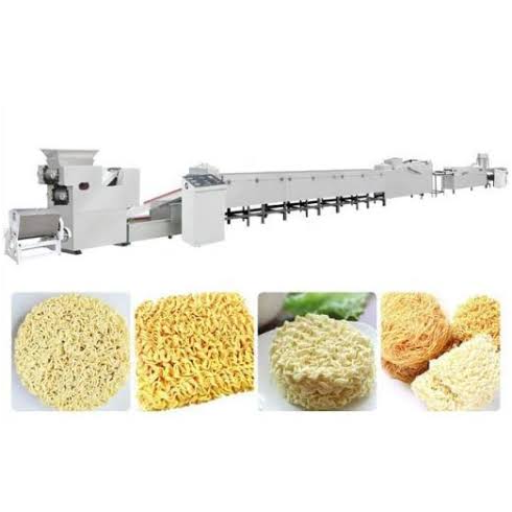
How Does a Noodle Packing Machine Work? Step by Step

How does a noodle packing machine work? It moves noodles through a timed cycle: portion the product, form or position the package, fill it, seal it, cut it, and inspect it. At 200 packs per minute, that cycle finishes in about 0.3 seconds.
Most explanations stop at the film roll and the heater. That satisfies curiosity, but it doesn’t help you choose a machine or explain a leak. This guide covers the full cycle, the four machine types, and the numbers that separate a brochure from a factory. For the full selection framework, see our automatic noodle packing machine guide.
Global demand reached 124.21 billion servings in 2025, so the packing stage runs at serious volume. We build complete noodle lines, including the cooling stage that feeds the packer, so we see both sides.
Key Takeaways
- Every noodle packing machine runs the same six-stage cycle: infeed, dose, form, fill, seal and cut, then inspect.
- Block instant noodles use a horizontal pillow packer; loose and stick noodles use a multihead weigher feeding a VFFS machine.
- Published single-lane speeds run 50–200 packs/min for block packers and 30–65 bags/min for stick-noodle lines.
- Most seal failures start before the jaws: warm cakes, starch dust, oil, or a sachet caught in the seal zone.
- Nameplate speed is not output. At 85% OEE, a 200 packs/min line delivers about 170 packs/min.
What Is a Noodle Packing Machine? Four Types Explained
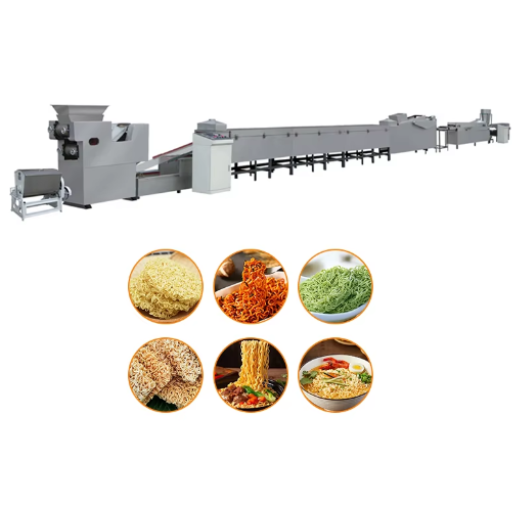
A noodle packing machine portions noodles and encloses them in a retail or bulk package. It forms a bag from roll film, or positions a cup or pouch, then seals and codes the pack. The noodle packing machine working principle is a timed cycle.
Every type performs six functions: infeed, dosing, package forming, filling, sealing and cutting, and inspection. The table below compares the four types of noodle packing machine.
| Machine type | Best for | Dosing method | Typical pack | Published speed |
|---|---|---|---|---|
| Horizontal pillow packer | Instant noodle blocks | Count and pitch | Pillow, brick, 3D bag | 50–200 packs/min |
| Multihead weigher + VFFS | Loose, stick, rice noodles | Combination weight | Pillow, gusset, block-bottom | 30–65 bags/min |
| Fresh noodle VFFS | Fresh, semi-wet, udon | Weight with anti-tangle tooling | Pillow or gusset, gas-flushed | 60–100 packs/min |
| Cup or bowl sealer | Cup and bowl noodles | Count and position | Lidded cup or bowl | Set by the cup line |
Horizontal pillow packers for instant noodle blocks
Cakes arrive in single file, a sachet drops onto each block, and a chain pushes the pair into a tube of film. End-sealing jaws close, seal, and cut.
This format is fast because the product is discrete. The packer counts and spaces blocks that were already formed to weight upstream. Published single-lane speeds run 50–200 packs per minute. Treat the top end as a best case for a narrow product range and perfect film.
Weigher and VFFS lines for loose and stick noodles
Loose noodles can’t be counted into a neat block, so they are weighed. A multihead weigher sits above a vertical form fill seal (VFFS) machine and releases a portion into the forming tube. These lines typically run 30–65 bags per minute, with published tolerances around ±2 g on 400–600 g packs. Strand length is often the binding constraint, with many systems limited to about 300 mm.
Fresh and wet noodle packers
Fresh noodles are soft, sticky, and prone to tangling. Standard weighers bridge and crush them.
Fresh lines use rotary rollers, memory hoppers, and steep 60° chutes, and often add a nitrogen flush. Published configurations run about 60–100 packs per minute.
Cup and bowl sealers
Cup lines use a different architecture. A denester drops cups onto a conveyor, a block and sachets are placed inside, and a lid film is heat-sealed to the rim. The package is rigid, so the machine controls rim alignment and lid tension rather than film forming. Our cup noodle sealing machine guide covers that format in detail.
How Does an Instant Noodle Packing Machine Work, Step by Step
Here is the sequence inside a block-noodle pillow packer.
- Infeed and orientation. Blocks are spaced, squared, and presented at a consistent pitch.
- Sachet placement. A seasoning packet is placed on the block or between block and film.
- Dosing and pitch. The block is counted and released into the packaging zone at the right moment.
- Film feed and forming. Film is drawn from a roll, folded into a tube, and closed with a lengthwise seam.
- Filling and synchronisation. The block is pushed into the tube while the jaws track the film.
- Sealing, cutting, coding, inspection. The ends are sealed, the pack is cut free, coded, weighed, and passed or rejected.
Step 1: Infeed and orientation
A cooling conveyor delivers cakes at room temperature. A laner separates them, and guide rails square each block before the former. A block that arrives rotated or 10 mm too thick will jam the former or skew the print. A reject gate should remove misshapen blocks before they reach the film.
Step 2: Seasoning sachet placement
A feeder drops one sachet onto each block. It must sit on the block or between block and film, never in the seal zone. A sachet caught in the jaw creates a channel through the seal.
Step 3: Dosing and pitch control
Block packers count; they don’t weigh. Target weight was set upstream when the cake was formed. The packer releases each block at the right moment and spacing. That is why a checkweigher after the packer matters: it catches upstream drift before a shift ships out of specification.
Step 4: Film feed and bag forming
Film passes a tension roller and wraps over a former, which folds it into a tube around the product path. A heated roller or belt makes the lengthwise fin seal. A photo-eye reads the registration mark so bag length and artwork stay aligned.
Step 5: Filling and synchronisation
A chain with lugs pushes each block into the open tube. The sealing jaws move in sync with the film and product. “No product, no bag” prevents empty packs; “no gap, no seal” prevents a jaw stroke from landing on a block.
Step 6: Sealing, cutting, coding, and inspection
The jaws apply heat, pressure, and dwell. Each stroke seals the trailing end of one pack and the leading end of the next. A cutter separates them at the centre of the seal.
Published machine guidance commonly cites 120–160 °C for plastic films, but the right setting depends on the sealant layer, film thickness, and speed. After sealing, the pack is coded, checkweighed, and scanned for metal or print defects.
After the packer: case packing
A case packer can take up to 400 packs per minute and turn them into about 20 cases per minute.
How a Weigher and VFFS Machine Work for Loose and Stick Noodles
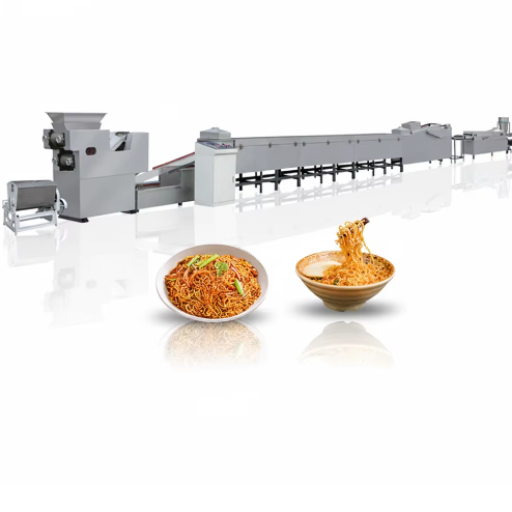
Loose and stick noodles take a different route.
Combination weighing in plain English
A multihead weigher spreads product across 10–16 feeder pans, each feeding a hopper. Load cells weigh every hopper, and the controller selects the combination closest to the target weight. More heads mean more combinations, better accuracy, and gentler release. Published tolerances for dry noodles sit around ±1–3 g.
Why long noodles break the standard weigher
Long strands bridge across hoppers and tangle in the feed. The fixes are mechanical: rotary rollers between the pans, memory hoppers that hold a portion before release, and steep 60° chutes. Most systems also cap product length around 300 mm.
The VFFS cycle and volumetric dosing
In a VFFS machine, film wraps a vertical forming tube, a vertical sealer closes the back seam, pull belts index the tube down, and horizontal jaws make a bottom seal. Product drops through the tube, the top seal closes the bag, and a cutter separates it. Very long goods may instead be dosed by volume: sticks align into channels, and a fixed volume or counted bundle is released. Accuracy then depends on bulk density, not weight.
Five Failure Modes That Decide Whether the Machine Works
Most packing problems are blamed on the packer. In practice, the packer is often the messenger.
1. Block geometry and skew
Symptom: jams at the former, crooked print, bags that look full on one side.
Cause: cakes that are too thick, too narrow, or arriving at an angle.
Fix: tighten upstream forming and cooling, add a reject gate, and check guide wear.
2. Moisture and temperature at the packing head
Symptom: fogging inside the film, soft seals, mould after storage.
Cause: packing cakes before they reach room temperature.
Fix: improve cooling and verify cake temperature at the infeed. Published frying studies put fried cake moisture at roughly 3–8%. Warm cakes condense moisture on the film, and that moisture sits against the seal and the product.
3. Starch, oil, and seasoning in the seal zone
Symptom: channel leaks, failed dye tests, a reject rate that climbs through the shift.
Cause: starch dust, oil, or a sachet in the jaw.
Fix: air knives, dust extraction, scheduled jaw cleaning, and sachet-placement verification. Picture a line running 120 packs per minute where rejects climb from 0.5% to 2% after a feeder adjustment. The seals look fine, but a dye test finds a channel at the sachet corner. Temperature was never the problem.
Seal quality has two measures: strength and integrity. A peel test measures how hard the seal is to open. A dye or burst test looks for a channel that lets air or moisture through.
A pack can pass one and fail the other, so a single seal-strength number is not enough. The difference between seal strength and seal integrity belongs in your FAT protocol.
4. Breakage in the drop and transfer
Symptom: broken noodles in the bag, lower fill weight than expected.
Cause: drop height, vibration, feed speed, or a transfer point that bends the product.
Fix: lower the drop, soften the feed, match conveyor speeds, and inspect every transfer. Breakage accumulates across the line, so attribute it stage by stage rather than blaming the packer.
5. Giveaway and calibration drift
Symptom: average pack weight creeping above target, more checkweigher rejects.
Cause: load-cell drift, product build-up on hoppers, or a target set high “for safety.”
Fix: scheduled calibration, clean hoppers, and a target based on process capability. A 1 g average overfill at 100 packs per minute gives away 28,800 kg a year on a 16-hour, 300-day schedule. At 1.50/kg,thatisabout1.50/kg,thatisabout43,200.
Speed, Accuracy, and OEE: Reading the Numbers
Nameplate speed is a ceiling, not a promise. The number that matters is sustained output over a real shift, including changeovers, stops, and rejects.
OEE is availability × performance × quality. World-class is often cited as 85%, built from 90% availability, 95% performance, and 99.9% quality. Consumer packaged goods packaging lines average closer to 58–62%, according to an industry OEE benchmark.
Run the arithmetic before accepting a speed claim:
- 100 packs/min × 80 g × 60 min × 16 h = 7.68 tonnes per day.
- At 85% OEE, a 200 packs/min line delivers about 170 packs/min.
- At 60% OEE, the same line delivers about 120 packs/min.
Now test the hand-off. Suppose a plant buys a 200 packs/min packer for 80 g blocks, but its cooler and sachet feeder sustain 140 packs/min. The packer is not the bottleneck. At 85% OEE, the line runs near 119 packs/min.
A shift claim needs the same check. One lane at 200 packs per minute, running 480 minutes, produces 96,000 bags. A 200,000-bag shift therefore needs more than two lanes, before any stops.
Changeover follows the same logic. Four changeovers a day at 35 minutes, 300 days, and 18perminuteofmarginisabout18perminuteofmarginisabout756,000 in annual opportunity. Cut changeover to 15 minutes and you recover roughly $432,000.
For the cost side of that equation, our noodle packing machine price guide breaks down machine bands and total cost of ownership.
How to Specify a Noodle Packing Machine
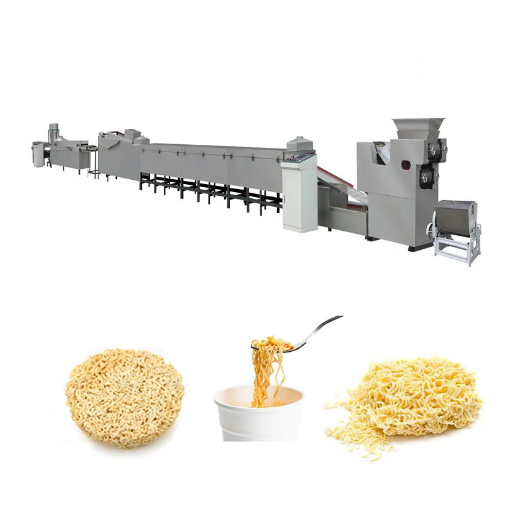
Start with the product. Use these seven checks.
- Product format and dimensions. Block weight, cake size, strand length, moisture, and infeed temperature.
- Pack format and film. Pillow, gusset, brick, cup, or pouch. Film structure, thickness, print registration, and paper or mono-material plans.
- Output target. Sustained packs per minute over an 8-hour shift, including changeovers and expected rejects.
- Dosing method. Count, weigh, or volumetric. Match it to the product and accept the accuracy trade-off.
- Inspection and rejection. Checkweigher, metal detector or X-ray, vision, and a reject gate that removes the pack.
- Hygiene and compliance. SUS 304 contact surfaces, IP65 where washdown is used, CE marking, and food-contact compliance. In the EU, that means Regulation 1935/2004; in the US, FDA 21 CFR Part 177.
- FAT, spares, and service. Run your product and film for at least two hours at sustained speed. Confirm spare-parts lead times and post-installation support.
Our noodle packing machine manufacturer guide turns these checks into an eight-point supplier evaluation.
Should the packer come from your line vendor?
Packing is the last station, but it is not independent of the rest. Cake temperature, moisture, block geometry, and upstream throughput all arrive at the packer’s infeed. If the cooler delivers 140 cakes a minute, a 200 packs/min packer will spend part of every shift waiting.
A line vendor sees the cooling stage, cake former, and sachet feeder as one system. A packaging specialist sees a sample and a target speed. Only one can tell you why the infeed is inconsistent.
Loyal builds the instant noodle production line through mixing, rolling, steaming, frying or drying, and forced-air cooling, then integrates the packing stage. We don’t sell a standalone packer, and we’ll say so. If your line is stable and you only need a replacement packer, a specialist may be the better buy. If you are building a line, the hand-off is where the money is won or lost.
What a Noodle Packing Machine Costs
Published FOB-China listing quotes in 2026 cluster into rough bands:
- Entry semi-automatic units: $4,000–9,000
- Automatic VFFS with a multihead weigher: $15,000–50,000
- Stick-noodle flow-wrap or weigher lines: $30,000–40,000
- Cup or bowl sealing lines: $40,000–70,000
- Turnkey multi-lane or multi-format systems: $220,000+
Treat these as observed listing quotes, not market research. The full price and cost guide covers the drivers and the payback math.
Conclusion
So how does a noodle packing machine work, end to end? It turns a continuous stream of product into a sealed, coded, inspected pack on a fixed cycle. Count and wrap a block, weigh and bag loose noodles, or lid a cup.
Three things separate a line that hits its number from one that does not. The product must arrive at the packer in a consistent condition. The dosing method must match the product, not the brochure. And the speed claim must be tested against sustained output, not a single clean run.
If you are planning a new line or replacing a packing stage, start with the product and work backward. Our team can review your specifications and target output, then tell you which packing architecture fits and where the hand-off needs work. Request a line consultation.
Frequently Asked Questions
How does a noodle packing machine work in simple terms?
It portions noodles, forms a bag or positions a cup, fills it, and heat-seals it. Block noodles are counted and wrapped by a pillow packer. Loose noodles are weighed and dropped into a vertical form-fill-seal machine.
What is the difference between a pillow packer and a VFFS machine?
A pillow packer runs horizontally. Product travels through a tube of film and is sealed at both ends. A vertical form fill seal (VFFS) machine forms the bag vertically, seals the bottom, drops product in, then seals the top. Pillow packers suit blocks; VFFS suits loose product.
How many packs per minute can a noodle packing machine produce?
Published single-lane block packers run 50–200 packs per minute, with some claims of 230. Stick-noodle lines run 30–65 bags per minute. Fresh-noodle lines run about 60–100. Real output is lower once changeovers and rejects are counted.
Why are my noodle bags leaking?
The usual cause is a contaminated seal, not the temperature. Starch dust, oil, or a sachet in the jaw creates a channel. Warm cakes can also condense moisture on the film. Check product temperature, jaw cleanliness, sachet placement, and film tension before changing the setpoint.
Can one machine pack instant, fresh, and dried noodles?
Rarely well. Block noodles need a pillow packer, loose dried noodles need a weigher and VFFS, and fresh noodles need anti-tangle tooling and often nitrogen flushing. Some VFFS platforms can switch formats, but changeover time and product damage usually favor a dedicated line.
How much does a noodle packing machine cost?
Observed 2026 FOB-China listing quotes range from about 4,000–9,000forentryunitsto4,000–9,000forentryunitsto220,000+ for turnkey systems. An automatic VFFS with a multihead weigher typically lists between 15,000and15,000and50,000.