
Industrial Food Machinery Equipment: Complete Guide to Types, Selection & Standards

Industrial food machinery equipment is the large-scale, automated, and sanitary machinery used to receive, prepare, process, thermally treat, package, and inspect food products in factories and co-manufacturing plants. The right food manufacturing equipment mix depends on your product, target throughput, hygiene requirements, and total cost of ownership, not on buying the biggest machine on the market.
The global food processing machinery market is projected to reach USD 66–88 billion in 2026, driven by automation, food-safety regulation, and rising demand for packaged and convenience foods, according to Mordor Intelligence and Fortune Business Insights. That growth sounds promising, but it also means buyers face an overwhelming number of machine types, suppliers, and certification claims. When Maria, a plant manager at a mid-sized snack co-manufacturer, first searched for industrial food processing equipment, she found pages that listed machines by category but never showed how those machines connect on a real production floor. She needed a map, not a catalog.
In this guide, you will learn how industrial food machinery is organized by production stage, how to choose equipment for your specific operation, what materials and compliance standards matter, and how to budget for both upfront cost and long-term ownership. We will also show where Shandong Loyal’s specialized food production line solutions, food extrusion solutions, and industrial microwave drying and sterilization systems fit into the broader landscape. We will also clarify where commercial food equipment ends and industrial-scale lines begin.
Key Takeaways
- Industrial food machinery equipment covers receiving, preparation, processing, thermal treatment, packaging, and quality control on a factory scale.
- Map equipment to production stages first; choosing isolated machines without flow integration causes bottlenecks and rework.
- Food-grade stainless steel 304 or 316, surface finish, and certifications such as CE, FDA, NSF, 3-A, and EHEDG should be treated as minimum requirements, not upgrades.
- Total cost of ownership typically runs 145–165% of the purchase price over five years when energy, maintenance, spare parts, and downtime are included.
- Predictive maintenance and Industry 4.0 integration can cut unplanned downtime by 25–40% and improve overall equipment effectiveness by 20–40%.
What Is Industrial Food Machinery Equipment?
Industrial food machinery equipment refers to machines engineered for high-volume, repeatable food manufacturing. Unlike commercial kitchen appliances, which serve restaurants and small batch operations, industrial equipment is designed for continuous or semi-continuous production, automated control, and integration into larger processing lines. Buyers and suppliers often use the terms food manufacturing equipment and food processing machinery interchangeably, although the former usually emphasizes the end-to-end factory line.
The scope spans every stage of the factory journey:
- Receiving and storage, silos, tanks, cold rooms, and pallet handling systems.
- Preparation and cleaning, washers, peelers, graders, optical sorters, and metal detectors.
- Size reduction and forming, slicers, dicers, meat grinders, mills, extruders, pelletizers, and molders.
- Mixing and blending, ribbon blenders, planetary mixers, high-shear mixers, and homogenizers.
- Thermal processing, pasteurizers, ovens, fryers, dryers, roasters, freezers, and industrial microwave systems.
- Packaging and end-of-line, vertical form-fill-seal (VFFS) machines, horizontal form-fill-seal (HFFS) machines, pouch fillers, flow wrappers, cartoners, labelers, and palletizers.
- Quality control and safety inspection, metal detectors, X-ray systems, checkweighers, and vision systems.
Commercial vs Industrial Food Equipment
A common point of confusion is the difference between commercial food equipment and industrial food machinery equipment. Commercial equipment is built for restaurants, cafeterias, and catering operations. It handles smaller batches, shorter run times, and simpler cleaning routines.
Industrial food machinery equipment is built for factories. It emphasizes throughput, integration, traceability, and compliance with regional machinery and food-safety directives. For a practical breakdown of equipment types by industry, see WASINC’s guide to food processing equipment.
If you are producing a few hundred kilograms per day for local distribution, commercial equipment may be sufficient. If you are producing several tons per day, exporting across borders, or supplying retail chains, industrial equipment is the appropriate investment.
Industrial Food Machinery Equipment Categories by Production Stage
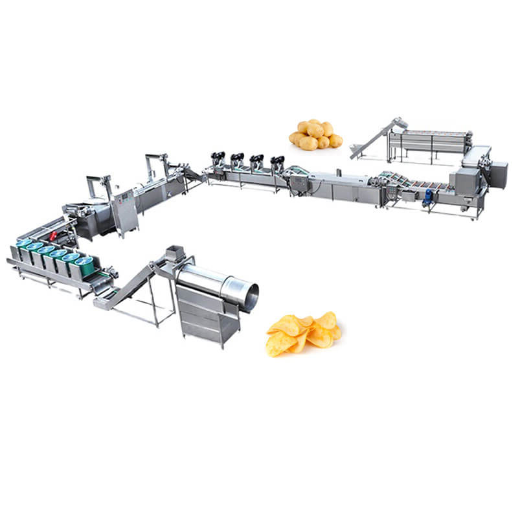
Top-ranking guides often list machine types alphabetically. A more useful approach is to map each machine to where it sits in the production flow. Mapping food processing machinery to production stages helps buyers identify bottlenecks, plan line layout, and avoid buying equipment that does not connect cleanly to upstream or downstream processes.
Receiving, Storage, and Material Handling
Before any processing begins, raw materials must be received, weighed, and stored under the right conditions. Equipment at this stage includes bulk silos for grains and powders, refrigerated tanks for liquids, cold-storage rooms for perishables, pallet racking, forklifts, and conveyor systems.
Material-handling equipment is easy to underestimate. A snack producer we worked with installed a high-capacity extruder but kept feeding it with manual bag dumps. The extruder was underutilized, and operators spent half their shift lifting sacks. Adding a pneumatic conveying system and day bin unlocked the real capacity of the line.
Preparation and Cleaning
Preparation equipment brings raw materials into a consistent, contamination-free state. Common machines include:
- Washers and spray cleaners for fruits, vegetables, and root crops.
- Peelers and corers to remove skins, cores, and inedible portions.
- Graders and optical sorters to remove defects, foreign material, and off-spec pieces.
- Metal detectors and foreign-body removal systems to protect downstream machinery and consumers.
This stage directly affects final product quality and shelf life. Inconsistent cleaning or grading upstream forces downstream equipment to compensate, which increases waste and wear.
Size Reduction and Forming
Once raw materials are clean, they often need to be cut, ground, or shaped. Equipment in this category includes slicers, dicers, meat grinders, bowl cutters, mills, pulpers, extruders, pelletizers, and molders.
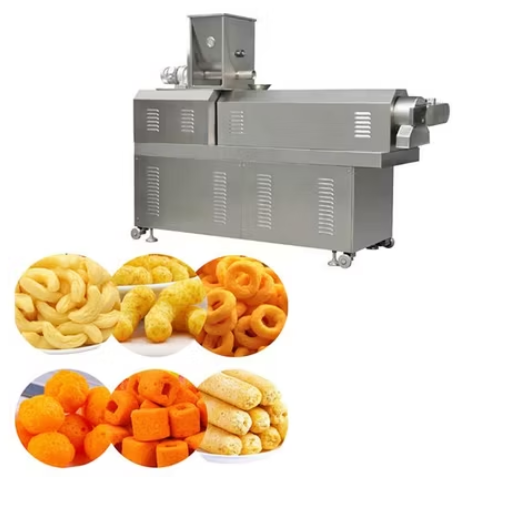
Food extrusion deserves special attention because it is central to snacks, cereals, pet food, and textured proteins. A twin-screw extruder cooks and shapes a dough under controlled temperature, pressure, and shear. As the product exits the die, moisture flash-evaporates and creates the desired texture. Shandong Loyal’s food extrusion solutions cover snack pellets, fried snacks, pet food, and specialty starch applications.
Mixing and Blending
Uniformity is critical in food manufacturing. Mixing equipment includes ribbon blenders for dry powders, planetary mixers for doughs and batters, high-shear mixers for emulsions, and homogenizers for dairy and beverage applications.
The right mixer depends on product viscosity, desired shear, batch or continuous operation, and cleaning requirements. A high-shear mixer that works well for salad dressing may destroy a delicate protein suspension.
Thermal Processing
Thermal processing changes the microbiological and physical state of food. Common equipment includes:
- Pasteurizers and sterilizers for liquid foods, ready meals, and canned goods.
- Ovens and roasters for bakery, nuts, coffee, and snack products.
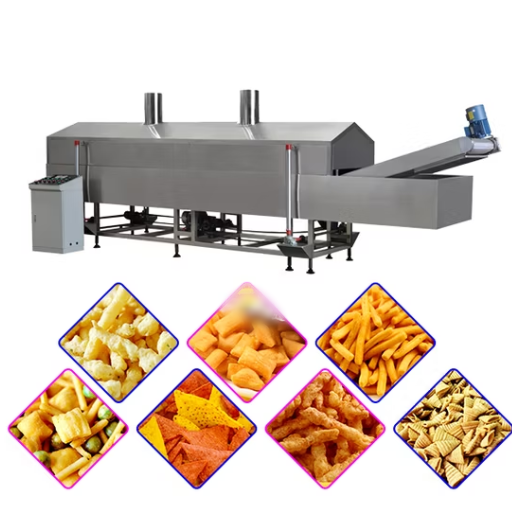
- Fryers for chips, extruded snacks, and battered foods.
- Dryers for fruits, vegetables, grains, pet food, and snack pellets.
- Freezers and chillers for meat, seafood, prepared meals, and baked goods.
- Industrial microwave systems for rapid drying, sterilization, and tempering.
Industrial microwave drying is gaining attention because it heats water molecules directly, reducing drying time and energy use compared with conventional hot-air systems. Shandong Loyal’s industrial microwave drying and sterilization equipment is used for snacks, grains, herbs, and heat-sensitive products.
Packaging and End-of-Line
Packaging protects the product, extends shelf life, and carries branding. Equipment includes VFFS and HFFS machines, premade pouch fillers, flow wrappers, vacuum sealers, cartoners, case packers, palletizers, and labeling systems.
Line integration matters here. A fast filler paired with a slow case packer creates a bottleneck. Changeover time, film compatibility, and gas-flushing capability should be evaluated alongside speed.
Quality Control and Safety Inspection
End-of-line inspection equipment includes metal detectors, X-ray inspection systems, checkweighers, and machine-vision systems. These systems catch contamination, underfills, and package defects before products reach customers.
Modern systems can log reject data and integrate with manufacturing execution systems (MES) for traceability. For exporters and retailers, this data is often required by customers and regulators.
Choosing Industrial Food Machinery Equipment
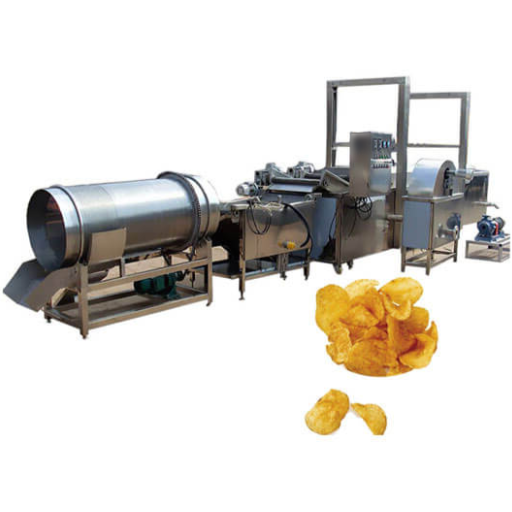
Food machinery selection is not a simple product comparison. It is a systems decision. The following framework helps buyers move from a vague requirement to a clear specification.
Define Product, Capacity, and Growth Requirements
Start with the product. What is the recipe? What is the target throughput per hour or per shift? What is the projected growth over three to five years?
A line specified only for today’s volume will become a constraint within two years. Capacity planning should include:
- Nominal throughput under ideal conditions.
- Realistic throughput including changeover, cleaning, and minor stops.
- Peak-season demand if applicable.
- Future product variants that may require different tooling.
- Documented food machinery selection criteria (product, capacity, growth, hygiene, budget) before contacting suppliers.
Match Equipment to Product Characteristics
Product characteristics determine machine selection. Moisture content, pH, viscosity, particle size, allergen status, and heat sensitivity all influence the right equipment.
For example, acidic fruit products require 316 stainless steel to resist chloride corrosion. Delicate baked goods need gentle conveying and controlled cooling. High-oil snacks need fryers with efficient oil management and filtration.
Evaluate Automation and Integration Needs
Automation should match the operation’s maturity and labor availability. A fully automated line with MES integration makes sense for a high-volume, multi-shift factory. A semi-automated line with manual packaging may be more appropriate for a startup testing market demand.
Integration considerations include:
- Communication protocols (Ethernet/IP, Profinet, Modbus).
- Data collection and traceability requirements.
- Operator training and maintenance capability.
- Spare parts availability in the local market.
Calculate Total Cost of Ownership
Purchase price is only the beginning. A realistic TCO model includes:
- Installation, commissioning, and utility connections.
- Energy and water consumption.
- Labor for operation, cleaning, and maintenance.
- Spare parts and consumables.
- Downtime and lost production.
- Regulatory compliance and validation costs.
Over a five-year horizon, TCO is typically 145–165% of the initial equipment investment. Maintenance and downtime alone can represent 35–60% of ten-year lifecycle cost.
CTA: Not sure how to map your product to the right equipment? Request a custom production-line consultation and our engineers will help you build a stage-by-stage flow.
Materials, Hygiene, and Compliance Standards for Industrial Food Machinery Equipment
Food equipment must be safe, cleanable, and durable. Material selection and certification are not afterthoughts; they determine whether a machine can pass audits, avoid recalls, and last in a washdown environment.
Food-Grade Stainless Steel: 304 vs 316
Most food-contact equipment uses austenitic stainless steel. The two most common grades are:
| Grade | Best For | Notes |
|---|---|---|
| 304 / 304L | Bakery, dry goods, beverages, general food contact | Cost-effective, corrosion-resistant in most food environments. |
| 316 / 316L | Acidic foods, seafood, dairy, high-chloride or salty applications | Higher nickel and molybdenum content resists pitting and chloride attack. |
Li Wei, a procurement director for a tropical fruit processor in Southeast Asia, initially selected 304 stainless for an acidic puree line to save cost. Within eighteen months, the tanks showed pitting near welds and product contact zones. Switching to 316L and improving weld passivation resolved the issue and allowed the facility to pass a major customer audit.
Avoid 201, 202, or 303 stainless steels for food-contact applications. These grades are less corrosion-resistant and are not considered food-grade in most markets.
Surface Finishes and Weld Quality
Surface finish is measured by Ra (roughness average). Food-contact surfaces typically require Ra ≤ 0.8 µm; tanks and pharmaceutical-grade equipment often require Ra ≤ 0.4 µm. Smoother surfaces are easier to clean and less likely to harbor bacteria. The World Stainless Association guide provides detailed guidance on selecting finishes for food and beverage equipment.
Weld quality is equally important. Welds should be continuous, smooth, and fully penetrated. Cracks, porosity, and rough weld beads create contamination risks and are common audit findings.
Key Certifications
Certification requirements vary by market and product, but the most common include:
- CE marking, required for machinery sold in the European Economic Area.
- FDA 21 CFR 175.300, covers indirect food additives in the United States.
- NSF/ANSI 51, food equipment materials standard.
- NSF/ANSI 2, commercial food equipment standard.
- 3-A Sanitary Standards, widely used for dairy and liquid-food equipment.
- EHEDG, European hygienic design guidelines.
- ISO 14159 / EN 1672-2, machinery hygiene and safety standards.
Buyers should request certificates of compliance and material test reports (MTRs) before accepting equipment.
Selecting a Food Machinery Manufacturer
The manufacturer you choose for your industrial food machinery equipment is as important as the machine itself. A low-priced machine with poor support can cost more in downtime than a higher-priced machine with responsive service.
Specialization and Track Record
Look for manufacturers with proven experience in your product category. A supplier that builds pasta lines every week will understand dough rheology, die design, and drying curves better than a generalist.
Customization, OEM, and ODM Capabilities
No two factories are identical. Customization may include capacity adjustments, recipe-specific tooling, layout constraints, voltage standards, and local-language HMI interfaces. Shandong Loyal designs food production line solutions with modular configurations so buyers can start with a baseline system and expand over time.
After-Sales Support and Spare Parts
Ask about commissioning support, operator training, spare parts lead times, and remote diagnostic capability. A parts warehouse on another continent can turn a two-hour repair into a two-week shutdown.
Global Logistics and Commissioning
International buyers should confirm packaging for sea freight, customs documentation, installation supervision, and acceptance testing. A manufacturer with export experience will understand voltage differences, regional standards, and site preparation requirements.
For a deeper framework on vetting suppliers, see our food machinery manufacturer guide.
Maintenance, Reliability, and Automation Trends in Industrial Food Machinery Equipment
Equipment that runs continuously requires a maintenance strategy. Reactive maintenance, fixing machines only after they fail, is the most expensive approach.
Preventive, Predictive, and Autonomous Maintenance
- Preventive maintenance schedules inspections and part replacements based on time or run hours.
- Predictive maintenance uses sensors and data analysis to predict failures before they happen.
- Autonomous maintenance trains operators to perform basic cleaning, inspection, and lubrication tasks as part of daily routines.
Predictive maintenance programs can reduce unplanned downtime by 25–40%. Total productive maintenance (TPM) programs can improve overall equipment effectiveness (OEE) by 20–40% and cut maintenance costs by 30–50%.
Industry 4.0, IoT, and Smart Factory Trends
Modern industrial food machinery equipment increasingly includes:
- IoT sensors for vibration, temperature, and energy monitoring.
- PLC and HMI systems with recipe management and alarm logging.
- Cloud dashboards for remote monitoring.
- MES and ERP integration for traceability and production planning.
- Machine vision for quality inspection and foreign-body detection.
These technologies are not just for large multinationals. Mid-sized factories are adopting affordable sensor kits and cloud-based monitoring to reduce downtime and document compliance.
Maintenance Scheduling and Documentation
A simple but effective maintenance program includes:
- Daily operator checks for leaks, abnormal noise, and cleaning completion.
- Weekly lubrication and fastener inspections.
- Monthly belt, seal, and bearing inspections.
- Quarterly calibration of sensors and safety devices.
- Annual preventive overhaul based on run hours.
For best practices tailored to production lines, see our guide to food production line maintenance.
New vs Used Industrial Food Machinery Equipment
Used food processing machinery can save 30–50% compared with new equipment. However, the savings disappear quickly if the machine needs extensive refurbishment, lacks documentation, or cannot meet current safety standards.
When Used Equipment Makes Sense
Used equipment is worth considering when:
- The application is well-understood and the machine is a proven model.
- Spare parts are still available from the manufacturer or aftermarket.
- The machine has verifiable service history and low run hours.
- The buyer has in-house technical capability to refurbish and validate.
Inspection Checklist and Red Flags
Before buying used equipment, inspect:
- Frames, welds, and contact surfaces for corrosion or damage.
- Electrical panels and safety devices for compliance with local standards.
- Motors, gearboxes, bearings, and seals for wear.
- Availability of operator manuals, electrical drawings, and spare parts lists.
- Evidence of previous product use to assess allergen or contamination risk.
Red flags include missing documentation, non-food-grade materials, obsolete controls, and signs of improvised repairs.
TCO Comparison
A used machine with a low purchase price but high energy consumption, frequent breakdowns, and long spare-parts lead times can exceed the TCO of a new machine within a few years. Always model five-year ownership cost before deciding.
Acme Frozen Foods, a regional ready-meal producer, evaluated a used tunnel freezer at 40% below the price of a new unit. During inspection, technicians found worn door seals, corroded evaporator fins, and a control system that could not log temperatures for traceability. The company chose a new freezer with predictive maintenance sensors. Uptime improved, and the unit paid back the premium through energy savings and avoided product loss.
Cost, ROI, and Investment Planning for Industrial Food Machinery Equipment
Transparent cost guidance is rare in industrial food machinery content. Buyers need realistic budgets for both individual machines and complete lines.
Equipment-Level Price Ranges
The following ranges are indicative and vary by capacity, automation level, and region:
| Equipment Type | Indicative Price Range (USD) |
|---|---|
| Industrial ribbon blender | 8,000–8,000–60,000 |
| Industrial food slicer | 18,000–18,000–55,000 |
| Automated conveyor line (50 ft) | 30,000–30,000–95,000 |
| Twin-screw food extruder | 50,000–50,000–250,000 |
| VFFS packaging machine | 45,000–45,000–180,000 |
| Tunnel pasteurizer | 120,000–120,000–350,000 |
| Industrial microwave dryer | 80,000–80,000–400,000 |
Complete Production Line Cost by Scale
| Line Scale | Throughput | Total Investment (USD) |
|---|---|---|
| Small scale | 100–300 kg/h | 150,000–150,000–450,000 |
| Medium scale | 300–1,000 kg/h | 450,000–450,000–1,500,000 |
| Large industrial | 1,000+ kg/h | 1,500,000–1,500,000–5,000,000+ |
Hidden Costs and Payback Periods
Hidden costs often include:
- Foundation, utility, and ventilation upgrades.
- Freight, insurance, and customs duties.
- Installation and commissioning.
- Operator and maintenance training.
- Initial recipe trials and yield optimization.
- Validation and regulatory documentation.
Payback periods vary by product margin and labor savings, but many automated food lines achieve payback in two to four years through labor reduction, yield improvement, and higher throughput.
Video: Pasta Production Line in Action
Seeing equipment run is often more useful than reading specifications. Below is a test-run video from Shandong Loyal’s YouTube channel showing a wide pasta production line producing consistent shapes at stable performance.
This line demonstrates the preparation, extrusion, cutting, and conveying stages in a single integrated system. The same integration principles apply to snack, pet food, and starch production lines.
FAQ
What is industrial food machinery equipment?
Industrial food machinery equipment is large-scale, automated machinery used in factories to receive, prepare, process, thermally treat, package, and inspect food products. It is built for high throughput, repeatable quality, and compliance with food-safety and electrical-safety standards.
What are the main types of food processing equipment?
The main types include material-handling equipment, preparation and cleaning equipment, size-reduction and forming equipment, mixing and blending equipment, thermal-processing equipment, packaging equipment, and quality-control systems.
How do I choose the right industrial food processing equipment?
Start by defining your product, capacity, and growth requirements. Then match equipment to product characteristics, evaluate automation and integration needs, and calculate total cost of ownership over five years.
What is the difference between commercial and industrial food equipment?
Commercial food equipment serves restaurants and small-batch operations. Industrial food machinery equipment is designed for factories, with higher throughput, automation, traceability, and compliance with regional machinery and food-safety directives.
What certifications should industrial food machinery equipment have?
Common certifications include CE, FDA 21 CFR 175.300, NSF/ANSI 51 and 2, 3-A Sanitary Standards, EHEDG, and ISO 14159 / EN 1672-2. Requirements vary by market and product.
How much does industrial food processing equipment cost?
Individual machines can range from 8,000forasmallblenderto8,000forasmallblenderto400,000 for a large industrial microwave dryer. Complete production lines typically range from 150,000forsmall−scalesystemsto150,000forsmall−scalesystemsto5,000,000+ for large industrial plants.
Is used food processing machinery worth buying?
Used machinery can save 30–50% upfront, but only if the unit has verifiable service history, available spare parts, and current documentation. A thorough inspection is essential.
Conclusion
The right food manufacturing equipment and industrial food machinery equipment choices, including the broader category of industrial food processing equipment, are the backbone of modern food manufacturing. Success comes from mapping machines to production stages, selecting materials and certifications for your product, and budgeting for total cost of ownership rather than purchase price alone.
The manufacturers that win in the next decade will treat equipment as an integrated system, not a collection of machines. Predictive maintenance, hygienic design, and smart controls are becoming baseline expectations rather than premium options.
Key takeaways:
- Map equipment choices to production flow before comparing brands.
- Specify 304 or 316 stainless steel and the right surface finish for your product.
- Demand certifications and material documentation upfront.
- Model five-year TCO, including energy, maintenance, and downtime.
- Use a structured food machinery selection framework to avoid isolated-machine purchases.
- Choose manufacturers with proven experience, customization capability, and responsive support.
Ready to design or upgrade your production line? Contact Shandong Loyal Industrial Co., Ltd. for a tailored consultation. Our engineering team will help you select the right industrial food machinery equipment for your product, capacity, and budget.