How to Scale Pet Food Production: A Practical Framework for Manufacturers

To scale pet food production, manufacturers should forecast demand, audit current line bottlenecks using OEE benchmarks, choose between shift expansion and equipment upgrades, specify modular extrusion and drying systems, automate the highest-ROI stations, then validate quality at the new throughput. Done in that order, output can often double or triple without rebuilding the plant from scratch.
As a forecast elaborated by market specialists shows, the pet food industry is expected to cross 175 billion dollars by 2030. This has become a driving force impacting production even in small factories. However, the problem remains in that when we come to most of the facilities, the majority of them do not meet such market demands. They want to scale pet food production but no one knows if it will be achieved by adding one shift or the other or by changing an extruder or by complaining about the plant.
Do you also have the same problem? Good. This guide provides a step-by-step process used by Shandong Loyal Industrial for manufacturers in over 20 countries. In the following, we will explain how to determine desired throughput, identify critical bottlenecks, select proper equipment to upgrade, and evaluate the benefits of automation while maintaining the margin and food safety.
Key Takeaways
- Pet food lines typically operate at 55-65% OEE. Closing that gap often unlocks 20-30% more output before any capital purchase.
- Drying, not extrusion, is the most common scaling bottleneck on dry kibble lines.
- Twin-screw extruders deliver 20-40% higher throughput than single-screw units at a similar footprint.
- Automated packaging and palletizing typically pay back in 14-22 months at mid and industrial tiers.
- Modular, phased scale-up protects cash flow better than a single greenfield build for most growing brands.
Why Pet Food Manufacturers Are Scaling Now
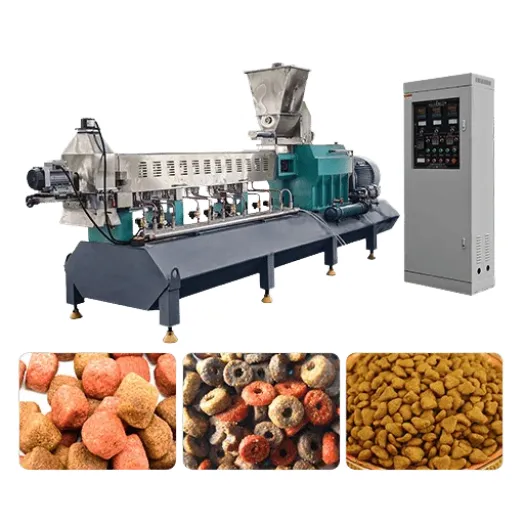
Pet ownership across the globe and the upscale trends in the development of nutrition for animals are high records of demand. According to Grand View Research, pet food market is expected to reach 128.7 billion USD by 2025, with the dry kibbles taking about 59% of the total product market share. The sales are still 35%–42% in North America, whereas Asia-Pacific has a 7%–9% year of increase.
In the eyes of the producing structure, such demand appears in longer order lead times, stretched co-packing contracts and the presence of advantageous private-label opportunities that existing capacities are unable to cope with. In North America, Mars Petcare and Champion Petfoods have announced their massive expansion in 2023, and since then, expansion projects worth nearly hundreds of millions of dollars from North America have been pinpointed. Now, smaller local brands are facing the same demands but with fewer means to meet them.
The window to capture growth is open. The real question is how to scale pet food production without overspending on equipment that won’t pay back.
A real scenario: when growth outpaces the line
Even though the launch of the retail campaign for Sarah’s regional brand of pet food was scheduled for 2024, it was then signed to cover Southern California area 12 stores and 1,400 kg per day. Her equipment, rated to 1 ton per hour, typically produced 620 kg of kibble every hour. The problem, however, was not with the extruder itself. It was more to do with a single pass drying stage that could not operate at the required speed while maintaining a moisture content of less than 9 %. Making the dryer more efficient, rather than the extruder, allowed for 80 % more throughput after 11 weeks of activity. The cost of her decision was reduced to less than what she would have spent to change everything in the line.
Such cases are surprisingly more frequent than what most operators anticipate. That’s precisely the reason for the importance of having a systematic way to scale pet food production.
6 Steps to Scale Pet Food Production
Use this six-step framework to move from “we need more output” to a financed, sequenced plan:
- Forecast demand and set a throughput target. Build a 24-month rolling forecast by SKU and channel. Translate it into kg/h required at 85% line utilization.
- Audit your current line for bottlenecks. Benchmark OEE station by station. Industry average is 55-65%; world-class is 85% or higher.
- Choose your scale path. Decide between adding shifts, upgrading a single bottleneck station, adding a parallel line, or building greenfield.
- Specify modular, scalable equipment. Prioritize twin-screw extruders, continuous dryers, gravimetric feeders, and PLC-ready control systems.
- Automate where ROI justifies. Target packaging, palletizing, traceability, and recipe management first.
- Validate quality and compliance at the new scale. Lock in HACCP, FSMA, and FEDIAF controls before going live at higher throughput.
Each step builds on the last. Skipping the audit is the most common mistake operators make. It usually costs six figures in misallocated CapEx.
Want a tailored audit? Request a capacity consultation from our engineering team.
Capacity Planning: From Kilograms to Tons per Hour
Before you specify equipment, define the throughput you actually need. Demand forecasting is the foundation of every successful pet food production scaling project. It prevents the two most expensive mistakes: under-buying and over-buying.
Forecast demand before you specify equipment
Build the forecast by SKU, by channel, and by month. Layer in seasonality (treats spike in Q4, fish feed in Q2 and Q3) and account for promotional cycles. Convert the result into kg/h required at a realistic 80-85% line utilization. That utilization buffer is critical; budgeting at 100% nameplate capacity almost always backfires.
Capacity tiers and investment ranges
Use the table below as a starting reference. Ranges reflect turnkey kibble lines, including preconditioner, extruder, dryer, coater, and primary packaging.
| Tier | Throughput | Footprint | CapEx Range | Typical User |
|---|---|---|---|---|
| Small | 100-500 kg/h | 50-120 m² | USD 150K-400K | Startups, regional brands |
| Mid | 500 kg/h – 2 T/h | 120-250 m² | USD 400K-1.2M | Growing brands, private label |
| Industrial | 2-5+ T/h | 250-600+ m² | USD 1.2M-4M+ | Contract manufacturers, multinationals |
These ranges assume modular twin-screw extrusion and continuous drying. Single-screw and batch alternatives can lower CapEx by 15-25%, but they typically reduce flexibility and throughput.
For a deeper breakdown of what each line component costs, see our guide to pet food production equipment costs.
Bottleneck Analysis: Where Most Lines Lose Capacity
Before buying anything, find where your line is leaking output. Most pet food production scaling efforts target the wrong machine because operators don’t measure overall equipment effectiveness (OEE) station by station.
OEE benchmarking for pet food lines
OEE equals Availability multiplied by Performance multiplied by Quality. The industry average for pet food lines sits between 55% and 65%. World-class is 85% or higher. Closing even half that gap on an existing line frequently delivers 20-30% more output before a single CapEx dollar is spent.
Common bottlenecks: drying, packaging, and preconditioning
In our experience commissioning lines across five continents, the bottleneck is rarely the extruder itself. The three most common constraints are:
- Drying capacity. Dryers consume 60-70% of line floor space and energy, yet they’re often undersized for upgraded extruders.
- Packaging speed. Manual or semi-auto bagging frequently caps throughput well below the upstream line rate.
- Preconditioning consistency. Variable moisture into the extruder destroys throughput stability.
How to decide between upgrade and replacement
Run a 14-day audit. Capture station-level OEE, downtime causes, and quality variance. If a single station is below 60% OEE while others run above 75%, upgrade the laggard. If multiple stations are below 60%, you may be looking at a parallel line or a controlled replacement.
Equipment Upgrades That Unlock Higher Output
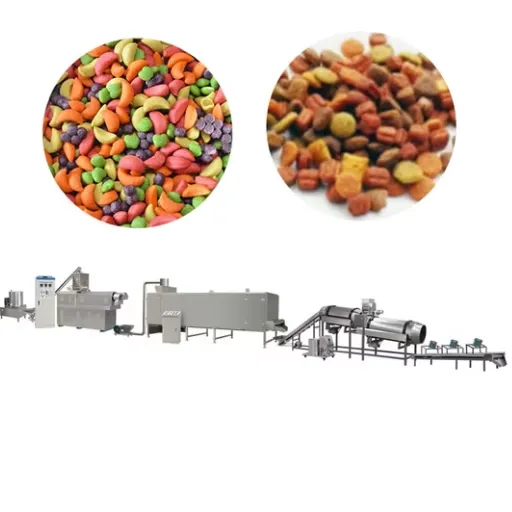
Once the bottleneck is identified, equipment choice becomes specific and measurable. Here are the upgrades that consistently deliver the biggest throughput gains.
Twin-screw extruders for throughput and recipe flexibility
A modern twin-screw food extruder delivers 20-40% higher throughput than a comparable single-screw unit at similar footprint. It also offers significantly better recipe flexibility. That flexibility matters as brands diversify into grain-free, freeze-dried hybrid, and functional formulations.
Continuous drying for stable moisture at scale
Multi-stage continuous dryers hold moisture variance to ±0.5% at industrial throughputs, compared with ±1.5% on single-stage units. Stable moisture protects shelf life and reduces giveaway from over-drying.
Gravimetric feeders for recipe accuracy
Gravimetric (loss-in-weight) feeders maintain recipe accuracy to within ±0.5%, even at high speed. That accuracy is the difference between consistent kibble density and customer complaints about variability between bags.
Inline and vacuum coating systems
Vacuum coating allows fat and palatant absorption deep into the kibble matrix. The result is better palatability, longer shelf stability, and reduced topical oil that can go rancid.
Automated packaging and palletizing
Manual bagging caps most lines well below their rated capacity. Automated bagging lines paired with palletizers typically pay back in 14-22 months at mid and industrial tiers.
Explore our modular extrusion solutions or our full range of food processing equipment to see how each upgrade fits a scalable plant.
Automation and the ROI of Scaling Smart
Automation isn’t all-or-nothing. The smartest pet food production capacity increases start by automating high-cost, high-error stations first.
Where automation pays back fastest
Three stations consistently lead in ROI:
- Packaging and palletizing: 14-22 month payback at 500 kg/h and above
- Traceability and MES integration: 18-30 month payback, plus protection against recall costs
- Recipe management via PLC: 12-18 month payback through reduced changeover time
Sample ROI math: automated bagging line
Assume in 2024 Mike runs operations of the 1 T/h output kibble plant. To pack these, four operators for each shift need to be hired, costing ─ at 32 000 US dollars per operator including all benefits ─ and so everyone has to be assigned one or more of such profiles. Instead, he installed a 25 kg automated bagging and palletizing system at 380 000 US$. As a result, labor costs fell by $96,000, as well as an additional $22,000 in giveaway, which has significantly raised the importance of the supplier’s trust account and has increased its balances. The period within which the firm was able to cover all the expenditure was 17 months, and the OEE for packaging unit jumped from 58 to 84 percent.
Data, MES, and traceability at scale
At 2 T/h and above, manual traceability becomes a liability. MES and PLC-driven recipe management let manufacturers run multi-SKU schedules without operator errors and produce audit-ready batch records on demand. That’s increasingly a requirement for major retail customers, not a nice-to-have.
Ready to test the impact on your line? Our team will run a free automation ROI analysis using your current labor, throughput, and quality data. Start your free automation ROI review.
Maintaining Quality and Compliance at Higher Volume
Scaling without quality discipline destroys brand equity faster than slow growth. Three controls protect quality as you scale pet food production.
HACCP, FSMA, and FEDIAF considerations
In the US, FSMA preventive controls for animal food require documented hazard analysis and process controls. In Europe, the FEDIAF safety guidelines establish a similar framework. Both demand more rigorous spatial separation, traceability, and process verification at higher throughputs.
Quality KPIs to track at the new scale
Watch these KPIs station by station after every scale-up:
- Bulk density variance (target under ±5%)
- Kibble size coefficient of variation (target under 8%)
- Finished moisture (target 8-10%, variance under ±0.5%)
- Foreign material detection rate (target zero per million)
Recipe consistency across multiple lines
If you run parallel lines, lock recipes into a central PLC and verify cross-line bulk density weekly. Manual recipe transfer between lines is a leading cause of quality drift after capacity expansions.
Modular vs. Greenfield: Choosing Your Scale-Up Path
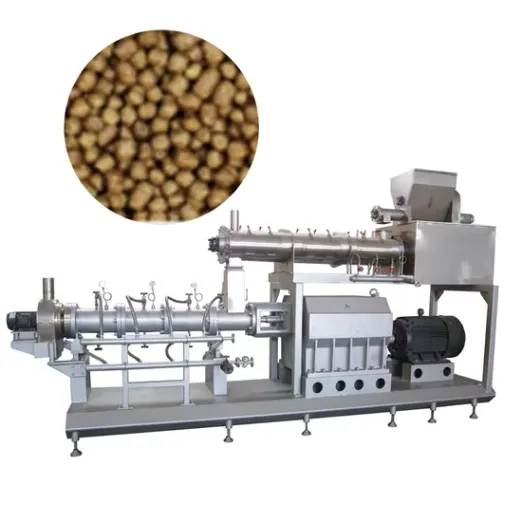
Most growing brands don’t need a greenfield facility. Modular expansion preserves cash flow and protects existing production while capacity grows.
When modular add-ons make sense
Choose modular upgrades when:
- Your building has 25% or more unused floor space or vertical clearance
- A single station is the dominant bottleneck
- Demand growth is 15-50% per year
- Cash flow can’t support a 24-month plant build
When to build greenfield
Build greenfield when:
- You need 3x or more current capacity within 36 months
- Your current location has zoning, utility, or labor constraints
- A new geographic market justifies regional production
- Co-manufacturing contracts require dedicated facilities
Phased scale-up protects cash flow
A common phased path looks like this: drying upgrade in year one, automated packaging in year two, second extrusion line in year three. Each phase pays for the next. You also avoid the worst-case scenario of a half-utilized greenfield plant carrying overhead.
For more on facility layout decisions, read our pet food production line layout guide.
Conclusion: Scale With a Plan, Not a Purchase Order
scale pet food production PET CAN Go discipline based studies rather than listing out grocery items. There is more than one way of doing profit, for example, forecasting the demand of the activity, auditing the capacity, going to the source of the problem, putting up a modular structure for the activity, automating where the return on even less than seven percent justifies and putting in a system that will have a lapse in quality at the increased level of production.
The six-step model presented in this guide teaches you how to achieve your goals without running out of money and decimating the brand. If the task that faces you is to increase the capacity of the existing production by a mere 200 kg/h to meet the retail demand, then it is obvious that the order of the steps is not changed: prognosis, examination, solution, specification, automation, rigging.
Shandong Loyal Industrial has assisted clients from more than 20 countries to design and implement modular pet food production lines. If the season is right and you have decided to work on incremental potential enhancement, our engineering support services can carry out a capacity study, and present all involved with the modular road map development in the context of your specific building site and resources available.
Ready to build your scale-up roadmap? Request a capacity audit and custom proposal and our team will respond within one business day.